24-hour parks and alcohol bans: what cities could learn from Paris’s ‘heatwave mode’ | Helen Massy-Beresford
Over the weekend, as evening fell on the hilly (and, crucially, shady) Parc des Buttes-Chaumont, one of Paris’s most popular green spaces, the joyfully chaotic Fête de la musique – a summer solstice celebration of music in all its forms – got under way, with competing DJs starting their sets in nearby cafes.
It was stiflingly hot and picnickers were cooling down with water, juice or alcohol-free beer – or at least, they should have been. The Paris authorities banned the consumption of alcohol in public spaces (apart from cafe terraces) during the festival, just one of the measures they can put in place to keep citizens safe once the city reaches vigilance rouge canicule – red heatwave alert.
This heatwave is set to be a long and intense one – as of Tuesday, 54 of the country’s 96 mainland departments were in vigilance rouge – and the national meteorological service Météo France had confirmed France was experiencing the hottest day since records began in 1947. This isn’t even the first heatwave of the year. France’s regimented approach to classifying and assessing heatwave risks and planning for the fallout from elevated temperatures could provide a useful model for other European countries as they brace themselves for more and more extreme heat episodes.
In Paris, people are organising their own ways to keep cool. With the metal shutters pulled down against the blinding sun and the windows closed until at least 10pm, my apartment is bearable, even if it’s not exactly a fun way to live. Across the road, a top-floor dweller under the eaves is clearly not so lucky – and has taped a reflective survival blanket to his window to try to keep out the heat.
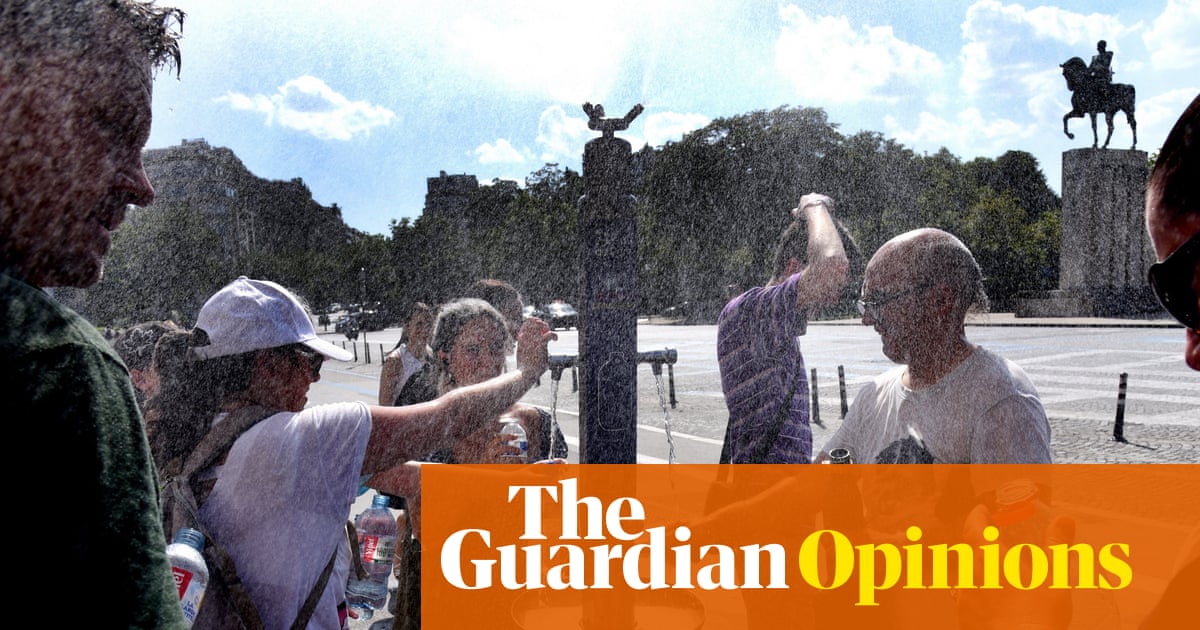
With temperatures forecast to reach 42C from Wednesday, Paris authorities are putting in place more collective measures to help heatwave-hit Parisians. As well as the alcohol ban, parks will stay open around the clock so that people can get fresh air when it’s cooler. “Cool islands”, such as air-conditioned public buildings, offer refuge from the scorching heat. Some outdoor sporting events have been cancelled and many schools have closed or are sending pupils home early.
Paris’s short-term measures come against the backdrop of a long-running drive to make the city greener and cooler: misting machines and water fountains in parks, more cycle lanes and green spaces and shadier school courtyards.
Some of Paris’s heatwave-busting plans make fun photo-ops: after the resounding success of Seine swimming last summer, the city’s new mayor, Emmanuel Grégoire, seized the opportunity to win over a few hearts last week, when he went down to the Canal Saint-Martin in person to tell locals he was bringing forward the opening of a dedicated swimming zone there.
But the city is also taking climate emergency preparedness extremely seriously. In 2023, the Paris mayor’s office conducted a 50C crisis planning exercise, which seemed outlandish at the time. Less so now. Two heatwaves before schools have even broken up for the summer, combined with a presidential election in just under a year, have put climate adaptation in the spotlight. Politicians of all stripes are generating a fair amount of hot air themselves.
Marine Le Pen’s National Rally wants better air conditioning for schools and hospitals, an idea her many critics say undermines the responsible energy consumption message, while the Green presidential hopeful, Marine Tondelier, is calling for a five-day heatwave sabbatical to help people cope with extreme heat.
Politicians, as usual, can’t agree on what should happen next, but at least the short-term problem and solutions are clear. This is thanks to France’s highly bureaucratic approach to heatwave planning, in which local authorities make on-the-ground decisions to best protect citizens’ health in consultation with health authorities and weather forecasters.
The four alert levels – red being the highest – were adopted after 2003’s devastating heatwave, which resulted in about 15,000 deaths in France, including many elderly people. Now, each department has a different alert threshold based on data such as average temperatures, preparedness and previous heatwaves. When the mercury rises, local authorities look at factors including expected temperatures, how long the heatwave will last and whether temperatures will drop at night, what major events are planned, and the status of available capacity in hospitals.
All that and more helps to determine which level of alert should be applied and which, if any, restrictions need to be put in place, such as the music festival alcohol ban.
after newsletter promotion
As the heatwave intensifies, so does criticism of the government’s response, fuelled by a spate of drownings and heat-related deaths across the country as well as school closures that highlight how much of the country’s infrastructure needs a revamp. But if the response in 2026 is far from perfect, the actions taken since 2003 do at least mean that decision-makers are better informed.
But with temperatures set to continue rising, the introduction of more tightly regimented plans to monitor and manage extreme heat seems inevitable in other countries, too, even if it’s hard to imagine citizens of somewhere like the UK taking kindly to an outdoor booze ban – let alone one during a festive summer event.
France may not have come up with a perfect solution, but after 2003, it has been better prepared for subsequent heatwaves. And in sweltering 2026, highly visible communication campaigns are raising awareness about heatwave dos and don’ts. “Passons tous en mode canicule”, runs the slogan from the national public health agency – “let’s all switch to heatwave mode”. Unfortunately, in Europe, we don’t have much choice about that – and France’s heatwave management framework may be a good place to start.
Helen Massy-Beresford is a British journalist and editor who lives in Paris
Read the full story at The Guardian ↗
As France experiences its hottest recorded temperatures since 1947, with 54 departments under red heatwave alert, Paris has activated its established emergency response protocol. Temperatures are forecast to reach 42°C, prompting authorities to open parks 24 hours daily, establish alcohol-free zones in public spaces (outside cafés), and designate air-conditioned public buildings as cooling refuges. Schools have closed and some outdoor events cancelled. This structured approach stems from France's post-2003 framework, which killed approximately 15,000 people and prompted the development of a four-tier alert system. Each department has individualized thresholds based on baseline temperatures and local preparedness. Decision-makers now consult health authorities and meteorologists before implementing restrictions tied to expected duration, nighttime temperature drops, hospital capacity, and scheduled events. France is also pursuing longer-term measures including expanded green spaces, water fountains, and cycle infrastructure. Other European nations may adopt similar frameworks as extreme heat becomes more frequent, though cultural and political differences may affect implementation.
Read the full story at The Guardian ↗
Over the weekend, as evening fell on the hilly (and, crucially, shady) Parc des Buttes-Chaumont, one of Paris’s most popular green spaces, the joyfully chaotic Fête de la musique – a summer solstice celebration of music in all its forms – got under way, with competing DJs starting their sets in nearby cafes.
It was stiflingly hot and picnickers were cooling down with water, juice or alcohol-free beer – or at least, they should have been. The Paris authorities banned the consumption of alcohol in public spaces (apart from cafe terraces) during the festival, just one of the measures they can put in place to keep citizens safe once the city reaches vigilance rouge canicule – red heatwave alert.
This heatwave is set to be a long and intense one – as of Tuesday, 54 of the country’s 96 mainland departments were in vigilance rouge – and the national meteorological service Météo France had confirmed France was experiencing the hottest day since records began in 1947. This isn’t even the first heatwave of the year. France’s regimented approach to classifying and assessing heatwave risks and planning for the fallout from elevated temperatures could provide a useful model for other European countries as they brace themselves for more and more extreme heat episodes.
In Paris, people are organising their own ways to keep cool. With the metal shutters pulled down against the blinding sun and the windows closed until at least 10pm, my apartment is bearable, even if it’s not exactly a fun way to live. Across the road, a top-floor dweller under the eaves is clearly not so lucky – and has taped a reflective survival blanket to his window to try to keep out the heat.
With temperatures forecast to reach 42C from Wednesday, Paris authorities are putting in place more collective measures to help heatwave-hit Parisians. As well as the alcohol ban, parks will stay open around the clock so that people can get fresh air when it’s cooler. “Cool islands”, such as air-conditioned public buildings, offer refuge from the scorching heat. Some outdoor sporting events have been cancelled and many schools have closed or are sending pupils home early.
Paris’s short-term measures come against the backdrop of a long-running drive to make the city greener and cooler: misting machines and water fountains in parks, more cycle lanes and green spaces and shadier school courtyards.
Some of Paris’s heatwave-busting plans make fun photo-ops: after the resounding success of Seine swimming last summer, the city’s new mayor, Emmanuel Grégoire, seized the opportunity to win over a few hearts last week, when he went down to the Canal Saint-Martin in person to tell locals he was bringing forward the opening of a dedicated swimming zone there.
But the city is also taking climate emergency preparedness extremely seriously. In 2023, the Paris mayor’s office conducted a 50C crisis planning exercise, which seemed outlandish at the time. Less so now. Two heatwaves before schools have even broken up for the summer, combined with a presidential election in just under a year, have put climate adaptation in the spotlight. Politicians of all stripes are generating a fair amount of hot air themselves.
Marine Le Pen’s National Rally wants better air conditioning for schools and hospitals, an idea her many critics say undermines the responsible energy consumption message, while the Green presidential hopeful, Marine Tondelier, is calling for a five-day heatwave sabbatical to help people cope with extreme heat.
Politicians, as usual, can’t agree on what should happen next, but at least the short-term problem and solutions are clear. This is thanks to France’s highly bureaucratic approach to heatwave planning, in which local authorities make on-the-ground decisions to best protect citizens’ health in consultation with health authorities and weather forecasters.
The four alert levels – red being the highest – were adopted after 2003’s devastating heatwave, which resulted in about 15,000 deaths in France, including many elderly people. Now, each department has a different alert threshold based on data such as average temperatures, preparedness and previous heatwaves. When the mercury rises, local authorities look at factors including expected temperatures, how long the heatwave will last and whether temperatures will drop at night, what major events are planned, and the status of available capacity in hospitals.
All that and more helps to determine which level of alert should be applied and which, if any, restrictions need to be put in place, such as the music festival alcohol ban.
after newsletter promotion
As the heatwave intensifies, so does criticism of the government’s response, fuelled by a spate of drownings and heat-related deaths across the country as well as school closures that highlight how much of the country’s infrastructure needs a revamp. But if the response in 2026 is far from perfect, the actions taken since 2003 do at least mean that decision-makers are better informed.
But with temperatures set to continue rising, the introduction of more tightly regimented plans to monitor and manage extreme heat seems inevitable in other countries, too, even if it’s hard to imagine citizens of somewhere like the UK taking kindly to an outdoor booze ban – let alone one during a festive summer event.
France may not have come up with a perfect solution, but after 2003, it has been better prepared for subsequent heatwaves. And in sweltering 2026, highly visible communication campaigns are raising awareness about heatwave dos and don’ts. “Passons tous en mode canicule”, runs the slogan from the national public health agency – “let’s all switch to heatwave mode”. Unfortunately, in Europe, we don’t have much choice about that – and France’s heatwave management framework may be a good place to start.
Helen Massy-Beresford is a British journalist and editor who lives in Paris
Read the full story at The Guardian ↗
France is currently experiencing its hottest temperatures since records began in 1947, with 54 of 96 mainland departments in red heatwave alert status. Paris authorities have banned public alcohol consumption (except at café terraces) and are keeping parks open 24 hours as temporary heatwave measures. Temperatures in Paris are forecast to reach 42°C. France's four-level heatwave alert system was adopted after the 2003 heatwave, which resulted in approximately 15,000 deaths. Each French department has different alert thresholds based on average temperatures, preparedness levels, and historical heatwave data. Local authorities consult health authorities and meteorologists to determine alert levels, considering factors including expected temperatures, duration, nighttime drops, hospital capacity, and scheduled events. Paris is pursuing longer-term cooling measures including more green spaces, water fountains, misting machines, cycle lanes, and shade improvements in schools. France's heatwave management framework may provide a useful model for other European countries. Adoption of measures like outdoor alcohol bans would likely face cultural resistance in countries like the UK. France has been better prepared for heatwaves since 2003 than it was before that crisis.
Read the full story at The Guardian ↗
- France has activated a multi-level heatwave alert system across 54 of 96 mainland departments, with temperatures reaching record highs since 1947
- Paris authorities implemented temporary measures including 24-hour park access, public alcohol bans, and 'cool islands' (air-conditioned public buildings) during red alert status
- France's bureaucratic heatwave framework, established after the 2003 heatwave that killed ~15,000 people, tailors responses by department based on temperature data, hospital capacity, and event scheduling
- The system offers a model for other European countries facing increasing extreme heat, though adoption of measures like alcohol bans may face cultural resistance