A solar eclipse happens this week. Here is what to know
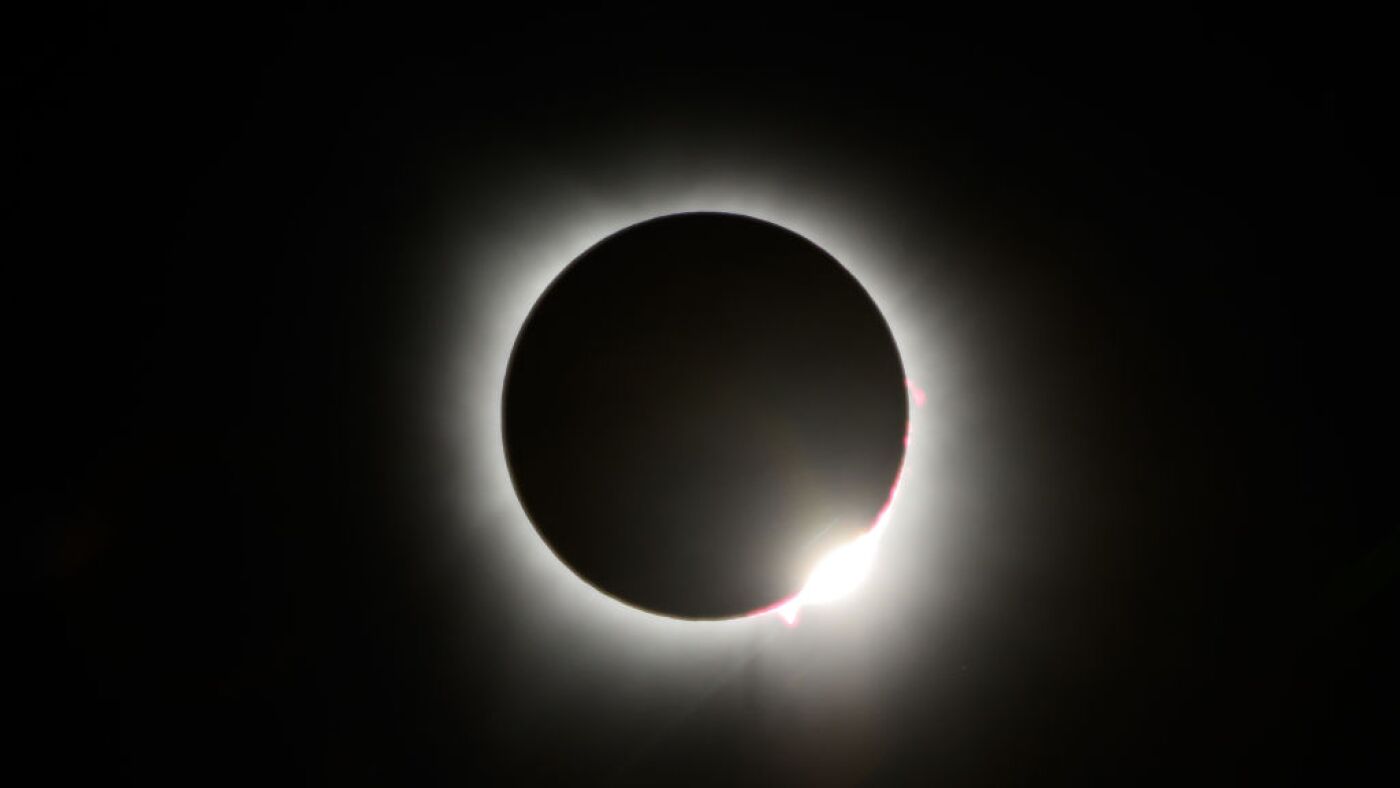 ✓
✓The Moon crosses in front of the Sun during a total solar eclipse at Lake Monroe on April 08, 2024 in Indiana, United States. Edward M. Pio Roda/Getty Images hide caption
toggle caption
Edward M. Pio Roda/Getty Images
People throughout Europe and parts of the U.S. will be treated to a chance to see a solar eclipse on Wednesday.
People in Iceland, Greenland, northern Russia, Spain, and a part of Portugal will see a total eclipse, according to astronomers. That's when the moon passes between the Earth and the Sun, fully blocking the Sun's face. NASA says northern parts of the United States, including from Alaska to North Carolina, will see a partial solar eclipse.
During a partial solar eclipse, the moon passes between the sun and Earth, but the celestial bodies are not perfectly aligned. Because only parts of the sun are obscured, the sun appears as a crescent shape.
The partial eclipse is expected to begin around 1:17 p.m. ET in Washington, D.C. and have 4% coverage, according to NASA. That means up to 4 percent of the sun will be covered by the moon. In Reykjavík, Iceland, the total eclipse will begin at 5:48 p.m. local time , and in León, Spain, totality will begin at 8:28 p.m and last for two minutes. This will be the first solar eclipse visible from Spain's mainland since 1905, according to the European Space Agency.
For those who plan to watch either the total or partial eclipse, special equipment such as eclipse glasses or handheld viewers with special filters will be necessary to protect one's eyes. Regular sunglasses will not be effective for eye protection, even during a partial eclipse. Looking at the sun, even if for a short time, can cause significant eye damage, including burns and even permanent vision loss, according to the American Academy of Ophthalmology.
While the eclipse will give skywatchers a chance to safely marvel at the rare phenomena, some scientists will use it as an opportunity to better understand the sun. NASA says it will have teams using scientific balloons and a high-altitude jet to study how the sky when darkened for a short period of time impacts the Earth's atmosphere.
"From our unique perspective on Earth during a total solar eclipse, scientists can study the Sun's corona in a way we can't from anywhere else in the solar system," Kelly Korreck, eclipse program manager for NASA, said in a statement.
The next partial solar eclipse will be visible across parts of the U.S. on Aug. 2, 2027 – with totality visible from Spain, the Middle East and parts of North Africa. A total solar eclipse will be visible across parts of the contiguous U.S. on Aug. 23, 2044.
It will be visible in parts of the U.S. on Wednesday
This lens runs the verified story through Cinnamon's AI — wired in the next step.
The Moon crosses in front of the Sun during a total solar eclipse at Lake Monroe on April 08, 2024 in Indiana, United States. Edward M. Pio Roda/Getty Images hide caption
toggle caption
Edward M. Pio Roda/Getty Images
People throughout Europe and parts of the U.S. will be treated to a chance to see a solar eclipse on Wednesday.
People in Iceland, Greenland, northern Russia, Spain, and a part of Portugal will see a total eclipse, according to astronomers. That's when the moon passes between the Earth and the Sun, fully blocking the Sun's face. NASA says northern parts of the United States, including from Alaska to North Carolina, will see a partial solar eclipse.
During a partial solar eclipse, the moon passes between the sun and Earth, but the celestial bodies are not perfectly aligned. Because only parts of the sun are obscured, the sun appears as a crescent shape.
The partial eclipse is expected to begin around 1:17 p.m. ET in Washington, D.C. and have 4% coverage, according to NASA. That means up to 4 percent of the sun will be covered by the moon. In Reykjavík, Iceland, the total eclipse will begin at 5:48 p.m. local time , and in León, Spain, totality will begin at 8:28 p.m and last for two minutes. This will be the first solar eclipse visible from Spain's mainland since 1905, according to the European Space Agency.
For those who plan to watch either the total or partial eclipse, special equipment such as eclipse glasses or handheld viewers with special filters will be necessary to protect one's eyes. Regular sunglasses will not be effective for eye protection, even during a partial eclipse. Looking at the sun, even if for a short time, can cause significant eye damage, including burns and even permanent vision loss, according to the American Academy of Ophthalmology.
While the eclipse will give skywatchers a chance to safely marvel at the rare phenomena, some scientists will use it as an opportunity to better understand the sun. NASA says it will have teams using scientific balloons and a high-altitude jet to study how the sky when darkened for a short period of time impacts the Earth's atmosphere.
"From our unique perspective on Earth during a total solar eclipse, scientists can study the Sun's corona in a way we can't from anywhere else in the solar system," Kelly Korreck, eclipse program manager for NASA, said in a statement.
The next partial solar eclipse will be visible across parts of the U.S. on Aug. 2, 2027 – with totality visible from Spain, the Middle East and parts of North Africa. A total solar eclipse will be visible across parts of the contiguous U.S. on Aug. 23, 2044.
The Moon crosses in front of the Sun during a total solar eclipse at Lake Monroe on April 08, 2024 in Indiana, United States. Edward M. Pio Roda/Getty Images hide caption
toggle caption
Edward M. Pio Roda/Getty Images
People throughout Europe and parts of the U.S. will be treated to a chance to see a solar eclipse on Wednesday.
People in Iceland, Greenland, northern Russia, Spain, and a part of Portugal will see a total eclipse, according to astronomers. That's when the moon passes between the Earth and the Sun, fully blocking the Sun's face. NASA says northern parts of the United States, including from Alaska to North Carolina, will see a partial solar eclipse.
During a partial solar eclipse, the moon passes between the sun and Earth, but the celestial bodies are not perfectly aligned. Because only parts of the sun are obscured, the sun appears as a crescent shape.
The partial eclipse is expected to begin around 1:17 p.m. ET in Washington, D.C. and have 4% coverage, according to NASA. That means up to 4 percent of the sun will be covered by the moon. In Reykjavík, Iceland, the total eclipse will begin at 5:48 p.m. local time , and in León, Spain, totality will begin at 8:28 p.m and last for two minutes. This will be the first solar eclipse visible from Spain's mainland since 1905, according to the European Space Agency.
For those who plan to watch either the total or partial eclipse, special equipment such as eclipse glasses or handheld viewers with special filters will be necessary to protect one's eyes. Regular sunglasses will not be effective for eye protection, even during a partial eclipse. Looking at the sun, even if for a short time, can cause significant eye damage, including burns and even permanent vision loss, according to the American Academy of Ophthalmology.
While the eclipse will give skywatchers a chance to safely marvel at the rare phenomena, some scientists will use it as an opportunity to better understand the sun. NASA says it will have teams using scientific balloons and a high-altitude jet to study how the sky when darkened for a short period of time impacts the Earth's atmosphere.
"From our unique perspective on Earth during a total solar eclipse, scientists can study the Sun's corona in a way we can't from anywhere else in the solar system," Kelly Korreck, eclipse program manager for NASA, said in a statement.
The next partial solar eclipse will be visible across parts of the U.S. on Aug. 2, 2027 – with totality visible from Spain, the Middle East and parts of North Africa. A total solar eclipse will be visible across parts of the contiguous U.S. on Aug. 23, 2044.
Read the full story at BBC ↗ · NPR ↗
This lens runs the verified story through Cinnamon's AI — wired in the next step.
- It will be visible in parts of the U.S.
How we verified this · 79% agreement
The thread
- Europe's first total solar eclipse in almost 30 years: What you need to know
- Solar eclipse and the island of Ireland: All you need to know and where to see it
- How to view the solar eclipse from Guernsey
- Best places to see partial solar eclipse across England
- What happens if the Fed holds fewer policy meetings
- Octopus Energy urges millions of households to use less electricity during solar eclipse