Aftershock frays nerves as many Venezuelans left to fend for themselves
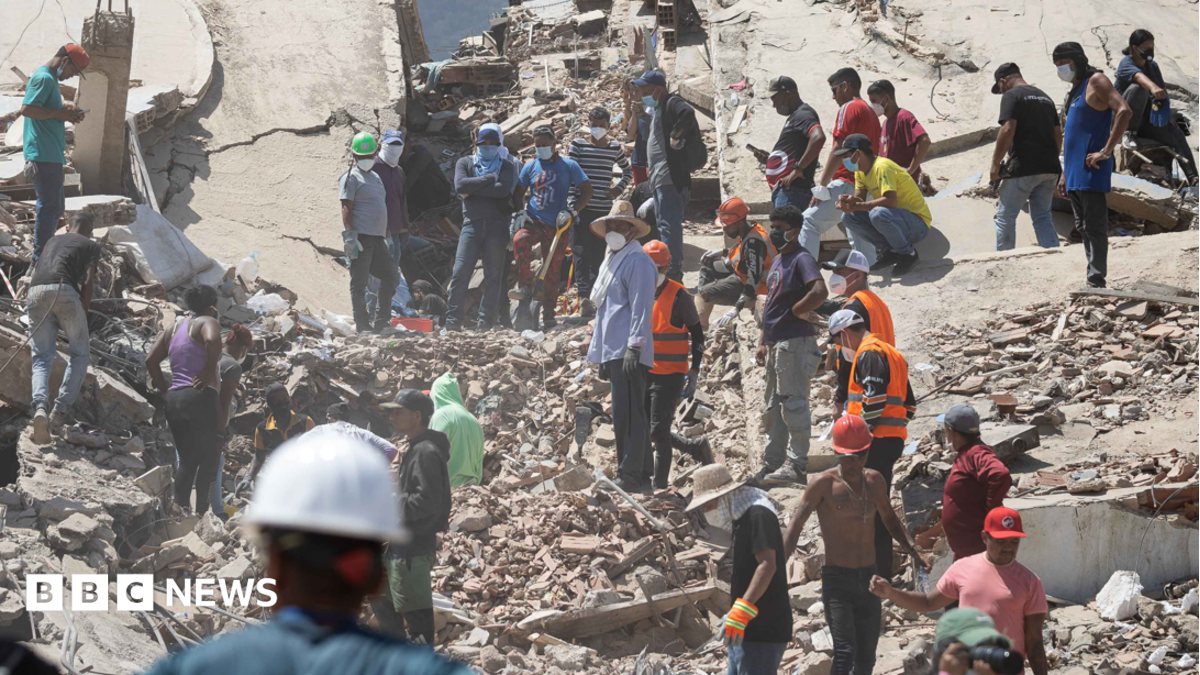
Many areas of Venezuela devastated by last week's twin earthquakes have yet to receive significant government help, leaving residents to carry out much of the rescue effort.
In the port of La Guaira, one of the hardest-hit cities, the BBC saw people using crowbars, mallets and pickaxes to try to dig out loved ones and neighbours. Tens of thousands of people are still believed to be missing.
Early on Monday, nerves were frayed by an aftershock, although no further damage was reported.
More than 1,700 people have been killed in what Interim President Delcy Rodríguez said was the "most brutal natural catastrophe" in Venezuela's history.
International aid has mobilised but hopes of finding survivors are fading. Overnight into Monday, a 21-year-old man became the latest person to be pulled alive after being trapped for over 100 hours.
The magnitude 7.2 and 7.5 quakes on Wednesday struck within 39 seconds of each other in the northern state of La Guaira, causing almost 800 buildings to collapse.
Monday's aftershock again shook La Guaira and the capital Caracas and was measured at magnitude 4.6.
In nearby Catia La Mar the main search-and-rescue efforts were also still being carried out by local volunteers and international teams and there was anger at the authorities.
The BBC saw signs of the Venezuelan police and army on the streets in the worst-affected areas, but not in the rubble.
Ruben Rojas, a 32-year-old electrician who has been digging in the rubble with only gloves and a hard hat, said: "The civil protection people decided to help, but they don't have the equipment. The government doesn't give it. They are just like us, working with their hands."
In La Guaira city the deployment of earth-moving equipment was patchy and sporadic, with local people working for days on a single building and the heavy machinery only arriving after it was too late.
Carolyn Zerpa, 39, was searching for her father and brother under the rubble by hand.
"You can't really do much with just a pickaxe," she told BBC Mundo.
Her focus has shifted from rescue to recovery, to find the remains of her family and give them a proper burial.
Zuly Marín, a La Guaira resident of 15 years, said she believed it was impossible to prepare for such a disaster but that the response had been too slow, exacerbated by Venezuela's dire economic situation.
"I lost my niece and my brother-in-law. I think that if they [the rescuers and digging equipment] had come sooner, many people could have been saved," she said.
In El Junquito, a mountainous area west of Caracas, residents told Reuters agency they had seen few public officials, while farmers and other residents have been providing basic supplies to the community.
"We are waiting for answers, for debris to be cleaned up, for inspections, for people who have been really affected to be helped," resident Keily Ibarra, 33, told Reuters.
On Monday Rodríguez said more than 25,000 emergency workers, police officers and soldiers had been assisting Venezuelans affected by the earthquakes.
"Every life saved is a victory for hope," she posted on social media platform X.
She has also announced a commission to assess the damage, to be chaired by her brother, National Assembly President Jorge Rodríguez.
Speaking on state television, she said the group would determine who could return home using a colour-coded traffic light system to classify safety. Temporary camps to house those displaced were being set up in the meantime, she added.
The rescued 21-year-old was found in the town of Caraballeda by teams from Venezuela, Mexico, and El Salvador, Salvadoran President Nayib Bukele announced on Monday.
The man, Aaron Levi Cantillo Vargas, is receiving specialised medical care, Bukele said, adding that the rescuers would "continue working with the hope of being able to save more lives".
The UN's resident humanitarian coordinator Gianluca Rampolla Del Tindaro said on Monday that there had been more than 500 aftershocks and that at least 2,500 structures had been affected by Wednesday's initial quakes, most of which had fully collapsed.
The UN was obtaining 10,000 body bags as part of its rescue operation, he added, saying that a rise in the death toll was unavoidable.
"It is very sad and we truly hope that actually the number is going to be smaller than that and that's why we are focusing now on the rescue operation," he said.
Meanwhile more international aid has been pledged. The US has announced more than $300m (£227m) to help Venezuela - an increase from its previous commitment of $150m.
"These funds will provide emergency medical care, food assistance, water and sanitation, shelter, protection, and logistics," the US state department said.
A US frigate, the USS Fort Lauderdale, is currently positioned off the coast of La Guaira. Sailors and Marines are using landing and amphibious craft to deliver aid to the most affected coastal areas.
The Netherlands has also said it is sending a vessel carrying emergency supplies, while China has promised almost $15m in assistance.
Read the full story at BBC ↗
Twin earthquakes struck Venezuela's northern La Guaira state on Wednesday, measuring 7.2 and 7.5 magnitude and striking 39 seconds apart. The quakes killed more than 1,700 people and caused nearly 800 building collapses. Tens of thousands remain unaccounted for. A magnitude 4.6 aftershock occurred Monday, adding to residents' anxiety though causing no additional reported damage. In heavily affected cities including La Guaira and Caracas, rescue efforts are being led largely by local volunteers and international teams using basic hand tools. Heavy machinery has arrived sporadically and often after initial rescue windows closed. The government reports deploying over 25,000 emergency workers, though residents in several areas report limited visible official presence in rubble zones. Venezuela's economic constraints have compounded response difficulties. International assistance is underway: the US committed over $300 million, China pledged nearly $15 million, and the Netherlands is sending emergency supplies. A 21-year-old man was rescued after being trapped for over 100 hours. The UN estimates at least 2,500 structures have been affected and has begun obtaining body bags as death tolls are expected to rise. Temporary housing camps are being organised for displaced residents.
Read the full story at BBC ↗
Many areas of Venezuela devastated by last week's twin earthquakes have yet to receive significant government help, leaving residents to carry out much of the rescue effort.
In the port of La Guaira, one of the hardest-hit cities, the BBC saw people using crowbars, mallets and pickaxes to try to dig out loved ones and neighbours. Tens of thousands of people are still believed to be missing.
Early on Monday, nerves were frayed by an aftershock, although no further damage was reported.
More than 1,700 people have been killed in what Interim President Delcy Rodríguez said was the "most brutal natural catastrophe" in Venezuela's history.
International aid has mobilised but hopes of finding survivors are fading. Overnight into Monday, a 21-year-old man became the latest person to be pulled alive after being trapped for over 100 hours.
The magnitude 7.2 and 7.5 quakes on Wednesday struck within 39 seconds of each other in the northern state of La Guaira, causing almost 800 buildings to collapse.
Monday's aftershock again shook La Guaira and the capital Caracas and was measured at magnitude 4.6.
In nearby Catia La Mar the main search-and-rescue efforts were also still being carried out by local volunteers and international teams and there was anger at the authorities.
The BBC saw signs of the Venezuelan police and army on the streets in the worst-affected areas, but not in the rubble.
Ruben Rojas, a 32-year-old electrician who has been digging in the rubble with only gloves and a hard hat, said: "The civil protection people decided to help, but they don't have the equipment. The government doesn't give it. They are just like us, working with their hands."
In La Guaira city the deployment of earth-moving equipment was patchy and sporadic, with local people working for days on a single building and the heavy machinery only arriving after it was too late.
Carolyn Zerpa, 39, was searching for her father and brother under the rubble by hand.
"You can't really do much with just a pickaxe," she told BBC Mundo.
Her focus has shifted from rescue to recovery, to find the remains of her family and give them a proper burial.
Zuly Marín, a La Guaira resident of 15 years, said she believed it was impossible to prepare for such a disaster but that the response had been too slow, exacerbated by Venezuela's dire economic situation.
"I lost my niece and my brother-in-law. I think that if they [the rescuers and digging equipment] had come sooner, many people could have been saved," she said.
In El Junquito, a mountainous area west of Caracas, residents told Reuters agency they had seen few public officials, while farmers and other residents have been providing basic supplies to the community.
"We are waiting for answers, for debris to be cleaned up, for inspections, for people who have been really affected to be helped," resident Keily Ibarra, 33, told Reuters.
On Monday Rodríguez said more than 25,000 emergency workers, police officers and soldiers had been assisting Venezuelans affected by the earthquakes.
"Every life saved is a victory for hope," she posted on social media platform X.
She has also announced a commission to assess the damage, to be chaired by her brother, National Assembly President Jorge Rodríguez.
Speaking on state television, she said the group would determine who could return home using a colour-coded traffic light system to classify safety. Temporary camps to house those displaced were being set up in the meantime, she added.
The rescued 21-year-old was found in the town of Caraballeda by teams from Venezuela, Mexico, and El Salvador, Salvadoran President Nayib Bukele announced on Monday.
The man, Aaron Levi Cantillo Vargas, is receiving specialised medical care, Bukele said, adding that the rescuers would "continue working with the hope of being able to save more lives".
The UN's resident humanitarian coordinator Gianluca Rampolla Del Tindaro said on Monday that there had been more than 500 aftershocks and that at least 2,500 structures had been affected by Wednesday's initial quakes, most of which had fully collapsed.
The UN was obtaining 10,000 body bags as part of its rescue operation, he added, saying that a rise in the death toll was unavoidable.
"It is very sad and we truly hope that actually the number is going to be smaller than that and that's why we are focusing now on the rescue operation," he said.
Meanwhile more international aid has been pledged. The US has announced more than $300m (£227m) to help Venezuela - an increase from its previous commitment of $150m.
"These funds will provide emergency medical care, food assistance, water and sanitation, shelter, protection, and logistics," the US state department said.
A US frigate, the USS Fort Lauderdale, is currently positioned off the coast of La Guaira. Sailors and Marines are using landing and amphibious craft to deliver aid to the most affected coastal areas.
The Netherlands has also said it is sending a vessel carrying emergency supplies, while China has promised almost $15m in assistance.
Read the full story at BBC ↗
Twin earthquakes measuring 7.2 and 7.5 magnitude struck Venezuela's La Guaira state on Wednesday within 39 seconds of each other. The earthquakes killed more than 1,700 people and caused nearly 800 building collapses. Tens of thousands of people remain unaccounted for. A magnitude 4.6 aftershock occurred on Monday morning in La Guaira and Caracas. In La Guaira and other hard-hit areas, local residents are conducting rescue efforts primarily using crowbars, mallets, pickaxes and hand tools. The BBC observed police and army presence on streets in affected areas but not in rubble zones where rescue work occurs. Interim President Delcy Rodríguez reported that over 25,000 emergency workers, police officers and soldiers have been assisting affected Venezuelans. Heavy machinery deployment in La Guaira has been patchy and sporadic, often arriving after rescue windows have closed. Residents describe rescue efforts as delayed and hampered by lack of equipment and the government's dire economic situation. A 21-year-old man was rescued by teams from Venezuela, Mexico and El Salvador after being trapped for over 100 hours. The UN estimates more than 500 aftershocks have occurred and at least 2,500 structures have been affected. The UN is obtaining 10,000 body bags as part of its operation, with the UN coordinator stating a rise in death toll is unavoidable. The US has committed over $300 million in aid; China pledged nearly $15 million; the Netherlands is sending emergency supplies. A US frigate is positioned off La Guaira delivering aid via landing craft to coastal areas. Interim President Rodríguez announced a damage assessment commission and plans to use a colour-coded system to determine housing safety and set up temporary displacement camps.
Read the full story at BBC ↗
- Twin earthquakes (magnitudes 7.2 and 7.5) struck Venezuela on Wednesday, killing over 1,700 people with tens of thousands still missing; a magnitude 4.6 aftershock occurred Monday.
- Local residents are conducting most rescue efforts with basic tools while government response has been slow and under-resourced, despite deployment of 25,000+ emergency workers.
- International aid from the US, China, Netherlands and regional partners is mobilising; a 21-year-old man was rescued after 100+ hours trapped, though hopes of finding more survivors are fading.