Anthropic’s alliance with pope on AI harms: all in good faith or ‘Vatican-washing?’
Why did Anthropic’s founder sit beside the pope during a warning about AI?
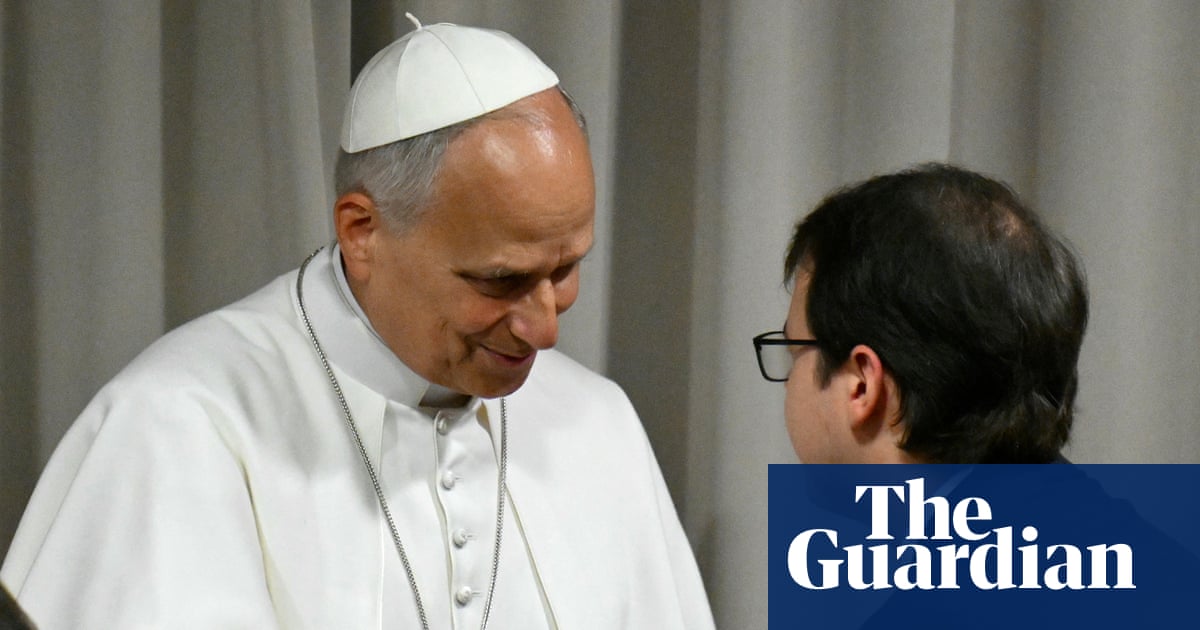
In the first major written teaching of his papacy, Pope Leo XIV took artificial intelligence to task. The pontiff delineated the technology’s most concerning threats to humanity: replacing workers, accelerating war and exploiting the environment. At a ceremony honoring the holy teaching the day of its release at the Vatican, the pope was flanked by an unusual guest speaker: Anthropic co-founder Chris Olah, one of the people behind the AI boom so worrying Leo.
Olah’s presence raises a key question: how could the Catholic church and the world’s most valuable AI startup work together, when Anthropic’s technology may bring about the future Leo is warning against?
Leo’s encyclical discusses at length the preservation of the dignity of humans’ work as it comes under threat from AI – but major AI companies, including Anthropic, aren’t prioritising these concerns, says Pete Furlong, senior manager of policy and research at Center for Humane Technology, a nonprofit advocating for accountability around AI.
“All of these companies are building technology that … is designed to replace people,” Furlong says. “That’s very much at odds with the pope’s words. You can’t have dignity in a world where you’re building technology to replace people.”
Some professions – such as coders, customer service representatives and data-entry workers – are especially vulnerable to AI’s ability to automate tasks, according to Anthropic’s own labor market analysis released in March. A survey published by nonprofit AI research center Epoch AI last month found that 20% of full-time workers in the US said AI has taken over parts of their job. Dario Amodei himself, CEO of Anthropic, has warned of an apocalyptic loss of white-collar jobs in the coming years.
There’s a risk that Anthropic’s engagement with the Vatican could remain superficial and lead to a “feelgood” discourse without critical self-examination, for both sides, says Paolo Carozza, a law professor at Notre Dame law school and co-chair of the Meta Oversight Board. “This is Anthropic’s brand, right? That’s how they’re distinguishing themselves, by aligning themselves with the more safety and responsibility oriented voices. There’s something to be gained by saying, ‘Look, even the pope is willing to talk to us because of [our pro-safety brand]. Google wasn’t on the stage and OpenAI wasn’t on the stage,’” Carozza says.
Carozza remains hopeful – even though he was initially skeptical about Olah’s presence at the ceremony. “There has to be dialogue among all of the actors here, and it can’t be an us-versus-them thing,” he added.
Furlong, at the Center for Humane Technology, largely agrees. “What the pope’s writing says is in conflict with what Anthropic says. To me, that’s a good sign,” he says. Furlong believes it’s worth taking Anthropic’s efforts at face value, for now, and that it’s important to engage AI’s pioneers, while being cautious about how increasing financial pressures like going public may bend their future stances.
Olah noted in his remarks that every frontier AI lab “operates inside a set of incentives and constraints that can sometimes conflict with doing the right thing”.
“No matter how sincerely any of us intend to do the right thing – and I believe many of us do – we will always be influenced by those incentives,” he said.
Some AI safety advocates feel the pope was not forceful enough in trying to rein in AI’s harms. Timnit Gebru, founder of the Distributed Artificial Intelligence Research Institute, wrote in a Linkedin post that the alliance was effectively “Vatican-washing” and said the church should have partnered with “the exploited data workers fighting for their rights, the people whose water is polluted fighting data centers, or the many other victims around the world”.
Anthropic did not offer comment on the matter.
after newsletter promotion
The church and Anthropic do agree on other issues, such as red lines on using AI in warfare. Leo wrote about how AI can “lower the threshold for the use of force, shield people from responsibility and foster a culture in which the enemy is reduced to a statistic and the victim to ‘collateral damage’.” He called for the “most rigorous ethical constraints” to protect “the sanctity of life and to avoid a race to develop such arms.”
When Amodei refused to allow the US government to use his company’s AI models in fully autonomous weapons and mass surveillance earlier this year, it led to a bitter feud with the president. The Trump administration subsequently blacklisted Anthropic, and designated the AI company as a supply chain threat – prompting a court battle, which is ongoing.
Anthropic has aligned its brand with being pro-AI safety in contrast to its competitor OpenAI, where Amodei once worked, by acknowledging the risks of its AI systems, and promoting safeguards for responsible AI use. The company spent a record $1.6m on lobbying in the first quarter of 2026 – beating out competitor OpenAI. Much of their advocacy in Washington and state legislatures promotes AI regulation.
Tucked away in one paragraph of the roughly 42,000-word encyclical is a soft critique of the datacenters powering the AI boom, and a call to reduce their environmental damage. “Current AI systems require enormous amounts of energy and water, significantly influencing carbon dioxide emissions, and place heavy demands on natural resources,” Leo wrote. “For this reason, it is essential to develop more sustainable technological solutions that reduce environmental impact and help protect our common home.”
Datacenters have sparked nationwide backlash in the US, which is home to the greatest number of them in the world, from communities worried about negative effects, from industrial emissions to rocketing energy bills. These energy-guzzling computer clusters are foundational to Anthropic’s business – it needs their compute power to fuel its increasingly powerful AI models. In turn, many federal agencies and the world’s biggest companies depend on Anthropic’s AI models for complex workflows and analysis–whether the goal is making a profit, or selecting a military target.
Anthropic’s ambitions may conflict with Leo’s calls for more sustainable growth. The AI startup has promised to invest $50bn on AI infrastructure, including datacenters, last year. The company has, however, committed to covering electricity price increases consumers face from these facilities, and systems that reduce power usage during peak demand.
Read the full story at The Guardian ↗
Pope Leo XIV's encyclical raises concerns about artificial intelligence's effects on employment, environmental sustainability, and military applications. Anthropic co-founder Chris Olah appeared alongside the pope at the ceremony, creating a visible partnership between a major AI company and the Catholic Church on AI governance. This alignment is complicated: Anthropic's core business relies on automating tasks that the pope identified as threats to worker dignity, and the company's planned infrastructure investments in energy-intensive datacenters conflict with papal calls for sustainability. Both parties do share opposition to autonomous weapons. Some observers see genuine dialogue potential; others worry the partnership amounts to reputation management by Anthropic without substantive change. Anthropic has positioned itself as more safety-focused than competitors, backed by $1.6m in lobbying spend on AI regulation. The underlying tension—between the church's warnings about AI harms and the company's business imperatives—remains unresolved.
Read the full story at The Guardian ↗
Why did Anthropic’s founder sit beside the pope during a warning about AI?
In the first major written teaching of his papacy, Pope Leo XIV took artificial intelligence to task. The pontiff delineated the technology’s most concerning threats to humanity: replacing workers, accelerating war and exploiting the environment. At a ceremony honoring the holy teaching the day of its release at the Vatican, the pope was flanked by an unusual guest speaker: Anthropic co-founder Chris Olah, one of the people behind the AI boom so worrying Leo.
Olah’s presence raises a key question: how could the Catholic church and the world’s most valuable AI startup work together, when Anthropic’s technology may bring about the future Leo is warning against?
Leo’s encyclical discusses at length the preservation of the dignity of humans’ work as it comes under threat from AI – but major AI companies, including Anthropic, aren’t prioritising these concerns, says Pete Furlong, senior manager of policy and research at Center for Humane Technology, a nonprofit advocating for accountability around AI.
“All of these companies are building technology that … is designed to replace people,” Furlong says. “That’s very much at odds with the pope’s words. You can’t have dignity in a world where you’re building technology to replace people.”
Some professions – such as coders, customer service representatives and data-entry workers – are especially vulnerable to AI’s ability to automate tasks, according to Anthropic’s own labor market analysis released in March. A survey published by nonprofit AI research center Epoch AI last month found that 20% of full-time workers in the US said AI has taken over parts of their job. Dario Amodei himself, CEO of Anthropic, has warned of an apocalyptic loss of white-collar jobs in the coming years.
There’s a risk that Anthropic’s engagement with the Vatican could remain superficial and lead to a “feelgood” discourse without critical self-examination, for both sides, says Paolo Carozza, a law professor at Notre Dame law school and co-chair of the Meta Oversight Board. “This is Anthropic’s brand, right? That’s how they’re distinguishing themselves, by aligning themselves with the more safety and responsibility oriented voices. There’s something to be gained by saying, ‘Look, even the pope is willing to talk to us because of [our pro-safety brand]. Google wasn’t on the stage and OpenAI wasn’t on the stage,’” Carozza says.
Carozza remains hopeful – even though he was initially skeptical about Olah’s presence at the ceremony. “There has to be dialogue among all of the actors here, and it can’t be an us-versus-them thing,” he added.
Furlong, at the Center for Humane Technology, largely agrees. “What the pope’s writing says is in conflict with what Anthropic says. To me, that’s a good sign,” he says. Furlong believes it’s worth taking Anthropic’s efforts at face value, for now, and that it’s important to engage AI’s pioneers, while being cautious about how increasing financial pressures like going public may bend their future stances.
Olah noted in his remarks that every frontier AI lab “operates inside a set of incentives and constraints that can sometimes conflict with doing the right thing”.
“No matter how sincerely any of us intend to do the right thing – and I believe many of us do – we will always be influenced by those incentives,” he said.
Some AI safety advocates feel the pope was not forceful enough in trying to rein in AI’s harms. Timnit Gebru, founder of the Distributed Artificial Intelligence Research Institute, wrote in a Linkedin post that the alliance was effectively “Vatican-washing” and said the church should have partnered with “the exploited data workers fighting for their rights, the people whose water is polluted fighting data centers, or the many other victims around the world”.
Anthropic did not offer comment on the matter.
after newsletter promotion
The church and Anthropic do agree on other issues, such as red lines on using AI in warfare. Leo wrote about how AI can “lower the threshold for the use of force, shield people from responsibility and foster a culture in which the enemy is reduced to a statistic and the victim to ‘collateral damage’.” He called for the “most rigorous ethical constraints” to protect “the sanctity of life and to avoid a race to develop such arms.”
When Amodei refused to allow the US government to use his company’s AI models in fully autonomous weapons and mass surveillance earlier this year, it led to a bitter feud with the president. The Trump administration subsequently blacklisted Anthropic, and designated the AI company as a supply chain threat – prompting a court battle, which is ongoing.
Anthropic has aligned its brand with being pro-AI safety in contrast to its competitor OpenAI, where Amodei once worked, by acknowledging the risks of its AI systems, and promoting safeguards for responsible AI use. The company spent a record $1.6m on lobbying in the first quarter of 2026 – beating out competitor OpenAI. Much of their advocacy in Washington and state legislatures promotes AI regulation.
Tucked away in one paragraph of the roughly 42,000-word encyclical is a soft critique of the datacenters powering the AI boom, and a call to reduce their environmental damage. “Current AI systems require enormous amounts of energy and water, significantly influencing carbon dioxide emissions, and place heavy demands on natural resources,” Leo wrote. “For this reason, it is essential to develop more sustainable technological solutions that reduce environmental impact and help protect our common home.”
Datacenters have sparked nationwide backlash in the US, which is home to the greatest number of them in the world, from communities worried about negative effects, from industrial emissions to rocketing energy bills. These energy-guzzling computer clusters are foundational to Anthropic’s business – it needs their compute power to fuel its increasingly powerful AI models. In turn, many federal agencies and the world’s biggest companies depend on Anthropic’s AI models for complex workflows and analysis–whether the goal is making a profit, or selecting a military target.
Anthropic’s ambitions may conflict with Leo’s calls for more sustainable growth. The AI startup has promised to invest $50bn on AI infrastructure, including datacenters, last year. The company has, however, committed to covering electricity price increases consumers face from these facilities, and systems that reduce power usage during peak demand.
Read the full story at The Guardian ↗
Pope Leo XIV released an encyclical warning that artificial intelligence threatens worker dignity, accelerates war, and exploits the environment Anthropic co-founder Chris Olah appeared as a speaker at the Vatican ceremony honoring the encyclical Anthropic's own labor market analysis shows that some professions—including coders, customer service representatives, and data-entry workers—are especially vulnerable to AI automation A survey by Epoch AI found that 20% of US full-time workers reported AI taking over parts of their job This is Anthropic's brand: distinguishing itself by aligning with safety and responsibility voices in a way that competitors like Google and OpenAI have not Anthropic's engagement with the Vatican risks remaining superficial 'feelgood' discourse without critical self-examination The alliance is effectively 'Vatican-washing,' according to AI safety advocate Timnit Gebru The pope's encyclical and Anthropic's automation-based business model are in conflict, which some view as a positive sign that dialogue is needed Anthropic refused to allow the US government to use its AI models in fully autonomous weapons and mass surveillance, leading to a Trump administration blacklist and ongoing court battle The encyclical includes a soft critique of datacenters' environmental impact and calls for more sustainable technological solutions Anthropic has committed to investing $50bn in AI infrastructure, including datacenters, while also committing to cover electricity price increases for consumers and reduce peak demand power usage Datacenters are foundational to Anthropic's business but have sparked nationwide backlash over emissions and energy costs
Read the full story at The Guardian ↗
- Pope Leo XIV released an encyclical warning about AI's threats to worker dignity, environmental impact, and warfare risks
- Anthropic co-founder Chris Olah appeared at the Vatican ceremony, raising questions about alignment between the church's concerns and Anthropic's business practices
- Critics argue the partnership risks becoming 'Vatican-washing'—superficial ethics engagement without addressing structural conflicts between papal teaching and AI automation
- Anthropic and the Vatican do align on restricting AI in autonomous weapons, and Anthropic has invested heavily in AI safety positioning and regulation advocacy
- Tensions remain: Anthropic's datacenters consume vast energy and water; the company plans $50bn in infrastructure investment while the pope calls for sustainability