'By the grace of God': Miners dig on as lab-grown diamonds change market
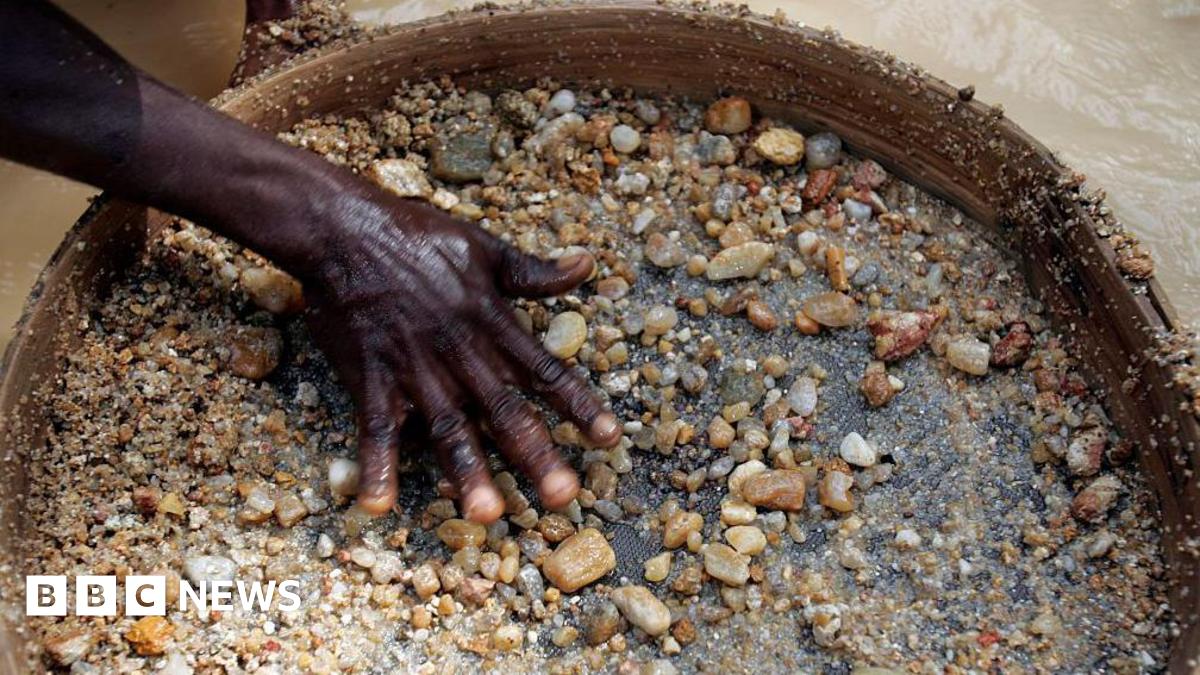
The rising popularity of lab-grown diamonds has caused a big fall in the price of the mined gems. In the West African nation of Sierra Leone the country's biggest diamond mine has closed.
Stripped to the waist, men toil in the heat of the sun. The mud in the pit is sifted and shovelled.
Daniel, the foreman in this remote, informal, small-scale mine in Kono, the diamond region of Sierra Leone, shows me the gravel he's picking through with his fingers.
"We put it in water and we wash it," he says. "If there is anything like a diamond or any bright stone, we can see it."
Daniel and five others are searching for just tiny fragments, but pickings are thin. "I have not made a lot of money yet," he says. "Sometimes for the whole of the year you can't get anything.
"It is by the grace of God that you find a diamond. We are just dreaming, really. We still have that hope."
Such informal mining has increased in Kono following the closure last year of the country's biggest diamond mine Koidu Holdings. It shut with the loss of 1,000 jobs after a bitter industrial dispute over the miners' pay.
Officially the company says it closed due to the cost of the dispute and security concerns, but privately, insiders also acknowledge that the weakness of the global market also played a role.
In just the past four years, the retail price of polished natural diamonds has fallen some 40%. The main driver has been the rapid growth of the so-called lab-grown diamond industry.
These factory-made diamonds, produced from crystalised carbon, are chemically and physically identical to mined diamonds.
Manufactured mostly in India and China using two different technologies – HPHT (high pressure high temperature) and CVD (chemical vapour deposition) – they cost a fraction of the price, up to 70% less.
Kono's governor, Augustine Shekho, says the big fall in the global price of natural diamonds has hit the region hard over the past five years. "Lower diamond values have reduced earnings for miners, constrained investment, and weakened local economic activity."
Diamond mining has been the lifeblood of this part of West Africa since the 1930s. Thirty-five years ago it became the focus of a brutal, long-running civil war in Sierra Leone, immortalised by Leonardo Di Caprio in the 2006 Hollywood film Blood Diamonds.
Kono was a target because of its diamond wealth. Shekho described multiple atrocities committed in the region, including the killing of his own mother, as armed factions traded control.
"They shot at random, they killed people, burnt the entire town," he says. "All houses were mined.
"It was a war of terror... She, my mother, unfortunately, was the victim of that… It was a nightmare. I would really not want to think about it."
It's estimated that by the end of the 11-year conflict, more than 50,000 people had died, and hundreds of thousands more were maimed or displaced.
In 2003, a United Nations-backed international diamond certification scheme, the Kimberley Process,, external was launched in order to prevent conflict stones from entering the mainstream diamond market. But the industry has struggled to contain the reputational damage.
"To me the diamonds have failed us," says Abubakar Amara, a primary school teacher in Kono. "What have those diamonds done for our community, for Kono, for Sierra Leone? We are considered as poor in the world."
The British multinational, De Beers, which specialises in the mining and marketing of diamonds, is eager to change the narrative. In Sierra Leone, it's launched a project called Gemfair,, external where local artisanal miners are offered equipment, training, and more transparent pricing for their finds. You might call it a kind of fairtrade scheme for diamonds.
"The idea is to connect with markets so that they can be able to find a place to sell their diamonds, and also to empower them, give them training, we give them skills," says Raymond Alpha, Gemfair's local representative.
But for De Beers, perhaps its most important function is reputational, allowing retailers to tell the origin story of every diamond they sell.
"We are seeing a growing interest from consumers," says David Johnson, a De Beers representative. "With people increasingly wanting to know where their coffee, cotton or chocolate has come from, it's not surprising that people also want to know where their diamond – one of the most emotionally significant purchases – has come from."
While this increased traceability could win mined diamonds more customers, others say that the lab-grown alternatives are only going to continue to grow in popularity.
Rohit Mehta, chief executive of Forlink Ventures, a commodities house based in India's lab-grown diamond capital, Surat, says these diamonds are not just cheaper, but also more ethical and better for the environment.
"People are more conscious about climate change, about extracting too much from the earth," he says.
But the argument that lab-grown diamonds are "green" doesn't sit well with everyone. Unlike natural diamonds, the lab-grown variety are hugely energy-intensive, requiring vast amounts of electricity to produce a single rough carat.
"These reactors run at the temperature of the sun," says Stanley Mathuram, a US-based environmental consultant who's studied the growth of the lab-grown diamond industry. "They're like data centres. That's the kind of energy that they require."
However, that concern about energy consumption does not appear to be putting off buyers. The global lab-grown diamond market was valued at $29.5bn (£21.9bn) last year, and is tipped to grow to $91.9bn by 2034, according to one study., external
The lab-grown figure for 2025 is already above the $20bn that De Beers estimates is the total, international annual value of natural, mined diamonds used in jewellery.
In the US, engagement rings with lab-grown stones now account for 61% of all sales, according to the 2026 Real Weddings Study, external by wedding planning website The Knot.
The report said this was a more than two-fold increase since 2022, with lab-grown diamonds by far the most popular choice. It said the shift was "driven by economic pragmatism and evolving values, with 40% of couples stating it is specifically important that their stone be lab grown".
Doug Meadows, co-founder of David Douglas Diamonds, a jewellery retailer in Atlanta, Georgia, says that people are going lab-grown as it means they can afford a bigger stone.
"It's all about the stone. They're going for the biggest bling that they can afford. Years ago, it used to be the diamond was the expensive part.
"With the advent of gold jumping up to $4,500, $5,000 an ounce, now the mounting is becoming a lot more expensive, and the diamond is becoming the cheap part."
Meadows adds that he is sympathetic to the idea of promoting natural diamonds, with a story rooted in the soil, and the experience of poor miners in West Africa. But it's a hard sell.
"To try to educate a consumer about the value in a natural diamond, it is a new challenge. I don't know how we do it yet, I'm hoping the industry can give us an idea."
Back in the diamond belt of Sierra Leone, Daniel discards another sieve-load of gravel.
"Unfortunately there is no diamond here," he says, head bowed, gazing into the blue-grey mud of the pit. "I will try my luck again," he adds as he resumes digging.
Read the full story at BBC ↗
Lab-grown diamonds—chemically identical to mined diamonds but produced in factories at 30% of the price—have reshaped the global diamond market over the past four years. Natural diamond prices have fallen 40% in that period. This shift has severely impacted Sierra Leone's mining-dependent economy. The country's largest diamond mine, Koidu Holdings, closed in 2023 after an industrial dispute over worker pay; insiders also cite market weakness as a factor. The closure cost 1,000 jobs. In response, informal small-scale mining has increased in Kono, Sierra Leone's diamond region, where workers search gravel by hand for tiny fragments, often finding nothing for months. Lab-grown diamonds, manufactured primarily in India and China, now account for 61% of US engagement ring sales as of 2025—more than double the 2022 figure. The global lab-grown market is valued at $29.5bn and is projected to reach $91.9bn by 2034. Meanwhile, De Beers and other industry players are promoting traceability and ethical sourcing through programs like Gemfair to distinguish mined diamonds. Environmental claims around lab-grown diamonds are contested: while marketed as greener, production requires vast electricity at reactor temperatures comparable to the sun's surface.
Read the full story at BBC ↗
The rising popularity of lab-grown diamonds has caused a big fall in the price of the mined gems. In the West African nation of Sierra Leone the country's biggest diamond mine has closed.
Stripped to the waist, men toil in the heat of the sun. The mud in the pit is sifted and shovelled.
Daniel, the foreman in this remote, informal, small-scale mine in Kono, the diamond region of Sierra Leone, shows me the gravel he's picking through with his fingers.
"We put it in water and we wash it," he says. "If there is anything like a diamond or any bright stone, we can see it."
Daniel and five others are searching for just tiny fragments, but pickings are thin. "I have not made a lot of money yet," he says. "Sometimes for the whole of the year you can't get anything.
"It is by the grace of God that you find a diamond. We are just dreaming, really. We still have that hope."
Such informal mining has increased in Kono following the closure last year of the country's biggest diamond mine Koidu Holdings. It shut with the loss of 1,000 jobs after a bitter industrial dispute over the miners' pay.
Officially the company says it closed due to the cost of the dispute and security concerns, but privately, insiders also acknowledge that the weakness of the global market also played a role.
In just the past four years, the retail price of polished natural diamonds has fallen some 40%. The main driver has been the rapid growth of the so-called lab-grown diamond industry.
These factory-made diamonds, produced from crystalised carbon, are chemically and physically identical to mined diamonds.
Manufactured mostly in India and China using two different technologies – HPHT (high pressure high temperature) and CVD (chemical vapour deposition) – they cost a fraction of the price, up to 70% less.
Kono's governor, Augustine Shekho, says the big fall in the global price of natural diamonds has hit the region hard over the past five years. "Lower diamond values have reduced earnings for miners, constrained investment, and weakened local economic activity."
Diamond mining has been the lifeblood of this part of West Africa since the 1930s. Thirty-five years ago it became the focus of a brutal, long-running civil war in Sierra Leone, immortalised by Leonardo Di Caprio in the 2006 Hollywood film Blood Diamonds.
Kono was a target because of its diamond wealth. Shekho described multiple atrocities committed in the region, including the killing of his own mother, as armed factions traded control.
"They shot at random, they killed people, burnt the entire town," he says. "All houses were mined.
"It was a war of terror... She, my mother, unfortunately, was the victim of that… It was a nightmare. I would really not want to think about it."
It's estimated that by the end of the 11-year conflict, more than 50,000 people had died, and hundreds of thousands more were maimed or displaced.
In 2003, a United Nations-backed international diamond certification scheme, the Kimberley Process,, external was launched in order to prevent conflict stones from entering the mainstream diamond market. But the industry has struggled to contain the reputational damage.
"To me the diamonds have failed us," says Abubakar Amara, a primary school teacher in Kono. "What have those diamonds done for our community, for Kono, for Sierra Leone? We are considered as poor in the world."
The British multinational, De Beers, which specialises in the mining and marketing of diamonds, is eager to change the narrative. In Sierra Leone, it's launched a project called Gemfair,, external where local artisanal miners are offered equipment, training, and more transparent pricing for their finds. You might call it a kind of fairtrade scheme for diamonds.
"The idea is to connect with markets so that they can be able to find a place to sell their diamonds, and also to empower them, give them training, we give them skills," says Raymond Alpha, Gemfair's local representative.
But for De Beers, perhaps its most important function is reputational, allowing retailers to tell the origin story of every diamond they sell.
"We are seeing a growing interest from consumers," says David Johnson, a De Beers representative. "With people increasingly wanting to know where their coffee, cotton or chocolate has come from, it's not surprising that people also want to know where their diamond – one of the most emotionally significant purchases – has come from."
While this increased traceability could win mined diamonds more customers, others say that the lab-grown alternatives are only going to continue to grow in popularity.
Rohit Mehta, chief executive of Forlink Ventures, a commodities house based in India's lab-grown diamond capital, Surat, says these diamonds are not just cheaper, but also more ethical and better for the environment.
"People are more conscious about climate change, about extracting too much from the earth," he says.
But the argument that lab-grown diamonds are "green" doesn't sit well with everyone. Unlike natural diamonds, the lab-grown variety are hugely energy-intensive, requiring vast amounts of electricity to produce a single rough carat.
"These reactors run at the temperature of the sun," says Stanley Mathuram, a US-based environmental consultant who's studied the growth of the lab-grown diamond industry. "They're like data centres. That's the kind of energy that they require."
However, that concern about energy consumption does not appear to be putting off buyers. The global lab-grown diamond market was valued at $29.5bn (£21.9bn) last year, and is tipped to grow to $91.9bn by 2034, according to one study., external
The lab-grown figure for 2025 is already above the $20bn that De Beers estimates is the total, international annual value of natural, mined diamonds used in jewellery.
In the US, engagement rings with lab-grown stones now account for 61% of all sales, according to the 2026 Real Weddings Study, external by wedding planning website The Knot.
The report said this was a more than two-fold increase since 2022, with lab-grown diamonds by far the most popular choice. It said the shift was "driven by economic pragmatism and evolving values, with 40% of couples stating it is specifically important that their stone be lab grown".
Doug Meadows, co-founder of David Douglas Diamonds, a jewellery retailer in Atlanta, Georgia, says that people are going lab-grown as it means they can afford a bigger stone.
"It's all about the stone. They're going for the biggest bling that they can afford. Years ago, it used to be the diamond was the expensive part.
"With the advent of gold jumping up to $4,500, $5,000 an ounce, now the mounting is becoming a lot more expensive, and the diamond is becoming the cheap part."
Meadows adds that he is sympathetic to the idea of promoting natural diamonds, with a story rooted in the soil, and the experience of poor miners in West Africa. But it's a hard sell.
"To try to educate a consumer about the value in a natural diamond, it is a new challenge. I don't know how we do it yet, I'm hoping the industry can give us an idea."
Back in the diamond belt of Sierra Leone, Daniel discards another sieve-load of gravel.
"Unfortunately there is no diamond here," he says, head bowed, gazing into the blue-grey mud of the pit. "I will try my luck again," he adds as he resumes digging.
Read the full story at BBC ↗
Lab-grown diamonds are chemically and physically identical to mined diamonds Lab-grown diamonds cost up to 70% less than mined diamonds In the past four years, retail prices of polished natural diamonds have fallen 40% Sierra Leone's largest diamond mine, Koidu Holdings, closed in 2023 after an industrial dispute and market weakness The closure of Koidu Holdings resulted in the loss of 1,000 jobs Lab-grown diamonds are manufactured primarily in India and China using HPHT and CVD technologies In the US, engagement rings with lab-grown stones account for 61% of sales as of 2025, up from approximately 28% in 2022 The global lab-grown diamond market was valued at $29.5bn in 2024 and is projected to reach $91.9bn by 2034 Lab-grown diamonds are more ethical and better for the environment Lab-grown diamond production is hugely energy-intensive, requiring energy comparable to data centres Diamond mining in Sierra Leone has been the economic lifeblood of the region since the 1930s The 11-year civil war in Sierra Leone resulted in more than 50,000 deaths and hundreds of thousands displaced or maimed
Read the full story at BBC ↗
- Lab-grown diamonds have caused natural diamond prices to fall 40% in four years, disrupting mining economies in West Africa including Sierra Leone
- Sierra Leone's largest diamond mine closed in 2023 after industrial disputes and market weakness, displacing 1,000 workers and increasing informal small-scale mining
- Lab-grown diamonds now dominate US engagement ring sales (61% in 2025, up from 28% in 2022) despite being energy-intensive to produce
- The global lab-grown diamond market is projected to reach $91.9bn by 2034, already exceeding the estimated $20bn annual value of mined diamonds in jewelry