Climate-saving wonder – or €240m vanity bauble that ages like milk? The rocks set to hit Rotterdam docks
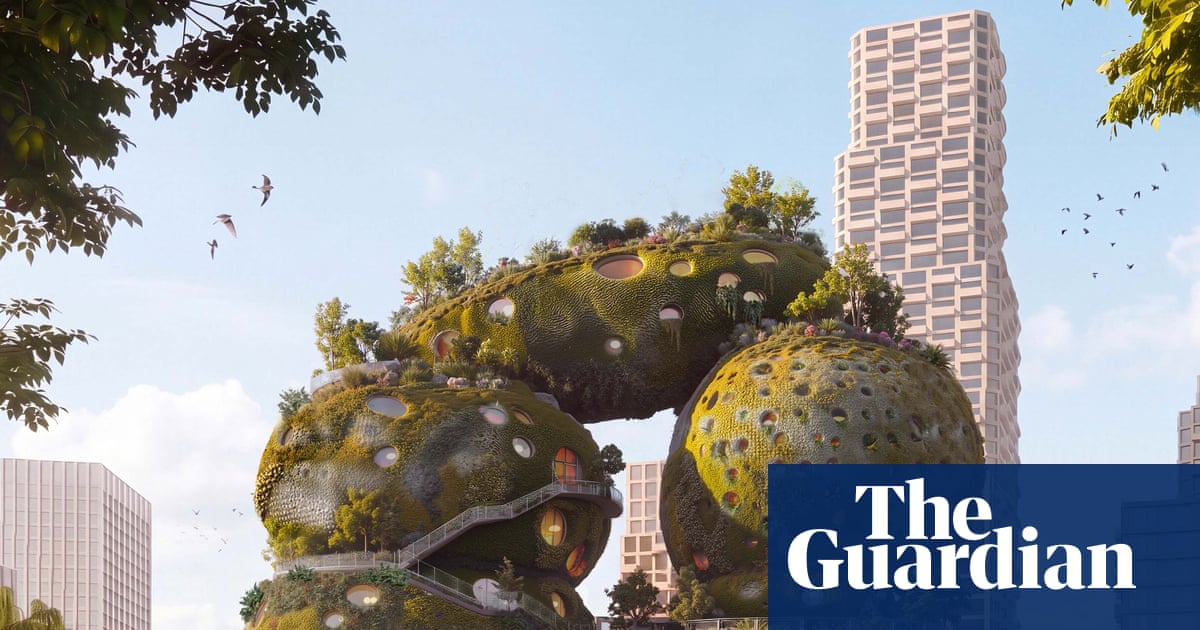
‘It looks like something Shrek would throw up,” sniffed one online commentator, unflatteringly comparing Rotterdam ROCKS!, the recently unveiled proposal for a waterfront site in Europe’s largest port, with the vomitings of a cartoon ogre. Designed by Dutch architectural firm MVRDV, which gave London the supremely underwhelming Marble Arch Mound in 2021, Rotterdam ROCKS! (the use of EMPHATIC CAPITALS connoting an in-your-face energy) is the winner of a major architectural competition intended to create “a new world wonder”.
But instead of a modern Hanging Gardens of Babylon or contemporary Colossus of Rhodes, MVRDV’s super slick renderings depict a pile of artificial “rocks” (or ROCKS!) stacked together in a humongously scaled tottering cairn, wreathed in suspiciously luxuriant foliage and sluiced by a preposterous waterfall.
Conceived as a paying visitor attraction that will proselytise aspects of sustainability and green living, the €240m (£205m) project is the precocious brainchild of Dutch entrepreneur Don Ritzen, who made his reputation through Rockstart, a venture capital fund for green tech startups. Ritzen’s evangelising mission is to speed the world’s transition to a green economy via his non-profit organisation Shift, which provided the impetus for a radical new landmark building – to be constructed on a site previously earmarked for football club Feyenoord’s new stadium.
The project will anchor the Waterkant, a more architecturally humdrum large-scale urban development on the south bank of the Maas. Pulverised during the second world war, Rotterdam’s docklands have provided an obliging tabula rasa for architectural experimentation, but with its amped-up, Flintstones-esque primitivism, Rotterdam ROCKS! will be far and away the most conspicuously off piste offering to date.
Hyperbole abounds. Described as “a stacked landscape of living rocks that turns architecture into a regenerative, urban ecosystem and a new landmark for the city: rocks that breathe”, the project incorporates the more prosaic functions of a hotel, conference centre, food court and viewing deck. Underpinning it all is an immersive experience called the Elysium, which will illustrate paradigms for sustainability and circular living, elevating them into “something individuals, companies and organisations can feel, experience and act on”.
In theory, visitors forking out entrance fees between €20 and €45 will come away energised and motivated to spread a new green gospel that goes beyond recycling their rubbish and carbon-offsetting their short break flights. But in practice, it may well end up being just a wallet-sapping mooch around a weird-looking building, rather like visiting a funfair.
If the dismaying experience of the Marble Arch Mound is anything to go by, then MVRDV will have its work cut out. Optimistically conceived as a temporary artificial hill, softly studded with lush vegetation, the Mound was beset by cost overruns, shonky construction and visitor apathy. Its patchy flanks of stuck-on turf were described by one critic as “more like an ensemble of ill-matched carpet tiles than a greensward”, prompting comparisons to those scrubby winter wonderlands that pop up every Christmas to disappoint yuletide revellers.
Computer-generated renderings are a perpetual hostage to fortune, and MVRDV went gangbusters on Rotterdam ROCKS!, doubtless in an attempt to seduce the competition jurors. But already some aspects of the design are being dialled down – the sluicing waterfall has been quietly aborted – as the chastening reality of how this absurd confection might actually be built begins to sink in. A non-computer generated image shows architect Winy Maas (the M of MVRDV) clutching a pile of moss-covered pebbles.
Wider contradictions also abound. Ritzen clearly subscribes to history’s “great man” theory, in which idealistic outliers and entrepreneurs heroically save the world, and progress is impelled by “charismatic” individuals (the Musks and the Zuckerbergs) rather than the messy flailings of collective political and social endeavour.
But in an era increasingly being reshaped by the mantra “the greenest building is the one that already exists”, the idea of a constructing a hugely costly vanity bauble that promises to age like milk seems like a stupendous misfire, calculated simply to stroke egos and stoke clickbait.
Wouter Vanstiphout, a leading Dutch architectural historian, summed it up: “It is as if MVRDV has allowed the entire fundamental contradiction between architecture and sustainability to implode in a gesture of ontological self-loathing, a metaphorical ruin of the very idea of architecture, collapsing under its own weight, gnawed at and overgrown by a nature that has turned against humanity out of spite.”
The final irony was that Rotterdam ROCKS! was unveiled during the height of Europe’s infernal summer, when the existential consequences of the climate crisis became even more viscerally apparent, as wildfires immolated large tracts of hill and dale. Low-lying Netherlands (the Maldives of Europe) is doubly damned, with over half its terrain also vulnerable to flooding. Nearly all of Rotterdam lies below sea level, so if things continue on the predicted hell-in-a-handcart trajectory, Rotterdam ROCKS! may well be under water some day. Which might be the best place for it.
Read the full story at The Guardian ↗
MVRDV – the firm behind Marble Arch Mound – says Rotterdam ROCKS! will inspire visitors to live sustainably. But in an era when the greenest building is the one that already…
This lens runs the verified story through Cinnamon's AI — wired in the next step.
‘It looks like something Shrek would throw up,” sniffed one online commentator, unflatteringly comparing Rotterdam ROCKS!, the recently unveiled proposal for a waterfront site in Europe’s largest port, with the vomitings of a cartoon ogre. Designed by Dutch architectural firm MVRDV, which gave London the supremely underwhelming Marble Arch Mound in 2021, Rotterdam ROCKS! (the use of EMPHATIC CAPITALS connoting an in-your-face energy) is the winner of a major architectural competition intended to create “a new world wonder”.
But instead of a modern Hanging Gardens of Babylon or contemporary Colossus of Rhodes, MVRDV’s super slick renderings depict a pile of artificial “rocks” (or ROCKS!) stacked together in a humongously scaled tottering cairn, wreathed in suspiciously luxuriant foliage and sluiced by a preposterous waterfall.
Conceived as a paying visitor attraction that will proselytise aspects of sustainability and green living, the €240m (£205m) project is the precocious brainchild of Dutch entrepreneur Don Ritzen, who made his reputation through Rockstart, a venture capital fund for green tech startups. Ritzen’s evangelising mission is to speed the world’s transition to a green economy via his non-profit organisation Shift, which provided the impetus for a radical new landmark building – to be constructed on a site previously earmarked for football club Feyenoord’s new stadium.
The project will anchor the Waterkant, a more architecturally humdrum large-scale urban development on the south bank of the Maas. Pulverised during the second world war, Rotterdam’s docklands have provided an obliging tabula rasa for architectural experimentation, but with its amped-up, Flintstones-esque primitivism, Rotterdam ROCKS! will be far and away the most conspicuously off piste offering to date.
Hyperbole abounds. Described as “a stacked landscape of living rocks that turns architecture into a regenerative, urban ecosystem and a new landmark for the city: rocks that breathe”, the project incorporates the more prosaic functions of a hotel, conference centre, food court and viewing deck. Underpinning it all is an immersive experience called the Elysium, which will illustrate paradigms for sustainability and circular living, elevating them into “something individuals, companies and organisations can feel, experience and act on”.
In theory, visitors forking out entrance fees between €20 and €45 will come away energised and motivated to spread a new green gospel that goes beyond recycling their rubbish and carbon-offsetting their short break flights. But in practice, it may well end up being just a wallet-sapping mooch around a weird-looking building, rather like visiting a funfair.
If the dismaying experience of the Marble Arch Mound is anything to go by, then MVRDV will have its work cut out. Optimistically conceived as a temporary artificial hill, softly studded with lush vegetation, the Mound was beset by cost overruns, shonky construction and visitor apathy. Its patchy flanks of stuck-on turf were described by one critic as “more like an ensemble of ill-matched carpet tiles than a greensward”, prompting comparisons to those scrubby winter wonderlands that pop up every Christmas to disappoint yuletide revellers.
Computer-generated renderings are a perpetual hostage to fortune, and MVRDV went gangbusters on Rotterdam ROCKS!, doubtless in an attempt to seduce the competition jurors. But already some aspects of the design are being dialled down – the sluicing waterfall has been quietly aborted – as the chastening reality of how this absurd confection might actually be built begins to sink in. A non-computer generated image shows architect Winy Maas (the M of MVRDV) clutching a pile of moss-covered pebbles.
Wider contradictions also abound. Ritzen clearly subscribes to history’s “great man” theory, in which idealistic outliers and entrepreneurs heroically save the world, and progress is impelled by “charismatic” individuals (the Musks and the Zuckerbergs) rather than the messy flailings of collective political and social endeavour.
But in an era increasingly being reshaped by the mantra “the greenest building is the one that already exists”, the idea of a constructing a hugely costly vanity bauble that promises to age like milk seems like a stupendous misfire, calculated simply to stroke egos and stoke clickbait.
Wouter Vanstiphout, a leading Dutch architectural historian, summed it up: “It is as if MVRDV has allowed the entire fundamental contradiction between architecture and sustainability to implode in a gesture of ontological self-loathing, a metaphorical ruin of the very idea of architecture, collapsing under its own weight, gnawed at and overgrown by a nature that has turned against humanity out of spite.”
The final irony was that Rotterdam ROCKS! was unveiled during the height of Europe’s infernal summer, when the existential consequences of the climate crisis became even more viscerally apparent, as wildfires immolated large tracts of hill and dale. Low-lying Netherlands (the Maldives of Europe) is doubly damned, with over half its terrain also vulnerable to flooding. Nearly all of Rotterdam lies below sea level, so if things continue on the predicted hell-in-a-handcart trajectory, Rotterdam ROCKS! may well be under water some day. Which might be the best place for it.
Read the full story at The Guardian ↗
‘It looks like something Shrek would throw up,” sniffed one online commentator, unflatteringly comparing Rotterdam ROCKS!, the recently unveiled proposal for a waterfront site in Europe’s largest port, with the vomitings of a cartoon ogre. Designed by Dutch architectural firm MVRDV, which gave London the supremely underwhelming Marble Arch Mound in 2021, Rotterdam ROCKS! (the use of EMPHATIC CAPITALS connoting an in-your-face energy) is the winner of a major architectural competition intended to create “a new world wonder”.
But instead of a modern Hanging Gardens of Babylon or contemporary Colossus of Rhodes, MVRDV’s super slick renderings depict a pile of artificial “rocks” (or ROCKS!) stacked together in a humongously scaled tottering cairn, wreathed in suspiciously luxuriant foliage and sluiced by a preposterous waterfall.
Conceived as a paying visitor attraction that will proselytise aspects of sustainability and green living, the €240m (£205m) project is the precocious brainchild of Dutch entrepreneur Don Ritzen, who made his reputation through Rockstart, a venture capital fund for green tech startups. Ritzen’s evangelising mission is to speed the world’s transition to a green economy via his non-profit organisation Shift, which provided the impetus for a radical new landmark building – to be constructed on a site previously earmarked for football club Feyenoord’s new stadium.
The project will anchor the Waterkant, a more architecturally humdrum large-scale urban development on the south bank of the Maas. Pulverised during the second world war, Rotterdam’s docklands have provided an obliging tabula rasa for architectural experimentation, but with its amped-up, Flintstones-esque primitivism, Rotterdam ROCKS! will be far and away the most conspicuously off piste offering to date.
Hyperbole abounds. Described as “a stacked landscape of living rocks that turns architecture into a regenerative, urban ecosystem and a new landmark for the city: rocks that breathe”, the project incorporates the more prosaic functions of a hotel, conference centre, food court and viewing deck. Underpinning it all is an immersive experience called the Elysium, which will illustrate paradigms for sustainability and circular living, elevating them into “something individuals, companies and organisations can feel, experience and act on”.
In theory, visitors forking out entrance fees between €20 and €45 will come away energised and motivated to spread a new green gospel that goes beyond recycling their rubbish and carbon-offsetting their short break flights. But in practice, it may well end up being just a wallet-sapping mooch around a weird-looking building, rather like visiting a funfair.
If the dismaying experience of the Marble Arch Mound is anything to go by, then MVRDV will have its work cut out. Optimistically conceived as a temporary artificial hill, softly studded with lush vegetation, the Mound was beset by cost overruns, shonky construction and visitor apathy. Its patchy flanks of stuck-on turf were described by one critic as “more like an ensemble of ill-matched carpet tiles than a greensward”, prompting comparisons to those scrubby winter wonderlands that pop up every Christmas to disappoint yuletide revellers.
Computer-generated renderings are a perpetual hostage to fortune, and MVRDV went gangbusters on Rotterdam ROCKS!, doubtless in an attempt to seduce the competition jurors. But already some aspects of the design are being dialled down – the sluicing waterfall has been quietly aborted – as the chastening reality of how this absurd confection might actually be built begins to sink in. A non-computer generated image shows architect Winy Maas (the M of MVRDV) clutching a pile of moss-covered pebbles.
Wider contradictions also abound. Ritzen clearly subscribes to history’s “great man” theory, in which idealistic outliers and entrepreneurs heroically save the world, and progress is impelled by “charismatic” individuals (the Musks and the Zuckerbergs) rather than the messy flailings of collective political and social endeavour.
But in an era increasingly being reshaped by the mantra “the greenest building is the one that already exists”, the idea of a constructing a hugely costly vanity bauble that promises to age like milk seems like a stupendous misfire, calculated simply to stroke egos and stoke clickbait.
Wouter Vanstiphout, a leading Dutch architectural historian, summed it up: “It is as if MVRDV has allowed the entire fundamental contradiction between architecture and sustainability to implode in a gesture of ontological self-loathing, a metaphorical ruin of the very idea of architecture, collapsing under its own weight, gnawed at and overgrown by a nature that has turned against humanity out of spite.”
The final irony was that Rotterdam ROCKS! was unveiled during the height of Europe’s infernal summer, when the existential consequences of the climate crisis became even more viscerally apparent, as wildfires immolated large tracts of hill and dale. Low-lying Netherlands (the Maldives of Europe) is doubly damned, with over half its terrain also vulnerable to flooding. Nearly all of Rotterdam lies below sea level, so if things continue on the predicted hell-in-a-handcart trajectory, Rotterdam ROCKS! may well be under water some day. Which might be the best place for it.
Read the full story at The Guardian ↗
This lens runs the verified story through Cinnamon's AI — wired in the next step.
- MVRDV – the firm behind Marble Arch Mound – says Rotterdam ROCKS!
- will inspire visitors to live sustainably.
- But in an era when the greenest building is the one that already…