Country diary: A lesson from my final diary after nearly 40 years – keep looking closely | Phil Gates
After another exceptionally dry summer, there’s a nagging question lurking at the back of naturalists’ minds: which species will be the winners and losers in our evolving climate?
Throughout summer’s heatwaves and drought, I watched a dense stand of broad-leaved docks, Rumex obtusifolius, thrive while surrounding fields turned the colour of bleached straw. They have promising credentials as drought survivors, thanks to a deep taproot, fast, early spring growth and a long-lasting dormant seed bank in the soil.
“One year’s seeding, seven years weeding” goes the old adage, warning of the consequences of allowing weed seeds to ripen and disperse on cultivated ground. That’s an over-optimistic outlook in the case of docks, whose buried seeds can remain viable for up to 80 years. They need light to germinate, but some of today’s bumper seed crop, brought to the surface by burrowing animals eight decades hence, could conceivably grow, flower and set seeds in the early years of the 22nd century.
Broad-leaved dock, growing as a weed, has colonised cultivated land since the earliest days of British agriculture. As a wildflower, it’s a rather coarse, unattractive but medicinally useful ruderal (early coloniser). Country children of my generation learned to identify and crush dock for the sap that soothes nettle stings – perhaps the most widely used of all folk remedies. This morning, it was the flash of cerise breast feathers of a male bullfinch, feeding on the docks’ forest of russet seed heads, that caught my attention. There is enough food here to feed a bullfinch family for months.
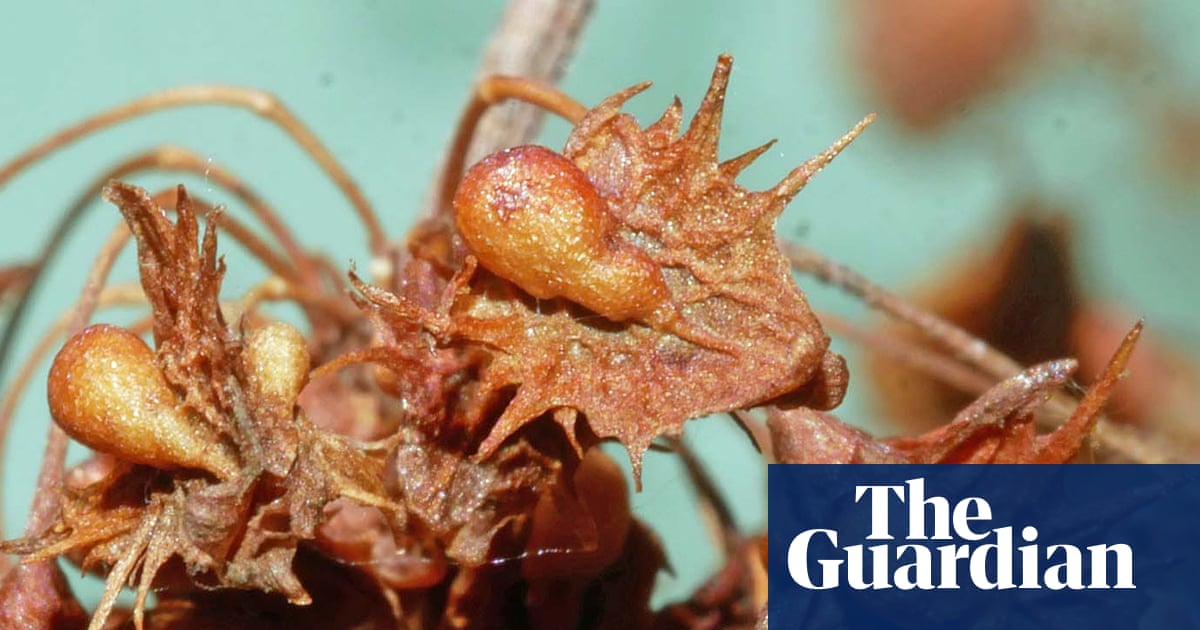
After 39 years and more than 500 country diaries, this is my last. During that time, I’ve realised that there is often hidden beauty in commonplace and superficially mundane plants, if you look closely enough with a hand lens. So it was with the dock seed that the bullfinch had been eating. Each was oblong, reminiscent of the head and body of a miniature mouse sitting on a papery bract, whose spiky, dry veins extended beyond its margins like claws: exquisite, natural Gothic architecture.
Later, at home, I found some of those clawed seeds hooked into my coat sleeves. In autumn, wherever we go, plants often travel with us.
Read the full story at The Guardian ↗
Stanhope, Weardale: I’ve realised in that time that beauty and fascination can lie in the most mundane of plants – in this case, broad-leaved dock. After another exceptionally dry…
This lens runs the verified story through Cinnamon's AI — wired in the next step.
After another exceptionally dry summer, there’s a nagging question lurking at the back of naturalists’ minds: which species will be the winners and losers in our evolving climate?
Throughout summer’s heatwaves and drought, I watched a dense stand of broad-leaved docks, Rumex obtusifolius, thrive while surrounding fields turned the colour of bleached straw. They have promising credentials as drought survivors, thanks to a deep taproot, fast, early spring growth and a long-lasting dormant seed bank in the soil.
“One year’s seeding, seven years weeding” goes the old adage, warning of the consequences of allowing weed seeds to ripen and disperse on cultivated ground. That’s an over-optimistic outlook in the case of docks, whose buried seeds can remain viable for up to 80 years. They need light to germinate, but some of today’s bumper seed crop, brought to the surface by burrowing animals eight decades hence, could conceivably grow, flower and set seeds in the early years of the 22nd century.
Broad-leaved dock, growing as a weed, has colonised cultivated land since the earliest days of British agriculture. As a wildflower, it’s a rather coarse, unattractive but medicinally useful ruderal (early coloniser). Country children of my generation learned to identify and crush dock for the sap that soothes nettle stings – perhaps the most widely used of all folk remedies. This morning, it was the flash of cerise breast feathers of a male bullfinch, feeding on the docks’ forest of russet seed heads, that caught my attention. There is enough food here to feed a bullfinch family for months.
After 39 years and more than 500 country diaries, this is my last. During that time, I’ve realised that there is often hidden beauty in commonplace and superficially mundane plants, if you look closely enough with a hand lens. So it was with the dock seed that the bullfinch had been eating. Each was oblong, reminiscent of the head and body of a miniature mouse sitting on a papery bract, whose spiky, dry veins extended beyond its margins like claws: exquisite, natural Gothic architecture.
Later, at home, I found some of those clawed seeds hooked into my coat sleeves. In autumn, wherever we go, plants often travel with us.
Read the full story at The Guardian ↗
After another exceptionally dry summer, there’s a nagging question lurking at the back of naturalists’ minds: which species will be the winners and losers in our evolving climate?
Throughout summer’s heatwaves and drought, I watched a dense stand of broad-leaved docks, Rumex obtusifolius, thrive while surrounding fields turned the colour of bleached straw. They have promising credentials as drought survivors, thanks to a deep taproot, fast, early spring growth and a long-lasting dormant seed bank in the soil.
“One year’s seeding, seven years weeding” goes the old adage, warning of the consequences of allowing weed seeds to ripen and disperse on cultivated ground. That’s an over-optimistic outlook in the case of docks, whose buried seeds can remain viable for up to 80 years. They need light to germinate, but some of today’s bumper seed crop, brought to the surface by burrowing animals eight decades hence, could conceivably grow, flower and set seeds in the early years of the 22nd century.
Broad-leaved dock, growing as a weed, has colonised cultivated land since the earliest days of British agriculture. As a wildflower, it’s a rather coarse, unattractive but medicinally useful ruderal (early coloniser). Country children of my generation learned to identify and crush dock for the sap that soothes nettle stings – perhaps the most widely used of all folk remedies. This morning, it was the flash of cerise breast feathers of a male bullfinch, feeding on the docks’ forest of russet seed heads, that caught my attention. There is enough food here to feed a bullfinch family for months.
After 39 years and more than 500 country diaries, this is my last. During that time, I’ve realised that there is often hidden beauty in commonplace and superficially mundane plants, if you look closely enough with a hand lens. So it was with the dock seed that the bullfinch had been eating. Each was oblong, reminiscent of the head and body of a miniature mouse sitting on a papery bract, whose spiky, dry veins extended beyond its margins like claws: exquisite, natural Gothic architecture.
Later, at home, I found some of those clawed seeds hooked into my coat sleeves. In autumn, wherever we go, plants often travel with us.
Read the full story at The Guardian ↗
This lens runs the verified story through Cinnamon's AI — wired in the next step.
- Stanhope, Weardale: I’ve realised in that time that beauty and fascination can lie in the most mundane of plants – in this case, broad-leaved dock.
- After another exceptionally dry…