Country diary: Phacelia is the most useful plant – I always have a packet for my garden | Susie White
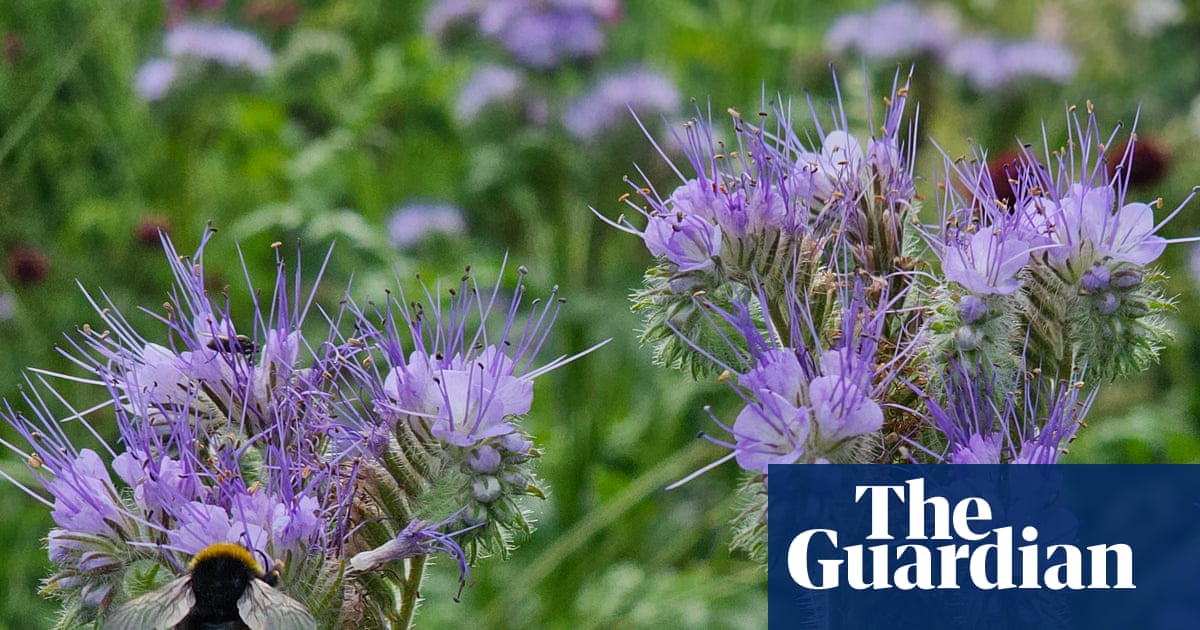
Cupped by bristly sepals, the five-petalled flowers of phacelia flare open at the tips, drawing insects to their abundant nectar and blue pollen. Hoverflies, honeybees, parasitic wasps, solitary bees and bumblebees – there’s life all around me as I hunker down among the plants.
I always have a ready packet of Phacelia tanacetifolia and use it for sowing into any bare soil among both vegetables and ornamentals. This part of the flower garden was rejigged in early May to curtail the spread of some vigorous Michaelmas daisies. It left a space for me to plant biennial cotton thistles, the giant Onopordum acanthium, which will tower above my head next summer.
To stop weeds germinating in the temporarily cleared ground, I sowed phacelia, and its softly mauve flowers have become a watercolour wash of colour at mid‑height in the border.
Grown by farmers as a cover crop, phacelia grows fast, suppressing weeds, capturing nutrients, improving drainage and conditioning the soil. At field scale, it is an eye-soothing haze of purple with a high nectar yield, supporting millions of insect lives. In gardens, it is direct-sown as a green manure plant, cut down while still green and dug into the vegetable garden.
Looked at closely, phacelia has a rhythmic structure, each flower opening in sequence along a coiled scroll like the headstock of a violin; its common name is fiddlehead. This is what I’m looking at now as I hold a sprig of phacelia next to my sketchbook. It’s through the act of drawing that I notice the details: the way the amethyst stamens explode out of the flowers, that every stem is covered in hairs, the lines of maturing seedpods stacked along the stem like an ear of wheat.
The form of this arrangement is most strikingly shown in a 1928 photograph by Karl Blossfeldt, whose work revealed with extraordinary precision the patterns and symmetry of plants. The unfurling of ferns, the uncoiling of comfrey and the elegant curls of phacelia are revealed with startling clarity in his black and white images. It is a plant that inspires art, nurtures the soil, adds colour to my borders and fills the air with pollinating insects.
Read the full story at The Guardian ↗
Allendale, Northumberland: Farmers use it as cover crop, and I sow it into bare soil – but not before I’ve had a close look at its stunning details. Cupped by bristly sepals, the…
This lens runs the verified story through Cinnamon's AI — wired in the next step.
Cupped by bristly sepals, the five-petalled flowers of phacelia flare open at the tips, drawing insects to their abundant nectar and blue pollen. Hoverflies, honeybees, parasitic wasps, solitary bees and bumblebees – there’s life all around me as I hunker down among the plants.
I always have a ready packet of Phacelia tanacetifolia and use it for sowing into any bare soil among both vegetables and ornamentals. This part of the flower garden was rejigged in early May to curtail the spread of some vigorous Michaelmas daisies. It left a space for me to plant biennial cotton thistles, the giant Onopordum acanthium, which will tower above my head next summer.
To stop weeds germinating in the temporarily cleared ground, I sowed phacelia, and its softly mauve flowers have become a watercolour wash of colour at mid‑height in the border.
Grown by farmers as a cover crop, phacelia grows fast, suppressing weeds, capturing nutrients, improving drainage and conditioning the soil. At field scale, it is an eye-soothing haze of purple with a high nectar yield, supporting millions of insect lives. In gardens, it is direct-sown as a green manure plant, cut down while still green and dug into the vegetable garden.
Looked at closely, phacelia has a rhythmic structure, each flower opening in sequence along a coiled scroll like the headstock of a violin; its common name is fiddlehead. This is what I’m looking at now as I hold a sprig of phacelia next to my sketchbook. It’s through the act of drawing that I notice the details: the way the amethyst stamens explode out of the flowers, that every stem is covered in hairs, the lines of maturing seedpods stacked along the stem like an ear of wheat.
The form of this arrangement is most strikingly shown in a 1928 photograph by Karl Blossfeldt, whose work revealed with extraordinary precision the patterns and symmetry of plants. The unfurling of ferns, the uncoiling of comfrey and the elegant curls of phacelia are revealed with startling clarity in his black and white images. It is a plant that inspires art, nurtures the soil, adds colour to my borders and fills the air with pollinating insects.
Read the full story at The Guardian ↗
Cupped by bristly sepals, the five-petalled flowers of phacelia flare open at the tips, drawing insects to their abundant nectar and blue pollen. Hoverflies, honeybees, parasitic wasps, solitary bees and bumblebees – there’s life all around me as I hunker down among the plants.
I always have a ready packet of Phacelia tanacetifolia and use it for sowing into any bare soil among both vegetables and ornamentals. This part of the flower garden was rejigged in early May to curtail the spread of some vigorous Michaelmas daisies. It left a space for me to plant biennial cotton thistles, the giant Onopordum acanthium, which will tower above my head next summer.
To stop weeds germinating in the temporarily cleared ground, I sowed phacelia, and its softly mauve flowers have become a watercolour wash of colour at mid‑height in the border.
Grown by farmers as a cover crop, phacelia grows fast, suppressing weeds, capturing nutrients, improving drainage and conditioning the soil. At field scale, it is an eye-soothing haze of purple with a high nectar yield, supporting millions of insect lives. In gardens, it is direct-sown as a green manure plant, cut down while still green and dug into the vegetable garden.
Looked at closely, phacelia has a rhythmic structure, each flower opening in sequence along a coiled scroll like the headstock of a violin; its common name is fiddlehead. This is what I’m looking at now as I hold a sprig of phacelia next to my sketchbook. It’s through the act of drawing that I notice the details: the way the amethyst stamens explode out of the flowers, that every stem is covered in hairs, the lines of maturing seedpods stacked along the stem like an ear of wheat.
The form of this arrangement is most strikingly shown in a 1928 photograph by Karl Blossfeldt, whose work revealed with extraordinary precision the patterns and symmetry of plants. The unfurling of ferns, the uncoiling of comfrey and the elegant curls of phacelia are revealed with startling clarity in his black and white images. It is a plant that inspires art, nurtures the soil, adds colour to my borders and fills the air with pollinating insects.
Read the full story at The Guardian ↗
This lens runs the verified story through Cinnamon's AI — wired in the next step.
- Allendale, Northumberland: Farmers use it as cover crop, and I sow it into bare soil – but not before I’ve had a close look at its stunning details.
- Cupped by bristly sepals, the…