Country diary: This is as wild and remote as Britain gets – a trip to St Kilda | Nigel Brown
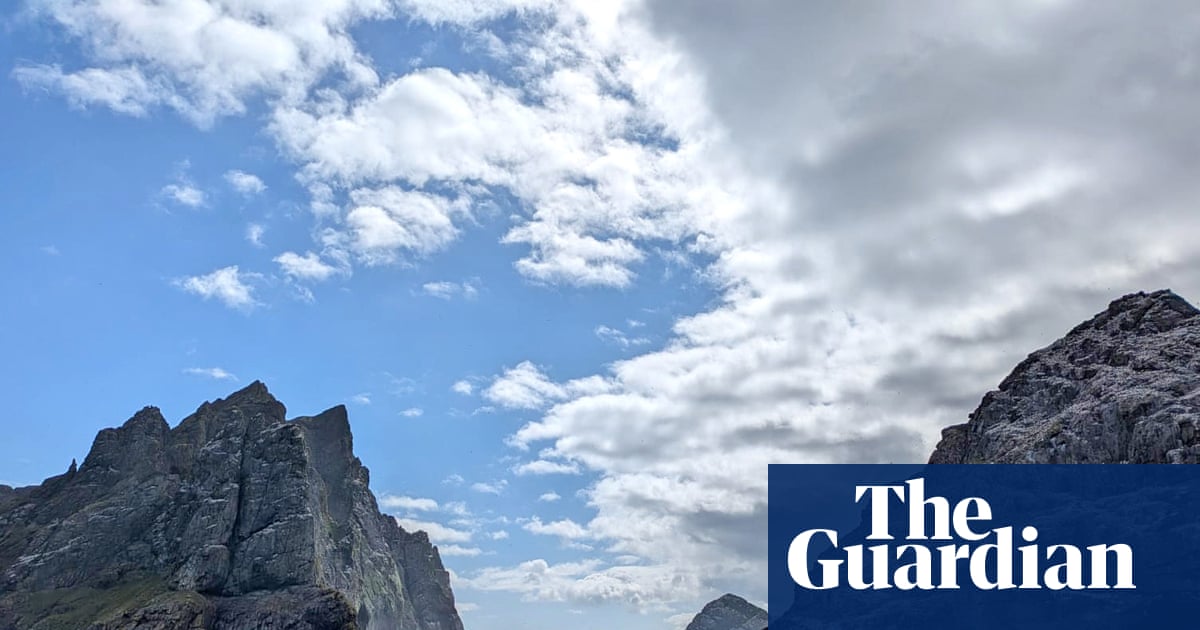
Dawn on a deep-rolling ocean, and I am about to realise a dream. We’re 35 nautical miles west of the Outer Hebrides, on board the expedition cruise ship M/V Sea Spirit, approaching the archipelago of St Kilda – the most remote outpost of the British Isles, and the UK’s only dual Unesco world heritage site. Impregnable sheer cliffs spike the seascape, rising to 1,400 feet, and we’re in the company of Risso’s dolphins, flights of gannets and hurrying auks.
We make landing at Hirta, the largest of the four islands at about 2.7 square miles. Above the great storm beach lies a deserted, unnamed “village”, a thin crescent of traditional Hebridean cottages. Nowadays, the only inhabitants are St Kilda wrens (Troglodytes troglodytes hirtensis) – larger and darker than the mainland populations – but each cottage also bears a simple plaque listing the last family to live there.
No 3 was home to Mary Ann and William MacDonald and their 11 children, not all of whom survived long, their names adopted by later siblings – John, Finlay, Annabella, Mary, Mary B, Finlay Jonn, Malcolm, Kirsty, Rachel, Marion and Mae. It seems almost impossible, standing here now, but for centuries their ancestors were adapted to this harsh isolation, before the last St Kildans were finally evacuated at their request in 1930.
What remains is of boundless interest. Splaying out from the cottages are small, sea-turfed fields, bounded by lichenised stone walls and unique beehive-shaped drystone cleits (like a small bothy). Historically they were used to store seabirds, eggs, crops and peat for fuel; today they make “desirable residences” for nesting wheatears, whose breezy calls cut through the silence.
We venture up the steep slopes of the Conachair summit, where slight but tenacious Soay sheep graze and the low-cut heath hides miniature heath spotted orchids and carnivorous butterworts. Bonxies growl and snipes sing.
Quite suddenly we’re at the cliff edge, 1,000ft above the ocean. Beyond are the greatest sea stacks of the North Atlantic – Stac an Armin (where the UK’s last great auk was seen in 1840) and Stac Lee – and the formidable cliffs of Boreray, each teeming with seabird activity: nearly 1 million live on these islands during breeding season. Sea eagles soar above Conachair as we balance on the world’s edge.
Under the Changing Skies: The Best of the Guardian’s Country Diary, 2018-2024, is available now at guardianbookshop.com
Read the full story at The Guardian ↗
St Kilda is an archipelago in the North Atlantic, 35 nautical miles west of Scotland's Outer Hebrides. The four islands, dominated by Hirta at 2.7 square miles, feature cliffs rising to 1,400 feet and are designated as a dual UNESCO World Heritage Site. The islands supported a human population for centuries before residents requested evacuation in 1930. Today, wildlife dominates the landscape: nearly 1 million seabirds breed there seasonally, including gannets and auks. Endemic species include the St Kilda wren and Soay sheep. Visible remnants include abandoned stone cottages and beehive-shaped cleits that once stored food and fuel. The islands support diverse plant life including heath spotted orchids and carnivorous butterworts.
Read the full story at The Guardian ↗
Dawn on a deep-rolling ocean, and I am about to realise a dream. We’re 35 nautical miles west of the Outer Hebrides, on board the expedition cruise ship M/V Sea Spirit, approaching the archipelago of St Kilda – the most remote outpost of the British Isles, and the UK’s only dual Unesco world heritage site. Impregnable sheer cliffs spike the seascape, rising to 1,400 feet, and we’re in the company of Risso’s dolphins, flights of gannets and hurrying auks.
We make landing at Hirta, the largest of the four islands at about 2.7 square miles. Above the great storm beach lies a deserted, unnamed “village”, a thin crescent of traditional Hebridean cottages. Nowadays, the only inhabitants are St Kilda wrens (Troglodytes troglodytes hirtensis) – larger and darker than the mainland populations – but each cottage also bears a simple plaque listing the last family to live there.
No 3 was home to Mary Ann and William MacDonald and their 11 children, not all of whom survived long, their names adopted by later siblings – John, Finlay, Annabella, Mary, Mary B, Finlay Jonn, Malcolm, Kirsty, Rachel, Marion and Mae. It seems almost impossible, standing here now, but for centuries their ancestors were adapted to this harsh isolation, before the last St Kildans were finally evacuated at their request in 1930.
What remains is of boundless interest. Splaying out from the cottages are small, sea-turfed fields, bounded by lichenised stone walls and unique beehive-shaped drystone cleits (like a small bothy). Historically they were used to store seabirds, eggs, crops and peat for fuel; today they make “desirable residences” for nesting wheatears, whose breezy calls cut through the silence.
We venture up the steep slopes of the Conachair summit, where slight but tenacious Soay sheep graze and the low-cut heath hides miniature heath spotted orchids and carnivorous butterworts. Bonxies growl and snipes sing.
Quite suddenly we’re at the cliff edge, 1,000ft above the ocean. Beyond are the greatest sea stacks of the North Atlantic – Stac an Armin (where the UK’s last great auk was seen in 1840) and Stac Lee – and the formidable cliffs of Boreray, each teeming with seabird activity: nearly 1 million live on these islands during breeding season. Sea eagles soar above Conachair as we balance on the world’s edge.
Under the Changing Skies: The Best of the Guardian’s Country Diary, 2018-2024, is available now at guardianbookshop.com
Read the full story at The Guardian ↗
St Kilda is located 35 nautical miles west of the Outer Hebrides St Kilda is the most remote outpost of the British Isles St Kilda holds dual UNESCO World Heritage Site status Cliffs on the islands rise to 1,400 feet Hirta is the largest of the four islands at approximately 2.7 square miles St Kilda wrens are larger and darker than mainland populations The last St Kildans were evacuated in 1930 at their request Nearly 1 million seabirds live on the islands during breeding season The UK's last great auk was seen at Stac an Armin in 1840
Read the full story at The Guardian ↗
- St Kilda is a remote British archipelago located 35 nautical miles west of the Outer Hebrides
- The islands feature dramatic cliffs up to 1,400 feet and support nearly 1 million seabirds during breeding season
- St Kilda was continuously inhabited for centuries until the last residents were evacuated in 1930
- The islands are now a dual UNESCO World Heritage Site with distinctive wildlife including endemic St Kilda wrens and Soay sheep
- Remaining structures include traditional cottages and beehive-shaped stone cleits historically used for food storage