Dutch PM apologises for Moluccan soldiers’ mistreatment after Indonesian independence
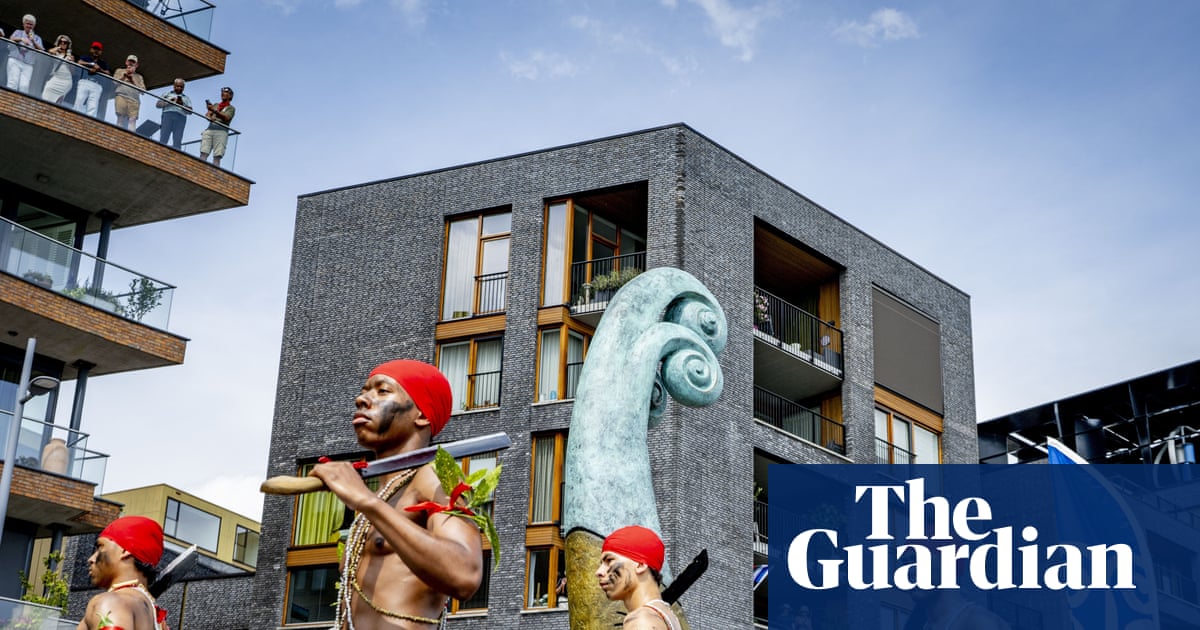
The Dutch prime minister, Rob Jetten, has formally apologised for the “heartless” mistreatment of thousands of Moluccan soldiers who fought for the Dutch colonial army during Indonesia’s struggle for independence.
About 12,500 people – men who had served in the Royal Dutch East Indies and their families – came from a group of Indonesian islands to the Netherlands in 1951, many having been given no choice. They thought it would be a temporary evacuation after Indonesia had won independence.
The soldiers hoped for their own Moluccan republic after a six-month stay but instead they were involuntarily discharged, banned from work and voting, and housed in places such as the former Nazi transit camp Westerbork. A republic never came and some never unpacked their suitcases.
At the unveiling ceremony for a crowdfunded national monument on the harbourside in Rotterdam, where their last boat arrived, Jetten said: “For their heartless and dishonourable discharge as soldiers, for their inadequate reception and housing, for being unseen and abandoned, for the unfulfilled longing for home, for the grief and pain in so many Moluccan families … for this, I offer apologies today on behalf of the Dutch government. It is not only high time, but it is also necessary if we want to move forward.”
Activism by the descendants of those Moluccan families in the 1970s – including a school hostage-taking and an armed train hijack – ended in a bloody raid by Dutch special forces. There was a 1986 agreement with the government, including cultural funding and jobs schemes, but pressure had since grown for a formal recognition of the wrongs done.
Jetten stressed that a forthcoming parliamentary investigation, involving the community that now numbers 70,000 descendants, was vital.
Carola Schouten, the mayor of Rotterdam, said she hoped the monument would be a place for stories to be told openly. “They were treated with coldness, their loyalty had a high price and it was often a silent sorrow,” she said at the opening ceremony. “It is important that there is recognition of the injustice that was done to you.”
The project to create the monument – by the artists Jaïr Pattipeilohy and Maurice den Boer, and representing the prow of a traditional ship – had been a 10-year struggle, said Yordi Tahamata, the chair of the monument foundation.
“I stand here as the grandson of my grandfathers … part of a generation that came to the Netherlands under military orders and built a life in a strange land, unsure about a future none of them had predicted,” he said. “This is about the right to tell our history and to give it on to new generations.”
There was some criticism that the government had in effect gatecrashed the opening of a community’s monument, and that the words of apology had come too late for many people who lived through the exclusion and injustice.
Eduard Latuheri, 98, was invited to bless the monument, with several other surviving soldiers and first-generation family members. His grandson Dennis van Peterson spoke for Latuheri. “He is thankful just to come here,” he told the Guardian. “There’s a mixed feeling about an apology. For Grandad, it’s the right thing, but the first generation are mostly not here any more – it’s too late.”
Others recalled the lifelong bitterness of their parents over the broken promise from the Dutch government to help them return. Fred Roos, 70, was born and lived for five years in Westerbork and said his late father was never allowed to work and always felt angry. “Everything was always ready to go back but it never happened,” he said. “This is a loaded moment.”
Fridus Steijlen, a co-author of a recent history of the Moluccan community in the Netherlands, said that because the Moluccans’ stay was always supposed to be temporary, integration was affected for generations – despite the community’s own resilience.
“An apology should address the parternalistic attitude of the Dutch government at the time, and that it didn’t think about how they could go back,” he said. “That’s why the pain went on.”
Read the full story at The Guardian ↗
Dutch Prime Minister Rob Jetten apologised at a ceremony in Rotterdam for the treatment of Moluccan soldiers who served in the Dutch colonial army and arrived in the Netherlands in 1951 following Indonesian independence. About 12,500 people—soldiers and their families from the Moluccan islands—came expecting temporary relocation but were discharged from military service, restricted from employment and voting, and housed in inadequate facilities including the former Westerbork transit camp. Many remained in the Netherlands permanently rather than returning home as anticipated. A crowdfunded monument marking their arrival was unveiled at the Rotterdam harbourside. Jetten acknowledged the discharge, housing conditions, and unfulfilled expectations. A parliamentary investigation involving the community, now numbering approximately 70,000 descendants, is planned. Some survivors and descendants expressed mixed feelings, noting the apology came too late for many who experienced the exclusion directly, and highlighting the intergenerational impact of the broken promise of return.
Read the full story at The Guardian ↗
The Dutch prime minister, Rob Jetten, has formally apologised for the “heartless” mistreatment of thousands of Moluccan soldiers who fought for the Dutch colonial army during Indonesia’s struggle for independence.
About 12,500 people – men who had served in the Royal Dutch East Indies and their families – came from a group of Indonesian islands to the Netherlands in 1951, many having been given no choice. They thought it would be a temporary evacuation after Indonesia had won independence.
The soldiers hoped for their own Moluccan republic after a six-month stay but instead they were involuntarily discharged, banned from work and voting, and housed in places such as the former Nazi transit camp Westerbork. A republic never came and some never unpacked their suitcases.
At the unveiling ceremony for a crowdfunded national monument on the harbourside in Rotterdam, where their last boat arrived, Jetten said: “For their heartless and dishonourable discharge as soldiers, for their inadequate reception and housing, for being unseen and abandoned, for the unfulfilled longing for home, for the grief and pain in so many Moluccan families … for this, I offer apologies today on behalf of the Dutch government. It is not only high time, but it is also necessary if we want to move forward.”
Activism by the descendants of those Moluccan families in the 1970s – including a school hostage-taking and an armed train hijack – ended in a bloody raid by Dutch special forces. There was a 1986 agreement with the government, including cultural funding and jobs schemes, but pressure had since grown for a formal recognition of the wrongs done.
Jetten stressed that a forthcoming parliamentary investigation, involving the community that now numbers 70,000 descendants, was vital.
Carola Schouten, the mayor of Rotterdam, said she hoped the monument would be a place for stories to be told openly. “They were treated with coldness, their loyalty had a high price and it was often a silent sorrow,” she said at the opening ceremony. “It is important that there is recognition of the injustice that was done to you.”
The project to create the monument – by the artists Jaïr Pattipeilohy and Maurice den Boer, and representing the prow of a traditional ship – had been a 10-year struggle, said Yordi Tahamata, the chair of the monument foundation.
“I stand here as the grandson of my grandfathers … part of a generation that came to the Netherlands under military orders and built a life in a strange land, unsure about a future none of them had predicted,” he said. “This is about the right to tell our history and to give it on to new generations.”
There was some criticism that the government had in effect gatecrashed the opening of a community’s monument, and that the words of apology had come too late for many people who lived through the exclusion and injustice.
Eduard Latuheri, 98, was invited to bless the monument, with several other surviving soldiers and first-generation family members. His grandson Dennis van Peterson spoke for Latuheri. “He is thankful just to come here,” he told the Guardian. “There’s a mixed feeling about an apology. For Grandad, it’s the right thing, but the first generation are mostly not here any more – it’s too late.”
Others recalled the lifelong bitterness of their parents over the broken promise from the Dutch government to help them return. Fred Roos, 70, was born and lived for five years in Westerbork and said his late father was never allowed to work and always felt angry. “Everything was always ready to go back but it never happened,” he said. “This is a loaded moment.”
Fridus Steijlen, a co-author of a recent history of the Moluccan community in the Netherlands, said that because the Moluccans’ stay was always supposed to be temporary, integration was affected for generations – despite the community’s own resilience.
“An apology should address the parternalistic attitude of the Dutch government at the time, and that it didn’t think about how they could go back,” he said. “That’s why the pain went on.”
Read the full story at The Guardian ↗
Dutch PM Rob Jetten formally apologised for the mistreatment of Moluccan soldiers at a ceremony in Rotterdam in 2024 Approximately 12,500 Moluccan soldiers and family members arrived in the Netherlands in 1951 after Indonesian independence They were involuntarily discharged, banned from work and voting, and housed in places including the former Nazi transit camp Westerbork The soldiers expected either a six-month temporary stay or their own Moluccan republic A crowdfunded national monument was unveiled at the Rotterdam harbourside marking their arrival A parliamentary investigation involving the Moluccan community is forthcoming The apology was 'heartless' in its original execution The government treatment was 'dishonourable' The mistreatment was a result of a 'paternalistic attitude' that failed to plan for return Some survivors and descendants felt the apology came too late for those who lived through the exclusion The promised return never materialised, causing 'lifelong bitterness'
Read the full story at The Guardian ↗
- Dutch PM Rob Jetten formally apologised for the mistreatment of approximately 12,500 Moluccan soldiers and their families who arrived in the Netherlands in 1951 after Indonesia's independence
- The soldiers were involuntarily discharged, banned from work and voting, and housed in poor conditions including a former Nazi transit camp, despite expectations of temporary stay and their own republic
- A crowdfunded national monument was unveiled in Rotterdam; a parliamentary investigation into the community's experiences is forthcoming