‘Emotional connection’: Wonderwall becomes England’s World Cup anthem
It has become England’s World Cup anthem more three decades after it was first released, being belted out by fans from Texas to Massachusetts.
Wonderwall by Oasis will soon be heard in Mexico City too, where the Three Lions will face the tournament co-hosts Mexico on Sunday evening – or at 1am on Monday for fans singing along back home.
“It’s almost a time-and-place moment for those guys out in the States following the team,” said Russell Osborne, who hosts the Three Lions podcast. “And the team are singing it back to them – it’s a reciprocal thing. They’re all enjoying it and loving it, coming together with that one song.”
The three-way relationship between a travelling English support, the group of players they were cheering on and a three-decade-old hit by a Manchester band started with a DJ in Texas and a crucial win over a Croatian team that has stood between England’s men’s football team and glory before.
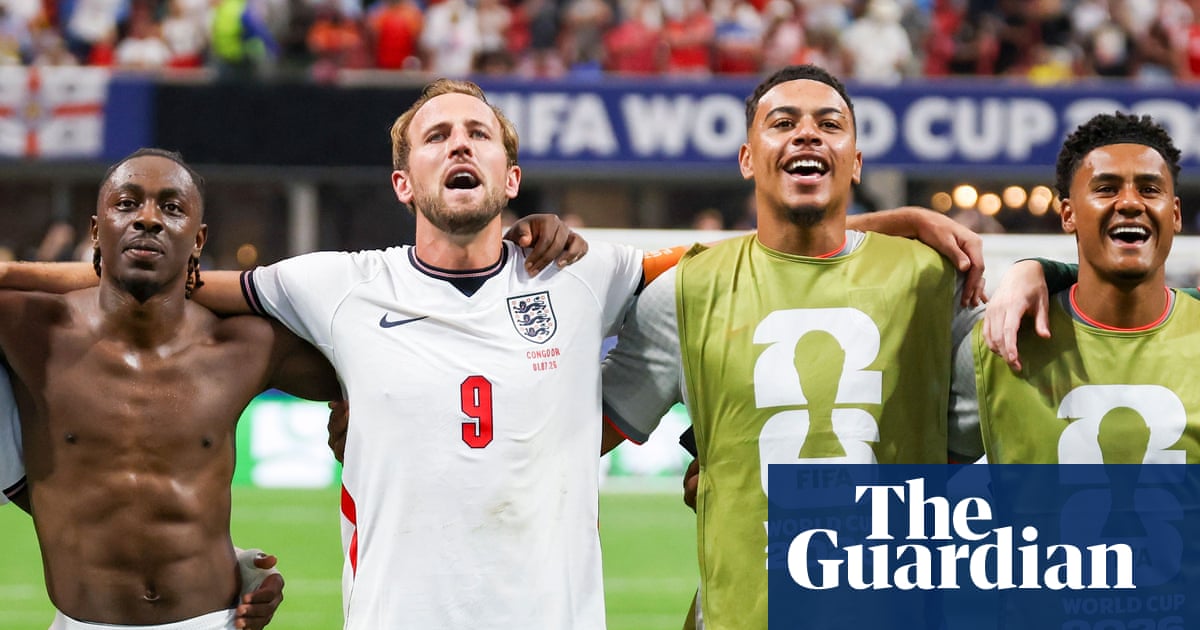
The team’s captain, Harry Kane, has described the moment when fans started up as one of his favourite in an England shirt – and he has had a few good ones. Many fans may have been high up, away from the pitch, but the emotion on Kane’s face was beamed around the stadium on the jumbotron.
Kane told the Lions’ Den podcast that what got him was the “emotional connection with the fans, we know how much it means to them”. Since that moment at the end of England’s opening game, Wonderwall has been adopted as their unofficial anthem.
Osborne compared it to the final of the last European Championship, when England were beaten by Spain in Berlin. “I went to all the Euros games out there. Prematch, they played Robbie Williams’ Angels as the England song for everyone to come together in a communal way. [That] got everyone singing together in a way that Wonderwall has got people singing together now over in the States.”
The author and broadcaster PJ Harrison, who has written the biography Gallagher: The Fall and Rise of Oasis, has said the song made such good terrace material because of the ambiguity of its lyrics and the simple and familiar melody. “What is a Wonderwall? I’m not really sure what it is but I can sing about it and it can be whatever I think it is,” he told BBC News. “If I think it’s Jude Bellingham or if I think it’s England winning, it can be that, or it could be my girlfriend or whatever.”
Osborne also attributes some of its popularity to nostalgia, with many of England’s travelling contingent now remembering the mid-90s as the time when they were young and the country optimistic.
It was also a connection between fans and players that could be one of the things that makes the difference, he said. “When they see the players are standing there in a line listening and … singing it back to the fans – perhaps that is just going to give them just that little bit of extra sparkle, just to carry on throughout the tournament, to carry them through the next game.”
England fans had previously adopted Neil Diamond’s Sweet Caroline as their unofficial song, starting during their run to the Euro 2020 final. It was also enthusiastically taken on by the women’s team as they twice surpassed that achievement to win Euros titles in 2022 and 2025.
But that song has had its time and should be left there, Osborne said. And the same should happen to Wonderwall once the England team come home – whether or not they are carrying a trophy.
“Looking into the future, I can almost see England play on a wet Thursday night in March in a friendly, and drawing 0-0, and half the crowd have gone home early, and the DJ at the end of the game thinks ‘Right, I’m going to stick Wonderwall on and we’re going to try and get the same reaction.’” But, he said, to really get it, you probably had to be there.
Read the full story at The Guardian ↗
Oasis's 1990s song Wonderwall has become an unofficial anthem for England's World Cup campaign, sung by fans across the US ahead of the team's match against Mexico. The adoption began after England's opening match, when fans started singing it and players, including captain Harry Kane, joined in. Kane later described the moment as one of his favourites in an England shirt, citing the emotional connection with supporters. Experts point to the song's ambiguous lyrics and simple melody as reasons for its appeal, alongside nostalgia for the 1990s among England's travelling fans. The song replaces Neil Diamond's Sweet Caroline, which served as an unofficial anthem during Euro 2020 and subsequent women's tournaments. Podcast host Russell Osborne noted the reciprocal relationship between fans and players singing together, though he predicted the song's relevance would fade once the tournament ends.
Read the full story at The Guardian ↗
It has become England’s World Cup anthem more three decades after it was first released, being belted out by fans from Texas to Massachusetts.
Wonderwall by Oasis will soon be heard in Mexico City too, where the Three Lions will face the tournament co-hosts Mexico on Sunday evening – or at 1am on Monday for fans singing along back home.
“It’s almost a time-and-place moment for those guys out in the States following the team,” said Russell Osborne, who hosts the Three Lions podcast. “And the team are singing it back to them – it’s a reciprocal thing. They’re all enjoying it and loving it, coming together with that one song.”
The three-way relationship between a travelling English support, the group of players they were cheering on and a three-decade-old hit by a Manchester band started with a DJ in Texas and a crucial win over a Croatian team that has stood between England’s men’s football team and glory before.
The team’s captain, Harry Kane, has described the moment when fans started up as one of his favourite in an England shirt – and he has had a few good ones. Many fans may have been high up, away from the pitch, but the emotion on Kane’s face was beamed around the stadium on the jumbotron.
Kane told the Lions’ Den podcast that what got him was the “emotional connection with the fans, we know how much it means to them”. Since that moment at the end of England’s opening game, Wonderwall has been adopted as their unofficial anthem.
Osborne compared it to the final of the last European Championship, when England were beaten by Spain in Berlin. “I went to all the Euros games out there. Prematch, they played Robbie Williams’ Angels as the England song for everyone to come together in a communal way. [That] got everyone singing together in a way that Wonderwall has got people singing together now over in the States.”
The author and broadcaster PJ Harrison, who has written the biography Gallagher: The Fall and Rise of Oasis, has said the song made such good terrace material because of the ambiguity of its lyrics and the simple and familiar melody. “What is a Wonderwall? I’m not really sure what it is but I can sing about it and it can be whatever I think it is,” he told BBC News. “If I think it’s Jude Bellingham or if I think it’s England winning, it can be that, or it could be my girlfriend or whatever.”
Osborne also attributes some of its popularity to nostalgia, with many of England’s travelling contingent now remembering the mid-90s as the time when they were young and the country optimistic.
It was also a connection between fans and players that could be one of the things that makes the difference, he said. “When they see the players are standing there in a line listening and … singing it back to the fans – perhaps that is just going to give them just that little bit of extra sparkle, just to carry on throughout the tournament, to carry them through the next game.”
England fans had previously adopted Neil Diamond’s Sweet Caroline as their unofficial song, starting during their run to the Euro 2020 final. It was also enthusiastically taken on by the women’s team as they twice surpassed that achievement to win Euros titles in 2022 and 2025.
But that song has had its time and should be left there, Osborne said. And the same should happen to Wonderwall once the England team come home – whether or not they are carrying a trophy.
“Looking into the future, I can almost see England play on a wet Thursday night in March in a friendly, and drawing 0-0, and half the crowd have gone home early, and the DJ at the end of the game thinks ‘Right, I’m going to stick Wonderwall on and we’re going to try and get the same reaction.’” But, he said, to really get it, you probably had to be there.
Read the full story at The Guardian ↗
Wonderwall by Oasis, released three decades ago, has become England's World Cup anthem and is being sung by fans from Texas to Massachusetts. England faces Mexico in Mexico City on Sunday evening (1am Monday UK time). The adoption of Wonderwall started after a DJ in Texas and England's crucial win over Croatia. Captain Harry Kane described the moment fans started singing as one of his favourite moments in an England shirt. Kane cited the 'emotional connection with the fans' and how much it means to them as what moved him. Wonderwall has been adopted as England's unofficial anthem since the opening game. The song works well as terrace material because of the ambiguity of its lyrics and simple familiar melody. The song's popularity is partly attributable to nostalgia among England's travelling contingent for the optimistic 1990s. The emotional connection between fans and players singing together could give the team 'that little bit of extra sparkle' to carry them through the tournament. Sweet Caroline has had its time and should be left there. Wonderwall should only have relevance during the tournament and not be revived for routine friendly matches.
Read the full story at The Guardian ↗
- Oasis's Wonderwall, released in the 1990s, has become England's unofficial World Cup anthem, sung by fans in the US and expected to feature during England's match against Mexico.
- The song gained prominence after England's opening game win, with captain Harry Kane citing the emotional connection with fans as a favourite moment in his England career.
- Music experts attribute its adoption to the song's ambiguous lyrics, simple melody, and nostalgic associations with the 1990s for England's travelling support.