EU calls emergency meeting to discuss Ceuta migrant crossings
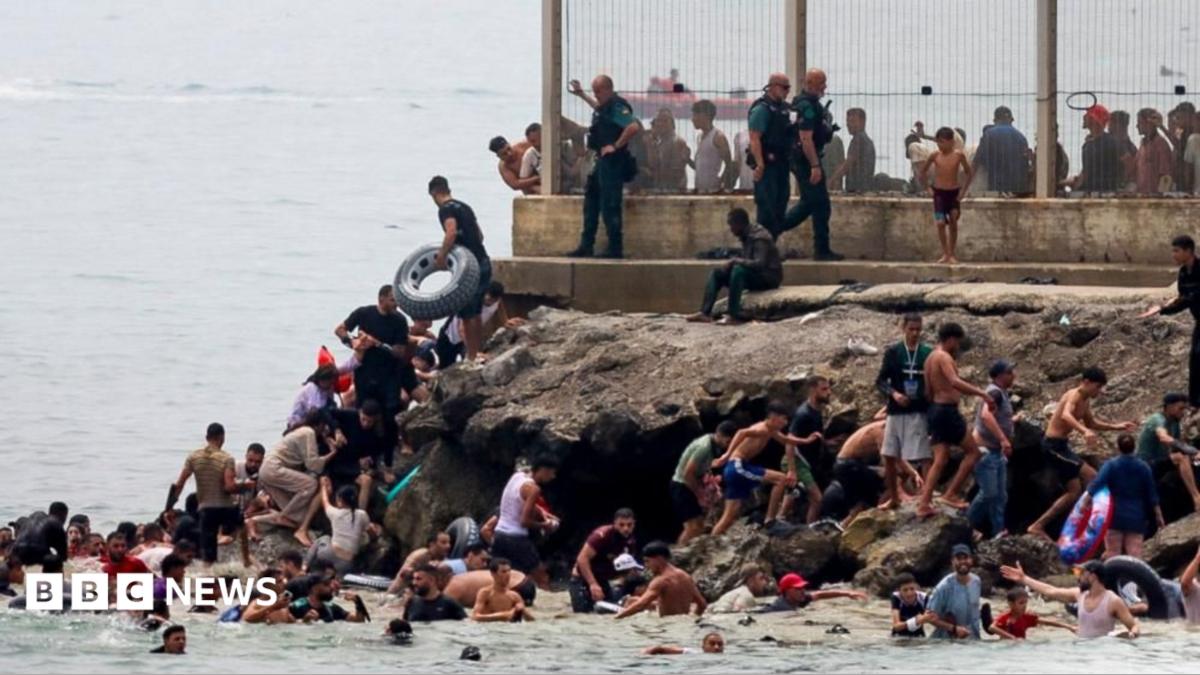
The European Union will hold emergency talks on Tuesday to discuss the migration crisis in Ceuta after tense exchanges between Spain and other member states.
Twenty-two member states issued a joint letter calling for co-ordinated action and the strengthening of the EU's external borders, after some 60,000 migrants entered the Spanish enclave from Morocco.
Spain condemned "selfish, polarising and unlawful" reaction to the crisis after Italy suspended the EU's border-free Schengen arrangement with Spain - a move backed by Finland and Denmark.
Officials say almost all those who reached Ceuta on 30 July have returned, while deaths from the surge in crossings had risen to at least 67.
The EU members' letter addresses concerns around "hybrid threats to create the perception that illegal entry into the European Union is possible," adding that the perception "would encourage further attempts, undermine confidence in our common migration policy and have repercussions for all Member States".
Leaders of the Netherlands, Finland and Belgium are among 22 signatures on the letter, addressed to EU President Antonio Costa, president of the European Commission Ursula von der Leyen and Taoiseach Michael Martin, as Ireland currently holds the presidency of the Council of the European Union.
In a separate letter to von der Leyen, Spanish Prime Minister Pedro Sánchez said he had "serious concerns" about some European governments.
He said the Spanish government had fully restored control over the border and prevented any "unauthorised onward movement towards continental Europe" in less than 48 hours.
While most had shown "support and solidarity", Sánchez said other European governments had chosen to attack Spain, "driven by prejudice, fake news, ignorance, or political interest", and pointed out that Ceuta was not part of the Schengen area.
The EU is convening emergency talks following a migration event in Ceuta. On July 30, approximately 60,000 migrants crossed from Morocco into the Spanish enclave. Twenty-two EU member states issued a joint letter advocating for coordinated border strengthening and expressing concerns about the incident's deterrent effects on migration policy across the bloc. Italy, Finland, and Denmark responded by suspending Schengen arrangements with Spain—a move Spain's government criticized. Spain stated that nearly all arrivals have since returned and that border control was restored within 48 hours. At least 67 deaths were recorded in connection with the crossings. Tensions between member states centre on interpretations of the event and appropriate responses, with Spain noting that Ceuta falls outside Schengen's usual framework.
The European Union will hold emergency talks on Tuesday to discuss the migration crisis in Ceuta after tense exchanges between Spain and other member states.
Twenty-two member states issued a joint letter calling for co-ordinated action and the strengthening of the EU's external borders, after some 60,000 migrants entered the Spanish enclave from Morocco.
Spain condemned "selfish, polarising and unlawful" reaction to the crisis after Italy suspended the EU's border-free Schengen arrangement with Spain - a move backed by Finland and Denmark.
Officials say almost all those who reached Ceuta on 30 July have returned, while deaths from the surge in crossings had risen to at least 67.
The EU members' letter addresses concerns around "hybrid threats to create the perception that illegal entry into the European Union is possible," adding that the perception "would encourage further attempts, undermine confidence in our common migration policy and have repercussions for all Member States".
Leaders of the Netherlands, Finland and Belgium are among 22 signatures on the letter, addressed to EU President Antonio Costa, president of the European Commission Ursula von der Leyen and Taoiseach Michael Martin, as Ireland currently holds the presidency of the Council of the European Union.
In a separate letter to von der Leyen, Spanish Prime Minister Pedro Sánchez said he had "serious concerns" about some European governments.
He said the Spanish government had fully restored control over the border and prevented any "unauthorised onward movement towards continental Europe" in less than 48 hours.
While most had shown "support and solidarity", Sánchez said other European governments had chosen to attack Spain, "driven by prejudice, fake news, ignorance, or political interest", and pointed out that Ceuta was not part of the Schengen area.
The EU will hold emergency talks on Tuesday to discuss migration in Ceuta Approximately 60,000 migrants entered Ceuta from Morocco on July 30 Twenty-two EU member states issued a joint letter calling for coordinated action and stronger external borders Italy, Finland, and Denmark suspended Schengen arrangements with Spain Almost all migrants who reached Ceuta have since returned At least 67 deaths were reported from the crossings Spain restored border control within 48 hours and prevented unauthorised onward movement Ceuta is not part of the Schengen area Spain condemned the response of some EU governments as "selfish, polarising and unlawful" The 22 member states characterised the migration surge as a "hybrid threat" designed to create perceptions that illegal EU entry is possible Spain's government attributed criticism from other EU members to "prejudice, fake news, ignorance, or political interest"
- The EU will hold emergency talks on Tuesday to address migration in Ceuta after approximately 60,000 migrants entered the Spanish enclave from Morocco on July 30
- Twenty-two EU member states called for coordinated border action, while Spain condemned Italy, Finland, and Denmark for suspending Schengen arrangements with it
- Nearly all migrants who reached Ceuta have returned; at least 67 deaths were reported from the crossings
- Spain's government says it restored border control within 48 hours and prevented onward movement to continental Europe
- Spanish PM Sánchez expressed concern about other EU governments' responses, stating Ceuta is outside the Schengen area