Ex-Israeli diplomat calls opposition's refusal to work with Arab parties 'reckless'
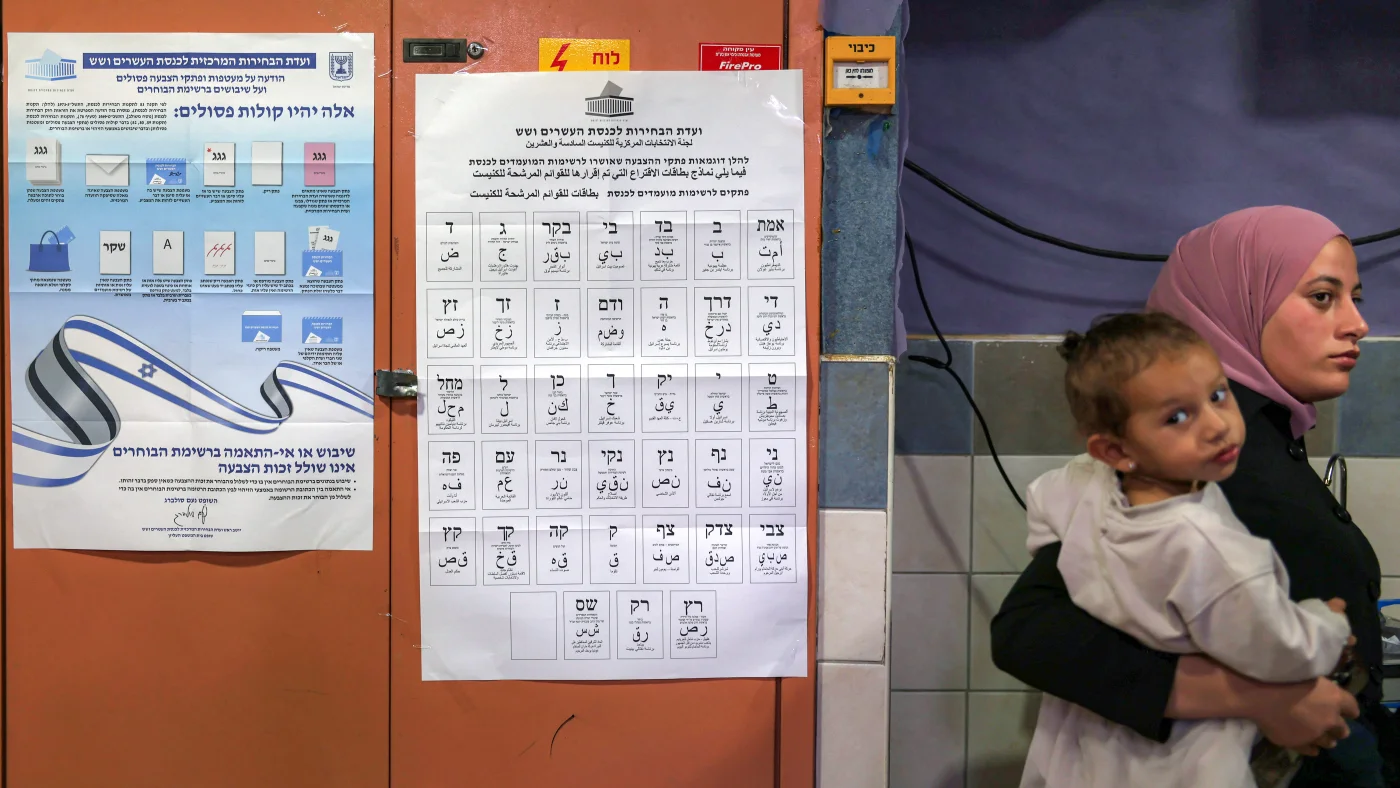
A woman carries a child past a sign displaying political parties' electoral symbols at a polling station in the southern Bedouin city of Rahat, Israel, on Oct. 27, during Israel's parliamentary election. Hazem Bader/AFP via Getty Images hide caption
Hazem Bader/AFP via Getty Images
The strong showing by Arab-led parties in Israel's election has raised a question for the opposition: Will its leaders work with them to form a government?
Political observers doubt such a partnership will materialize, given the unwillingness of several opposition leaders to work with Arab-led parties. Alon Pinkas, an Israeli political analyst and former diplomat who advised former Prime Ministers Ehud Barak and Shimon Peres, called that reluctance "myopic and reckless."
Pinkas told Morning Edition that opposition leader Gadi Eisenkot could either form a coalition with the parties or establish a minority government with their outside support, allowing them to back major legislation and confidence votes without formally joining the coalition.
But both Eisenkot and Prime Minister Benjamin Netanyahu have rejected working with Arab-led parties, which draw much of their support from Palestinian citizens of Israel. Netanyahu went further, calling the prospect of a government relying on their support "a shame and a disgrace."
Speaking with NPR's Steve Inskeep, Pinkas challenged arguments that relying on Arab-led parties would undermine Israel's identity as a Jewish state. He questioned why the same reasoning would not apply to ultra-Orthodox Jewish parties, which he said describe themselves as non-Zionist.
Pinkas attributed growing support for Arab-led parties to rising crime and murder rates in Arab communities, particularly violence involving organized crime groups. He said Netanyahu's government had "willfully ignored their plight" by failing to deploy police or investigate the killings.
As for Netanyahu's chances of forming a government, his assessment was emphatic: "Mr. Netanyahu cannot. I repeat, cannot form a government."
Listen to the full interview by clicking on the blue button above.
The digital version of this interview was edited by Treye Green.
Read the full story at NPR ↗
Why a stronger showing for Arab parties may not translate into political power in Israel
This lens runs the verified story through Cinnamon's AI — wired in the next step.
A woman carries a child past a sign displaying political parties' electoral symbols at a polling station in the southern Bedouin city of Rahat, Israel, on Oct. 27, during Israel's parliamentary election. Hazem Bader/AFP via Getty Images hide caption
Hazem Bader/AFP via Getty Images
The strong showing by Arab-led parties in Israel's election has raised a question for the opposition: Will its leaders work with them to form a government?
Political observers doubt such a partnership will materialize, given the unwillingness of several opposition leaders to work with Arab-led parties. Alon Pinkas, an Israeli political analyst and former diplomat who advised former Prime Ministers Ehud Barak and Shimon Peres, called that reluctance "myopic and reckless."
Pinkas told Morning Edition that opposition leader Gadi Eisenkot could either form a coalition with the parties or establish a minority government with their outside support, allowing them to back major legislation and confidence votes without formally joining the coalition.
But both Eisenkot and Prime Minister Benjamin Netanyahu have rejected working with Arab-led parties, which draw much of their support from Palestinian citizens of Israel. Netanyahu went further, calling the prospect of a government relying on their support "a shame and a disgrace."
Speaking with NPR's Steve Inskeep, Pinkas challenged arguments that relying on Arab-led parties would undermine Israel's identity as a Jewish state. He questioned why the same reasoning would not apply to ultra-Orthodox Jewish parties, which he said describe themselves as non-Zionist.
Pinkas attributed growing support for Arab-led parties to rising crime and murder rates in Arab communities, particularly violence involving organized crime groups. He said Netanyahu's government had "willfully ignored their plight" by failing to deploy police or investigate the killings.
As for Netanyahu's chances of forming a government, his assessment was emphatic: "Mr. Netanyahu cannot. I repeat, cannot form a government."
Listen to the full interview by clicking on the blue button above.
The digital version of this interview was edited by Treye Green.
Read the full story at NPR ↗
This lens runs the verified story through Cinnamon's AI — wired in the next step.
- Why a stronger showing for Arab parties may not translate into political power in Israel