From cool-down spots to chalk on windows - how Europe is coping with the heat
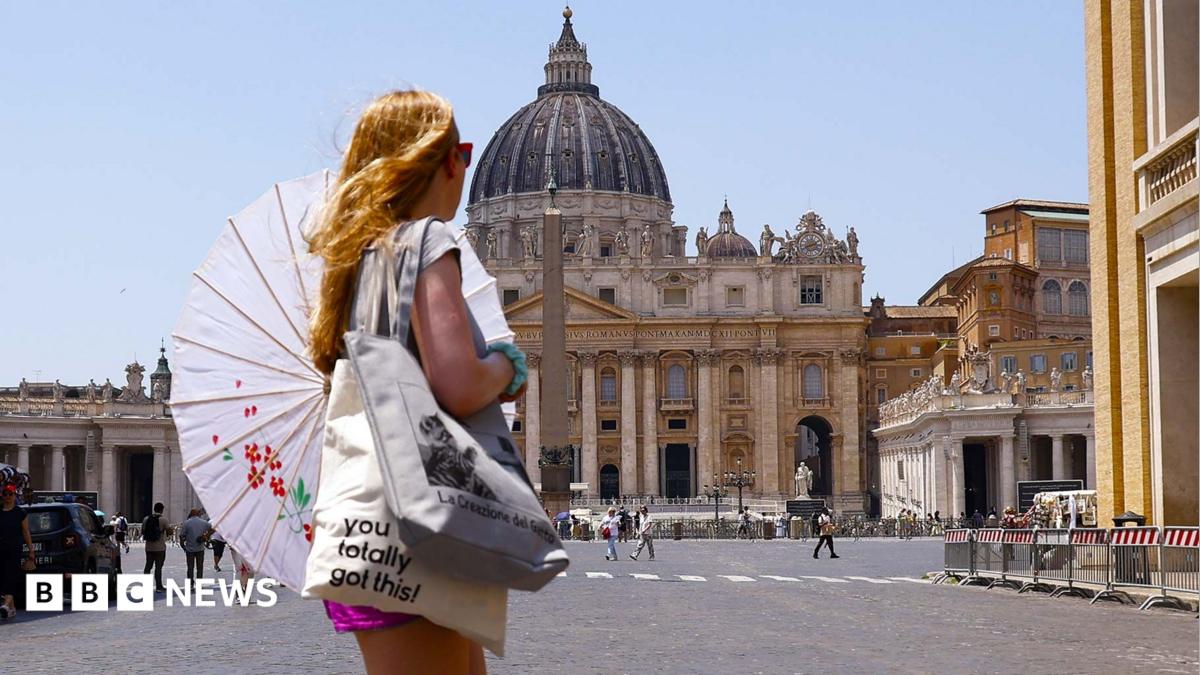
Image source, Getty Images
Much like the UK, countries across Europe are experiencing intense heat this week
Europe is in the throes of a scorching heatwave, with temperature records expected to tumble in the coming days.
We asked our reporters across the continent how people are dealing with the searing temperatures where they are.
Image source, Getty Images
Amsterdam's heatwave is expected to peak at 38C later this week
By Anna Holligan, in Amsterdam
Amsterdam is rolling out a network of "cool‑down" spots across the city, offering residents a place to escape the worst of the heat.
These spaces - in libraries, city farms, theatres, churches, community centres and even supermarkets - provide seating, drinking water and toilets, and many are open to pets as well.
In the pilot phase, most of the 12 cool‑down spots will be concentrated in Nieuw‑West, the district that city modelling identified as facing the greatest heat risk.
Officials weighed up how much shade is available, how many vulnerable residents such as young children and older people live there, and how quickly homes heat up.
Schools are also adapting. Many are moving to "tropical" timetables in the coming days, with shorter school days or fewer lessons, more breaks, extra drinks and increased ventilation.
Each school decides its own measures as there is no legal maximum classroom temperature.
The guiding principle is that pupils and teachers must be able to work in conditions that are safe and healthy.
Image source, Getty Images
In Nantes, a school has coated its windows with chalk to shade pupils from the heat
By Hugh Schofield, in Paris
The town hall of the 10th arrondissement of Paris is offering free cinema tickets to help people get out of the heat.
The plan is organised with three independent – and air-conditioned – cinemas.
To qualify you have to be under 25 or over 65, and the offer is for afternoon sessions only.
Cinemas, libraries and museums have been identified as places where people should be encouraged to go to escape the punishing temperatures.
Some towns, such as Lyon, have temporarily suspended charging in municipal museums.
According to French newspapers, there has been a run on a chalky product called Blanc de Meudon, or Meudon Whiting, in DIY shops.
The powder is mixed with water and then painted on windows, thus diminishing the power of the sun's rays and in theory bringing down the inside temperature. It does actually seem to work.
Image source, Getty Images
Workers were seen sheltering under umbrellas in Madrid, where new heat-related protections were introduced in 2024
By Guy Hedgecoe, in Madrid
The north-eastern Spanish region of Aragón is seeing some of the highest temperatures of the heatwave, and in the cities of Zaragoza and Huesca local authorities have responded by reducing the price of entry for public swimming pools.
The northern city of Logroño, which is expecting temperatures of up to 40C on Tuesday, has made entrance to swimming pools free for the duration of the heatwave and authorities there have announced that ornamental water fountains will be turned on until 23:00 at night.
People can also cool off under water sprinklers which have been switched on in several areas of the city.
Some places have suspended the traditional burning of a bonfire to celebrate the festival of San Juan (John the Baptist) because of the fire risk posed by the extreme conditions.
The northern city of León has cancelled a fireworks display which had been scheduled for tonight to mark the festivities.
Meanwhile, many cities have established "heat refuges", which are air-conditioned public buildings where anyone can go in and escape the worst of the weather.
A 2024 law seeks to protect Spanish workers during heatwaves, ensuring employers take safety measures, including making sure outdoor manual work is not done during the hottest time of the day.
Image source, Getty Images
More than a dozen Italian cities are covered by a red heat warning
By Sarah Rainsford, in Rome
Even for sun-loving Italy, current temperatures are extreme for June.
The list of cities issued with a red alert warning is long and set to grow on Wednesday, with the most sweltering spots in the centre and north of the country.
As the temperature climbed this week, the government reintroduced measures to help workers most exposed to the heat: either those baking outside, like farmers and construction workers, or those indoors with poor ventilation.
It means certain businesses can suspend or reduce their activity when the temperature is exceptionally high, then access state funds for furlough payments to workers.
For the rest, it's air con time. Anyone who has it installed at home or work now has it on full blast and the shutters closed.
Those without, especially the elderly and most vulnerable, have been advised to head for air-conditioned public spaces instead.
In Palermo, tourists who still insist on a horse-drawn-carriage ride will now have to wait until evening, or a cooler day.
In Turin, some restaurants have closed their terraces - elsewhere, including in Rome, giant outdoor fans and sprinklers are working overtime.
For those who do head out to eat, the health ministry has issued some advice: to choose pasta over meat, and switch dehydrating coffee or cold beer for a glass of water.
Image source, Getty Images
Some Belgians are enjoying the record-threatening June heat
By Jessica Parker and Pol Reygaerts, in Brussels
Belgium's hottest days this week are yet to arrive, with an orange alert soon due to come into force for the whole country.
That's as temperatures in some areas start climbing towards the high 30s, with an expectation that the daytime record for June could be broken.
It was back in 1947 that the country's official weather service measured a local temperature of 36.8 degrees but that could be topped this week.
The federal government had an emergency meeting on Tuesday to discuss the situation.
It is already affecting travel, with some older commuter trains not yet equipped with air conditioning being pulled from service for now.
However, there will also reportedly be some extra services to cope with the crowds, who are likely to head for the country's northern coast.
Meanwhile, Flemish news site HLN, external reports that teenage students in the Brussels suburb of Tervuren took their exams inside the cooler confines of a church.
"Kids are doing their best and the Holy Spirit is doing the rest," the local pastor posted on Facebook.
Image source, Getty Images
In Munich, where temperatures are forecast to stretch into the high 30s, public water fountains offer respite
By Bethany Bell, in Leipzig
In Germany, people are bracing for record-breaking June temperatures on Friday, when it could get as hot as 40C in the west and south-west of the country.
Postal workers from Deutsche Post have been advised to wear long-sleeved shirts and caps - while the DHL Group said that they could also order Bermuda shorts from their corporate clothing catalogue.
After several people drowned in Germany over the weekend, the German Life Saving Association (DLRG) has urging people not to underestimate the dangers of swimming.
The Conservation Association for German Forests has warned that with the heatwave continuing across the country, the risk of forest fires is rising dramatically. It said "lighting any kind of fire in the forest or at the edge of the forest is only permitted at designated fire pits".
The DAK health insurance company has set up a hotline on how to deal with the heat.
Read the full story at BBC ↗
Europe faces a significant heatwave this week, with temperatures approaching or exceeding 38-40°C in various regions. Cities have implemented coordinated responses: Amsterdam established cool-down zones in public buildings; Paris offered subsidised cinema access; Spanish cities reduced swimming pool costs and activated public water features; Italy activated state support for workers in high-heat sectors; Germany warned of drowning risks and forest fire danger. Schools adjusted schedules with shorter days and extra breaks. Workplaces adopted protective measures including time-shifting outdoor labour away from peak heat hours. Households used methods like window chalk coating and air conditioning, while those without cooling were directed to air-conditioned public spaces. Transport services were modified to accommodate heat-related limitations.
Read the full story at BBC ↗
Image source, Getty Images
Much like the UK, countries across Europe are experiencing intense heat this week
Europe is in the throes of a scorching heatwave, with temperature records expected to tumble in the coming days.
We asked our reporters across the continent how people are dealing with the searing temperatures where they are.
Image source, Getty Images
Amsterdam's heatwave is expected to peak at 38C later this week
By Anna Holligan, in Amsterdam
Amsterdam is rolling out a network of "cool‑down" spots across the city, offering residents a place to escape the worst of the heat.
These spaces - in libraries, city farms, theatres, churches, community centres and even supermarkets - provide seating, drinking water and toilets, and many are open to pets as well.
In the pilot phase, most of the 12 cool‑down spots will be concentrated in Nieuw‑West, the district that city modelling identified as facing the greatest heat risk.
Officials weighed up how much shade is available, how many vulnerable residents such as young children and older people live there, and how quickly homes heat up.
Schools are also adapting. Many are moving to "tropical" timetables in the coming days, with shorter school days or fewer lessons, more breaks, extra drinks and increased ventilation.
Each school decides its own measures as there is no legal maximum classroom temperature.
The guiding principle is that pupils and teachers must be able to work in conditions that are safe and healthy.
Image source, Getty Images
In Nantes, a school has coated its windows with chalk to shade pupils from the heat
By Hugh Schofield, in Paris
The town hall of the 10th arrondissement of Paris is offering free cinema tickets to help people get out of the heat.
The plan is organised with three independent – and air-conditioned – cinemas.
To qualify you have to be under 25 or over 65, and the offer is for afternoon sessions only.
Cinemas, libraries and museums have been identified as places where people should be encouraged to go to escape the punishing temperatures.
Some towns, such as Lyon, have temporarily suspended charging in municipal museums.
According to French newspapers, there has been a run on a chalky product called Blanc de Meudon, or Meudon Whiting, in DIY shops.
The powder is mixed with water and then painted on windows, thus diminishing the power of the sun's rays and in theory bringing down the inside temperature. It does actually seem to work.
Image source, Getty Images
Workers were seen sheltering under umbrellas in Madrid, where new heat-related protections were introduced in 2024
By Guy Hedgecoe, in Madrid
The north-eastern Spanish region of Aragón is seeing some of the highest temperatures of the heatwave, and in the cities of Zaragoza and Huesca local authorities have responded by reducing the price of entry for public swimming pools.
The northern city of Logroño, which is expecting temperatures of up to 40C on Tuesday, has made entrance to swimming pools free for the duration of the heatwave and authorities there have announced that ornamental water fountains will be turned on until 23:00 at night.
People can also cool off under water sprinklers which have been switched on in several areas of the city.
Some places have suspended the traditional burning of a bonfire to celebrate the festival of San Juan (John the Baptist) because of the fire risk posed by the extreme conditions.
The northern city of León has cancelled a fireworks display which had been scheduled for tonight to mark the festivities.
Meanwhile, many cities have established "heat refuges", which are air-conditioned public buildings where anyone can go in and escape the worst of the weather.
A 2024 law seeks to protect Spanish workers during heatwaves, ensuring employers take safety measures, including making sure outdoor manual work is not done during the hottest time of the day.
Image source, Getty Images
More than a dozen Italian cities are covered by a red heat warning
By Sarah Rainsford, in Rome
Even for sun-loving Italy, current temperatures are extreme for June.
The list of cities issued with a red alert warning is long and set to grow on Wednesday, with the most sweltering spots in the centre and north of the country.
As the temperature climbed this week, the government reintroduced measures to help workers most exposed to the heat: either those baking outside, like farmers and construction workers, or those indoors with poor ventilation.
It means certain businesses can suspend or reduce their activity when the temperature is exceptionally high, then access state funds for furlough payments to workers.
For the rest, it's air con time. Anyone who has it installed at home or work now has it on full blast and the shutters closed.
Those without, especially the elderly and most vulnerable, have been advised to head for air-conditioned public spaces instead.
In Palermo, tourists who still insist on a horse-drawn-carriage ride will now have to wait until evening, or a cooler day.
In Turin, some restaurants have closed their terraces - elsewhere, including in Rome, giant outdoor fans and sprinklers are working overtime.
For those who do head out to eat, the health ministry has issued some advice: to choose pasta over meat, and switch dehydrating coffee or cold beer for a glass of water.
Image source, Getty Images
Some Belgians are enjoying the record-threatening June heat
By Jessica Parker and Pol Reygaerts, in Brussels
Belgium's hottest days this week are yet to arrive, with an orange alert soon due to come into force for the whole country.
That's as temperatures in some areas start climbing towards the high 30s, with an expectation that the daytime record for June could be broken.
It was back in 1947 that the country's official weather service measured a local temperature of 36.8 degrees but that could be topped this week.
The federal government had an emergency meeting on Tuesday to discuss the situation.
It is already affecting travel, with some older commuter trains not yet equipped with air conditioning being pulled from service for now.
However, there will also reportedly be some extra services to cope with the crowds, who are likely to head for the country's northern coast.
Meanwhile, Flemish news site HLN, external reports that teenage students in the Brussels suburb of Tervuren took their exams inside the cooler confines of a church.
"Kids are doing their best and the Holy Spirit is doing the rest," the local pastor posted on Facebook.
Image source, Getty Images
In Munich, where temperatures are forecast to stretch into the high 30s, public water fountains offer respite
By Bethany Bell, in Leipzig
In Germany, people are bracing for record-breaking June temperatures on Friday, when it could get as hot as 40C in the west and south-west of the country.
Postal workers from Deutsche Post have been advised to wear long-sleeved shirts and caps - while the DHL Group said that they could also order Bermuda shorts from their corporate clothing catalogue.
After several people drowned in Germany over the weekend, the German Life Saving Association (DLRG) has urging people not to underestimate the dangers of swimming.
The Conservation Association for German Forests has warned that with the heatwave continuing across the country, the risk of forest fires is rising dramatically. It said "lighting any kind of fire in the forest or at the edge of the forest is only permitted at designated fire pits".
The DAK health insurance company has set up a hotline on how to deal with the heat.
Read the full story at BBC ↗
Europe is experiencing intense heat this week, with temperature records expected in multiple countries Amsterdam has rolled out cool-down spots in libraries, city farms, theatres, churches, community centres and supermarkets with seating, drinking water and toilets The 12 cool-down spots in Amsterdam's pilot phase are concentrated in Nieuw-West, identified through city modelling as facing the greatest heat risk Dutch schools are moving to shortened timetables with more breaks and increased ventilation, with no legal maximum classroom temperature Paris's 10th arrondissement offered free cinema tickets to those under 25 or over 65 for afternoon sessions Blanc de Meudon, a chalk-based powder mixed with water and painted on windows, has seen increased sales in French DIY shops Spain's Aragón region reduced swimming pool prices, and some cities made them free during the heatwave A 2024 Spanish law requires employers to implement safety measures during heatwaves, including avoiding outdoor manual work during peak heat Italy's government reintroduced measures allowing certain businesses to suspend activity during extreme heat and access state furlough funds In Palermo, horse-drawn-carriage rides were restricted to evening or cooler days Italy's health ministry advised people eating out to choose pasta over meat and water over dehydrating beverages Belgium's hottest days were yet to arrive at the time of reporting, with temperatures expected to potentially break the June record of 36.8°C set in 1947 Some older commuter trains in Belgium without air conditioning were pulled from service Germany expects record-breaking June temperatures reaching up to 40°C in western and south-western regions on Friday The German Life Saving Association warned of drowning dangers after several people drowned over the weekend Germany's Conservation Association for German Forests warned that forest fire risk is rising dramatically with the heatwave
Read the full story at BBC ↗
- Europe is experiencing an intense heatwave with record temperatures expected across multiple countries this week
- Cities are responding with practical measures: cool-down spaces, free or discounted public amenities, and workplace protections during peak heat hours
- Individual adaptations include chalk-coating windows, adjusted school schedules, water sprinklers in public spaces, and restrictions on outdoor activities like horse carriage rides and fireworks