Growing legal bill for failed defence of controversial NSW protest laws runs to hundreds of thousands of dollars
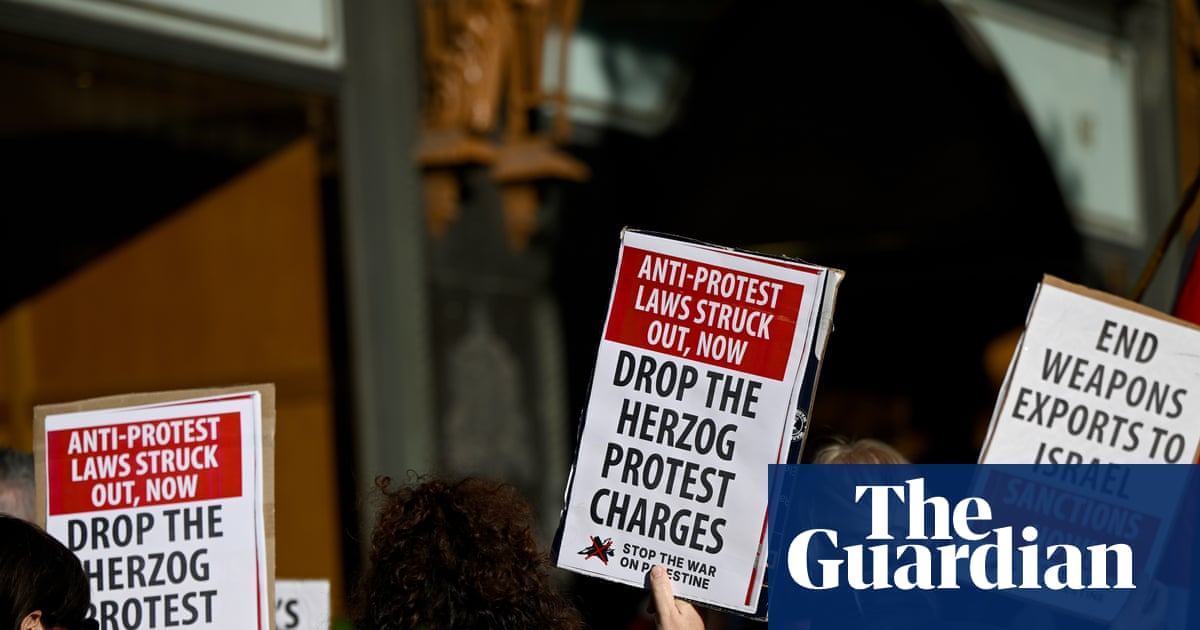
The New South Wales government has already spent hundreds of thousands of dollars on legal fees to unsuccessfully defend constitutional challenges against protest laws that were expected to be struck down.
The costs, outlined in documents obtained by Guardian Australia via freedom of information legislation, include $117,455.50 of taxpayers’ money on a single challenge to controversial public assembly restriction declaration (Pard) laws. Those laws were enacted following the Bondi beach terror attack and were in place during a now infamous rally against the Israeli president, Isaac Herzog, in February.
The state’s court of appeal struck down the laws in April after finding they impermissibly burdened the implied constitutional right to freedom of political communication. It awarded costs to the plaintiffs, three activist groups, with the total bill to the taxpayer set to rise once they are finalised.
It was the second time in six months an anti-protest law passed by the Minns government was found unconstitutional by a court, after the NSW supreme court struck down an older law that gave police expanded powers to prevent protests near places of worship. The government spent almost $96,400 on barristers and solicitors fees in that case, the documents reveal.
The law, which was reintroduced with amendments last year, caused friction during a Labor caucus meeting when it was first being legislated.
Upper house Labor MP Anthony D’Adam had moved a motion to redraft the bill so that it was limited to protests directed at a place of worship, with colleagues Stephen Lawrence and Cameron Murphy warning the current wording could be found to be unconstitutional. The premier, Chris Minns, said in March 2025 the government believed the laws were “constitutionally sound”.
Guardian Australia has also obtained NSW police’s costs over two court cases which saw them oppose “form 1” applications to authorise pro-Palestine protests on the Sydney Harbour Bridge and Opera House last year.
In the first case, which police lost, the force spent more than $91,600 on external barristers and solicitors to fight the application. Unlike the NSW government’s costs, the police figures provided to Guardian Australia do not include the cost of employing in-house legal staff.
In response to questions, a spokesperson for NSW police referred Guardian Australia to a statement made following a August 2025 protest which occurred without major incident and was attended by Minns government ministers.
“The greatest concern for police during the operation was that of a crowd crush due to the significant numbers of attendees. Police managed this situation in line with public safety,” it said.
Police spent almost $59,500 on legal fees last October opposing a planned pro-Palestine march to the Sydney Opera House, before the court of appeal sided with police against the Palestine Action Group due to “extreme” safety concerns.
In total the NSW government and police have spent at least $305,500 on cases against pro-Palestine groups heard in NSW’s highest courts – the supreme court and the court of appeal – and $87,099.29 on cases they successfully contested.
Josh Lees, organiser for the Palestine Action Group, a party to all five cases, said “this huge waste of money shows the desperate lengths has been prepared to go to, in order to rip up our democratic rights”.
after newsletter promotion
The government rushed through the Pard laws to give the police commissioner the power to issue a declaration to ban protesting in a particular area after a suspected terrorist attack.
Legal experts and civil liberties groups had raised concerns, with Anne Twomey, professor emerita in constitutional law at the University of Sydney, warning: “History tells us that anti-protest laws rushed through parliament often have an unhappy ending in the courts.”
In response to questions, a government spokesperson said Labor had “acted to protect the community, maintain social cohesion and ensure people felt safe” following the Bondi terror attack.
“These laws played an important role in ensuring there was no conflict on Sydney’s streets, including around Bondi and the CBD, during the visit of a global head of state,” they said.
The spokesperson said “while some of the challenges to these laws have been successful, others have not”, including the challenge to the government’s decision to declare a major event during Herzog’s visit.
The government also spent $27,600 on an administrative challenge brought by protesters to the use of a major events declaration before the protest against Herzog, winning the case. Activist groups have indicated they intend to appeal the decision if necessary to see charges against protesters dropped.
Read the full story at The Guardian ↗ · The Guardian ↗
New South Wales has incurred substantial legal costs defending protest restrictions introduced following the 2024 Bondi beach terror attack. The Public Assembly Restriction Declaration laws, which granted police commissioners power to ban protests in specified areas, were challenged in court and struck down by the Court of Appeal in April 2025 as impermissibly restricting the implied constitutional right to political communication. The government spent approximately $117,455 defending this case alone. A related law granting expanded police powers to restrict protests near places of worship was also found unconstitutional, costing $96,400 in legal fees. Police separately spent over $91,600 opposing a pro-Palestine protest permit application on the Sydney Harbour Bridge, which they lost, and $59,500 opposing another at the Opera House, which they won. Across five related cases heard in NSW's highest courts, total spending reached at least $305,500. The government stated these measures were necessary to maintain public safety and social cohesion. Constitutional law experts had cautioned that hastily drafted protest restrictions frequently encounter legal difficulties.
Read the full story at The Guardian ↗ · The Guardian ↗
The New South Wales government has already spent hundreds of thousands of dollars on legal fees to unsuccessfully defend constitutional challenges against protest laws that were expected to be struck down.
The costs, outlined in documents obtained by Guardian Australia via freedom of information legislation, include $117,455.50 of taxpayers’ money on a single challenge to controversial public assembly restriction declaration (Pard) laws. Those laws were enacted following the Bondi beach terror attack and were in place during a now infamous rally against the Israeli president, Isaac Herzog, in February.
The state’s court of appeal struck down the laws in April after finding they impermissibly burdened the implied constitutional right to freedom of political communication. It awarded costs to the plaintiffs, three activist groups, with the total bill to the taxpayer set to rise once they are finalised.
It was the second time in six months an anti-protest law passed by the Minns government was found unconstitutional by a court, after the NSW supreme court struck down an older law that gave police expanded powers to prevent protests near places of worship. The government spent almost $96,400 on barristers and solicitors fees in that case, the documents reveal.
The law, which was reintroduced with amendments last year, caused friction during a Labor caucus meeting when it was first being legislated.
Upper house Labor MP Anthony D’Adam had moved a motion to redraft the bill so that it was limited to protests directed at a place of worship, with colleagues Stephen Lawrence and Cameron Murphy warning the current wording could be found to be unconstitutional. The premier, Chris Minns, said in March 2025 the government believed the laws were “constitutionally sound”.
Guardian Australia has also obtained NSW police’s costs over two court cases which saw them oppose “form 1” applications to authorise pro-Palestine protests on the Sydney Harbour Bridge and Opera House last year.
In the first case, which police lost, the force spent more than $91,600 on external barristers and solicitors to fight the application. Unlike the NSW government’s costs, the police figures provided to Guardian Australia do not include the cost of employing in-house legal staff.
In response to questions, a spokesperson for NSW police referred Guardian Australia to a statement made following a August 2025 protest which occurred without major incident and was attended by Minns government ministers.
“The greatest concern for police during the operation was that of a crowd crush due to the significant numbers of attendees. Police managed this situation in line with public safety,” it said.
Police spent almost $59,500 on legal fees last October opposing a planned pro-Palestine march to the Sydney Opera House, before the court of appeal sided with police against the Palestine Action Group due to “extreme” safety concerns.
In total the NSW government and police have spent at least $305,500 on cases against pro-Palestine groups heard in NSW’s highest courts – the supreme court and the court of appeal – and $87,099.29 on cases they successfully contested.
Josh Lees, organiser for the Palestine Action Group, a party to all five cases, said “this huge waste of money shows the desperate lengths has been prepared to go to, in order to rip up our democratic rights”.
after newsletter promotion
The government rushed through the Pard laws to give the police commissioner the power to issue a declaration to ban protesting in a particular area after a suspected terrorist attack.
Legal experts and civil liberties groups had raised concerns, with Anne Twomey, professor emerita in constitutional law at the University of Sydney, warning: “History tells us that anti-protest laws rushed through parliament often have an unhappy ending in the courts.”
In response to questions, a government spokesperson said Labor had “acted to protect the community, maintain social cohesion and ensure people felt safe” following the Bondi terror attack.
“These laws played an important role in ensuring there was no conflict on Sydney’s streets, including around Bondi and the CBD, during the visit of a global head of state,” they said.
The spokesperson said “while some of the challenges to these laws have been successful, others have not”, including the challenge to the government’s decision to declare a major event during Herzog’s visit.
The government also spent $27,600 on an administrative challenge brought by protesters to the use of a major events declaration before the protest against Herzog, winning the case. Activist groups have indicated they intend to appeal the decision if necessary to see charges against protesters dropped.
Read the full story at The Guardian ↗ · The Guardian ↗
NSW has spent at least $305,500 on legal fees across cases challenging or defending protest laws in NSW's supreme and appeal courts The Public Assembly Restriction Declaration laws were struck down by the Court of Appeal in April 2025 as impermissibly burdening the implied constitutional right to freedom of political communication The government spent $117,455.50 defending the Pard laws challenge A separate law giving police expanded powers near places of worship was found unconstitutional by the NSW Supreme Court; the government spent $96,400 on that defence Police spent $91,600 opposing a pro-Palestine protest permit application at the Sydney Harbour Bridge, which they lost Police spent $59,500 opposing a pro-Palestine protest application at the Opera House, which they won on safety grounds These laws represent 'a huge waste of money' and show government desperation to 'rip up our democratic rights' The government acted to 'protect the community, maintain social cohesion and ensure people felt safe' following the Bondi terror attack History shows anti-protest laws rushed through parliament often have unhappy endings in courts
Read the full story at The Guardian ↗ · The Guardian ↗
- NSW has spent at least $305,500 defending anti-protest laws in courts, with multiple cases lost
- The Public Assembly Restriction Declaration (Pard) laws, introduced after the Bondi beach terror attack, were struck down by the Court of Appeal as unconstitutional
- Police and government spent $91,600+ opposing individual pro-Palestine protest permits, with mixed results in court
- Legal experts warned rushed anti-protest laws historically face court challenges; the government maintains they were necessary for public safety