How cow showers and fans help farmers keep cattle cool
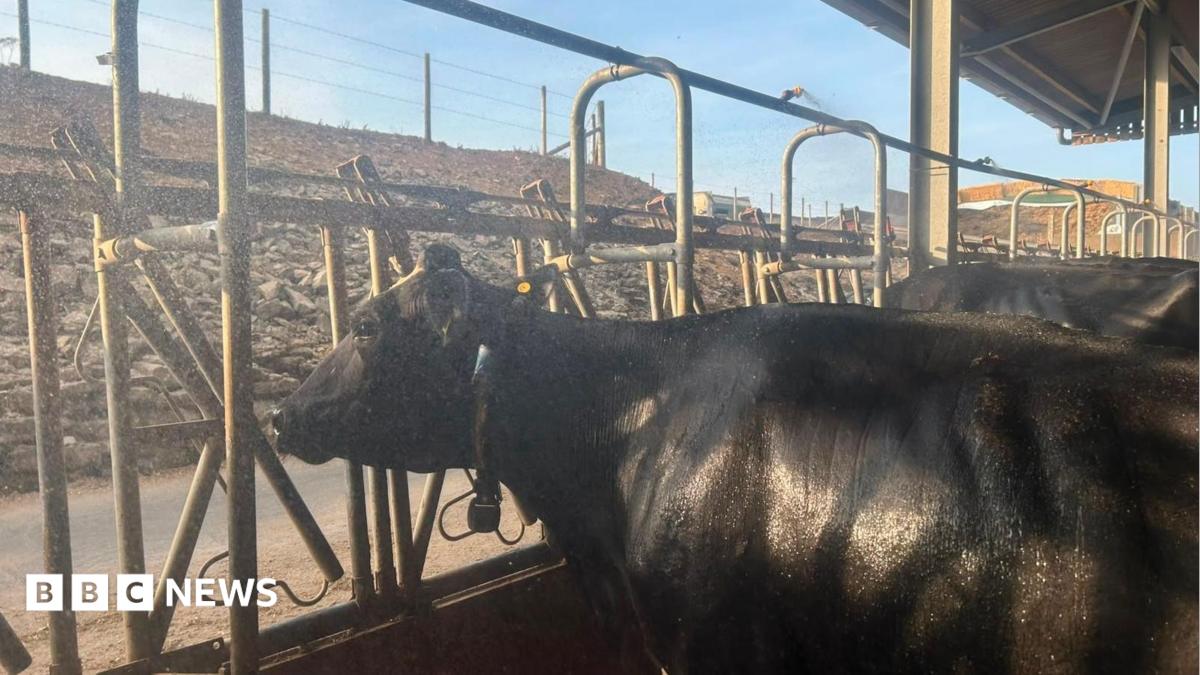
Cows at a dairy farm near Chippenham are doused with cool water to beat the heat
By
West of England business and environment correspondent
Dairy farmers are installing "cow showers" and giant cooling fans as hotter, drier summers become more common.
Extreme heat has cut milk production by up to 20% and farmers are spending thousands of pounds to keep their cattle cool and protect milk yields.
Sarah Godwin's family have invested £15,000 in a ventilation and sprinkler system at their farm near Chippenham, Wiltshire, to help their animals cope with the "nearly continuous heatwave we are living through".
Professor Nicola Cannon from the Royal Agricultural University (RAU) in Cirencester says drought-hit grassland is also forcing many farmers to use winter feed earlier than planned.
On a dairy farm near Swindon, Sam Woolford presses a switch on the wall of the milking parlour and 10 industrial-scale fans whirr into life.
"It's like a wind tunnel in here," he says.
It blows my hair back, like I'm riding a motorbike at speed.
The cows like it too, it seems, and crucially, they linger in the milking parlour, clearly cool and relaxed.
The system helps keep cattle comfortable during hot weather, but farmers say it cannot eliminate all of the effects of prolonged heat.
"Milk production is down by 20%," Prof Cannon says.
She explains that "cows feel stressed just as humans feel stressed when it's really hot and, as a response to that, their milk productivity goes down.
"So farmers are trying to help their cows, by putting in big fans, or sprinkler systems, to just try and cool animals down."
Experts say prolonged dry weather is now becoming a regular challenge for dairy farms, leaving grass scorched, cattle heat-stressed and farmers relying on winter feed months earlier than planned.
"What we used to think of as extreme weather, we increasingly consider as normal." says Mike Kendon, a climate scientist at the Met Office., external
In Somerset, farmers have described this as the worst drought in 50 years, leaving crops struggling.
"Look at this stemmy nonsense," says Woolford, holding a bunch of thin grass towards me.
"There's no leaf to it, they don't get any nutritional quality from this rubbish."
His family have farmed dairy cows just outside Swindon for five generations.
They have seen hot summers and wet ones, but now Woolford, aged 20, and his dad and grandad have noticed a permanent change in the weather.
"We're praying it's not going to become the new norm," he says.
"But it looks like it will recur.
"It's really tough. The cows don't enjoy it, we're down on milk production by 20%, we just need some rain for the grass."
"There's no nutritional value here for them," says Sam Woolford, in a field of parched grass on his family farm in Wiltshire.
"Basically, soils are parched," explains Prof Cannon.
"There's people quoting 38, 39 days without rainfall now.
"We call that 'permanent wilting point'. Grass can't rebound after grazing, or after cutting for hay or silage."
Woolford's cows still come out into the fields in the morning, but by midday they are back in the barns, sheltering from the sun and eating feedstocks that should have been saved for the winter.
Last year this was news; this year, it is standard practice across west country dairy farming.
Two of the ten big fans installed in the milking parlour to keep cows cool
Down the road near Chippenham, Godwin's family have gone a step further, installing a network of what they call 'cow showers'- sprinklers that douse the cattle with cool water.
"Farming has got very hard recently," Godwin says.
"It seems like one long heatwave this summer."
The whole system cost £15,000 and "a lot of elbow grease and hard work" to install but it is not unique.
Even ice cream producers are having a tough time.
Just north of Bath, Marshfield Farm churns out some of the West Country's best-known ice creams using milk from its own herd.
Rory Hawkins helps manage the herd that produces all the milk.
"The summers are getting hotter, which is great for the ice cream sales," he explains.
"But it affects the cows with heat stress, and we lose a lot of milk through the hotter summers now."
Hawkins, 27, is one of three children working in the family business.
Speaking to him and Woolford, aged just 20, I wonder why they would commit to a life in dairy farming.
All the Met Office experts agree that these hot summers will be more common, grass will be harder to grow, cows will need cooling down.
"You just have to get on with it," smile Lara Browne and Sam Woolford, two young dairy farmers from Wiltshire
"I love working outside, helping look after the animals," Hawkins says.
"Weather is changing, but we just have to crack on with it."
Woolford agrees it is the "variety" of farm work that keeps him interested.
On his farm, I also meet Lara Browne, whose family run a farm near Trowbridge.
"You just have to make the best of the situation, and make your farm as resilient as you can," she says.
While many in their 20s often worry about the changing climate, these young farmers seem determined just to change the way they farm, and get on with it.
"I've not got any kids," Browne says, "but I feel like I'm already farming for the next generation."
Tell us which stories we should cover in Wiltshire
Read the full story at BBC ↗
Dairy farms across England's southwest are adapting to hotter, drier summers by installing mechanical cooling systems. Heat stress reduces milk yields by approximately 20%, and prolonged drought has scorched pastures, forcing farmers to deplete winter feed stocks months ahead of schedule. Some farms have invested in sprinkler networks and industrial fans to keep cattle comfortable during milking and shelter periods. Young farmers acknowledge the permanence of these weather patterns and are restructuring their practices accordingly, though they express uncertainty about whether these conditions will become the long-term norm.
Read the full story at BBC ↗
Cows at a dairy farm near Chippenham are doused with cool water to beat the heat
By
West of England business and environment correspondent
Dairy farmers are installing "cow showers" and giant cooling fans as hotter, drier summers become more common.
Extreme heat has cut milk production by up to 20% and farmers are spending thousands of pounds to keep their cattle cool and protect milk yields.
Sarah Godwin's family have invested £15,000 in a ventilation and sprinkler system at their farm near Chippenham, Wiltshire, to help their animals cope with the "nearly continuous heatwave we are living through".
Professor Nicola Cannon from the Royal Agricultural University (RAU) in Cirencester says drought-hit grassland is also forcing many farmers to use winter feed earlier than planned.
On a dairy farm near Swindon, Sam Woolford presses a switch on the wall of the milking parlour and 10 industrial-scale fans whirr into life.
"It's like a wind tunnel in here," he says.
It blows my hair back, like I'm riding a motorbike at speed.
The cows like it too, it seems, and crucially, they linger in the milking parlour, clearly cool and relaxed.
The system helps keep cattle comfortable during hot weather, but farmers say it cannot eliminate all of the effects of prolonged heat.
"Milk production is down by 20%," Prof Cannon says.
She explains that "cows feel stressed just as humans feel stressed when it's really hot and, as a response to that, their milk productivity goes down.
"So farmers are trying to help their cows, by putting in big fans, or sprinkler systems, to just try and cool animals down."
Experts say prolonged dry weather is now becoming a regular challenge for dairy farms, leaving grass scorched, cattle heat-stressed and farmers relying on winter feed months earlier than planned.
"What we used to think of as extreme weather, we increasingly consider as normal." says Mike Kendon, a climate scientist at the Met Office., external
In Somerset, farmers have described this as the worst drought in 50 years, leaving crops struggling.
"Look at this stemmy nonsense," says Woolford, holding a bunch of thin grass towards me.
"There's no leaf to it, they don't get any nutritional quality from this rubbish."
His family have farmed dairy cows just outside Swindon for five generations.
They have seen hot summers and wet ones, but now Woolford, aged 20, and his dad and grandad have noticed a permanent change in the weather.
"We're praying it's not going to become the new norm," he says.
"But it looks like it will recur.
"It's really tough. The cows don't enjoy it, we're down on milk production by 20%, we just need some rain for the grass."
"There's no nutritional value here for them," says Sam Woolford, in a field of parched grass on his family farm in Wiltshire.
"Basically, soils are parched," explains Prof Cannon.
"There's people quoting 38, 39 days without rainfall now.
"We call that 'permanent wilting point'. Grass can't rebound after grazing, or after cutting for hay or silage."
Woolford's cows still come out into the fields in the morning, but by midday they are back in the barns, sheltering from the sun and eating feedstocks that should have been saved for the winter.
Last year this was news; this year, it is standard practice across west country dairy farming.
Two of the ten big fans installed in the milking parlour to keep cows cool
Down the road near Chippenham, Godwin's family have gone a step further, installing a network of what they call 'cow showers'- sprinklers that douse the cattle with cool water.
"Farming has got very hard recently," Godwin says.
"It seems like one long heatwave this summer."
The whole system cost £15,000 and "a lot of elbow grease and hard work" to install but it is not unique.
Even ice cream producers are having a tough time.
Just north of Bath, Marshfield Farm churns out some of the West Country's best-known ice creams using milk from its own herd.
Rory Hawkins helps manage the herd that produces all the milk.
"The summers are getting hotter, which is great for the ice cream sales," he explains.
"But it affects the cows with heat stress, and we lose a lot of milk through the hotter summers now."
Hawkins, 27, is one of three children working in the family business.
Speaking to him and Woolford, aged just 20, I wonder why they would commit to a life in dairy farming.
All the Met Office experts agree that these hot summers will be more common, grass will be harder to grow, cows will need cooling down.
"You just have to get on with it," smile Lara Browne and Sam Woolford, two young dairy farmers from Wiltshire
"I love working outside, helping look after the animals," Hawkins says.
"Weather is changing, but we just have to crack on with it."
Woolford agrees it is the "variety" of farm work that keeps him interested.
On his farm, I also meet Lara Browne, whose family run a farm near Trowbridge.
"You just have to make the best of the situation, and make your farm as resilient as you can," she says.
While many in their 20s often worry about the changing climate, these young farmers seem determined just to change the way they farm, and get on with it.
"I've not got any kids," Browne says, "but I feel like I'm already farming for the next generation."
Tell us which stories we should cover in Wiltshire
Read the full story at BBC ↗
Dairy farms near Chippenham and Swindon have installed cooling systems including sprinklers and fans costing around £15,000 Heat stress has reduced milk production by up to 20% on affected farms Grassland drought has forced farmers to use winter feed supplies earlier than planned Met Office climate scientists report 38–39 days without rainfall in some areas, reaching 'permanent wilting point' where grass cannot recover Young farmers describe the shift as permanent and are restructuring their operations accordingly What was once considered extreme weather is increasingly becoming normal practice Young farmers in the region express determination to adapt rather than concern about climate change impacts
Read the full story at BBC ↗
- UK dairy farmers are installing cooling systems (fans and sprinklers) to mitigate heat stress in cattle, with some farms investing £15,000 in infrastructure
- Extreme heat has reduced milk production by up to 20% and forced farmers to use winter feed supplies earlier than usual due to drought-damaged grassland
- Prolonged dry weather is becoming regular rather than exceptional, with climate scientists noting what was once considered extreme is now standard