‘It’s all right for them’: private schools and golf courses stay green despite England’s hosepipe bans
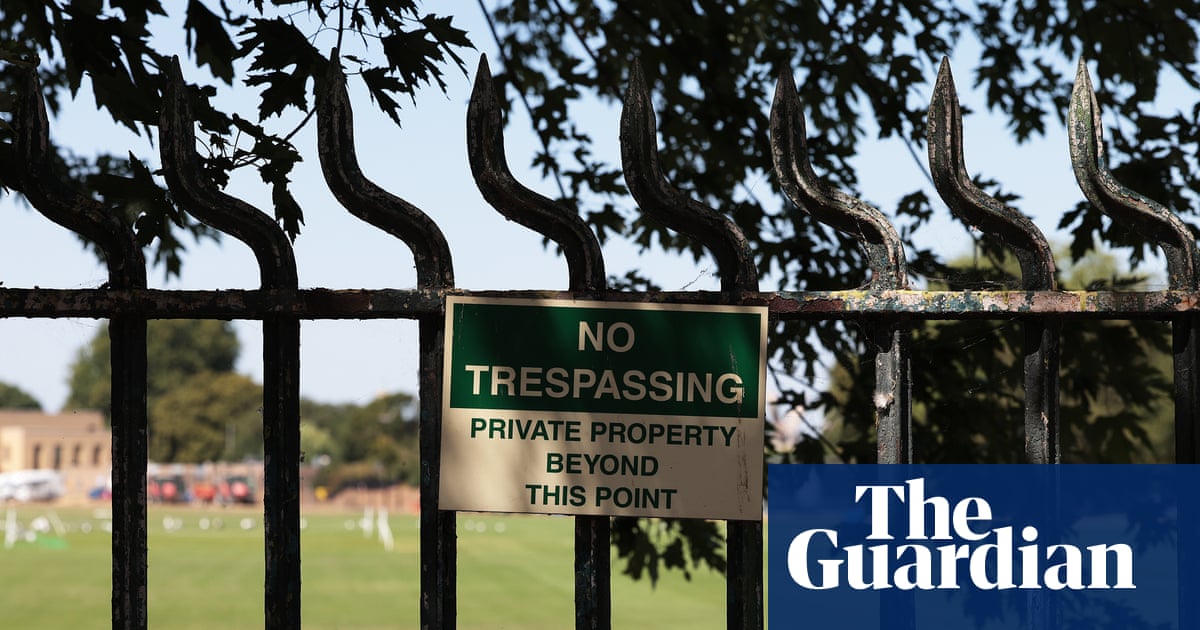
After multiple punishing heatwaves, and no rain in parts for over a month, it seems the whole of the south of England is golden brown.
But by Hammersmith Bridge in Barnes, south-west London, there is the unmistakable scent of damp soil. The playing fields of St Paul’s school, where fees are up to £57,000 a year, are a bright, lush green.
The neatly trimmed grass, with water droplets clinging to each blade, looks like a mirage in the otherwise parched landscape. It has been a shock to appalled residents, who are under a hosepipe ban and have to let their own lawns die.
In England, 40% of the population is under a hosepipe ban, with seven water companies – Affinity Water, Anglian Water, Cambridge Water, Southern Water, South East Water, Thames Water and South West Water – all restricting use. But there are exemptions for golf courses, sports pitches and school playing fields, meaning there are pockets of green while the vegetation in the public parks dies.
It seems the bans came too late; the lack of water across the country means half of England is now in drought. This is despite the fact some parts of the country had the wettest start to the year on record.
Elsewhere in south-west London, families were desperately trying to keep their children cool during school holidays. Young children could be seen huddled under trees in the shade on Tooting Bec Common, which has been scorched by the sun to the extent that the grass has died, leaving bare, hard soil.
Parents with young children are unable to fill paddling pools to keep them cool, as temperatures have hit 30C or above on 24 separate occasions so far this summer.
The school, despite being closed for the summer, is allowed to keep its lawns verdant because of a loophole that allows schools to water their pitches for “health and safety” reasons.
“They should be under the same rules as the rest of us,” says 62-year-old Steve Barker, who was stopping to mop his brow while on a walk along the Thames. “Why are they watering the playing fields when they aren’t even using them? It isn’t term-time!
“It definitely looks better than my grass – I’ve had to let it die, and it is probably too late to save it now. They must be using a lot of water to keep it all so green.”
While the contrast between the lush green of St Paul’s and the withering hydrangeas of the local community gardens is sharp, it is by no means unique: similar tensions are at play across swathes of the south. On the coast of Sandwich Bay in Kent, there are patches of bright green among the parched heathland. This is the Royal St George’s Golf Club, which hosts the Open Championship. The exclusive club allows membership only by recommendation by other members.
Visitors can attend on some occasions throughout the year for about £400 a day. South East Water customers in the county are under a hosepipe ban, and the parks in Kent have gone brown.
Dulwich College in south London, the £67,000-a-year school that counts Nigel Farage among its alumni, has also been keeping its acres of sports pitches lush and green, using powerful sprinklers. The school has said it is “using water as conservatively as possible”.
It broke up for summer earlier this month, but continues to keep its sports pitches well watered. The community gardens in nearby Brockwell Park, however, cannot be properly watered.
That pattern has intensified calls for a change in the water system, to iron out these inequalities and stop the need for as many hosepipe bans. Helena Dollimore, the Labour MP for Hastings and Rye, said: “Hosepipe ban exemptions for golf courses and private school sports pitches symbolise everything wrong with our water system. How can it be right that a private school can use hundreds of litres of water to keep the grass green in the middle of the summer holidays, but children cannot play in their paddling pools?
“These are the consequences of consecutive Conservative governments selling off our most precious resource to create a system that benefits shareholders. All the while my constituents in Hastings, Rye and the villages suffer water outages year on year due to decades of underinvestment in our pipes and infrastructure. It cannot be one rule for them and another for everybody else.”
Cat Hobbs, founder and director of the campaign group We Own It, said the inequality was “shocking”. She added: “Private school playing fields are staying lush and green while everywhere else, flowers wilt, parks go brown and kids can’t stay cool in the padding pool.”
Hobbs thinks that “public ownership is crucial to manage our water properly, cut leaks and stop unfair exemptions like this”.
In Barnes, anger at the private school’s green lawns has reached fever pitch. The school is hurriedly writing a letter to its neighbours to explain why the water is being used. Danielle Pierce, the estates manager, said: “We are watering our sports pitches, not the wider grounds, in line with Thames Water’s published guidance. This water comes from a dedicated standpipe and is not mains drinking water. We’re also preparing a short note for local residents, going out this afternoon, which covers the same points.”
Barker said: “The parks are all yellow and dry, too – they aren’t allowed to break the hosepipe ban even though more people use them.”
At some community gardens in the area, the plants are suffering as they cannot be watered with a hosepipe, requiring those who tend them to make multiple trips with a watering can.
Julith Jedamus, a writer and editor who lives in the area, helps tend a community garden. “It is very tough on the trees and non-perennials,” she said. “Our garden is going very brown. I have been using a watering can for the hydrangeas, which have been suffering.”
She seemed disgusted by the water use at the school, where snaking pipes of irrigation systems can be seen crisscrossing the grounds. “What annoys me is schools like St Paul’s can water their grass all year long, even now when school is not in session.”
One passing man shouted out: “It’s all right for them!” while gesturing at the green playing fields. Of his garden he said: “It’s not dead quite yet, but it’s getting there.”
Scientists have said that allowing golf courses and playing fields to remain lush and green can undermine efforts to encourage households to save water.
Prof Hannah Cloke, a natural hazards researcher at the University of Reading, said: “I would hope green keepers and grounds staff follow best advice about when to water, only watering areas that they need to. It does seem crazy to sprinkle drinking water over sports pitches that don’t need it, when others are facing severe shortages.”
Read the full story at The Guardian ↗
As parks turn brown and paddling pools go unfilled, exemptions mean sports pitches can stay lush – even in school holidays. After multiple punishing heatwaves, and no rain in…
This lens runs the verified story through Cinnamon's AI — wired in the next step.
After multiple punishing heatwaves, and no rain in parts for over a month, it seems the whole of the south of England is golden brown.
But by Hammersmith Bridge in Barnes, south-west London, there is the unmistakable scent of damp soil. The playing fields of St Paul’s school, where fees are up to £57,000 a year, are a bright, lush green.
The neatly trimmed grass, with water droplets clinging to each blade, looks like a mirage in the otherwise parched landscape. It has been a shock to appalled residents, who are under a hosepipe ban and have to let their own lawns die.
In England, 40% of the population is under a hosepipe ban, with seven water companies – Affinity Water, Anglian Water, Cambridge Water, Southern Water, South East Water, Thames Water and South West Water – all restricting use. But there are exemptions for golf courses, sports pitches and school playing fields, meaning there are pockets of green while the vegetation in the public parks dies.
It seems the bans came too late; the lack of water across the country means half of England is now in drought. This is despite the fact some parts of the country had the wettest start to the year on record.
Elsewhere in south-west London, families were desperately trying to keep their children cool during school holidays. Young children could be seen huddled under trees in the shade on Tooting Bec Common, which has been scorched by the sun to the extent that the grass has died, leaving bare, hard soil.
Parents with young children are unable to fill paddling pools to keep them cool, as temperatures have hit 30C or above on 24 separate occasions so far this summer.
The school, despite being closed for the summer, is allowed to keep its lawns verdant because of a loophole that allows schools to water their pitches for “health and safety” reasons.
“They should be under the same rules as the rest of us,” says 62-year-old Steve Barker, who was stopping to mop his brow while on a walk along the Thames. “Why are they watering the playing fields when they aren’t even using them? It isn’t term-time!
“It definitely looks better than my grass – I’ve had to let it die, and it is probably too late to save it now. They must be using a lot of water to keep it all so green.”
While the contrast between the lush green of St Paul’s and the withering hydrangeas of the local community gardens is sharp, it is by no means unique: similar tensions are at play across swathes of the south. On the coast of Sandwich Bay in Kent, there are patches of bright green among the parched heathland. This is the Royal St George’s Golf Club, which hosts the Open Championship. The exclusive club allows membership only by recommendation by other members.
Visitors can attend on some occasions throughout the year for about £400 a day. South East Water customers in the county are under a hosepipe ban, and the parks in Kent have gone brown.
Dulwich College in south London, the £67,000-a-year school that counts Nigel Farage among its alumni, has also been keeping its acres of sports pitches lush and green, using powerful sprinklers. The school has said it is “using water as conservatively as possible”.
It broke up for summer earlier this month, but continues to keep its sports pitches well watered. The community gardens in nearby Brockwell Park, however, cannot be properly watered.
That pattern has intensified calls for a change in the water system, to iron out these inequalities and stop the need for as many hosepipe bans. Helena Dollimore, the Labour MP for Hastings and Rye, said: “Hosepipe ban exemptions for golf courses and private school sports pitches symbolise everything wrong with our water system. How can it be right that a private school can use hundreds of litres of water to keep the grass green in the middle of the summer holidays, but children cannot play in their paddling pools?
“These are the consequences of consecutive Conservative governments selling off our most precious resource to create a system that benefits shareholders. All the while my constituents in Hastings, Rye and the villages suffer water outages year on year due to decades of underinvestment in our pipes and infrastructure. It cannot be one rule for them and another for everybody else.”
Cat Hobbs, founder and director of the campaign group We Own It, said the inequality was “shocking”. She added: “Private school playing fields are staying lush and green while everywhere else, flowers wilt, parks go brown and kids can’t stay cool in the padding pool.”
Hobbs thinks that “public ownership is crucial to manage our water properly, cut leaks and stop unfair exemptions like this”.
In Barnes, anger at the private school’s green lawns has reached fever pitch. The school is hurriedly writing a letter to its neighbours to explain why the water is being used. Danielle Pierce, the estates manager, said: “We are watering our sports pitches, not the wider grounds, in line with Thames Water’s published guidance. This water comes from a dedicated standpipe and is not mains drinking water. We’re also preparing a short note for local residents, going out this afternoon, which covers the same points.”
Barker said: “The parks are all yellow and dry, too – they aren’t allowed to break the hosepipe ban even though more people use them.”
At some community gardens in the area, the plants are suffering as they cannot be watered with a hosepipe, requiring those who tend them to make multiple trips with a watering can.
Julith Jedamus, a writer and editor who lives in the area, helps tend a community garden. “It is very tough on the trees and non-perennials,” she said. “Our garden is going very brown. I have been using a watering can for the hydrangeas, which have been suffering.”
She seemed disgusted by the water use at the school, where snaking pipes of irrigation systems can be seen crisscrossing the grounds. “What annoys me is schools like St Paul’s can water their grass all year long, even now when school is not in session.”
One passing man shouted out: “It’s all right for them!” while gesturing at the green playing fields. Of his garden he said: “It’s not dead quite yet, but it’s getting there.”
Scientists have said that allowing golf courses and playing fields to remain lush and green can undermine efforts to encourage households to save water.
Prof Hannah Cloke, a natural hazards researcher at the University of Reading, said: “I would hope green keepers and grounds staff follow best advice about when to water, only watering areas that they need to. It does seem crazy to sprinkle drinking water over sports pitches that don’t need it, when others are facing severe shortages.”
Read the full story at The Guardian ↗
After multiple punishing heatwaves, and no rain in parts for over a month, it seems the whole of the south of England is golden brown.
But by Hammersmith Bridge in Barnes, south-west London, there is the unmistakable scent of damp soil. The playing fields of St Paul’s school, where fees are up to £57,000 a year, are a bright, lush green.
The neatly trimmed grass, with water droplets clinging to each blade, looks like a mirage in the otherwise parched landscape. It has been a shock to appalled residents, who are under a hosepipe ban and have to let their own lawns die.
In England, 40% of the population is under a hosepipe ban, with seven water companies – Affinity Water, Anglian Water, Cambridge Water, Southern Water, South East Water, Thames Water and South West Water – all restricting use. But there are exemptions for golf courses, sports pitches and school playing fields, meaning there are pockets of green while the vegetation in the public parks dies.
It seems the bans came too late; the lack of water across the country means half of England is now in drought. This is despite the fact some parts of the country had the wettest start to the year on record.
Elsewhere in south-west London, families were desperately trying to keep their children cool during school holidays. Young children could be seen huddled under trees in the shade on Tooting Bec Common, which has been scorched by the sun to the extent that the grass has died, leaving bare, hard soil.
Parents with young children are unable to fill paddling pools to keep them cool, as temperatures have hit 30C or above on 24 separate occasions so far this summer.
The school, despite being closed for the summer, is allowed to keep its lawns verdant because of a loophole that allows schools to water their pitches for “health and safety” reasons.
“They should be under the same rules as the rest of us,” says 62-year-old Steve Barker, who was stopping to mop his brow while on a walk along the Thames. “Why are they watering the playing fields when they aren’t even using them? It isn’t term-time!
“It definitely looks better than my grass – I’ve had to let it die, and it is probably too late to save it now. They must be using a lot of water to keep it all so green.”
While the contrast between the lush green of St Paul’s and the withering hydrangeas of the local community gardens is sharp, it is by no means unique: similar tensions are at play across swathes of the south. On the coast of Sandwich Bay in Kent, there are patches of bright green among the parched heathland. This is the Royal St George’s Golf Club, which hosts the Open Championship. The exclusive club allows membership only by recommendation by other members.
Visitors can attend on some occasions throughout the year for about £400 a day. South East Water customers in the county are under a hosepipe ban, and the parks in Kent have gone brown.
Dulwich College in south London, the £67,000-a-year school that counts Nigel Farage among its alumni, has also been keeping its acres of sports pitches lush and green, using powerful sprinklers. The school has said it is “using water as conservatively as possible”.
It broke up for summer earlier this month, but continues to keep its sports pitches well watered. The community gardens in nearby Brockwell Park, however, cannot be properly watered.
That pattern has intensified calls for a change in the water system, to iron out these inequalities and stop the need for as many hosepipe bans. Helena Dollimore, the Labour MP for Hastings and Rye, said: “Hosepipe ban exemptions for golf courses and private school sports pitches symbolise everything wrong with our water system. How can it be right that a private school can use hundreds of litres of water to keep the grass green in the middle of the summer holidays, but children cannot play in their paddling pools?
“These are the consequences of consecutive Conservative governments selling off our most precious resource to create a system that benefits shareholders. All the while my constituents in Hastings, Rye and the villages suffer water outages year on year due to decades of underinvestment in our pipes and infrastructure. It cannot be one rule for them and another for everybody else.”
Cat Hobbs, founder and director of the campaign group We Own It, said the inequality was “shocking”. She added: “Private school playing fields are staying lush and green while everywhere else, flowers wilt, parks go brown and kids can’t stay cool in the padding pool.”
Hobbs thinks that “public ownership is crucial to manage our water properly, cut leaks and stop unfair exemptions like this”.
In Barnes, anger at the private school’s green lawns has reached fever pitch. The school is hurriedly writing a letter to its neighbours to explain why the water is being used. Danielle Pierce, the estates manager, said: “We are watering our sports pitches, not the wider grounds, in line with Thames Water’s published guidance. This water comes from a dedicated standpipe and is not mains drinking water. We’re also preparing a short note for local residents, going out this afternoon, which covers the same points.”
Barker said: “The parks are all yellow and dry, too – they aren’t allowed to break the hosepipe ban even though more people use them.”
At some community gardens in the area, the plants are suffering as they cannot be watered with a hosepipe, requiring those who tend them to make multiple trips with a watering can.
Julith Jedamus, a writer and editor who lives in the area, helps tend a community garden. “It is very tough on the trees and non-perennials,” she said. “Our garden is going very brown. I have been using a watering can for the hydrangeas, which have been suffering.”
She seemed disgusted by the water use at the school, where snaking pipes of irrigation systems can be seen crisscrossing the grounds. “What annoys me is schools like St Paul’s can water their grass all year long, even now when school is not in session.”
One passing man shouted out: “It’s all right for them!” while gesturing at the green playing fields. Of his garden he said: “It’s not dead quite yet, but it’s getting there.”
Scientists have said that allowing golf courses and playing fields to remain lush and green can undermine efforts to encourage households to save water.
Prof Hannah Cloke, a natural hazards researcher at the University of Reading, said: “I would hope green keepers and grounds staff follow best advice about when to water, only watering areas that they need to. It does seem crazy to sprinkle drinking water over sports pitches that don’t need it, when others are facing severe shortages.”
Read the full story at The Guardian ↗
This lens runs the verified story through Cinnamon's AI — wired in the next step.
- As parks turn brown and paddling pools go unfilled, exemptions mean sports pitches can stay lush – even in school holidays.
- After multiple punishing heatwaves, and no rain in…