Monday briefing: How the Cockroach protests have exposed the cracks in India’s government
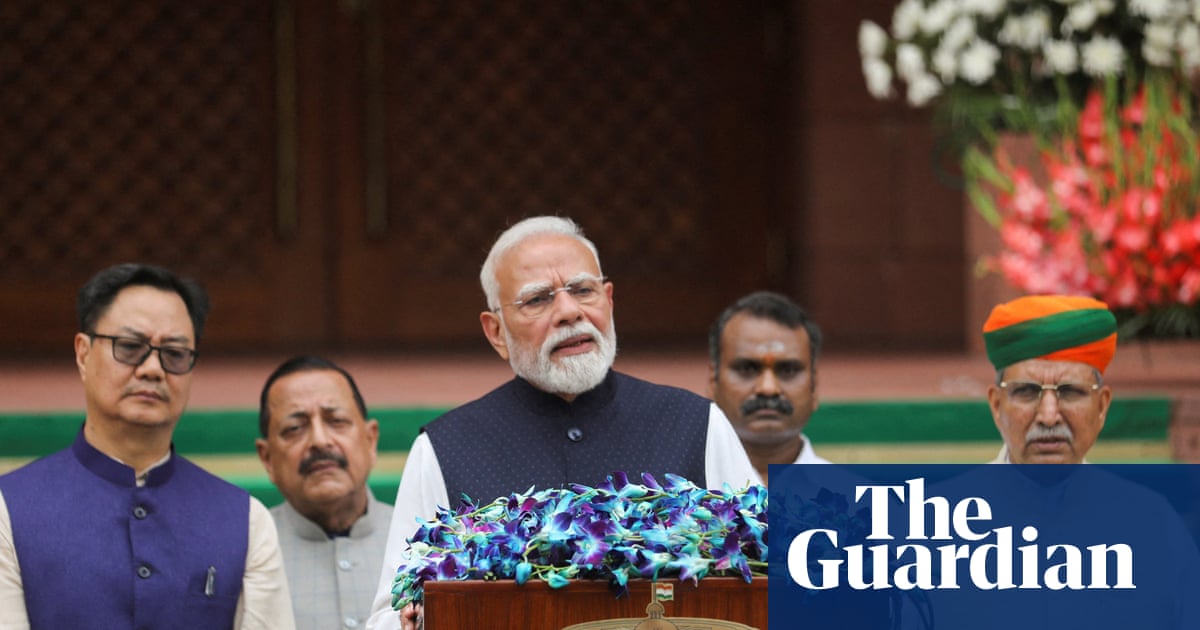
Good morning. As flames engulfed parts of France and Spain this weekend, in India, the prime minister, Narendra Modi, was trying to put out a very different kind of fire. Thousands of people arrived in Delhi on Saturday to demand the resignation of his education minister, Dharmendra Pradhan. When he stepped down in the early afternoon, the protests turned into a triumphant block party.
But the Cockroach protests that have swept through India this summer are about much more than a single minister. They have humiliated Modi and undermined the indomitable power of his Bharatiya Janata party (BJP) that has ruled India for the past 12 years. They’re also a lesson in using humour to political advantage.
Modi likes to present himself as an infallible messiah, but young people have mocked the prime minister online and in the streets, calling him a “56-inch monkey” (a reference to Modi boasting about his ample 56-inch chest), and parodied his social media addresses. “Hating Modi is cool on the internet now, after years of criminalising dissent,” one told a reporter.
Now the protesters have secured a victory, will their calls for revolution continue? For this morning’s newsletter, I spoke to our south Asia correspondent Hannah Ellis-Petersen, who has been reporting on the “Cockroaches” in Delhi, about what their anger stems from and what it means for the BJP. That’s after a roundup of the biggest stories of the weekend.
Wild fires | Authorities in France battled to contain a huge wildfire near Bordeaux in the south-west as Spain’s prime minister, Pedro Sánchez, warned Spain and the Iberian peninsula were suffering the effects of the climate emergency.
Germany | A man suspected of driving a van into a crowd near Berlin’s Pride festival then going on a knife rampage in an Islamist terror attack has been shot dead by police, German officials have said.
Iran | The US has paused strikes on Iran for a second night as top military officials advised Donald Trump to halt his bombing campaign, and diplomatic negotiations have continued to avoid a return to all-out war.
UK politics | Britain’s foreign secretary, Ed Miliband, is to indicate he will put the climate crisis and overseas development at the heart of UK international relations by taking up the country’s seat on the board at the World Bank.
UK news | Five Palestine Action activists face being sentenced as terrorists for breaking windows and throwing red paint at a branch of Barclays Bank in Lancashire.
It started as a sardonic joke. On 16 May, Abhijeet Dipke, an Indian student at Boston University, posted on X: “What if all cockroaches come together?” It was a tongue-in-cheek response to India’s chief justice, who had called unemployed young Indians “cockroaches”. Online, thousands of people responded to Dipke’s message. Realising he had tapped into something big, Dipke flew to Delhi on 6 June and went to Jantar Mantar, its famous protest ground.
The protests drew young people from across the country, and the Cockroach Janta party (CJP) – a play on the BJP’s name – created a website listing their demands, including reform of India’s education system. India has a young population who are better educated than ever before, but it has proven a weak point for the BJP, with the country’s universities crumbling and its economy failing to provide jobs for many graduates. Millions of young people spend years prepping for gruelling public exams in the hope of securing a decent job, and their parents go into debt or sell their land to fund these studies.
To make matters worse, these exam papers are routinely leaked and sold to the highest bidder. “Anyone rich enough can buy the answers,” Hannah tells me. This is devastating for millions of young people, forcing them to retake tests for which they’ve already studied. After a medical entrance exam was leaked in May, at least 12 students took their own lives; some left notes behind saying they could not bear the thought of resitting the test. The leaks are a potent symbol of institutional corruption, inflaming the anger that young people feel towards a political system that is failing them.
Thief, thief
Sonam Wangchuk, an engineer and education reformer from Ladakh, joined the protest on 28 June and declared he would go on indefinite hunger strike until the education minister resigned. “The idea of a hunger strike has a particularly powerful resonance in India,” says Hannah. “Gandhi put his life on the line several times with his hunger strikes for independence.”
Delhi police forcibly removed Wangchuk from Jantar Mantar on 18 July and took him to hospital, supposedly for the sake of his health. Footage of his hospital stay went viral, and the Cockroach party called for a march on parliament. On Monday, tens of thousands of people started to fill Delhi’s streets. “In my whole time covering India, I’ve never seen so many people turning out,” Hannah says. The mood was jubilant, but by the afternoon, things had turned violent as the police began firing teargas and using batons on the protesters.
Despite that, many of the protesters stayed put, and Hannah went back to Jantar Mantar in the following days. “It was the place to be in India,” she says. “There were people camping out, delivery guys bringing pizza and biryani, people cooking food. It had become about more than just the education minister resigning. More, even than education.”
The protesters’ very public displays of contempt – graffiti of Modi’s name under the image of a urinating dog; people stamping on a poster of his face and chanting “thief, thief” – would have seemed unimaginable just two weeks ago. “People were just revelling in the opportunity to speak their mind,” Rahul Bhatia, a writer and author of The New India, who attended the protests on Saturday, tells me. “It was delightful. It made people think: things are possible.”
Modi lost control of the narrative
Pradhan’s resignation is a major victory for the Cockroach protesters. He is a Modi loyalist and former organiser for the RSS, the Hindu supremacist group closely affiliated with the BJP (for more on its sinister ideology, it’s worth reading this fascinating 2020 piece by Samanth Subramanian). “It creates a crack in the BJP’s armour,” Hannah says. Modi has projected an image of total authority, but this is one of the first instances where he has bent to popular will. He demands unflinching loyalty from his ministers. They may now be questioning whether their positions are quite as secure as they thought.
India has taken a sharp turn towards autocracy under the BJP. Its main media channels are controlled by (or intensely favourable to) the government, and most of them gave minimal coverage to the protests, so young people resorted to sharing information and anti-government memes on social media. The party is no stranger to social media (its “troll army” is adept at smearing digital opponents, and the government tried to shut down the Cockroach party’s X account in early July), but it has lost control of the narrative.
Modi’s last-ditch attempt to engage protesters with two reels he posted to his then 101 million Instagram followers on Thursday night (after which he gained over 1 million more, an impressive number, though still fewer than Beyoncé’s 299 million) seemed contrived and stilted. “He has been crucified online for those videos,” Hannah says.
Is this the start of something bigger?
It’s tempting to compare the Cockroach protests to other youth uprisings that have led to regime change in south Asia. But “a quick look at the outcome of people’s movements in India is not encouraging,” the novelist Arundhati Roy wrote in a recent piece for Equator magazine. “Revenge is surely being planned and will be visited on those [the government] sees as the main instigators.” After people took to the streets in 2019 to protest against the BJP’s controversial new citizenship act, the government swiftly outlawed gatherings in several places and detained protesters.
The real test of the BJP’s power will come at election time. It is one of the world’s richest and most formidable parties, and has attempted to capture India’s electoral machinery, pushing for reforms to its voting map that would tilt power further in Modi’s favour. In West Bengal, a state the BJP had never won before, it “revised” the electoral roll and excluded more than 9.1 million voters from the register, securing a decisive victory earlier this year.
“It seems like the BJP has much less support than people actually think,” Bhatia says. But after these protests, Modi will be doing all that he can to maintain his party’s grip on power.
Monday | Andrew and Tristan Tate are due back in the Florida court where they’re fighting their extradition to the UK, to face rape and sex-trafficking charges.
Tuesday | Donald Trump and Volodymyr Zelenskyy are expected to be among those attending the Washington DC memorial service for the late South Carolina senator and Trump ally Lindsey Graham.
Thursday | People will go to the polls to elect the next mayor of Greater Manchester, who will replace Andy Burnham.
To enshittification, we can now add the idea of decadence without pleasure: “For anyone with an Internet connection and a little discretionary income, the contemporary moment offers a superabundance of seductive distractions. Why then the pervasive mood of emptiness?” Truly, what a time to be alive. Toby Moses, head of newsletters
The world is approaching “plutocratic collapse”. That’s the view of the French economist Gabriel Zucman, and I’m inclined to agree. I enjoyed Will Dunn’s recent profile of him in the New Statesman (£). Hettie
Add shingles to the long list of things millennial women need to worry about – Emily Retter has looked at why the excruciating disease is on the rise. Toby
after newsletter promotion
Tour de France | Tadej Pogacar took a record-equalling fifth win in the Tour de France on Sunday, joining the all-time greats, as Mathieu van der Poel won a frantic final stage in Paris.
Commonwealth Games | Adam Ramsay-Peaty is ready to bounce back after his 100m breaststroke bronze at the Commonwealth Games. He said: “The last 24 hours have been a bit of a whirlwind, but I’m really happy with that.”
Formula One | Lando Norris won the Hungarian Grand Prix with an assured drive for McLaren at the Hungaroring, his and the team’s first victory of the year.
“Miliband vows to give UK ‘global leadership’ role on climate crisis”, is the Guardian’s front page today.
The Times says “Teen anxiety pays more than job”, and the Telegraph also has “PM to crack down on youth benefits”. Still on politics, The Mail goes with “Streeting: I will quit if defence plan falls short”, the i Paper says “Council tax and stamp duty to be scrapped under Burnham plans”, and the Express splashes “Police ‘waste’ millions on diversity schemes”.
The FT splashes “Biggest defence companies home in on start-ups for nimbler military tech”, and the Mirror leads with its water safety campaign, saying “No child should die for a day at the seaside”. Lastly, Metro splashes “Fly and dry” on Gatwick’s water outage.
How Palantir got into the NHS
Investigative journalist, Lucas Amin, reports on how the tech company Palantir won a £330m contract with the NHS … and what happened once its software was introduced.
A bit of good news to remind you that the world’s not all bad
Restricting eating to a nine‑hour window and avoiding food for four hours before sleep may improve cognitive health in older adults. In a six‑month trial of 47 women who were considered overweight or obese, both groups lost similar weight, but those following time‑restricted eating performed better on spatial planning and problem‑solving tests, with hints of improved memory.
Researchers suggest circadian rhythms, metabolism and inflammation may play a role. Experts stress the findings are preliminary and require larger, peer‑reviewed studies.
Prof Wendy Hall, the head of nutritional sciences at King’s College London, said: “Time-restricted eating is a plausible approach to supporting cognitive health in midlife”.
Sign up here for a weekly roundup of The Upside, sent to you every Sunday
And finally, the Guardian’s puzzles are here to keep you entertained throughout the day. Until tomorrow.
Quick crossword
Cryptic crossword
Wordiply
Read the full story at The Guardian ↗
In today’s newsletter: Across the country, a younger generation is turning private disillusionment into public defiance against a government that once felt untouchable. Good…
This lens runs the verified story through Cinnamon's AI — wired in the next step.
Good morning. As flames engulfed parts of France and Spain this weekend, in India, the prime minister, Narendra Modi, was trying to put out a very different kind of fire. Thousands of people arrived in Delhi on Saturday to demand the resignation of his education minister, Dharmendra Pradhan. When he stepped down in the early afternoon, the protests turned into a triumphant block party.
But the Cockroach protests that have swept through India this summer are about much more than a single minister. They have humiliated Modi and undermined the indomitable power of his Bharatiya Janata party (BJP) that has ruled India for the past 12 years. They’re also a lesson in using humour to political advantage.
Modi likes to present himself as an infallible messiah, but young people have mocked the prime minister online and in the streets, calling him a “56-inch monkey” (a reference to Modi boasting about his ample 56-inch chest), and parodied his social media addresses. “Hating Modi is cool on the internet now, after years of criminalising dissent,” one told a reporter.
Now the protesters have secured a victory, will their calls for revolution continue? For this morning’s newsletter, I spoke to our south Asia correspondent Hannah Ellis-Petersen, who has been reporting on the “Cockroaches” in Delhi, about what their anger stems from and what it means for the BJP. That’s after a roundup of the biggest stories of the weekend.
Wild fires | Authorities in France battled to contain a huge wildfire near Bordeaux in the south-west as Spain’s prime minister, Pedro Sánchez, warned Spain and the Iberian peninsula were suffering the effects of the climate emergency.
Germany | A man suspected of driving a van into a crowd near Berlin’s Pride festival then going on a knife rampage in an Islamist terror attack has been shot dead by police, German officials have said.
Iran | The US has paused strikes on Iran for a second night as top military officials advised Donald Trump to halt his bombing campaign, and diplomatic negotiations have continued to avoid a return to all-out war.
UK politics | Britain’s foreign secretary, Ed Miliband, is to indicate he will put the climate crisis and overseas development at the heart of UK international relations by taking up the country’s seat on the board at the World Bank.
UK news | Five Palestine Action activists face being sentenced as terrorists for breaking windows and throwing red paint at a branch of Barclays Bank in Lancashire.
It started as a sardonic joke. On 16 May, Abhijeet Dipke, an Indian student at Boston University, posted on X: “What if all cockroaches come together?” It was a tongue-in-cheek response to India’s chief justice, who had called unemployed young Indians “cockroaches”. Online, thousands of people responded to Dipke’s message. Realising he had tapped into something big, Dipke flew to Delhi on 6 June and went to Jantar Mantar, its famous protest ground.
The protests drew young people from across the country, and the Cockroach Janta party (CJP) – a play on the BJP’s name – created a website listing their demands, including reform of India’s education system. India has a young population who are better educated than ever before, but it has proven a weak point for the BJP, with the country’s universities crumbling and its economy failing to provide jobs for many graduates. Millions of young people spend years prepping for gruelling public exams in the hope of securing a decent job, and their parents go into debt or sell their land to fund these studies.
To make matters worse, these exam papers are routinely leaked and sold to the highest bidder. “Anyone rich enough can buy the answers,” Hannah tells me. This is devastating for millions of young people, forcing them to retake tests for which they’ve already studied. After a medical entrance exam was leaked in May, at least 12 students took their own lives; some left notes behind saying they could not bear the thought of resitting the test. The leaks are a potent symbol of institutional corruption, inflaming the anger that young people feel towards a political system that is failing them.
Thief, thief
Sonam Wangchuk, an engineer and education reformer from Ladakh, joined the protest on 28 June and declared he would go on indefinite hunger strike until the education minister resigned. “The idea of a hunger strike has a particularly powerful resonance in India,” says Hannah. “Gandhi put his life on the line several times with his hunger strikes for independence.”
Delhi police forcibly removed Wangchuk from Jantar Mantar on 18 July and took him to hospital, supposedly for the sake of his health. Footage of his hospital stay went viral, and the Cockroach party called for a march on parliament. On Monday, tens of thousands of people started to fill Delhi’s streets. “In my whole time covering India, I’ve never seen so many people turning out,” Hannah says. The mood was jubilant, but by the afternoon, things had turned violent as the police began firing teargas and using batons on the protesters.
Despite that, many of the protesters stayed put, and Hannah went back to Jantar Mantar in the following days. “It was the place to be in India,” she says. “There were people camping out, delivery guys bringing pizza and biryani, people cooking food. It had become about more than just the education minister resigning. More, even than education.”
The protesters’ very public displays of contempt – graffiti of Modi’s name under the image of a urinating dog; people stamping on a poster of his face and chanting “thief, thief” – would have seemed unimaginable just two weeks ago. “People were just revelling in the opportunity to speak their mind,” Rahul Bhatia, a writer and author of The New India, who attended the protests on Saturday, tells me. “It was delightful. It made people think: things are possible.”
Modi lost control of the narrative
Pradhan’s resignation is a major victory for the Cockroach protesters. He is a Modi loyalist and former organiser for the RSS, the Hindu supremacist group closely affiliated with the BJP (for more on its sinister ideology, it’s worth reading this fascinating 2020 piece by Samanth Subramanian). “It creates a crack in the BJP’s armour,” Hannah says. Modi has projected an image of total authority, but this is one of the first instances where he has bent to popular will. He demands unflinching loyalty from his ministers. They may now be questioning whether their positions are quite as secure as they thought.
India has taken a sharp turn towards autocracy under the BJP. Its main media channels are controlled by (or intensely favourable to) the government, and most of them gave minimal coverage to the protests, so young people resorted to sharing information and anti-government memes on social media. The party is no stranger to social media (its “troll army” is adept at smearing digital opponents, and the government tried to shut down the Cockroach party’s X account in early July), but it has lost control of the narrative.
Modi’s last-ditch attempt to engage protesters with two reels he posted to his then 101 million Instagram followers on Thursday night (after which he gained over 1 million more, an impressive number, though still fewer than Beyoncé’s 299 million) seemed contrived and stilted. “He has been crucified online for those videos,” Hannah says.
Is this the start of something bigger?
It’s tempting to compare the Cockroach protests to other youth uprisings that have led to regime change in south Asia. But “a quick look at the outcome of people’s movements in India is not encouraging,” the novelist Arundhati Roy wrote in a recent piece for Equator magazine. “Revenge is surely being planned and will be visited on those [the government] sees as the main instigators.” After people took to the streets in 2019 to protest against the BJP’s controversial new citizenship act, the government swiftly outlawed gatherings in several places and detained protesters.
The real test of the BJP’s power will come at election time. It is one of the world’s richest and most formidable parties, and has attempted to capture India’s electoral machinery, pushing for reforms to its voting map that would tilt power further in Modi’s favour. In West Bengal, a state the BJP had never won before, it “revised” the electoral roll and excluded more than 9.1 million voters from the register, securing a decisive victory earlier this year.
“It seems like the BJP has much less support than people actually think,” Bhatia says. But after these protests, Modi will be doing all that he can to maintain his party’s grip on power.
Monday | Andrew and Tristan Tate are due back in the Florida court where they’re fighting their extradition to the UK, to face rape and sex-trafficking charges.
Tuesday | Donald Trump and Volodymyr Zelenskyy are expected to be among those attending the Washington DC memorial service for the late South Carolina senator and Trump ally Lindsey Graham.
Thursday | People will go to the polls to elect the next mayor of Greater Manchester, who will replace Andy Burnham.
To enshittification, we can now add the idea of decadence without pleasure: “For anyone with an Internet connection and a little discretionary income, the contemporary moment offers a superabundance of seductive distractions. Why then the pervasive mood of emptiness?” Truly, what a time to be alive. Toby Moses, head of newsletters
The world is approaching “plutocratic collapse”. That’s the view of the French economist Gabriel Zucman, and I’m inclined to agree. I enjoyed Will Dunn’s recent profile of him in the New Statesman (£). Hettie
Add shingles to the long list of things millennial women need to worry about – Emily Retter has looked at why the excruciating disease is on the rise. Toby
after newsletter promotion
Tour de France | Tadej Pogacar took a record-equalling fifth win in the Tour de France on Sunday, joining the all-time greats, as Mathieu van der Poel won a frantic final stage in Paris.
Commonwealth Games | Adam Ramsay-Peaty is ready to bounce back after his 100m breaststroke bronze at the Commonwealth Games. He said: “The last 24 hours have been a bit of a whirlwind, but I’m really happy with that.”
Formula One | Lando Norris won the Hungarian Grand Prix with an assured drive for McLaren at the Hungaroring, his and the team’s first victory of the year.
“Miliband vows to give UK ‘global leadership’ role on climate crisis”, is the Guardian’s front page today.
The Times says “Teen anxiety pays more than job”, and the Telegraph also has “PM to crack down on youth benefits”. Still on politics, The Mail goes with “Streeting: I will quit if defence plan falls short”, the i Paper says “Council tax and stamp duty to be scrapped under Burnham plans”, and the Express splashes “Police ‘waste’ millions on diversity schemes”.
The FT splashes “Biggest defence companies home in on start-ups for nimbler military tech”, and the Mirror leads with its water safety campaign, saying “No child should die for a day at the seaside”. Lastly, Metro splashes “Fly and dry” on Gatwick’s water outage.
How Palantir got into the NHS
Investigative journalist, Lucas Amin, reports on how the tech company Palantir won a £330m contract with the NHS … and what happened once its software was introduced.
A bit of good news to remind you that the world’s not all bad
Restricting eating to a nine‑hour window and avoiding food for four hours before sleep may improve cognitive health in older adults. In a six‑month trial of 47 women who were considered overweight or obese, both groups lost similar weight, but those following time‑restricted eating performed better on spatial planning and problem‑solving tests, with hints of improved memory.
Researchers suggest circadian rhythms, metabolism and inflammation may play a role. Experts stress the findings are preliminary and require larger, peer‑reviewed studies.
Prof Wendy Hall, the head of nutritional sciences at King’s College London, said: “Time-restricted eating is a plausible approach to supporting cognitive health in midlife”.
Sign up here for a weekly roundup of The Upside, sent to you every Sunday
And finally, the Guardian’s puzzles are here to keep you entertained throughout the day. Until tomorrow.
Quick crossword
Cryptic crossword
Wordiply
Read the full story at The Guardian ↗
Good morning. As flames engulfed parts of France and Spain this weekend, in India, the prime minister, Narendra Modi, was trying to put out a very different kind of fire. Thousands of people arrived in Delhi on Saturday to demand the resignation of his education minister, Dharmendra Pradhan. When he stepped down in the early afternoon, the protests turned into a triumphant block party.
But the Cockroach protests that have swept through India this summer are about much more than a single minister. They have humiliated Modi and undermined the indomitable power of his Bharatiya Janata party (BJP) that has ruled India for the past 12 years. They’re also a lesson in using humour to political advantage.
Modi likes to present himself as an infallible messiah, but young people have mocked the prime minister online and in the streets, calling him a “56-inch monkey” (a reference to Modi boasting about his ample 56-inch chest), and parodied his social media addresses. “Hating Modi is cool on the internet now, after years of criminalising dissent,” one told a reporter.
Now the protesters have secured a victory, will their calls for revolution continue? For this morning’s newsletter, I spoke to our south Asia correspondent Hannah Ellis-Petersen, who has been reporting on the “Cockroaches” in Delhi, about what their anger stems from and what it means for the BJP. That’s after a roundup of the biggest stories of the weekend.
Wild fires | Authorities in France battled to contain a huge wildfire near Bordeaux in the south-west as Spain’s prime minister, Pedro Sánchez, warned Spain and the Iberian peninsula were suffering the effects of the climate emergency.
Germany | A man suspected of driving a van into a crowd near Berlin’s Pride festival then going on a knife rampage in an Islamist terror attack has been shot dead by police, German officials have said.
Iran | The US has paused strikes on Iran for a second night as top military officials advised Donald Trump to halt his bombing campaign, and diplomatic negotiations have continued to avoid a return to all-out war.
UK politics | Britain’s foreign secretary, Ed Miliband, is to indicate he will put the climate crisis and overseas development at the heart of UK international relations by taking up the country’s seat on the board at the World Bank.
UK news | Five Palestine Action activists face being sentenced as terrorists for breaking windows and throwing red paint at a branch of Barclays Bank in Lancashire.
It started as a sardonic joke. On 16 May, Abhijeet Dipke, an Indian student at Boston University, posted on X: “What if all cockroaches come together?” It was a tongue-in-cheek response to India’s chief justice, who had called unemployed young Indians “cockroaches”. Online, thousands of people responded to Dipke’s message. Realising he had tapped into something big, Dipke flew to Delhi on 6 June and went to Jantar Mantar, its famous protest ground.
The protests drew young people from across the country, and the Cockroach Janta party (CJP) – a play on the BJP’s name – created a website listing their demands, including reform of India’s education system. India has a young population who are better educated than ever before, but it has proven a weak point for the BJP, with the country’s universities crumbling and its economy failing to provide jobs for many graduates. Millions of young people spend years prepping for gruelling public exams in the hope of securing a decent job, and their parents go into debt or sell their land to fund these studies.
To make matters worse, these exam papers are routinely leaked and sold to the highest bidder. “Anyone rich enough can buy the answers,” Hannah tells me. This is devastating for millions of young people, forcing them to retake tests for which they’ve already studied. After a medical entrance exam was leaked in May, at least 12 students took their own lives; some left notes behind saying they could not bear the thought of resitting the test. The leaks are a potent symbol of institutional corruption, inflaming the anger that young people feel towards a political system that is failing them.
Thief, thief
Sonam Wangchuk, an engineer and education reformer from Ladakh, joined the protest on 28 June and declared he would go on indefinite hunger strike until the education minister resigned. “The idea of a hunger strike has a particularly powerful resonance in India,” says Hannah. “Gandhi put his life on the line several times with his hunger strikes for independence.”
Delhi police forcibly removed Wangchuk from Jantar Mantar on 18 July and took him to hospital, supposedly for the sake of his health. Footage of his hospital stay went viral, and the Cockroach party called for a march on parliament. On Monday, tens of thousands of people started to fill Delhi’s streets. “In my whole time covering India, I’ve never seen so many people turning out,” Hannah says. The mood was jubilant, but by the afternoon, things had turned violent as the police began firing teargas and using batons on the protesters.
Despite that, many of the protesters stayed put, and Hannah went back to Jantar Mantar in the following days. “It was the place to be in India,” she says. “There were people camping out, delivery guys bringing pizza and biryani, people cooking food. It had become about more than just the education minister resigning. More, even than education.”
The protesters’ very public displays of contempt – graffiti of Modi’s name under the image of a urinating dog; people stamping on a poster of his face and chanting “thief, thief” – would have seemed unimaginable just two weeks ago. “People were just revelling in the opportunity to speak their mind,” Rahul Bhatia, a writer and author of The New India, who attended the protests on Saturday, tells me. “It was delightful. It made people think: things are possible.”
Modi lost control of the narrative
Pradhan’s resignation is a major victory for the Cockroach protesters. He is a Modi loyalist and former organiser for the RSS, the Hindu supremacist group closely affiliated with the BJP (for more on its sinister ideology, it’s worth reading this fascinating 2020 piece by Samanth Subramanian). “It creates a crack in the BJP’s armour,” Hannah says. Modi has projected an image of total authority, but this is one of the first instances where he has bent to popular will. He demands unflinching loyalty from his ministers. They may now be questioning whether their positions are quite as secure as they thought.
India has taken a sharp turn towards autocracy under the BJP. Its main media channels are controlled by (or intensely favourable to) the government, and most of them gave minimal coverage to the protests, so young people resorted to sharing information and anti-government memes on social media. The party is no stranger to social media (its “troll army” is adept at smearing digital opponents, and the government tried to shut down the Cockroach party’s X account in early July), but it has lost control of the narrative.
Modi’s last-ditch attempt to engage protesters with two reels he posted to his then 101 million Instagram followers on Thursday night (after which he gained over 1 million more, an impressive number, though still fewer than Beyoncé’s 299 million) seemed contrived and stilted. “He has been crucified online for those videos,” Hannah says.
Is this the start of something bigger?
It’s tempting to compare the Cockroach protests to other youth uprisings that have led to regime change in south Asia. But “a quick look at the outcome of people’s movements in India is not encouraging,” the novelist Arundhati Roy wrote in a recent piece for Equator magazine. “Revenge is surely being planned and will be visited on those [the government] sees as the main instigators.” After people took to the streets in 2019 to protest against the BJP’s controversial new citizenship act, the government swiftly outlawed gatherings in several places and detained protesters.
The real test of the BJP’s power will come at election time. It is one of the world’s richest and most formidable parties, and has attempted to capture India’s electoral machinery, pushing for reforms to its voting map that would tilt power further in Modi’s favour. In West Bengal, a state the BJP had never won before, it “revised” the electoral roll and excluded more than 9.1 million voters from the register, securing a decisive victory earlier this year.
“It seems like the BJP has much less support than people actually think,” Bhatia says. But after these protests, Modi will be doing all that he can to maintain his party’s grip on power.
Monday | Andrew and Tristan Tate are due back in the Florida court where they’re fighting their extradition to the UK, to face rape and sex-trafficking charges.
Tuesday | Donald Trump and Volodymyr Zelenskyy are expected to be among those attending the Washington DC memorial service for the late South Carolina senator and Trump ally Lindsey Graham.
Thursday | People will go to the polls to elect the next mayor of Greater Manchester, who will replace Andy Burnham.
To enshittification, we can now add the idea of decadence without pleasure: “For anyone with an Internet connection and a little discretionary income, the contemporary moment offers a superabundance of seductive distractions. Why then the pervasive mood of emptiness?” Truly, what a time to be alive. Toby Moses, head of newsletters
The world is approaching “plutocratic collapse”. That’s the view of the French economist Gabriel Zucman, and I’m inclined to agree. I enjoyed Will Dunn’s recent profile of him in the New Statesman (£). Hettie
Add shingles to the long list of things millennial women need to worry about – Emily Retter has looked at why the excruciating disease is on the rise. Toby
after newsletter promotion
Tour de France | Tadej Pogacar took a record-equalling fifth win in the Tour de France on Sunday, joining the all-time greats, as Mathieu van der Poel won a frantic final stage in Paris.
Commonwealth Games | Adam Ramsay-Peaty is ready to bounce back after his 100m breaststroke bronze at the Commonwealth Games. He said: “The last 24 hours have been a bit of a whirlwind, but I’m really happy with that.”
Formula One | Lando Norris won the Hungarian Grand Prix with an assured drive for McLaren at the Hungaroring, his and the team’s first victory of the year.
“Miliband vows to give UK ‘global leadership’ role on climate crisis”, is the Guardian’s front page today.
The Times says “Teen anxiety pays more than job”, and the Telegraph also has “PM to crack down on youth benefits”. Still on politics, The Mail goes with “Streeting: I will quit if defence plan falls short”, the i Paper says “Council tax and stamp duty to be scrapped under Burnham plans”, and the Express splashes “Police ‘waste’ millions on diversity schemes”.
The FT splashes “Biggest defence companies home in on start-ups for nimbler military tech”, and the Mirror leads with its water safety campaign, saying “No child should die for a day at the seaside”. Lastly, Metro splashes “Fly and dry” on Gatwick’s water outage.
How Palantir got into the NHS
Investigative journalist, Lucas Amin, reports on how the tech company Palantir won a £330m contract with the NHS … and what happened once its software was introduced.
A bit of good news to remind you that the world’s not all bad
Restricting eating to a nine‑hour window and avoiding food for four hours before sleep may improve cognitive health in older adults. In a six‑month trial of 47 women who were considered overweight or obese, both groups lost similar weight, but those following time‑restricted eating performed better on spatial planning and problem‑solving tests, with hints of improved memory.
Researchers suggest circadian rhythms, metabolism and inflammation may play a role. Experts stress the findings are preliminary and require larger, peer‑reviewed studies.
Prof Wendy Hall, the head of nutritional sciences at King’s College London, said: “Time-restricted eating is a plausible approach to supporting cognitive health in midlife”.
Sign up here for a weekly roundup of The Upside, sent to you every Sunday
And finally, the Guardian’s puzzles are here to keep you entertained throughout the day. Until tomorrow.
Quick crossword
Cryptic crossword
Wordiply
Read the full story at The Guardian ↗
This lens runs the verified story through Cinnamon's AI — wired in the next step.
- In today’s newsletter: Across the country, a younger generation is turning private disillusionment into public defiance against a government that once felt untouchable.