Russian strike on Kyiv’s science academy kills at least one in latest daytime attack
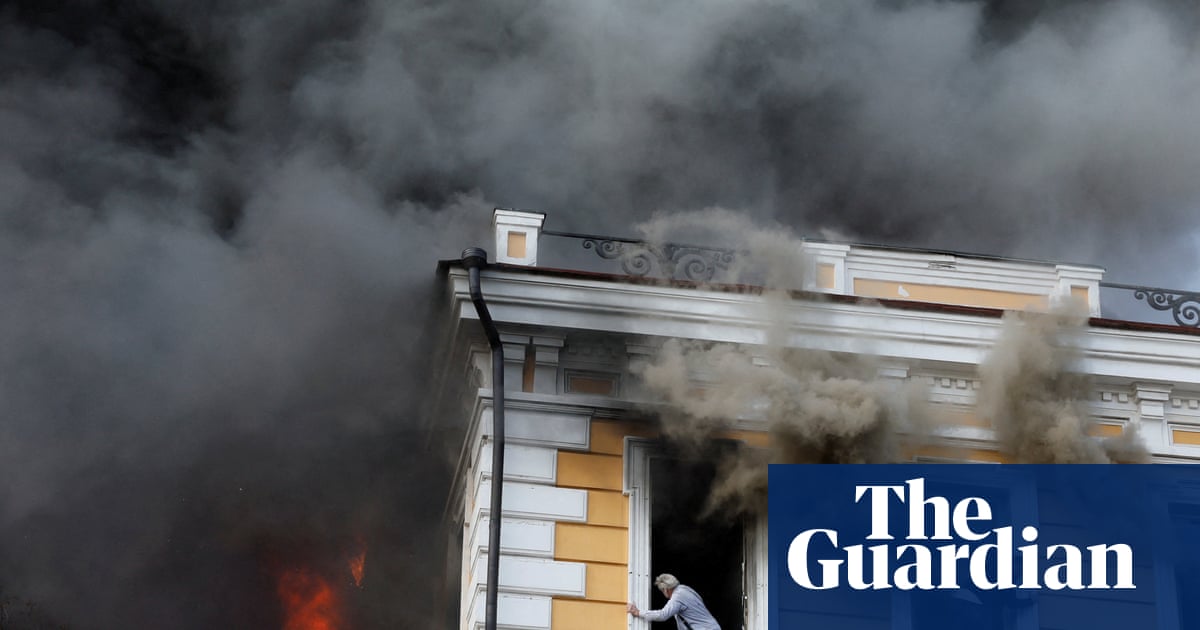
A Russian drone hit the National Academy of Sciences in central Kyiv on Monday, killing at least one person, in the latest daytime attack on Ukraine’s capital.
Flames tore through the historic building as people clambered out of first- and second-floor windows to escape, in dramatic scenes increasingly familiar in the heavily bombarded city.
At least one person was killed and three others were wounded, according to Kyiv’s mayor, Vitali Klitschko, who said the injured had been taken to hospital.
The 19th-century building stands close to the German embassy, the National Opera, St Volodymyr’s Cathedral and several government buildings.
Anatoliy Zagorodny, the president of the national academy, said the blast struck while many staff members were inside. Standing outside the burning building, he said he did not know why Russia had targeted a leading centre of scientific research.
“We are not connected with the military. This is an attack on science. It is terrorism,” he said. He feared some of his colleagues could still be trapped inside the academy.
While the sciences building is a civilian scientific institution, it has longstanding ties to Ukraine’s defence sector. Among those injured in Monday’s strike was Volodymyr Horbulin, the academy’s first vice-president and a former high-ranking security official.
Another Russian drone struck a nearby private medical centre, killing at least one person.
Russian strikes over the past week involving missiles and increasingly sophisticated jet-powered drones have hit apartment blocks, offices, warehouses and datacentres across the capital, killing and wounding civilians almost daily and giving Kyiv an increasingly frontline feel as it faces some of its most sustained bombardment since the early stages of Russia’s full-scale invasion in 2022.
The drone and missile campaign is designed to grind down public resilience and damage the economy. Monday’s double strike is likely to raise fresh concerns over Ukraine’s ability to protect even the most heavily guarded parts of the capital.
The newer jet-powered drones fly faster and are harder to intercept than the older Shahed or Geran-2 models that were the backbone of Moscow’s air campaign. Ukraine is racing to develop and manufacture interceptors capable of bringing them down.
Moscow has also changed its tactics, launching more attacks in daylight hours so that residents in major cities have to spend more of the day under air raid alerts.
after newsletter promotion
Buildings hit during daytime strikes are often occupied because many Ukrainians work through drone alerts rather than spend hours in shelters.
Meanwhile, a Russian jet-powered drone struck western Ukraine near the border crossing with Poland, prompting Warsaw to issue an alert warning of a possible air attack and urging residents in the eastern Lublin region to seek shelter.
Russian forces have increasingly targeted Ukrainian border crossings with Poland and Moldova, leading Kyiv to consider relocating joint customs checkpoints to the territory of neighbouring countries. “It’s again a threat very close to our border,” said Lt Col Jacek Goryszewski, speaking to Poland’s broadcaster TVN24.
Ukraine’s president, Volodymyr Zelenskyy, called on western countries to intensify their pressure on Russia. “Every Russian terrorist attack is a loss of life that could have been prevented if pressure on Russia had finally become total,” he wrote on X on Monday. “The world must understand that terrorists will go further if they are not stopped here, in Ukraine. And we cannot turn a blind eye to such brutal strikes.”
Russia has signalled that its attacks on Ukraine could intensify, and US-brokered efforts to end the war show little sign of progress.
“Ukraine will have to pay a price for the actions that have taken place in recent months,” the Kremlin spokesperson, Dmitry Peskov, told reporters on Monday, referring to Ukrainian strikes deep inside Russian territory. “That is happening right now.”
Read the full story at The Guardian ↗
Three others wounded as jet-powered drones increasingly target Ukraine’s capital, with medical centre also hit. Europe live – latest updates. A Russian drone hit the National…
This lens runs the verified story through Cinnamon's AI — wired in the next step.
A Russian drone hit the National Academy of Sciences in central Kyiv on Monday, killing at least one person, in the latest daytime attack on Ukraine’s capital.
Flames tore through the historic building as people clambered out of first- and second-floor windows to escape, in dramatic scenes increasingly familiar in the heavily bombarded city.
At least one person was killed and three others were wounded, according to Kyiv’s mayor, Vitali Klitschko, who said the injured had been taken to hospital.
The 19th-century building stands close to the German embassy, the National Opera, St Volodymyr’s Cathedral and several government buildings.
Anatoliy Zagorodny, the president of the national academy, said the blast struck while many staff members were inside. Standing outside the burning building, he said he did not know why Russia had targeted a leading centre of scientific research.
“We are not connected with the military. This is an attack on science. It is terrorism,” he said. He feared some of his colleagues could still be trapped inside the academy.
While the sciences building is a civilian scientific institution, it has longstanding ties to Ukraine’s defence sector. Among those injured in Monday’s strike was Volodymyr Horbulin, the academy’s first vice-president and a former high-ranking security official.
Another Russian drone struck a nearby private medical centre, killing at least one person.
Russian strikes over the past week involving missiles and increasingly sophisticated jet-powered drones have hit apartment blocks, offices, warehouses and datacentres across the capital, killing and wounding civilians almost daily and giving Kyiv an increasingly frontline feel as it faces some of its most sustained bombardment since the early stages of Russia’s full-scale invasion in 2022.
The drone and missile campaign is designed to grind down public resilience and damage the economy. Monday’s double strike is likely to raise fresh concerns over Ukraine’s ability to protect even the most heavily guarded parts of the capital.
The newer jet-powered drones fly faster and are harder to intercept than the older Shahed or Geran-2 models that were the backbone of Moscow’s air campaign. Ukraine is racing to develop and manufacture interceptors capable of bringing them down.
Moscow has also changed its tactics, launching more attacks in daylight hours so that residents in major cities have to spend more of the day under air raid alerts.
after newsletter promotion
Buildings hit during daytime strikes are often occupied because many Ukrainians work through drone alerts rather than spend hours in shelters.
Meanwhile, a Russian jet-powered drone struck western Ukraine near the border crossing with Poland, prompting Warsaw to issue an alert warning of a possible air attack and urging residents in the eastern Lublin region to seek shelter.
Russian forces have increasingly targeted Ukrainian border crossings with Poland and Moldova, leading Kyiv to consider relocating joint customs checkpoints to the territory of neighbouring countries. “It’s again a threat very close to our border,” said Lt Col Jacek Goryszewski, speaking to Poland’s broadcaster TVN24.
Ukraine’s president, Volodymyr Zelenskyy, called on western countries to intensify their pressure on Russia. “Every Russian terrorist attack is a loss of life that could have been prevented if pressure on Russia had finally become total,” he wrote on X on Monday. “The world must understand that terrorists will go further if they are not stopped here, in Ukraine. And we cannot turn a blind eye to such brutal strikes.”
Russia has signalled that its attacks on Ukraine could intensify, and US-brokered efforts to end the war show little sign of progress.
“Ukraine will have to pay a price for the actions that have taken place in recent months,” the Kremlin spokesperson, Dmitry Peskov, told reporters on Monday, referring to Ukrainian strikes deep inside Russian territory. “That is happening right now.”
Read the full story at The Guardian ↗
A Russian drone hit the National Academy of Sciences in central Kyiv on Monday, killing at least one person, in the latest daytime attack on Ukraine’s capital.
Flames tore through the historic building as people clambered out of first- and second-floor windows to escape, in dramatic scenes increasingly familiar in the heavily bombarded city.
At least one person was killed and three others were wounded, according to Kyiv’s mayor, Vitali Klitschko, who said the injured had been taken to hospital.
The 19th-century building stands close to the German embassy, the National Opera, St Volodymyr’s Cathedral and several government buildings.
Anatoliy Zagorodny, the president of the national academy, said the blast struck while many staff members were inside. Standing outside the burning building, he said he did not know why Russia had targeted a leading centre of scientific research.
“We are not connected with the military. This is an attack on science. It is terrorism,” he said. He feared some of his colleagues could still be trapped inside the academy.
While the sciences building is a civilian scientific institution, it has longstanding ties to Ukraine’s defence sector. Among those injured in Monday’s strike was Volodymyr Horbulin, the academy’s first vice-president and a former high-ranking security official.
Another Russian drone struck a nearby private medical centre, killing at least one person.
Russian strikes over the past week involving missiles and increasingly sophisticated jet-powered drones have hit apartment blocks, offices, warehouses and datacentres across the capital, killing and wounding civilians almost daily and giving Kyiv an increasingly frontline feel as it faces some of its most sustained bombardment since the early stages of Russia’s full-scale invasion in 2022.
The drone and missile campaign is designed to grind down public resilience and damage the economy. Monday’s double strike is likely to raise fresh concerns over Ukraine’s ability to protect even the most heavily guarded parts of the capital.
The newer jet-powered drones fly faster and are harder to intercept than the older Shahed or Geran-2 models that were the backbone of Moscow’s air campaign. Ukraine is racing to develop and manufacture interceptors capable of bringing them down.
Moscow has also changed its tactics, launching more attacks in daylight hours so that residents in major cities have to spend more of the day under air raid alerts.
after newsletter promotion
Buildings hit during daytime strikes are often occupied because many Ukrainians work through drone alerts rather than spend hours in shelters.
Meanwhile, a Russian jet-powered drone struck western Ukraine near the border crossing with Poland, prompting Warsaw to issue an alert warning of a possible air attack and urging residents in the eastern Lublin region to seek shelter.
Russian forces have increasingly targeted Ukrainian border crossings with Poland and Moldova, leading Kyiv to consider relocating joint customs checkpoints to the territory of neighbouring countries. “It’s again a threat very close to our border,” said Lt Col Jacek Goryszewski, speaking to Poland’s broadcaster TVN24.
Ukraine’s president, Volodymyr Zelenskyy, called on western countries to intensify their pressure on Russia. “Every Russian terrorist attack is a loss of life that could have been prevented if pressure on Russia had finally become total,” he wrote on X on Monday. “The world must understand that terrorists will go further if they are not stopped here, in Ukraine. And we cannot turn a blind eye to such brutal strikes.”
Russia has signalled that its attacks on Ukraine could intensify, and US-brokered efforts to end the war show little sign of progress.
“Ukraine will have to pay a price for the actions that have taken place in recent months,” the Kremlin spokesperson, Dmitry Peskov, told reporters on Monday, referring to Ukrainian strikes deep inside Russian territory. “That is happening right now.”
Read the full story at The Guardian ↗
This lens runs the verified story through Cinnamon's AI — wired in the next step.
- Three others wounded as jet-powered drones increasingly target Ukraine’s capital, with medical centre also hit.
- Europe live – latest updates.
- A Russian drone hit the National…