Scientist publishes fresh doubts over Microsoft's quantum claims
Microsoft's claims it has made major breakthroughs in quantum computing have been questioned by a UK-based physicist, in a paper published by the science journal Nature.
Dr Henry Legg, a long-term critic of Microsoft's quantum work, argued a software tool used by the tech giant to check its research contained coding errors and was not sufficiently accurate.
Legg also said Microsoft had still not proved its assertion that it has managed to create a theoretical quasi-particle called Majorana, which underpins its approach to quantum computing.
The tech giant has consistently stood by its conclusions despite scepticism from experts in the field.
It has invested heavily in the race to build quantum computers, which work very differently to traditional machines and are said to have the potential to solve difficult global challenges which are too big for even the world's most powerful supercomputers to process.
Quantum computing is already a multi-billion dollar industry despite there only being very limited devices currently in existence.
Current quantum machines are prone to start making mistakes in the event of the slightest interference such as small vibrations or a tiny change in temperature.
"Last year Microsoft claimed they had built the equivalent of a precision Swiss watch. However when I opened the case to examine the mechanism, I found what looked like a chaotic jumble of mismatched parts," Legg said.
"Something was making noise, but it didn't look like the breakthrough Microsoft had claimed."
Microsoft has stood by its results.
"At the end of the day, success is the delivery of a scalable quantum computer," said Dr Chetan Nayak, Technical Fellow and Corporate Vice President, Quantum Hardware, Microsoft.
"Scepticism and rigour are hallmarks of the scientific process, which we appreciate and have supported from various academics. We have participated in dialogue and our thorough rebuttal was accepted and published by Nature."
In that response, Microsoft states that the software Legg referred to did not "interpret" the measurements which led to its conclusions.
Legg also accused Microsoft of not sharing enough data for other scientists to scrutinise, which is how scientific research is generally either validated or dismissed by the wider expert community.
Microsoft said it was sharing all of its data with the US defence agency Darpa for independent arbitration but has claimed some of it is too commercially sensitive to publish more widely.
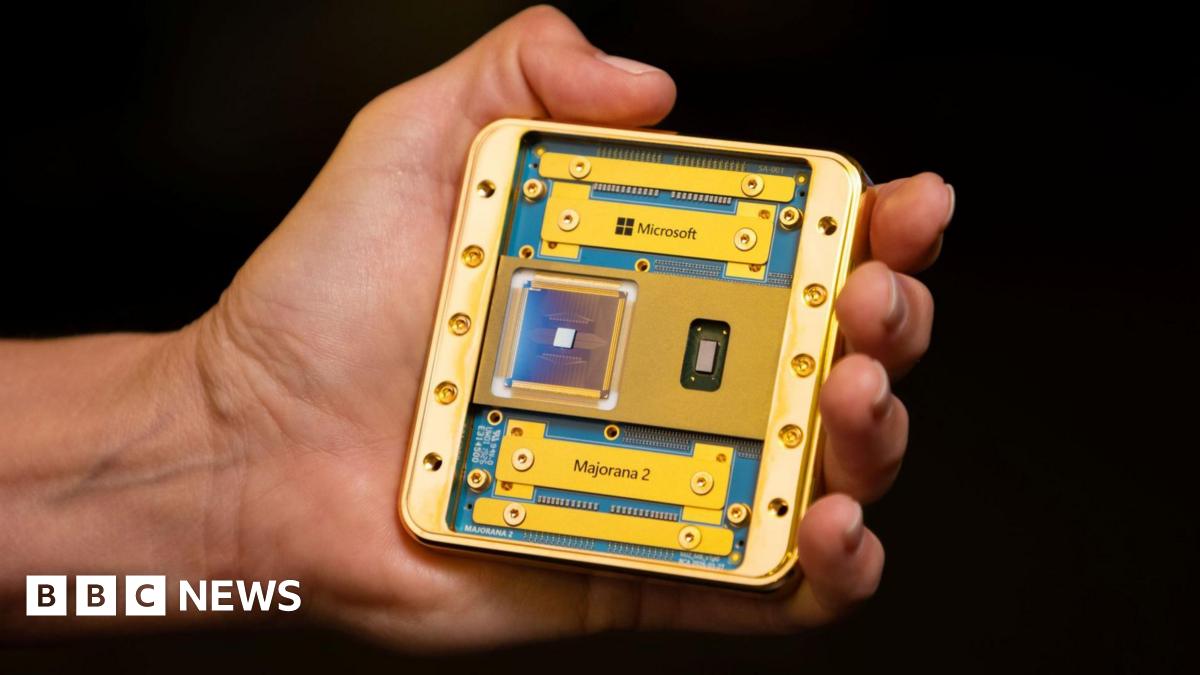
Legg's paper critiqued research published by Microsoft in 2025. It has since released a second generation of its Majorana chip, which it says is 1,000 times more reliable than the previous one.
Read the full story at BBC ↗
Microsoft's quantum computing research has drawn formal criticism in a Nature paper by physicist Dr Henry Legg. Legg argues that the software tool Microsoft uses to verify its results contains coding errors affecting accuracy, and that Microsoft has not demonstrated it has successfully created Majorana quasi-particles—theoretical entities central to Microsoft's quantum approach. Microsoft maintains its conclusions are sound and states its validation software does not interpret measurements. On data sharing, Legg notes limited publication for peer review; Microsoft responds that it shares comprehensive data with US defense agency Darpa for independent assessment but restricts some release on commercial grounds. The company released a second-generation Majorana chip claiming 1,000× improvement in reliability over its predecessor. The exchange reflects standard scientific scrutiny within an industry already worth billions despite very few operational devices existing.
Read the full story at BBC ↗
Microsoft's claims it has made major breakthroughs in quantum computing have been questioned by a UK-based physicist, in a paper published by the science journal Nature.
Dr Henry Legg, a long-term critic of Microsoft's quantum work, argued a software tool used by the tech giant to check its research contained coding errors and was not sufficiently accurate.
Legg also said Microsoft had still not proved its assertion that it has managed to create a theoretical quasi-particle called Majorana, which underpins its approach to quantum computing.
The tech giant has consistently stood by its conclusions despite scepticism from experts in the field.
It has invested heavily in the race to build quantum computers, which work very differently to traditional machines and are said to have the potential to solve difficult global challenges which are too big for even the world's most powerful supercomputers to process.
Quantum computing is already a multi-billion dollar industry despite there only being very limited devices currently in existence.
Current quantum machines are prone to start making mistakes in the event of the slightest interference such as small vibrations or a tiny change in temperature.
"Last year Microsoft claimed they had built the equivalent of a precision Swiss watch. However when I opened the case to examine the mechanism, I found what looked like a chaotic jumble of mismatched parts," Legg said.
"Something was making noise, but it didn't look like the breakthrough Microsoft had claimed."
Microsoft has stood by its results.
"At the end of the day, success is the delivery of a scalable quantum computer," said Dr Chetan Nayak, Technical Fellow and Corporate Vice President, Quantum Hardware, Microsoft.
"Scepticism and rigour are hallmarks of the scientific process, which we appreciate and have supported from various academics. We have participated in dialogue and our thorough rebuttal was accepted and published by Nature."
In that response, Microsoft states that the software Legg referred to did not "interpret" the measurements which led to its conclusions.
Legg also accused Microsoft of not sharing enough data for other scientists to scrutinise, which is how scientific research is generally either validated or dismissed by the wider expert community.
Microsoft said it was sharing all of its data with the US defence agency Darpa for independent arbitration but has claimed some of it is too commercially sensitive to publish more widely.
Legg's paper critiqued research published by Microsoft in 2025. It has since released a second generation of its Majorana chip, which it says is 1,000 times more reliable than the previous one.
Read the full story at BBC ↗
A UK-based physicist published criticism of Microsoft's quantum claims in the journal Nature Dr Henry Legg argued Microsoft's validation software contained coding errors and lacked sufficient accuracy Legg stated Microsoft has not proved it created Majorana quasi-particles Microsoft maintains its conclusions and states its software does not interpret measurements Legg accused Microsoft of insufficient data sharing for peer scrutiny Microsoft shares quantum data with Darpa but withholds some as commercially sensitive Microsoft released a second-generation Majorana chip claiming 1,000× greater reliability Legg's metaphor comparing Microsoft's work to 'a chaotic jumble of mismatched parts' rather than 'a precision Swiss watch'
Read the full story at BBC ↗
- A UK physicist published a Nature paper questioning Microsoft's quantum computing claims, arguing its validation software contains errors
- Microsoft claims to have created Majorana quasi-particles; the critic says this remains unproven
- Microsoft shares quantum data with US defense agency Darpa but withholds some citing commercial sensitivity
- Microsoft released a second-generation chip it says is 1,000× more reliable than the previous version