The ancient trick making food waste useful and tasty
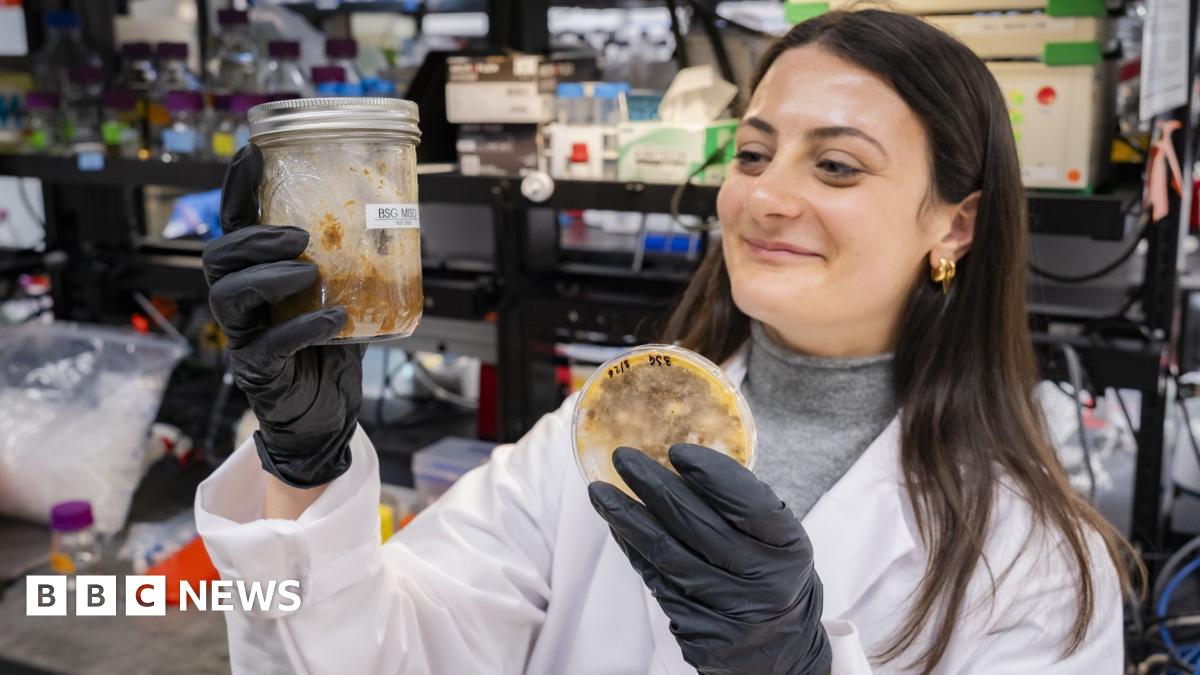
Vayu Hill-Maini's lab has created a new cheese, or at least something that tastes like cheese, but is actually made from food waste.
The bioengineer, who runs a lab at Stanford University in California, is experimenting with fermentation using fungi.
"One of the most amazing things that we found recently is that we could take waste and add a few other ingredients in a fungal fermentation and create this delicious cheese that is like a Pecorino or Parmigiano," he says.
Fermentation is a biological process whereby organisms convert carbohydrates like starch or sugar into substances like alcohol, without using oxygen.
Perhaps the best-known examples of fermentation are in baking and brewing, where yeast breaks down sugar into ethanol and carbon dioxide.
But it's not just wheat flour, or barley that can fuel fermentation, all sorts of substances are suitable - in biology those fermentation hosts are known as substrates.
With the latest biotech tools, companies are taking by-products of the food industry, that are currently discarded or have little value, and using fermentation to turn them into something useful.
UK-based Fermtech is transforming cocoa shells, which are normally thrown away, into a cocoa powder substitute, using fermentation.
"If you were to sniff a bag of cocoa shells, you would be really struck by the intense chocolatey nature of it," says Andy Clayton, Fermtech's CEO.
He says it's a shame that by-products of the food industry are composted or burnt, rather than using microorganisms to break down the hard bits of the plant and make it bioavailable for humans, while retaining the flavours.
Utilising a broader palette of substrates can save money, help the environment, and expand flavour.
"We're kind of like flavour miners," says Clayton says.
Take peas. Protein makes up about a quarter of a pea, and pea protein has become an increasingly popular source of plant-based protein.
What then to do with the other three-quarters of the pea?
That makes "a perfect substrate for fermentation," according to Bosco Emparanza, the CEO of Spain's MOA Foodtech.
His company gathers data on environmental conditions and available substrates, and sequences the genomes of microorganisms appropriate for the food industry.
With that data, MOA has trained an AI to work out what combinations of substrates and microorganisms would achieve the best yields.
Emparanza marvels at the speed of such AI-driven fermentation design.
"When we started the company, we were able to develop one bioprocess in two weeks," he says, referring to the use of living cells to generate a product.
"Nowadays, the platform can develop 300 bioprocesses per hour."
Using that tech, MOA Foodtech discovered the best microorganisms to make use of the leftover starch and fibre in the pea protein industry.
Those byproducts would normally get sold at rock-bottom prices for animal feed, for instance, or possibly even discarded.
MOA Foodtech is working to put those byproducts back into the human food chain.
Singapore's Mottainai Food Tech also has a mission to use unconventional and underappreciated ingredients, which can be nutritious and widely available throughout Asia.
The inspiration for the name comes from the Japanese term mottainai, which laments waste - think of the phrase "waste not, want not" and you have the sentiment.
The company has produced a meat substitute called Jiro Meat based on okara, a soy pulp typically discarded after making tofu and soymilk.
Mottainai also recently started a plant-based tuna project.
They've experimented with different microorganisms to minimise off-flavours and maximise desirable flavour compounds such as umami or sweetness.
Singapore has a supportive environment for these kinds of food experiments.
"In five years' time, we hope to be able to have a wide range of ingredients" drawing on the company's fermentation platform, says Daryl Pek, a cofounder of Mottainai Food Tech.
Back in Stanford, Hill-Maini's lab is working on precision fermentation.
This involves genetically engineering microorganisms, such as moulds, to produce a specific material in a fermentation process.
Precision fermentation can efficiently adjust the aesthetics, aroma or flavour of a food, but also its digestibility.
For instance, Hill-Maini says that some waste products are rich in cellulose, which humans can't digest. But as they grow, fungi can break down the cellulose and convert it into protein.
"They become kind of a bioconversion machine where they can remove some of those complicated molecules that the human gut cannot digest and convert them into more digestible substances."
Hill-Maini believes that his lab's work inspires others to think differently about food waste. But he doesn't want this work to stay in the lab.
They have a chef in residence and an R&D culinary innovation kitchen to ensure that their food experiments are as appealing to potential consumers as possible.
Of the recently developed Pecorino-like cheese, the lab used a Neurospora mould, but would not say what waste was used as a substrate. That's secret until they publish a paper about their work.
But he's excited about the new "cheese".
"You can grate it, it's salty, it has a nice texture, it can be added to pasta. And it's just really cool to see… the fermentation can help it become delicious."
Read the full story at BBC ↗
Fermentation—where organisms convert carbohydrates into useful compounds without oxygen—is being applied at scale to food waste. Researchers at Stanford and biotech firms across the UK, Spain, and Singapore are using fungi and other microorganisms to transform industry byproducts: cocoa shells into cocoa powder substitute, leftover pea solids into food ingredients, and soy pulp discarded from tofu production into meat alternatives. AI systems now accelerate this work, designing hundreds of bioprocesses per hour to match substrates with appropriate microorganisms. The resulting products retain desirable flavours while converting waste that would otherwise be composted, burnt, or sold cheaply as animal feed back into the human food supply.
Read the full story at BBC ↗
Vayu Hill-Maini's lab has created a new cheese, or at least something that tastes like cheese, but is actually made from food waste.
The bioengineer, who runs a lab at Stanford University in California, is experimenting with fermentation using fungi.
"One of the most amazing things that we found recently is that we could take waste and add a few other ingredients in a fungal fermentation and create this delicious cheese that is like a Pecorino or Parmigiano," he says.
Fermentation is a biological process whereby organisms convert carbohydrates like starch or sugar into substances like alcohol, without using oxygen.
Perhaps the best-known examples of fermentation are in baking and brewing, where yeast breaks down sugar into ethanol and carbon dioxide.
But it's not just wheat flour, or barley that can fuel fermentation, all sorts of substances are suitable - in biology those fermentation hosts are known as substrates.
With the latest biotech tools, companies are taking by-products of the food industry, that are currently discarded or have little value, and using fermentation to turn them into something useful.
UK-based Fermtech is transforming cocoa shells, which are normally thrown away, into a cocoa powder substitute, using fermentation.
"If you were to sniff a bag of cocoa shells, you would be really struck by the intense chocolatey nature of it," says Andy Clayton, Fermtech's CEO.
He says it's a shame that by-products of the food industry are composted or burnt, rather than using microorganisms to break down the hard bits of the plant and make it bioavailable for humans, while retaining the flavours.
Utilising a broader palette of substrates can save money, help the environment, and expand flavour.
"We're kind of like flavour miners," says Clayton says.
Take peas. Protein makes up about a quarter of a pea, and pea protein has become an increasingly popular source of plant-based protein.
What then to do with the other three-quarters of the pea?
That makes "a perfect substrate for fermentation," according to Bosco Emparanza, the CEO of Spain's MOA Foodtech.
His company gathers data on environmental conditions and available substrates, and sequences the genomes of microorganisms appropriate for the food industry.
With that data, MOA has trained an AI to work out what combinations of substrates and microorganisms would achieve the best yields.
Emparanza marvels at the speed of such AI-driven fermentation design.
"When we started the company, we were able to develop one bioprocess in two weeks," he says, referring to the use of living cells to generate a product.
"Nowadays, the platform can develop 300 bioprocesses per hour."
Using that tech, MOA Foodtech discovered the best microorganisms to make use of the leftover starch and fibre in the pea protein industry.
Those byproducts would normally get sold at rock-bottom prices for animal feed, for instance, or possibly even discarded.
MOA Foodtech is working to put those byproducts back into the human food chain.
Singapore's Mottainai Food Tech also has a mission to use unconventional and underappreciated ingredients, which can be nutritious and widely available throughout Asia.
The inspiration for the name comes from the Japanese term mottainai, which laments waste - think of the phrase "waste not, want not" and you have the sentiment.
The company has produced a meat substitute called Jiro Meat based on okara, a soy pulp typically discarded after making tofu and soymilk.
Mottainai also recently started a plant-based tuna project.
They've experimented with different microorganisms to minimise off-flavours and maximise desirable flavour compounds such as umami or sweetness.
Singapore has a supportive environment for these kinds of food experiments.
"In five years' time, we hope to be able to have a wide range of ingredients" drawing on the company's fermentation platform, says Daryl Pek, a cofounder of Mottainai Food Tech.
Back in Stanford, Hill-Maini's lab is working on precision fermentation.
This involves genetically engineering microorganisms, such as moulds, to produce a specific material in a fermentation process.
Precision fermentation can efficiently adjust the aesthetics, aroma or flavour of a food, but also its digestibility.
For instance, Hill-Maini says that some waste products are rich in cellulose, which humans can't digest. But as they grow, fungi can break down the cellulose and convert it into protein.
"They become kind of a bioconversion machine where they can remove some of those complicated molecules that the human gut cannot digest and convert them into more digestible substances."
Hill-Maini believes that his lab's work inspires others to think differently about food waste. But he doesn't want this work to stay in the lab.
They have a chef in residence and an R&D culinary innovation kitchen to ensure that their food experiments are as appealing to potential consumers as possible.
Of the recently developed Pecorino-like cheese, the lab used a Neurospora mould, but would not say what waste was used as a substrate. That's secret until they publish a paper about their work.
But he's excited about the new "cheese".
"You can grate it, it's salty, it has a nice texture, it can be added to pasta. And it's just really cool to see… the fermentation can help it become delicious."
Read the full story at BBC ↗
Fermentation is a biological process whereby organisms convert carbohydrates like starch or sugar into substances like alcohol, without using oxygen. Vayu Hill-Maini's lab at Stanford University has created a cheese-like product from food waste using fungal fermentation. Fermtech, a UK company, is using fermentation to transform cocoa shells into a cocoa powder substitute. Pea protein makes up about a quarter of a pea; the other three-quarters are underutilized. MOA Foodtech uses AI to train systems that can develop 300 bioprocesses per hour, compared to one bioprocess per two weeks when the company started. Mottainai Food Tech has produced a meat substitute called Jiro Meat from okara, soy pulp typically discarded after making tofu and soymilk. Hill-Maini's work with precision fermentation can engineer microorganisms to break down indigestible compounds like cellulose and convert them into digestible proteins. It's a shame that food industry byproducts are composted or burnt rather than transformed into useful products through fermentation. Fermtech's approach to using microorganisms makes it possible to retain the flavours of food byproducts while making them bioavailable.
Read the full story at BBC ↗
- Researchers and biotech companies are using fermentation—a biological process where microorganisms convert carbohydrates without oxygen—to transform food industry byproducts into edible products.
- Stanford's Vayu Hill-Maini has created a cheese-like product from food waste using fungal fermentation; companies like Fermtech, MOA Foodtech, and Mottainai Food Tech are scaling similar approaches with cocoa shells, pea byproducts, and soy pulp.
- AI-assisted bioprocess design now enables rapid development of fermentation systems; precision fermentation can genetically engineer microorganisms to break down indigestible compounds like cellulose into digestible proteins.