The artificial ice pyramids saving India's mountain villages
At an altitude of almost 4,000m (13,000ft) and receiving almost no rainfall, the Himalayan village of Sakti is a hostile place to be a farmer.
"Ladakh has a brutal, single-cultivation season," says Gelak Gutme, who has been growing wheat, peas and potatoes there for most of his 65 years.
"It is a desert with an extreme climate," he says.
Conditions have become worse in his lifetime. Global warming means that the smaller, low altitude glaciers they relied on to water their crops have disappeared.
"Now there is scarcity of water. Last year I lost everything - my entire field got dried due of lack of water," Gutme says.
"For generations, small glaciers sitting right above the valleys acted like frozen water towers, holding onto water all winter and releasing it right when spring farming began," explains Lobzang Fardod, who is a member of a local water management committee in Ladakh.
"Now that those lower glaciers have completely vanished into a desert of dry rock, there is nothing left at the top to melt," he says.
The mountain summer is short, so farmers have to plant their crops by May, otherwise the crops will not be ready before the winter hits again.
A reliable source of water in early spring is crucial for them.
To secure that vital resource, in the early 2010s some Ladakh villages attempted to create their own reservoirs of ice.
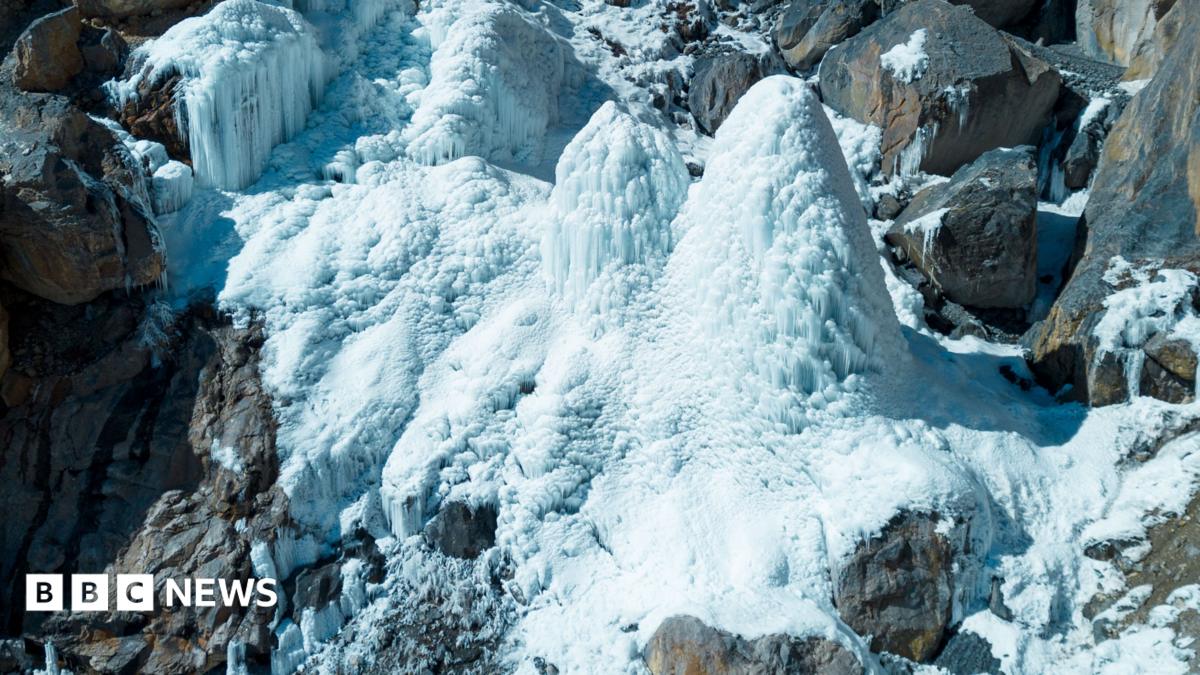
The system involved piping water from higher up in the mountains during the winter and spraying it into the air, where it would freeze, and over time form large towers of ice, called ice stupas.
They successfully supplied melt water in the spring, but were a "nightmare" to manage under harsh winter conditions, says Fardod.
If temperatures dropped quickly below minus 20C, or sometimes minus 30C, the water in the pipes was liable to freeze, cracking the pipes and ruining the whole system.
To guard against that, during the winter teams of four or five farmers would camp high-up, near the water source, rushing to any potential blockages with boiling water, often during the night when temperature drops were most likely.
But enduring those freezing, winter nights high in the mountains could be phased out.
"Because traditional water systems are failing, Leh-Ladakh has become a hub for innovative, grassroots hydraulic engineering," says Murtaza Ali, executive engineer in the Irrigation and Flood Control Division, at the Ladakh Autonomous Hill Development Council.
Leh is the capital of Ladakh, a disputed region in Indian-administered Kashmir that is sandwiched between China to the east and Pakistan to the west.
More on Ladakh's political challenges
As well as the potential for cracked pipes, the ice stupa system was not very efficient, says Ali.
Because water flowed constantly, on warmer days fresh water would melt the ice that had already formed.
But over the last couple of years that method has undergone a tech upgrade.
In partnership with private company Acres of Ice, a new system has been developed which precisely controls ice production.
Called an Automated Ice Reservoir (AIR), the process also involves piping water down from higher up in the mountains.
The water arrives at the valley floor under pressure and shoots out of a vertical nozzle like a "massive fountain", says Dr Suryanarayanan Balasubramanian, the founder of Acres of Ice.
That flow is computer controlled from a weatherproof control box, powered by solar panels and a battery.
The control system is connected to a weather station, which monitors, environmental conditions, including the water temperature inside the pipe.
If the sensors detect that the air temperature is dropping too fast, or the water temperature inside the pipe approaches a dangerous threshold, the control system takes action.
It shuts off the valve at the top of the stream and opens a valve at the bottom to completely drain the standing water out of the pipe.
That avoids the ruinous problem of cracked pipes, but the system is also more efficient at creating ice. Instead of continuously spraying water, AIR fires a burst of mist, coating the existing ice, and then shuts off.
"The system waits precisely long enough for that layer of water droplets to freeze solid based on current wind and humidity, then fires the spray again," explains Balasubramanian.
He says that AIR converts almost all of the diverted water into ice.
The whole system runs automatically and uses a local wireless network to connect the control box and the various valves. But the villagers do have a manual override, if needed.
It all appears to be making a difference to village life.
"When we speak to the villagers, they are saying the groundwater is getting recharged and spring sources are getting revived. They are getting water in time. We are also planning a scientific study now to see exactly what impact it has made," says Ali.
Read the full story at BBC ↗
In the high-altitude Ladakh region, farming depends on water availability during spring planting. Traditionally, lower glaciers provided this water by melting in spring, but these glaciers have disappeared as the climate has warmed. In the early 2010s, villages began creating artificial ice reservoirs by spraying mountain water into the air during winter, forming ice towers that could be tapped when needed. While effective, these systems required teams of farmers to camp in extreme conditions and manually prevent pipe freezing. A newer technology, called Automated Ice Reservoirs (AIR), uses solar-powered weather sensors and computer controls to spray water in timed bursts, freezing it more efficiently while automatically draining pipes if temperatures become too cold. Early reports suggest groundwater recharge and water availability have improved, though formal assessment is pending.
Read the full story at BBC ↗
At an altitude of almost 4,000m (13,000ft) and receiving almost no rainfall, the Himalayan village of Sakti is a hostile place to be a farmer.
"Ladakh has a brutal, single-cultivation season," says Gelak Gutme, who has been growing wheat, peas and potatoes there for most of his 65 years.
"It is a desert with an extreme climate," he says.
Conditions have become worse in his lifetime. Global warming means that the smaller, low altitude glaciers they relied on to water their crops have disappeared.
"Now there is scarcity of water. Last year I lost everything - my entire field got dried due of lack of water," Gutme says.
"For generations, small glaciers sitting right above the valleys acted like frozen water towers, holding onto water all winter and releasing it right when spring farming began," explains Lobzang Fardod, who is a member of a local water management committee in Ladakh.
"Now that those lower glaciers have completely vanished into a desert of dry rock, there is nothing left at the top to melt," he says.
The mountain summer is short, so farmers have to plant their crops by May, otherwise the crops will not be ready before the winter hits again.
A reliable source of water in early spring is crucial for them.
To secure that vital resource, in the early 2010s some Ladakh villages attempted to create their own reservoirs of ice.
The system involved piping water from higher up in the mountains during the winter and spraying it into the air, where it would freeze, and over time form large towers of ice, called ice stupas.
They successfully supplied melt water in the spring, but were a "nightmare" to manage under harsh winter conditions, says Fardod.
If temperatures dropped quickly below minus 20C, or sometimes minus 30C, the water in the pipes was liable to freeze, cracking the pipes and ruining the whole system.
To guard against that, during the winter teams of four or five farmers would camp high-up, near the water source, rushing to any potential blockages with boiling water, often during the night when temperature drops were most likely.
But enduring those freezing, winter nights high in the mountains could be phased out.
"Because traditional water systems are failing, Leh-Ladakh has become a hub for innovative, grassroots hydraulic engineering," says Murtaza Ali, executive engineer in the Irrigation and Flood Control Division, at the Ladakh Autonomous Hill Development Council.
Leh is the capital of Ladakh, a disputed region in Indian-administered Kashmir that is sandwiched between China to the east and Pakistan to the west.
More on Ladakh's political challenges
As well as the potential for cracked pipes, the ice stupa system was not very efficient, says Ali.
Because water flowed constantly, on warmer days fresh water would melt the ice that had already formed.
But over the last couple of years that method has undergone a tech upgrade.
In partnership with private company Acres of Ice, a new system has been developed which precisely controls ice production.
Called an Automated Ice Reservoir (AIR), the process also involves piping water down from higher up in the mountains.
The water arrives at the valley floor under pressure and shoots out of a vertical nozzle like a "massive fountain", says Dr Suryanarayanan Balasubramanian, the founder of Acres of Ice.
That flow is computer controlled from a weatherproof control box, powered by solar panels and a battery.
The control system is connected to a weather station, which monitors, environmental conditions, including the water temperature inside the pipe.
If the sensors detect that the air temperature is dropping too fast, or the water temperature inside the pipe approaches a dangerous threshold, the control system takes action.
It shuts off the valve at the top of the stream and opens a valve at the bottom to completely drain the standing water out of the pipe.
That avoids the ruinous problem of cracked pipes, but the system is also more efficient at creating ice. Instead of continuously spraying water, AIR fires a burst of mist, coating the existing ice, and then shuts off.
"The system waits precisely long enough for that layer of water droplets to freeze solid based on current wind and humidity, then fires the spray again," explains Balasubramanian.
He says that AIR converts almost all of the diverted water into ice.
The whole system runs automatically and uses a local wireless network to connect the control box and the various valves. But the villagers do have a manual override, if needed.
It all appears to be making a difference to village life.
"When we speak to the villagers, they are saying the groundwater is getting recharged and spring sources are getting revived. They are getting water in time. We are also planning a scientific study now to see exactly what impact it has made," says Ali.
Read the full story at BBC ↗
Ladakh receives almost no rainfall and sits at nearly 4,000 metres altitude. Lower-altitude glaciers that historically supplied irrigation water have disappeared. Farmers must plant crops by May or risk harvest failure before winter. In the early 2010s, villages created ice stupas by piping and spraying mountain water during winter. Ice stupa systems were a 'nightmare' to manage because pipes froze and cracked in extreme cold. Ice stupa maintenance required teams to camp high in mountains and use boiling water to clear blockages. Traditional ice stupa systems were inefficient because continuous water flow allowed melting on warmer days. The Automated Ice Reservoir (AIR) system uses weather sensors and computer controls to spray water in precise bursts. AIR converts almost all diverted water into ice. Villagers report groundwater recharge and revived spring sources since AIR deployment. A formal scientific study on AIR's impact is being planned.
Read the full story at BBC ↗
- Ladakh's mountain villages face water scarcity as glaciers disappear due to climate change, threatening spring crop planting.
- Villages developed 'ice stupas'—sprayed water that freezes into ice towers—to create seasonal water reserves, but the system was unreliable and required constant winter maintenance.
- A new automated system called AIR uses computer controls and weather sensors to create ice more efficiently, potentially reducing manual labour and improving water availability for farmers.