The Chinese robot army transforming the UK's retail industry
Every time you click "buy" on an online order, the chances are that your purchase starts getting processed within minutes.
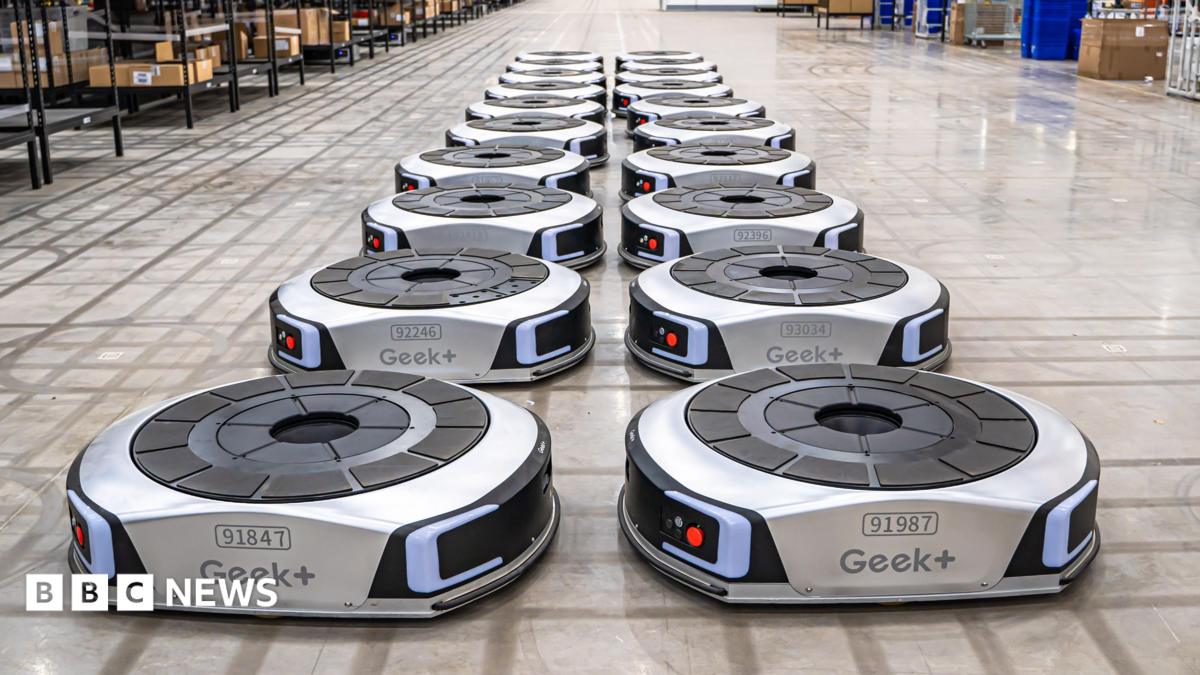
Increasingly, the journey starts with a squat silver floor robot gliding beneath a storage rack, lifting a shelf and carrying it across a warehouse to a waiting worker.
At Geek+'s factory in the eastern Chinese city of Hefei, which the BBC visited, fleets of the robots are built and tested before being shipped to warehouses around the world.
Some of Britain's biggest retailers - including Tesco, Asda and Next - now use the company's technology.
By automating these repetitive journeys, Geek+ says retailers can increase picking speeds, store more goods in spaces that are hard to reach for humans, and reduce errors.
Unlike traditional warehouse automation, which relies on fixed conveyor systems and permanent infrastructure, autonomous mobile robots can be deployed simply using QR code floor markers and safety fencing.
Geek+, which listed in Hong Kong last year in one of the biggest robotics share sales of 2025, has become the world's largest supplier of autonomous mobile robots.
The UK has struggled with weak productivity growth for more than a decade, and economists say wider adoption of robotics will be essential if businesses are to become more efficient.
In its 2026 report SME Technology Adoption in the United Kingdom, the Organisation for Economic Co-operation and Development (OECD) said technologies like robotics would be key to improving productivity.
According to the OECD, Britain's low adoption of robotics is "surprising" given its manufacturing heritage, noting that while UK firms have embraced mature digital technologies, they lag behind in robotics and automation.
That presents an opportunity for companies such as Geek+. The UK has one of Europe's largest e-commerce and logistics sectors, but many warehouses are still in the early stages of automation.
Britain has already become Geek+'s biggest European market, with UK partner MotionTech deploying more than 2,000 robots across 10 warehouse sites.
"Customers want fast deployable solutions," says Barry Pemberton, Account Director at MotionTech. "They want high volume, high storage, fast picking... ultimately on a smaller footprint with a reduced headcount."
"We seem to have a very big shortage of labour in the UK at the moment. These technologies are really important to keep businesses thriving and meet demand."
The Trades Union Congress (TUC), which represents almost 6 million UK workers, says robotics should be used to raise productivity and improve jobs, rather than simply cut labour costs.
In its response to the government's consultation on a new AI and innovation strategy, it urged ministers to ensure workers are involved in decisions about automation and that employers invest in retraining.
"Working with technologists, workers and unions can help steer the UK's research and innovation towards workers' priorities for automation... avoiding job-cutting, low-productivity automation," the TUC said in its report.
Robotics has become a strategic priority for Beijing under President Xi Jinping's drive to develop what he calls "new quality productive forces".
With China's working-age population shrinking, policymakers increasingly see automation as essential to boosting productivity and maintaining the country's manufacturing advantage.
"The robotics story builds directly on China's electric vehicle ecosystem," says Kyle Chan, a researcher at the Brookings Institution.
Batteries, electric motors, cameras, sensors and semiconductors developed for electric vehicles (EVs) are increasingly being used across China's robotics sector, creating what he describes as "overlapping industrial ecosystems".
One company leading that crossover is Chinese EV maker XPeng, which unveiled its humanoid robot, Iron, last year.
Founder He Xiaopeng says he no longer sees XPeng simply as a carmaker.
"We want XPeng to be a high-tech company," he told the BBC. "In the future, any car company will transform into a car and robotics company."
But the business case for humanoids is less clear than it is for today's warehouse robots. If wheeled robots move goods cheaply, reliably and efficiently or robots with just arms can do the other automated tasks, what problem does a humanoid solve?
Developers say factories, hospitals and offices have all been designed around people, and so they may eventually be able to work in different environments without the need to redesign workplaces around automation.
But experts and developers alike agree that the current technology is not yet suitable for some repetitive tasks that require more dexterity.
"I don't think [humanoids] will change the landscape of the types of technology or the automation that's going to be put into place," says Pemberton. "They're definitely going to be complementary."
Chinese companies already account for the vast majority of global humanoid deployments, but it may be years before they are commonplace in warehouses.
For Britain, where productivity pressures and labour shortages are driving demand for automation, the country's warehouses are becoming an early testing ground for China's next major technology export.
Additional reporting by Jaltson Akkanath Chummar
Read the full story at BBC ↗
Geek+, a Chinese robotics manufacturer, has become the world's largest supplier of autonomous mobile robots for warehouse automation. The company's floor robots, which retrieve and transport storage shelves, are now deployed by major UK retailers. Britain accounts for Geek+'s largest European market, with over 2,000 robots across 10 warehouse sites operated by partner MotionTech. The technology addresses UK labour shortages and productivity challenges. The OECD notes that UK firms have lagged in robotics adoption relative to other developed economies, despite the country's significant e-commerce and logistics sector. China's robotics industry is a state-level priority, benefiting from technology and supply chains developed for electric vehicles. Humanoid robots remain largely experimental; current practical automation uses wheeled robots for goods movement and robotic arms for specific tasks. The UK labour union body, the TUC, has called for worker involvement in automation decisions and employer investment in retraining to ensure automation improves job quality rather than simply reducing headcount.
Read the full story at BBC ↗
Every time you click "buy" on an online order, the chances are that your purchase starts getting processed within minutes.
Increasingly, the journey starts with a squat silver floor robot gliding beneath a storage rack, lifting a shelf and carrying it across a warehouse to a waiting worker.
At Geek+'s factory in the eastern Chinese city of Hefei, which the BBC visited, fleets of the robots are built and tested before being shipped to warehouses around the world.
Some of Britain's biggest retailers - including Tesco, Asda and Next - now use the company's technology.
By automating these repetitive journeys, Geek+ says retailers can increase picking speeds, store more goods in spaces that are hard to reach for humans, and reduce errors.
Unlike traditional warehouse automation, which relies on fixed conveyor systems and permanent infrastructure, autonomous mobile robots can be deployed simply using QR code floor markers and safety fencing.
Geek+, which listed in Hong Kong last year in one of the biggest robotics share sales of 2025, has become the world's largest supplier of autonomous mobile robots.
The UK has struggled with weak productivity growth for more than a decade, and economists say wider adoption of robotics will be essential if businesses are to become more efficient.
In its 2026 report SME Technology Adoption in the United Kingdom, the Organisation for Economic Co-operation and Development (OECD) said technologies like robotics would be key to improving productivity.
According to the OECD, Britain's low adoption of robotics is "surprising" given its manufacturing heritage, noting that while UK firms have embraced mature digital technologies, they lag behind in robotics and automation.
That presents an opportunity for companies such as Geek+. The UK has one of Europe's largest e-commerce and logistics sectors, but many warehouses are still in the early stages of automation.
Britain has already become Geek+'s biggest European market, with UK partner MotionTech deploying more than 2,000 robots across 10 warehouse sites.
"Customers want fast deployable solutions," says Barry Pemberton, Account Director at MotionTech. "They want high volume, high storage, fast picking... ultimately on a smaller footprint with a reduced headcount."
"We seem to have a very big shortage of labour in the UK at the moment. These technologies are really important to keep businesses thriving and meet demand."
The Trades Union Congress (TUC), which represents almost 6 million UK workers, says robotics should be used to raise productivity and improve jobs, rather than simply cut labour costs.
In its response to the government's consultation on a new AI and innovation strategy, it urged ministers to ensure workers are involved in decisions about automation and that employers invest in retraining.
"Working with technologists, workers and unions can help steer the UK's research and innovation towards workers' priorities for automation... avoiding job-cutting, low-productivity automation," the TUC said in its report.
Robotics has become a strategic priority for Beijing under President Xi Jinping's drive to develop what he calls "new quality productive forces".
With China's working-age population shrinking, policymakers increasingly see automation as essential to boosting productivity and maintaining the country's manufacturing advantage.
"The robotics story builds directly on China's electric vehicle ecosystem," says Kyle Chan, a researcher at the Brookings Institution.
Batteries, electric motors, cameras, sensors and semiconductors developed for electric vehicles (EVs) are increasingly being used across China's robotics sector, creating what he describes as "overlapping industrial ecosystems".
One company leading that crossover is Chinese EV maker XPeng, which unveiled its humanoid robot, Iron, last year.
Founder He Xiaopeng says he no longer sees XPeng simply as a carmaker.
"We want XPeng to be a high-tech company," he told the BBC. "In the future, any car company will transform into a car and robotics company."
But the business case for humanoids is less clear than it is for today's warehouse robots. If wheeled robots move goods cheaply, reliably and efficiently or robots with just arms can do the other automated tasks, what problem does a humanoid solve?
Developers say factories, hospitals and offices have all been designed around people, and so they may eventually be able to work in different environments without the need to redesign workplaces around automation.
But experts and developers alike agree that the current technology is not yet suitable for some repetitive tasks that require more dexterity.
"I don't think [humanoids] will change the landscape of the types of technology or the automation that's going to be put into place," says Pemberton. "They're definitely going to be complementary."
Chinese companies already account for the vast majority of global humanoid deployments, but it may be years before they are commonplace in warehouses.
For Britain, where productivity pressures and labour shortages are driving demand for automation, the country's warehouses are becoming an early testing ground for China's next major technology export.
Additional reporting by Jaltson Akkanath Chummar
Read the full story at BBC ↗
Geek+ supplies autonomous mobile robots that retrieve storage shelves and transport them across warehouses Tesco, Asda and Next use Geek+ technology Geek+ listed on Hong Kong exchange in 2025 MotionTech has deployed over 2,000 robots across 10 UK warehouse sites The OECD identified low UK robotics adoption as surprising given its manufacturing heritage The UK has labour shortages affecting warehouse operations China views robotics as essential to maintain manufacturing advantage as its working-age population shrinks XPeng and other Chinese EV makers are leveraging battery, motor, sensor and semiconductor technologies across robotics development Warehouse robots represent a practical automation solution while humanoid robots remain in early development stages Robotics deployment can increase picking speeds and storage density while reducing errors Factories, hospitals and offices designed around people may eventually accommodate humanoid robots without workplace redesign The UK is becoming an early testing ground for China's next major technology export
Read the full story at BBC ↗
- Chinese company Geek+ supplies autonomous mobile robots to UK retailers including Tesco, Asda and Next, automating warehouse picking and storage tasks
- The UK has adopted robotics more slowly than comparable economies despite having a large e-commerce sector; the OECD identifies this as a productivity opportunity
- China's robotics sector is growing as a strategic priority under state policy, with potential crossover between EV and robotics supply chains
- The TUC emphasises robotics should improve productivity and job quality, with worker involvement in automation decisions and employer retraining commitments