‘The eels were climbing out of the water to die’: why did every fish in this idyllic lake perish overnight?
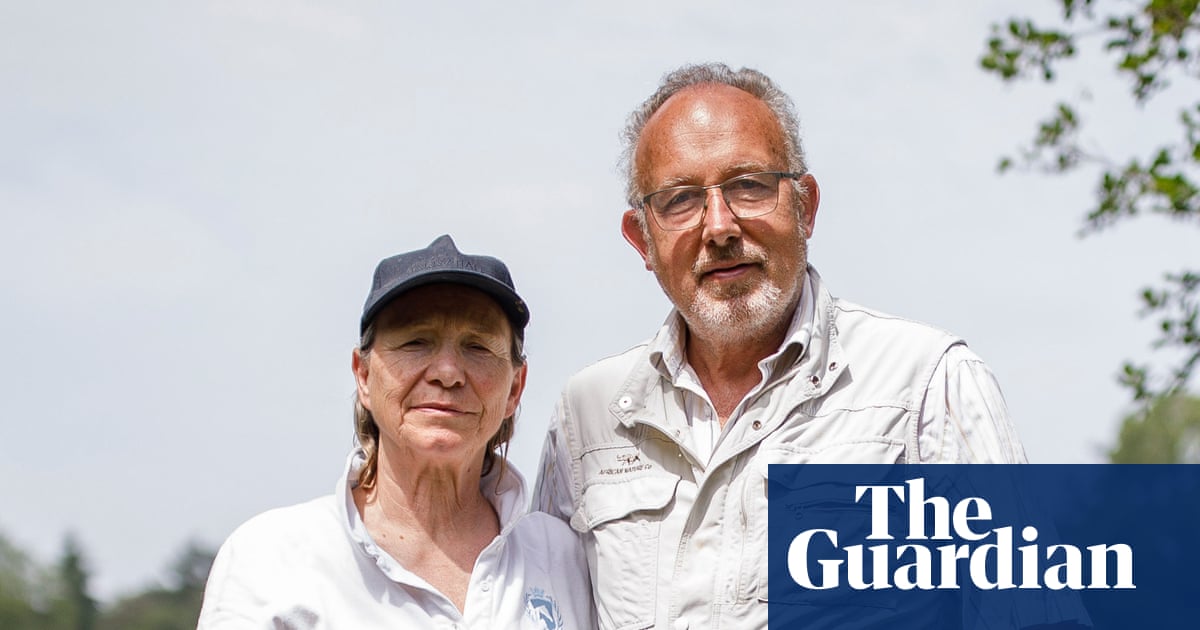
When Alistair and Diane Gould bought Furnace Brook in 2013, they had big plans. It was an idyllic spot: a stream-fed fishing lake nestled in a secluded valley in the High Weald, East Sussex, surrounded by woodland and fields. “People loved to come fishing here because it’s so beautiful,” says Diane. “Some of them had been coming for so many years that they got to know the individual fish.”
Diane moved here from Kent in 2000, when Furnace Brook was owned by a distant relative. Her two younger sons, then 10 and 14, flourished. They would chat to the anglers about the fish they were catching and throwing back in, and sell them bacon sandwiches. Her elder son, Simon, moved from London to join them in 2006 and became a keen angler himself, and then the fishing manager, or bailiff, looking after the fish and the landscape around the lake.
Diane, who is 68, and Alistair, 69, met in 2008. After Diane’s relative died, they decided to buy the property. Alistair, an ecological consultant with a background in low-carbon design, had drawn up a plan to restore the entire ecosystem of the eight-hectare (20-acre) site. But two years ago, their plans were blown out of the water.
On the morning of 20 June 2024, Alistair and Simon walked down to the lake and noticed dead fish floating on the surface. “We looked at it and thought: ‘This is a bit odd,’” says Alistair. On further inspection, almost everything in the 2.4-hectare lake was dead. “It brings tears to my eyes,” says Diane. There were at least 15 species of fish in the lake, she adds: carp, tench, bream, roach, trout and some large eels. “You get a sort of relationship with them, as living beings.” The larger fish even had names.
“It was very traumatic for us all,” Alistair continues. “Obviously for nature directly, but also seeing all these fish on the surface and the fact that Simon has been a fishery bailiff here for 15-plus years and these are his babies, and he’s just seeing them all curl up and die.”
Diane continues: “More than 2,000 fish were dead. Plus, the ones we don’t know about that sank to the bottom. The eels were climbing out of the lake to die.” Eels are pretty hardy, says Alistair; they can even travel over land if they need to. To see them gasping and dying on the banks was heartbreaking. “It was apocalyptic.”
At first, the Goulds thought it must be their fault, that they had mismanaged the fish stocks somehow. But when Alistair walked to the top of the lake, he saw that Clippenham stream, which feeds the lake, was also full of dead fish. “That’s when I twigged: ‘This isn’t us. There’s something else going on.’” It seemed clear to him that pollution was coming from somewhere upstream. “All down the stream, our friends were finding dead fish: lamprey, brown trout, freshwater mussels,” says Diane. The stream runs to the Pevensey Levels on the south coast, where water is extracted for drinking and agriculture.
They immediately called the Environment Agency (EA), the body responsible for the “protection and enhancement” of the environment in England, which visited two days later and declared it a Category 1 incident, the most severe kind, meaning it had “a serious, extensive or persistent impact on the environment, people or property”. The Goulds and their team removed 15 trailer loads of dead fish from the lake, which the EA advised them to bury. Their angling business was gone overnight. They estimate they have lost £500,000 in income so far. A biologist later estimated that the lake would take 10 to 15 years to recover. “It’s not just the loss of money,” says Alistair. “It’s the loss of the ecological function.”
The story of Furnace Brook could be Britain in microcosm. We take pride in our rural heritage, in the natural beauty of our countryside, but the illusion that it is an unspoilt, unchanging idyll is becoming ever harder to maintain. River pollution has become a national scandal. The release of sewage by privatised water companies – illegal but persistent and apparently unpoliced – has devastated landscapes throughout England. Often, we register this in terms of how picturesque our rivers are or how safe they are to swim in – how the pollution affects us directly – but beneath the surface, decades of pollution have decimated how much life they can support. According to government statistics from 2025, just 14% of England’s rivers and lakes have a “good ecological status” and every one of them is polluted with chemicals.
Illegal dumping has become a separate scandal, the scale and effects of which also seem beyond authorities’ control. In the past 12 months, there have been high-profile cases such as the 150-metre-long mountain of rubbish “discovered” in Kidlington, Oxfordshire, or the 35,000 tonnes of rubbish dumped in Hoad’s Wood, Kent, the latter of which cost an estimated £15m to clean up. In August, Andy Burnham visited another huge, foul-smelling illegal dump, in Midland Road, Bradford, where he vowed to take action, declaring: “The days of making easy money out of waste are over.” He has a (waste) mountain to climb. Over the past two decades, successive governments have loosened environmental regulations and removed protections – not least by neutering the EA.
The fact that this is happening in the countryside, sometimes in isolated areas, makes it hard to monitor or police. Furnace Brook is a symptom of all these problems, although it could also become a model for how to overcome them. The Goulds are working on a plan not only to restore the landscape, but also to show how we could reset our relationship to it in a more sustainable, nature-friendly, community-oriented way.
In the case of Furnace Brook, the water companies were not to blame. So the Goulds set out to discover what was. “I thought: ‘I bet I know exactly where that’s come from,’” says Jack (not his real name), Furnace Brook’s former ecological consultant, who has worked in the area for decades and knows the landscape intimately. He remembers walking up Clippenham stream two days after the pollution event. “It was hot weather and the whole of the valley stank. It smelled of dead fish and aquatic life. I thought: ‘It’s probably something that’s come off another property. And if any of the properties around here are likely to be doing something unpleasant like that, I’ll put money on it that I know which one it was.”
He headed about half a mile up the valley to a tributary joining the stream from a neighbouring property named Morgans Farm. “You could clearly see the water upstream [of the tributary] was totally normal, a sandy colour with clay silt in it, and what was below it had gone a blue-black colour. You could see dead brook trout, wild eels, and there was a dead crow or raven, which may well have eaten something poisonous from the river.” In some places, he says, there was a thick layer of blue-grey scum on the water, which he later learned is sometimes called “bacterial cheese”. “There’s so much nutrient [sic] in the water that it allows for a bacterial colonisation explosion.” The bacteria take up all the oxygen, which causes most of the fish, especially the older, larger ones, to die.
Jack followed the polluted tributary up through Ann Wood, a small pocket of ancient woodland on Morgans Farm. The source of the tributary seemed to be a large hole or pit at the north-west corner of the wood, in a cleared area, accessible by heavy vehicle. In one council document, it is referred to as a “slurry lagoon”. Shortly after the pollution incident, this hole was filled in and covered with waste soil. When I visited in September 2025, the area where the hole had been was obscured beneath a stack of hundreds of plastic-wrapped hay bales.
When EA officers visited in the days after the pollution event, they were shown the devastation and the suspected source of the pollution. They took water samples from various locations. One officer also visited Morgans Farm. The EA has the power to investigate and prosecute those in breach of environmental protection laws, which can result in fines or even imprisonment for offenders, but the process is notoriously slow. Investigations can take years and rarely result in meaningful penalties. More than two years later, the EA has yet to take action over the incident at Furnace Brook.
In the interim, Alistair and his team took matters into their own hands. They bought equipment to test the water for factors such as dissolved oxygen, dissolved solids and conductivity. They also tested for heavy metals, such as lead, cadmium, arsenic and mercury, which are usually a byproduct of industrial, rather than agricultural, processes. You can do crude tests for them with a paper strip that changes colour from orange through to dark purple. When they tested the water coming from Morgans Farm, it was “off the chart”, says Jack. “This went about as deep into the purple as you possibly could go.”
A year later, in July 2025, Furnace Brook sent samples of water collected from the lake to an independent testing lab. The results still found unusually high levels of heavy metals, ammonia levels that were “well outside acceptable limits for any freshwater life” and nitrogen levels that were “toxic to all aquatic life”.
What was going on at Morgans Farm? Quite a lot, according to its neighbours. Going by planning statements submitted by Morgans Farm, the owners farmed “a mix of cattle and sheep spread out over 243 hectares throughout Sussex”. Several large agricultural barns and other buildings have been constructed on the property, with planning permission. In 2022, the owners also applied for planning permission to extend an existing forestry track down one edge of Ann Wood, parallel to the suspected tributary. Permission was withheld – the woods are classified as “ancient and semi-natural woodland” and an “irreplaceable habitat” – but a 300-metre surfaced track was built anyway.
Over the years, Furnace Brook and other neighbours have seen a steady succession of tipper trucks arriving at Morgans Farm and depositing material on the land, some travelling down the new surfaced track and on to the lower part of the farm, closest to Clippenham stream. This activity preceded the pollution incident, but increased afterwards and has continued since.
Some days, trucks arrived every 10 minutes, says Jack. They would queue up, he says, pointing across the valley to the main road that passes Morgans Farm, before “travelling down and going into various different meadows and just tipping these heaps”. They have also observed material from the trucks being tipped into dug trenches in the fields, before soil is spread over the top. There is a mechanical excavator and a bulldozer on the site, says Jack: “They were using both of those flat-out, day after day, week after week, month after month, piling individual piles up into huge single piles.
“Then we noticed other activity: the excavator was making enormous, deep holes in the ground and they were bringing lorries in and emptying stuff into the holes, then using other soil from the site to cover the holes over. We were like: ‘What are they putting in? What are they digging and burying and then covering over?’ Because that’s, I believe, how the original spill took place.”
On my first visit to Furnace Book, in April 2025, large heaps of what looked like soil and manure were clearly visible on the lower fields of Morgans Farm. Jack has seen them up close. “The heaps were a very, very low grade of kind of compressed clay topsoil, sort of slag mixed with chunks of ceramic, red brick, tarmac scalpings – which are toxic to aquatic life and have to be controlled and licensed in their storage and their implementation on farmland, according to the government’s own laws. There was a lot of plastic refuse in there, plasterboard, all sorts of foreign objects, which I would not consider to be a clean, acceptable level to be putting all over permanent pasture in a protected landscape.”
When I returned in September 2025, there were even more signs of activity: previously green pastures now appeared to be barren brown fields, with soil or construction waste spread across them. “When it rains, that leaches huge amounts of very negative ammonia and nitrates into the watercourses,” Jack says. He and the Furnace Brook team have been testing the water continually since the pollution event. They have continued to find high levels of heavy metals, ammonia and long-chain hydrocarbons – compounds associated with industrial processes.
Other neighbours also say they have witnessed the trucks, sometimes as many as 30 to 40 a day, and into the night, arriving full at Morgans Farm and leaving empty. Material is now being deposited on the upper part of Morgans Farm as well. Where once there were pastures and ponds, now it is mostly bare soil and rubble. “England’s green and pleasant land,” the neighbour says sarcastically.
One of the neighbours shows me drone footage they took in March 2022 that appears to confirm Jack’s observations. It clearly shows a deep hole on Morgans Farm – about four metres in diameter and 10 metres deep – in a different location from the suspected source of the pollution incident. A large mechanical digger is scooping material out of the hole, as a truck full of an unknown substance reverses towards it.
Almost all the trucks seen bringing materials to Morgans Farm have come from one company: Robins of Herstmonceux, a family-run waste transfer company and supplier of topsoils and building materials, which has operated in the area for more than 60 years. Its vehicles are a familiar sight in the area. The company’s website claims it is “able to recycle 100% of inert waste received” and to produce and deliver “recycled materials such as crushed concrete … and screened soils”.
There are complex rules concerning what materials can and can’t be put on farmland, in what quantities and for what uses. In March 2024, three months before the pollution incident, Robins of Herstmonceux and Morgans Farm obtained what is known as a U1 exemption from the EA. This means they were permitted to use a limited amount of “suitable waste for construction projects and maintenance work” on the site: up to 5,000 tonnes of non-hazardous waste from construction over three years, for example. By Furnace Brook’s estimate, in 2025 alone, counting the number of trucks that have come into the farm, more than 15,000 tonnes of material was deposited at Morgans Farm.
Even so, this activity may not have been illegal. As well as the U1 exemption, there is another route landowners can take to import materials on to their land, known as CL:AIRE, which stands for Contaminated Land: Applications in Real Environments. The CL:AIRE scheme, a registered charity, enables the reuse of excavated material “without the need for traditional waste regulatory controls such as permits and exemptions”, according to its introductory video.
Essentially, it connects people generating large amounts of such material (construction sites, say) with people who might have a use for that soil “in a pre-identified place for a pre-identified purpose”. This makes sense from a sustainability perspective – the waste soil would otherwise go into a landfill. According to CL:AIRE, the process has plenty of checks and balances: each project requires a detailed “materials management plan” and a “qualified person” (such as the landowner) who must submit a declaration to the EA, as well as a verification report after the work is completed to confirm that it was done properly.
However, the CL:AIRE code of practice is apparently self-regulated and details of its extent or participants are opaque. Morgans Farm was mentioned as being part of the CL:AIRE scheme in a letter from the EA, but in response to requests for more details, CL:AIRE replied that “we cannot share any scheme-specific or participant-level information with you” and that “managed schemes are treated as strictly confidential”. That leaves a great many questions unanswered. How much material was Morgans Farm permitted to import under this scheme? How well was it being monitored? Where was all this material coming from? How many other properties are operating under similar conditions?
Morgans Farm and Robins of Herstmonceux were approached for comment regarding these issues, but neither responded.
Environmental groups, politicians and employees from government agencies all told me of their frustration at how powerless they are to act over what is happening at Furnace Brook and in many other cases like it, locally and nationally.
“It brought me down to earth with a bump to discover how little power a district council appears to have over such things,” says Greg Collins, a Green party councillor for Wealden district council, in which Furnace Brook is situated. Wealden is one of five district and borough councils within the county of East Sussex and at present it is under joint Green and Liberal Democrat control. (Diane Gould has been a Green party councillor for Wealden since July 2025.)
Collins continues: “My understanding is – and I am satisfied that I’ve kicked the tyres hard on this – that the district council has no effective powers in respect of the event that damaged the ecology of Furnace Brook. That is an EA matter. They own the regulatory regime that would deal with that and my understanding is that they’ve effectively gone: ‘Nothing to see here. Move along. Hey-ho, life’s a bit shit sometimes.’”
The EA investigation is showing little apparent progress, nearly two years later. In a letter last July, the EA wrote that it had visited Morgans Farm in late 2024 and early 2025, alongside other district and county council officials. “Having regard to all the circumstances, and in consultation with other agencies, we, the Environment Agency, have not found any evidence of the illegal importation of waste to Morgans Farm,” it wrote.
The EA was approached for comment and responded: “We take the incident at Furnace Brook Fishery very seriously and are progressing with our investigation. As this is an ongoing case, further details cannot be provided at this time.”
In the recent Channel 4 series Dirty Business, a docudrama that exposed water companies’ role in river pollution, the EA is portrayed as under-resourced, reluctant to take action and unhealthily close to the corporations it is supposed to police. There is evidence to support this. In January 2022, three EA officers told the Guardian the agency was increasingly unable to hold polluters to account or to improve the environment as a result of the body’s policies. Government grants to the EA have grown from £800m in 2016-17 to £1.8bn in 2024-25, but its powers apparently continue to diminish.
“Should a polluter be caught, any tools that were at [the EA’s] disposal to take action have been systematically removed,” a whistleblower said in 2022. “Officers are actively encouraged not to take enforcement action.” Another whistleblower last year revealed that the EA did not send investigators to nearly a third of reported water industry incidents in 2024. In July 2025, the EA admitted that, due to staff shortages, thousands of water samples from pollution incidents had not yet been tested, or never would be.
While water and river pollution are ostensibly the EA’s domain, matters of waste, dumping and contaminated land ought to be policed by local government. But, again, a lack of funding and resources has hampered this, says Rachel Millward, the leader of Wealden district council and the deputy leader of the Green Party in England and Wales. She says: “The basic issue is that the policy is there, but it has no teeth, because it doesn’t have funding so that the authorities who are meant to do it can do it, and then there’s no real threat of prosecution.”
Millward and other councillors point to the contaminated land regime, laid out in part 2A of the Environmental Protection Act, which requires local authorities to identify and monitor contaminated sites in their district. According to Wealden district council’s website, “there are no formally determined contaminated land sites in the Wealden District” and, owing to lack of funding, “the council is not currently pursuing strategic site inspections”. In other words, says Millward: “Councils have stopped making contaminated land registers and stopped updating them because they can’t afford to do it.”
Contaminated land is often identified only when a developer comes along and wants to build on it. Then the developer must pay for removing those contaminants; it becomes a planning matter, rather than an environmental one. But the planning system is also underfunded and incapable of monitoring such issues, according to insiders. “The planning system is designed to encourage development; it’s not designed to prevent it,” says Collins. “The rules are there to create the impression in the minds of the public that there is some sort of jeopardy if you break the rules. They are not there so that you actually experience that jeopardy.”
The pressure to build new homes only puts more strain on rural areas. To meet government targets, Wealden district council is expected to add more than 1,400 new homes a year to its housing stock. According to one planning expert, the town of Hailsham, five miles from Furnace Brook, has more than doubled in size in the past decade. Several sources wondered if there were connections between this scale of construction and the materials arriving at Morgans Farm.
A spokesperson for Wealden district council responded: “The council does not accept the assertion that planning enforcement is weak. Our planning enforcement team investigates reported breaches and takes proportionate action in line with national policy, legislation and the council’s adopted enforcement approach. Planning enforcement is intended to remedy unacceptable harm caused by breaches of planning control; it is not a mechanism for preventing development that has planning permission.”
In terms of illegal dumping, the local picture is also bleak, says Collins. “Anybody who drives around the district sees so much casual fly-tipping. If they stopped to think about it, it would be hard for them not to come to the conclusion that there is a large-scale problem.”
Other sources close to local government in East Sussex, who did not wish to be identified, are in despair at the situation. “There is so much to do with illegal waste disposal, organised criminality and the failure of agencies to apprehend these issues that it’s just depressing and extraordinary,” one insider says. “It’s so expensive to dispose of waste legally that many people attempt to do it illegally. And there are plenty of dubious arrangements to be arrived at between operators and landowners which are financially beneficial to both. It’s very difficult with our resources to keep up with those.”
Wealden district council responded that it has “one of the lowest reported levels of fly-tipping in East Sussex” and that “the number of recorded incidents in the district has fallen over the past five years”.
A report shared with the Guardian in November 2025 found that there were at least 8,000 illegal dumping sites in the UK, containing approximately 13m tonnes of rubbish. When Air & Space Evidence, the satellite company that helped compile the report, presented its findings to the EA, it said there was little interest at the management level. “From the outside, this looks like a fear of finding out. If the Environment Agency finds more illegal waste sites, then they feel they will have to do something about them. So, they would rather not know.” The EA has said it stopped activity at 743 illegal waste sites in 2024-25. It received 10,238 reports of suspected waste crime in 2025.
This March, the House of Commons’ public accounts select committee issued a report on environmental regulation in England. It concluded that the system needs to be overhauled. It stated: “We are concerned about the recent rise of illegal waste dumping. Gaps in the Environment Agency’s powers and intelligence have led to delays in responding to a problem that is out of control.”
If Furnace Brook is Britain’s polluted countryside in microcosm, it could also become a model for how to fix it. The pollution event was “a huge lag at one level, but a huge opportunity at another”, says Alistair Gould. Before the events of June 2024, his plan was to establish Furnace Brook as a “living laboratory”, a showcase for how to transform a landscape degraded by industrial farming into something richer and more resilient on every level: soil and water quality, biodiversity, food security, sustainable energy, community participation. That is still the plan, he says. They are starting several steps further back, but with a broader canvas: the Goulds recently acquired a neighbouring farm, quadrupling the size of the Furnace Brook site.
Much of Gould’s career as an environmental consultant was spent thinking about and researching these problems: clean technologies, decarbonising the environment, permaculture principles. He is plugged into what has become a global network of people pursuing similar goals and he has gathered a team of colleagues, volunteers and like-minded experts to help at Furnace Brook.
The immediate challenge is restoring the fishing lake. The emphasis is on “bioremediation”: removing pollutants and toxins using natural materials and processes – everything from plants to fungi, bacteria to rocks, explains Cassandra Shaffer, an ecological consultant from Oregon who is leading Furnace Brook’s restoration. For example, the team has been testing floating islands of straw and reeds in the lake, which use biochar – a form of charcoal – and fungi-based “mycorrhizal filtration systems” to trap sediment and encourage the proliferation of micro-organisms that digest the pollution and clean the water.
The area upstream from the lake will be a “constructed wetland” – a managed landscape of reeds, wildflowers and other plants. Particular plants have been found to be good at absorbing particular pollutants, says Shaffer. For example, species of Juncus have proved to be particularly effective at removing cadmium. “You plant specifically to the qualities of chemicals or pollutants that you find in your system.”
It sounds highly experimental, but these low-tech methods are tried and tested, says Bryan Spooner, a former colleague of Gould’s and an adviser on the project. “This is exactly how mother nature keeps our water clean. If you look at what beavers do, if you look at how an estuary works, if you look at how waterfalls operate, nature is full of examples.” If all goes to plan, these techniques should accelerate the healing of Furnace Brook’s damaged ecosystem. “You should see a very near complete remediation within 18 months,” says Shaffer.
The project is also envisioned as a teaching resource for students and organisations. That is the ethos of the “living lab” – to show other people what can be done and to give them a role in it. “We hope that the community members around us would be able to come and help us on volunteer days, and that way they get some hands-on experience,” says Shaffer.
She has worked on similar projects in the US and elsewhere in Europe and has seen how approaches benefit people as well as the landscape. “They’re faced with looking at the news and seeing everything that’s happening with these heatwaves, climate catastrophe, huge pollution spills, and it seems so out of our control and so much bigger than us.” When people are able to participate and see results such as water quality improving within a few weeks, she says: “It makes a huge difference in their mental aspect, in the way they communicate, in the way they make friends.”
Beyond the restoration, Alistair Gould sees Furnace Brook as a model for a new kind of rural community, where people jointly own and manage their landscape, to cater to local needs. “At the heart of the model is the idea that land should function as a shared foundation for regenerative activity, rather than as a commodity,” he says. “The land is bought so that aligned farmers, entrepreneurs, educators and families can steward it together, generate real value from it and use that value over time to repay the original purchase, enabling ownership to move into more permanent, community‑anchored forms and allowing the original capital to support similar projects elsewhere.”
He lays out aspects of the bigger plan: care for elderly people; cohousing projects; reconditioning dilapidated farm buildings; supporting local businesses. Food is a big part of it, including community farming, food storage and food resilience – as in preserving produce locally to feed the community in the event of an emergency, rather than growing it to sell to large, centralised suppliers.
This is effectively a reversal of the corporatised industrial model that has done so much to degrade our rural landscape, whether that be industrial farming, privatised water companies mismanaging rivers or operators dumping waste in the countryside. “It extracts from the rural areas and it doesn’t really reinvest in them,” says Spooner. “If you turn that around and start looking at the opportunities to build local community resilience, food resilience, and then looking at what that means in terms of new skills, new employment, new supply chain lines, and localising things again, the economic opportunities are massive.”
The community engagement aspect of the plan is already under way, with some help from Maarten Klop, a Dutch organiser who has developed similar initiatives in the Netherlands, organising events, bringing people together, “thinking about how to make these eco-social topics something fun and include everyone”. On a small scale, they are developing locally produced wares such as a “Clean the Lake” lager (Diane already runs a craft brewery at Furnace Brook) and a “cookie of resilience”, the profits from which will go towards the restoration, to draw people deeper into the story of the project.
There are plans for beekeeping, forest schooling, market gardening for local restaurants and community fridges and pantries. The soil consultant Michael Kennard has set up a “community compost club”, which collects food waste and turns it into nutrient-rich compost. “You don’t have much room for trying new things if you’re running a commercial farm. We have the space here to experiment and exemplify,” says Klop.
Amid a global crisis, all this may sound like a drop in the ocean, but “locally is the only place where we can fix ecological or social challenges”, says Klop. “We can plant a tree, harvest a vegetable, experience community, but if we want to change to a new system, then it needs to happen everywhere all at once. And, luckily, it’s been happening all over the world for decades already.”
In the meantime, the prospect of the Goulds receiving any compensation for the damage done to their land remains as remote as ever – they continue to await action by the EA while the truck deliveries continue to roll into Morgans Farm. But the Goulds are focusing on the future, rather than anger or despair. As much as they want to restore the land and model a sustainable rural future, they also want to see the return of the community that made Furnace Brook what it was, says Diane. “The ones who really valued this place, the ones who were really touched by it,” she says. “I really would like to see it open for them. It would be again a place of peace, tranquillity and healing.”
Read the full story at The Guardian ↗
Furnace Brook in East Sussex was home to carp, tench, bream, roach and trout – and 15 trailer-loads had to be buried. The mystery led to a neighbouring farm, and a story of waste,…
This lens runs the verified story through Cinnamon's AI — wired in the next step.
When Alistair and Diane Gould bought Furnace Brook in 2013, they had big plans. It was an idyllic spot: a stream-fed fishing lake nestled in a secluded valley in the High Weald, East Sussex, surrounded by woodland and fields. “People loved to come fishing here because it’s so beautiful,” says Diane. “Some of them had been coming for so many years that they got to know the individual fish.”
Diane moved here from Kent in 2000, when Furnace Brook was owned by a distant relative. Her two younger sons, then 10 and 14, flourished. They would chat to the anglers about the fish they were catching and throwing back in, and sell them bacon sandwiches. Her elder son, Simon, moved from London to join them in 2006 and became a keen angler himself, and then the fishing manager, or bailiff, looking after the fish and the landscape around the lake.
Diane, who is 68, and Alistair, 69, met in 2008. After Diane’s relative died, they decided to buy the property. Alistair, an ecological consultant with a background in low-carbon design, had drawn up a plan to restore the entire ecosystem of the eight-hectare (20-acre) site. But two years ago, their plans were blown out of the water.
On the morning of 20 June 2024, Alistair and Simon walked down to the lake and noticed dead fish floating on the surface. “We looked at it and thought: ‘This is a bit odd,’” says Alistair. On further inspection, almost everything in the 2.4-hectare lake was dead. “It brings tears to my eyes,” says Diane. There were at least 15 species of fish in the lake, she adds: carp, tench, bream, roach, trout and some large eels. “You get a sort of relationship with them, as living beings.” The larger fish even had names.
“It was very traumatic for us all,” Alistair continues. “Obviously for nature directly, but also seeing all these fish on the surface and the fact that Simon has been a fishery bailiff here for 15-plus years and these are his babies, and he’s just seeing them all curl up and die.”
Diane continues: “More than 2,000 fish were dead. Plus, the ones we don’t know about that sank to the bottom. The eels were climbing out of the lake to die.” Eels are pretty hardy, says Alistair; they can even travel over land if they need to. To see them gasping and dying on the banks was heartbreaking. “It was apocalyptic.”
At first, the Goulds thought it must be their fault, that they had mismanaged the fish stocks somehow. But when Alistair walked to the top of the lake, he saw that Clippenham stream, which feeds the lake, was also full of dead fish. “That’s when I twigged: ‘This isn’t us. There’s something else going on.’” It seemed clear to him that pollution was coming from somewhere upstream. “All down the stream, our friends were finding dead fish: lamprey, brown trout, freshwater mussels,” says Diane. The stream runs to the Pevensey Levels on the south coast, where water is extracted for drinking and agriculture.
They immediately called the Environment Agency (EA), the body responsible for the “protection and enhancement” of the environment in England, which visited two days later and declared it a Category 1 incident, the most severe kind, meaning it had “a serious, extensive or persistent impact on the environment, people or property”. The Goulds and their team removed 15 trailer loads of dead fish from the lake, which the EA advised them to bury. Their angling business was gone overnight. They estimate they have lost £500,000 in income so far. A biologist later estimated that the lake would take 10 to 15 years to recover. “It’s not just the loss of money,” says Alistair. “It’s the loss of the ecological function.”
The story of Furnace Brook could be Britain in microcosm. We take pride in our rural heritage, in the natural beauty of our countryside, but the illusion that it is an unspoilt, unchanging idyll is becoming ever harder to maintain. River pollution has become a national scandal. The release of sewage by privatised water companies – illegal but persistent and apparently unpoliced – has devastated landscapes throughout England. Often, we register this in terms of how picturesque our rivers are or how safe they are to swim in – how the pollution affects us directly – but beneath the surface, decades of pollution have decimated how much life they can support. According to government statistics from 2025, just 14% of England’s rivers and lakes have a “good ecological status” and every one of them is polluted with chemicals.
Illegal dumping has become a separate scandal, the scale and effects of which also seem beyond authorities’ control. In the past 12 months, there have been high-profile cases such as the 150-metre-long mountain of rubbish “discovered” in Kidlington, Oxfordshire, or the 35,000 tonnes of rubbish dumped in Hoad’s Wood, Kent, the latter of which cost an estimated £15m to clean up. In August, Andy Burnham visited another huge, foul-smelling illegal dump, in Midland Road, Bradford, where he vowed to take action, declaring: “The days of making easy money out of waste are over.” He has a (waste) mountain to climb. Over the past two decades, successive governments have loosened environmental regulations and removed protections – not least by neutering the EA.
The fact that this is happening in the countryside, sometimes in isolated areas, makes it hard to monitor or police. Furnace Brook is a symptom of all these problems, although it could also become a model for how to overcome them. The Goulds are working on a plan not only to restore the landscape, but also to show how we could reset our relationship to it in a more sustainable, nature-friendly, community-oriented way.
In the case of Furnace Brook, the water companies were not to blame. So the Goulds set out to discover what was. “I thought: ‘I bet I know exactly where that’s come from,’” says Jack (not his real name), Furnace Brook’s former ecological consultant, who has worked in the area for decades and knows the landscape intimately. He remembers walking up Clippenham stream two days after the pollution event. “It was hot weather and the whole of the valley stank. It smelled of dead fish and aquatic life. I thought: ‘It’s probably something that’s come off another property. And if any of the properties around here are likely to be doing something unpleasant like that, I’ll put money on it that I know which one it was.”
He headed about half a mile up the valley to a tributary joining the stream from a neighbouring property named Morgans Farm. “You could clearly see the water upstream [of the tributary] was totally normal, a sandy colour with clay silt in it, and what was below it had gone a blue-black colour. You could see dead brook trout, wild eels, and there was a dead crow or raven, which may well have eaten something poisonous from the river.” In some places, he says, there was a thick layer of blue-grey scum on the water, which he later learned is sometimes called “bacterial cheese”. “There’s so much nutrient [sic] in the water that it allows for a bacterial colonisation explosion.” The bacteria take up all the oxygen, which causes most of the fish, especially the older, larger ones, to die.
Jack followed the polluted tributary up through Ann Wood, a small pocket of ancient woodland on Morgans Farm. The source of the tributary seemed to be a large hole or pit at the north-west corner of the wood, in a cleared area, accessible by heavy vehicle. In one council document, it is referred to as a “slurry lagoon”. Shortly after the pollution incident, this hole was filled in and covered with waste soil. When I visited in September 2025, the area where the hole had been was obscured beneath a stack of hundreds of plastic-wrapped hay bales.
When EA officers visited in the days after the pollution event, they were shown the devastation and the suspected source of the pollution. They took water samples from various locations. One officer also visited Morgans Farm. The EA has the power to investigate and prosecute those in breach of environmental protection laws, which can result in fines or even imprisonment for offenders, but the process is notoriously slow. Investigations can take years and rarely result in meaningful penalties. More than two years later, the EA has yet to take action over the incident at Furnace Brook.
In the interim, Alistair and his team took matters into their own hands. They bought equipment to test the water for factors such as dissolved oxygen, dissolved solids and conductivity. They also tested for heavy metals, such as lead, cadmium, arsenic and mercury, which are usually a byproduct of industrial, rather than agricultural, processes. You can do crude tests for them with a paper strip that changes colour from orange through to dark purple. When they tested the water coming from Morgans Farm, it was “off the chart”, says Jack. “This went about as deep into the purple as you possibly could go.”
A year later, in July 2025, Furnace Brook sent samples of water collected from the lake to an independent testing lab. The results still found unusually high levels of heavy metals, ammonia levels that were “well outside acceptable limits for any freshwater life” and nitrogen levels that were “toxic to all aquatic life”.
What was going on at Morgans Farm? Quite a lot, according to its neighbours. Going by planning statements submitted by Morgans Farm, the owners farmed “a mix of cattle and sheep spread out over 243 hectares throughout Sussex”. Several large agricultural barns and other buildings have been constructed on the property, with planning permission. In 2022, the owners also applied for planning permission to extend an existing forestry track down one edge of Ann Wood, parallel to the suspected tributary. Permission was withheld – the woods are classified as “ancient and semi-natural woodland” and an “irreplaceable habitat” – but a 300-metre surfaced track was built anyway.
Over the years, Furnace Brook and other neighbours have seen a steady succession of tipper trucks arriving at Morgans Farm and depositing material on the land, some travelling down the new surfaced track and on to the lower part of the farm, closest to Clippenham stream. This activity preceded the pollution incident, but increased afterwards and has continued since.
Some days, trucks arrived every 10 minutes, says Jack. They would queue up, he says, pointing across the valley to the main road that passes Morgans Farm, before “travelling down and going into various different meadows and just tipping these heaps”. They have also observed material from the trucks being tipped into dug trenches in the fields, before soil is spread over the top. There is a mechanical excavator and a bulldozer on the site, says Jack: “They were using both of those flat-out, day after day, week after week, month after month, piling individual piles up into huge single piles.
“Then we noticed other activity: the excavator was making enormous, deep holes in the ground and they were bringing lorries in and emptying stuff into the holes, then using other soil from the site to cover the holes over. We were like: ‘What are they putting in? What are they digging and burying and then covering over?’ Because that’s, I believe, how the original spill took place.”
On my first visit to Furnace Book, in April 2025, large heaps of what looked like soil and manure were clearly visible on the lower fields of Morgans Farm. Jack has seen them up close. “The heaps were a very, very low grade of kind of compressed clay topsoil, sort of slag mixed with chunks of ceramic, red brick, tarmac scalpings – which are toxic to aquatic life and have to be controlled and licensed in their storage and their implementation on farmland, according to the government’s own laws. There was a lot of plastic refuse in there, plasterboard, all sorts of foreign objects, which I would not consider to be a clean, acceptable level to be putting all over permanent pasture in a protected landscape.”
When I returned in September 2025, there were even more signs of activity: previously green pastures now appeared to be barren brown fields, with soil or construction waste spread across them. “When it rains, that leaches huge amounts of very negative ammonia and nitrates into the watercourses,” Jack says. He and the Furnace Brook team have been testing the water continually since the pollution event. They have continued to find high levels of heavy metals, ammonia and long-chain hydrocarbons – compounds associated with industrial processes.
Other neighbours also say they have witnessed the trucks, sometimes as many as 30 to 40 a day, and into the night, arriving full at Morgans Farm and leaving empty. Material is now being deposited on the upper part of Morgans Farm as well. Where once there were pastures and ponds, now it is mostly bare soil and rubble. “England’s green and pleasant land,” the neighbour says sarcastically.
One of the neighbours shows me drone footage they took in March 2022 that appears to confirm Jack’s observations. It clearly shows a deep hole on Morgans Farm – about four metres in diameter and 10 metres deep – in a different location from the suspected source of the pollution incident. A large mechanical digger is scooping material out of the hole, as a truck full of an unknown substance reverses towards it.
Almost all the trucks seen bringing materials to Morgans Farm have come from one company: Robins of Herstmonceux, a family-run waste transfer company and supplier of topsoils and building materials, which has operated in the area for more than 60 years. Its vehicles are a familiar sight in the area. The company’s website claims it is “able to recycle 100% of inert waste received” and to produce and deliver “recycled materials such as crushed concrete … and screened soils”.
There are complex rules concerning what materials can and can’t be put on farmland, in what quantities and for what uses. In March 2024, three months before the pollution incident, Robins of Herstmonceux and Morgans Farm obtained what is known as a U1 exemption from the EA. This means they were permitted to use a limited amount of “suitable waste for construction projects and maintenance work” on the site: up to 5,000 tonnes of non-hazardous waste from construction over three years, for example. By Furnace Brook’s estimate, in 2025 alone, counting the number of trucks that have come into the farm, more than 15,000 tonnes of material was deposited at Morgans Farm.
Even so, this activity may not have been illegal. As well as the U1 exemption, there is another route landowners can take to import materials on to their land, known as CL:AIRE, which stands for Contaminated Land: Applications in Real Environments. The CL:AIRE scheme, a registered charity, enables the reuse of excavated material “without the need for traditional waste regulatory controls such as permits and exemptions”, according to its introductory video.
Essentially, it connects people generating large amounts of such material (construction sites, say) with people who might have a use for that soil “in a pre-identified place for a pre-identified purpose”. This makes sense from a sustainability perspective – the waste soil would otherwise go into a landfill. According to CL:AIRE, the process has plenty of checks and balances: each project requires a detailed “materials management plan” and a “qualified person” (such as the landowner) who must submit a declaration to the EA, as well as a verification report after the work is completed to confirm that it was done properly.
However, the CL:AIRE code of practice is apparently self-regulated and details of its extent or participants are opaque. Morgans Farm was mentioned as being part of the CL:AIRE scheme in a letter from the EA, but in response to requests for more details, CL:AIRE replied that “we cannot share any scheme-specific or participant-level information with you” and that “managed schemes are treated as strictly confidential”. That leaves a great many questions unanswered. How much material was Morgans Farm permitted to import under this scheme? How well was it being monitored? Where was all this material coming from? How many other properties are operating under similar conditions?
Morgans Farm and Robins of Herstmonceux were approached for comment regarding these issues, but neither responded.
Environmental groups, politicians and employees from government agencies all told me of their frustration at how powerless they are to act over what is happening at Furnace Brook and in many other cases like it, locally and nationally.
“It brought me down to earth with a bump to discover how little power a district council appears to have over such things,” says Greg Collins, a Green party councillor for Wealden district council, in which Furnace Brook is situated. Wealden is one of five district and borough councils within the county of East Sussex and at present it is under joint Green and Liberal Democrat control. (Diane Gould has been a Green party councillor for Wealden since July 2025.)
Collins continues: “My understanding is – and I am satisfied that I’ve kicked the tyres hard on this – that the district council has no effective powers in respect of the event that damaged the ecology of Furnace Brook. That is an EA matter. They own the regulatory regime that would deal with that and my understanding is that they’ve effectively gone: ‘Nothing to see here. Move along. Hey-ho, life’s a bit shit sometimes.’”
The EA investigation is showing little apparent progress, nearly two years later. In a letter last July, the EA wrote that it had visited Morgans Farm in late 2024 and early 2025, alongside other district and county council officials. “Having regard to all the circumstances, and in consultation with other agencies, we, the Environment Agency, have not found any evidence of the illegal importation of waste to Morgans Farm,” it wrote.
The EA was approached for comment and responded: “We take the incident at Furnace Brook Fishery very seriously and are progressing with our investigation. As this is an ongoing case, further details cannot be provided at this time.”
In the recent Channel 4 series Dirty Business, a docudrama that exposed water companies’ role in river pollution, the EA is portrayed as under-resourced, reluctant to take action and unhealthily close to the corporations it is supposed to police. There is evidence to support this. In January 2022, three EA officers told the Guardian the agency was increasingly unable to hold polluters to account or to improve the environment as a result of the body’s policies. Government grants to the EA have grown from £800m in 2016-17 to £1.8bn in 2024-25, but its powers apparently continue to diminish.
“Should a polluter be caught, any tools that were at [the EA’s] disposal to take action have been systematically removed,” a whistleblower said in 2022. “Officers are actively encouraged not to take enforcement action.” Another whistleblower last year revealed that the EA did not send investigators to nearly a third of reported water industry incidents in 2024. In July 2025, the EA admitted that, due to staff shortages, thousands of water samples from pollution incidents had not yet been tested, or never would be.
While water and river pollution are ostensibly the EA’s domain, matters of waste, dumping and contaminated land ought to be policed by local government. But, again, a lack of funding and resources has hampered this, says Rachel Millward, the leader of Wealden district council and the deputy leader of the Green Party in England and Wales. She says: “The basic issue is that the policy is there, but it has no teeth, because it doesn’t have funding so that the authorities who are meant to do it can do it, and then there’s no real threat of prosecution.”
Millward and other councillors point to the contaminated land regime, laid out in part 2A of the Environmental Protection Act, which requires local authorities to identify and monitor contaminated sites in their district. According to Wealden district council’s website, “there are no formally determined contaminated land sites in the Wealden District” and, owing to lack of funding, “the council is not currently pursuing strategic site inspections”. In other words, says Millward: “Councils have stopped making contaminated land registers and stopped updating them because they can’t afford to do it.”
Contaminated land is often identified only when a developer comes along and wants to build on it. Then the developer must pay for removing those contaminants; it becomes a planning matter, rather than an environmental one. But the planning system is also underfunded and incapable of monitoring such issues, according to insiders. “The planning system is designed to encourage development; it’s not designed to prevent it,” says Collins. “The rules are there to create the impression in the minds of the public that there is some sort of jeopardy if you break the rules. They are not there so that you actually experience that jeopardy.”
The pressure to build new homes only puts more strain on rural areas. To meet government targets, Wealden district council is expected to add more than 1,400 new homes a year to its housing stock. According to one planning expert, the town of Hailsham, five miles from Furnace Brook, has more than doubled in size in the past decade. Several sources wondered if there were connections between this scale of construction and the materials arriving at Morgans Farm.
A spokesperson for Wealden district council responded: “The council does not accept the assertion that planning enforcement is weak. Our planning enforcement team investigates reported breaches and takes proportionate action in line with national policy, legislation and the council’s adopted enforcement approach. Planning enforcement is intended to remedy unacceptable harm caused by breaches of planning control; it is not a mechanism for preventing development that has planning permission.”
In terms of illegal dumping, the local picture is also bleak, says Collins. “Anybody who drives around the district sees so much casual fly-tipping. If they stopped to think about it, it would be hard for them not to come to the conclusion that there is a large-scale problem.”
Other sources close to local government in East Sussex, who did not wish to be identified, are in despair at the situation. “There is so much to do with illegal waste disposal, organised criminality and the failure of agencies to apprehend these issues that it’s just depressing and extraordinary,” one insider says. “It’s so expensive to dispose of waste legally that many people attempt to do it illegally. And there are plenty of dubious arrangements to be arrived at between operators and landowners which are financially beneficial to both. It’s very difficult with our resources to keep up with those.”
Wealden district council responded that it has “one of the lowest reported levels of fly-tipping in East Sussex” and that “the number of recorded incidents in the district has fallen over the past five years”.
A report shared with the Guardian in November 2025 found that there were at least 8,000 illegal dumping sites in the UK, containing approximately 13m tonnes of rubbish. When Air & Space Evidence, the satellite company that helped compile the report, presented its findings to the EA, it said there was little interest at the management level. “From the outside, this looks like a fear of finding out. If the Environment Agency finds more illegal waste sites, then they feel they will have to do something about them. So, they would rather not know.” The EA has said it stopped activity at 743 illegal waste sites in 2024-25. It received 10,238 reports of suspected waste crime in 2025.
This March, the House of Commons’ public accounts select committee issued a report on environmental regulation in England. It concluded that the system needs to be overhauled. It stated: “We are concerned about the recent rise of illegal waste dumping. Gaps in the Environment Agency’s powers and intelligence have led to delays in responding to a problem that is out of control.”
If Furnace Brook is Britain’s polluted countryside in microcosm, it could also become a model for how to fix it. The pollution event was “a huge lag at one level, but a huge opportunity at another”, says Alistair Gould. Before the events of June 2024, his plan was to establish Furnace Brook as a “living laboratory”, a showcase for how to transform a landscape degraded by industrial farming into something richer and more resilient on every level: soil and water quality, biodiversity, food security, sustainable energy, community participation. That is still the plan, he says. They are starting several steps further back, but with a broader canvas: the Goulds recently acquired a neighbouring farm, quadrupling the size of the Furnace Brook site.
Much of Gould’s career as an environmental consultant was spent thinking about and researching these problems: clean technologies, decarbonising the environment, permaculture principles. He is plugged into what has become a global network of people pursuing similar goals and he has gathered a team of colleagues, volunteers and like-minded experts to help at Furnace Brook.
The immediate challenge is restoring the fishing lake. The emphasis is on “bioremediation”: removing pollutants and toxins using natural materials and processes – everything from plants to fungi, bacteria to rocks, explains Cassandra Shaffer, an ecological consultant from Oregon who is leading Furnace Brook’s restoration. For example, the team has been testing floating islands of straw and reeds in the lake, which use biochar – a form of charcoal – and fungi-based “mycorrhizal filtration systems” to trap sediment and encourage the proliferation of micro-organisms that digest the pollution and clean the water.
The area upstream from the lake will be a “constructed wetland” – a managed landscape of reeds, wildflowers and other plants. Particular plants have been found to be good at absorbing particular pollutants, says Shaffer. For example, species of Juncus have proved to be particularly effective at removing cadmium. “You plant specifically to the qualities of chemicals or pollutants that you find in your system.”
It sounds highly experimental, but these low-tech methods are tried and tested, says Bryan Spooner, a former colleague of Gould’s and an adviser on the project. “This is exactly how mother nature keeps our water clean. If you look at what beavers do, if you look at how an estuary works, if you look at how waterfalls operate, nature is full of examples.” If all goes to plan, these techniques should accelerate the healing of Furnace Brook’s damaged ecosystem. “You should see a very near complete remediation within 18 months,” says Shaffer.
The project is also envisioned as a teaching resource for students and organisations. That is the ethos of the “living lab” – to show other people what can be done and to give them a role in it. “We hope that the community members around us would be able to come and help us on volunteer days, and that way they get some hands-on experience,” says Shaffer.
She has worked on similar projects in the US and elsewhere in Europe and has seen how approaches benefit people as well as the landscape. “They’re faced with looking at the news and seeing everything that’s happening with these heatwaves, climate catastrophe, huge pollution spills, and it seems so out of our control and so much bigger than us.” When people are able to participate and see results such as water quality improving within a few weeks, she says: “It makes a huge difference in their mental aspect, in the way they communicate, in the way they make friends.”
Beyond the restoration, Alistair Gould sees Furnace Brook as a model for a new kind of rural community, where people jointly own and manage their landscape, to cater to local needs. “At the heart of the model is the idea that land should function as a shared foundation for regenerative activity, rather than as a commodity,” he says. “The land is bought so that aligned farmers, entrepreneurs, educators and families can steward it together, generate real value from it and use that value over time to repay the original purchase, enabling ownership to move into more permanent, community‑anchored forms and allowing the original capital to support similar projects elsewhere.”
He lays out aspects of the bigger plan: care for elderly people; cohousing projects; reconditioning dilapidated farm buildings; supporting local businesses. Food is a big part of it, including community farming, food storage and food resilience – as in preserving produce locally to feed the community in the event of an emergency, rather than growing it to sell to large, centralised suppliers.
This is effectively a reversal of the corporatised industrial model that has done so much to degrade our rural landscape, whether that be industrial farming, privatised water companies mismanaging rivers or operators dumping waste in the countryside. “It extracts from the rural areas and it doesn’t really reinvest in them,” says Spooner. “If you turn that around and start looking at the opportunities to build local community resilience, food resilience, and then looking at what that means in terms of new skills, new employment, new supply chain lines, and localising things again, the economic opportunities are massive.”
The community engagement aspect of the plan is already under way, with some help from Maarten Klop, a Dutch organiser who has developed similar initiatives in the Netherlands, organising events, bringing people together, “thinking about how to make these eco-social topics something fun and include everyone”. On a small scale, they are developing locally produced wares such as a “Clean the Lake” lager (Diane already runs a craft brewery at Furnace Brook) and a “cookie of resilience”, the profits from which will go towards the restoration, to draw people deeper into the story of the project.
There are plans for beekeeping, forest schooling, market gardening for local restaurants and community fridges and pantries. The soil consultant Michael Kennard has set up a “community compost club”, which collects food waste and turns it into nutrient-rich compost. “You don’t have much room for trying new things if you’re running a commercial farm. We have the space here to experiment and exemplify,” says Klop.
Amid a global crisis, all this may sound like a drop in the ocean, but “locally is the only place where we can fix ecological or social challenges”, says Klop. “We can plant a tree, harvest a vegetable, experience community, but if we want to change to a new system, then it needs to happen everywhere all at once. And, luckily, it’s been happening all over the world for decades already.”
In the meantime, the prospect of the Goulds receiving any compensation for the damage done to their land remains as remote as ever – they continue to await action by the EA while the truck deliveries continue to roll into Morgans Farm. But the Goulds are focusing on the future, rather than anger or despair. As much as they want to restore the land and model a sustainable rural future, they also want to see the return of the community that made Furnace Brook what it was, says Diane. “The ones who really valued this place, the ones who were really touched by it,” she says. “I really would like to see it open for them. It would be again a place of peace, tranquillity and healing.”
Read the full story at The Guardian ↗
When Alistair and Diane Gould bought Furnace Brook in 2013, they had big plans. It was an idyllic spot: a stream-fed fishing lake nestled in a secluded valley in the High Weald, East Sussex, surrounded by woodland and fields. “People loved to come fishing here because it’s so beautiful,” says Diane. “Some of them had been coming for so many years that they got to know the individual fish.”
Diane moved here from Kent in 2000, when Furnace Brook was owned by a distant relative. Her two younger sons, then 10 and 14, flourished. They would chat to the anglers about the fish they were catching and throwing back in, and sell them bacon sandwiches. Her elder son, Simon, moved from London to join them in 2006 and became a keen angler himself, and then the fishing manager, or bailiff, looking after the fish and the landscape around the lake.
Diane, who is 68, and Alistair, 69, met in 2008. After Diane’s relative died, they decided to buy the property. Alistair, an ecological consultant with a background in low-carbon design, had drawn up a plan to restore the entire ecosystem of the eight-hectare (20-acre) site. But two years ago, their plans were blown out of the water.
On the morning of 20 June 2024, Alistair and Simon walked down to the lake and noticed dead fish floating on the surface. “We looked at it and thought: ‘This is a bit odd,’” says Alistair. On further inspection, almost everything in the 2.4-hectare lake was dead. “It brings tears to my eyes,” says Diane. There were at least 15 species of fish in the lake, she adds: carp, tench, bream, roach, trout and some large eels. “You get a sort of relationship with them, as living beings.” The larger fish even had names.
“It was very traumatic for us all,” Alistair continues. “Obviously for nature directly, but also seeing all these fish on the surface and the fact that Simon has been a fishery bailiff here for 15-plus years and these are his babies, and he’s just seeing them all curl up and die.”
Diane continues: “More than 2,000 fish were dead. Plus, the ones we don’t know about that sank to the bottom. The eels were climbing out of the lake to die.” Eels are pretty hardy, says Alistair; they can even travel over land if they need to. To see them gasping and dying on the banks was heartbreaking. “It was apocalyptic.”
At first, the Goulds thought it must be their fault, that they had mismanaged the fish stocks somehow. But when Alistair walked to the top of the lake, he saw that Clippenham stream, which feeds the lake, was also full of dead fish. “That’s when I twigged: ‘This isn’t us. There’s something else going on.’” It seemed clear to him that pollution was coming from somewhere upstream. “All down the stream, our friends were finding dead fish: lamprey, brown trout, freshwater mussels,” says Diane. The stream runs to the Pevensey Levels on the south coast, where water is extracted for drinking and agriculture.
They immediately called the Environment Agency (EA), the body responsible for the “protection and enhancement” of the environment in England, which visited two days later and declared it a Category 1 incident, the most severe kind, meaning it had “a serious, extensive or persistent impact on the environment, people or property”. The Goulds and their team removed 15 trailer loads of dead fish from the lake, which the EA advised them to bury. Their angling business was gone overnight. They estimate they have lost £500,000 in income so far. A biologist later estimated that the lake would take 10 to 15 years to recover. “It’s not just the loss of money,” says Alistair. “It’s the loss of the ecological function.”
The story of Furnace Brook could be Britain in microcosm. We take pride in our rural heritage, in the natural beauty of our countryside, but the illusion that it is an unspoilt, unchanging idyll is becoming ever harder to maintain. River pollution has become a national scandal. The release of sewage by privatised water companies – illegal but persistent and apparently unpoliced – has devastated landscapes throughout England. Often, we register this in terms of how picturesque our rivers are or how safe they are to swim in – how the pollution affects us directly – but beneath the surface, decades of pollution have decimated how much life they can support. According to government statistics from 2025, just 14% of England’s rivers and lakes have a “good ecological status” and every one of them is polluted with chemicals.
Illegal dumping has become a separate scandal, the scale and effects of which also seem beyond authorities’ control. In the past 12 months, there have been high-profile cases such as the 150-metre-long mountain of rubbish “discovered” in Kidlington, Oxfordshire, or the 35,000 tonnes of rubbish dumped in Hoad’s Wood, Kent, the latter of which cost an estimated £15m to clean up. In August, Andy Burnham visited another huge, foul-smelling illegal dump, in Midland Road, Bradford, where he vowed to take action, declaring: “The days of making easy money out of waste are over.” He has a (waste) mountain to climb. Over the past two decades, successive governments have loosened environmental regulations and removed protections – not least by neutering the EA.
The fact that this is happening in the countryside, sometimes in isolated areas, makes it hard to monitor or police. Furnace Brook is a symptom of all these problems, although it could also become a model for how to overcome them. The Goulds are working on a plan not only to restore the landscape, but also to show how we could reset our relationship to it in a more sustainable, nature-friendly, community-oriented way.
In the case of Furnace Brook, the water companies were not to blame. So the Goulds set out to discover what was. “I thought: ‘I bet I know exactly where that’s come from,’” says Jack (not his real name), Furnace Brook’s former ecological consultant, who has worked in the area for decades and knows the landscape intimately. He remembers walking up Clippenham stream two days after the pollution event. “It was hot weather and the whole of the valley stank. It smelled of dead fish and aquatic life. I thought: ‘It’s probably something that’s come off another property. And if any of the properties around here are likely to be doing something unpleasant like that, I’ll put money on it that I know which one it was.”
He headed about half a mile up the valley to a tributary joining the stream from a neighbouring property named Morgans Farm. “You could clearly see the water upstream [of the tributary] was totally normal, a sandy colour with clay silt in it, and what was below it had gone a blue-black colour. You could see dead brook trout, wild eels, and there was a dead crow or raven, which may well have eaten something poisonous from the river.” In some places, he says, there was a thick layer of blue-grey scum on the water, which he later learned is sometimes called “bacterial cheese”. “There’s so much nutrient [sic] in the water that it allows for a bacterial colonisation explosion.” The bacteria take up all the oxygen, which causes most of the fish, especially the older, larger ones, to die.
Jack followed the polluted tributary up through Ann Wood, a small pocket of ancient woodland on Morgans Farm. The source of the tributary seemed to be a large hole or pit at the north-west corner of the wood, in a cleared area, accessible by heavy vehicle. In one council document, it is referred to as a “slurry lagoon”. Shortly after the pollution incident, this hole was filled in and covered with waste soil. When I visited in September 2025, the area where the hole had been was obscured beneath a stack of hundreds of plastic-wrapped hay bales.
When EA officers visited in the days after the pollution event, they were shown the devastation and the suspected source of the pollution. They took water samples from various locations. One officer also visited Morgans Farm. The EA has the power to investigate and prosecute those in breach of environmental protection laws, which can result in fines or even imprisonment for offenders, but the process is notoriously slow. Investigations can take years and rarely result in meaningful penalties. More than two years later, the EA has yet to take action over the incident at Furnace Brook.
In the interim, Alistair and his team took matters into their own hands. They bought equipment to test the water for factors such as dissolved oxygen, dissolved solids and conductivity. They also tested for heavy metals, such as lead, cadmium, arsenic and mercury, which are usually a byproduct of industrial, rather than agricultural, processes. You can do crude tests for them with a paper strip that changes colour from orange through to dark purple. When they tested the water coming from Morgans Farm, it was “off the chart”, says Jack. “This went about as deep into the purple as you possibly could go.”
A year later, in July 2025, Furnace Brook sent samples of water collected from the lake to an independent testing lab. The results still found unusually high levels of heavy metals, ammonia levels that were “well outside acceptable limits for any freshwater life” and nitrogen levels that were “toxic to all aquatic life”.
What was going on at Morgans Farm? Quite a lot, according to its neighbours. Going by planning statements submitted by Morgans Farm, the owners farmed “a mix of cattle and sheep spread out over 243 hectares throughout Sussex”. Several large agricultural barns and other buildings have been constructed on the property, with planning permission. In 2022, the owners also applied for planning permission to extend an existing forestry track down one edge of Ann Wood, parallel to the suspected tributary. Permission was withheld – the woods are classified as “ancient and semi-natural woodland” and an “irreplaceable habitat” – but a 300-metre surfaced track was built anyway.
Over the years, Furnace Brook and other neighbours have seen a steady succession of tipper trucks arriving at Morgans Farm and depositing material on the land, some travelling down the new surfaced track and on to the lower part of the farm, closest to Clippenham stream. This activity preceded the pollution incident, but increased afterwards and has continued since.
Some days, trucks arrived every 10 minutes, says Jack. They would queue up, he says, pointing across the valley to the main road that passes Morgans Farm, before “travelling down and going into various different meadows and just tipping these heaps”. They have also observed material from the trucks being tipped into dug trenches in the fields, before soil is spread over the top. There is a mechanical excavator and a bulldozer on the site, says Jack: “They were using both of those flat-out, day after day, week after week, month after month, piling individual piles up into huge single piles.
“Then we noticed other activity: the excavator was making enormous, deep holes in the ground and they were bringing lorries in and emptying stuff into the holes, then using other soil from the site to cover the holes over. We were like: ‘What are they putting in? What are they digging and burying and then covering over?’ Because that’s, I believe, how the original spill took place.”
On my first visit to Furnace Book, in April 2025, large heaps of what looked like soil and manure were clearly visible on the lower fields of Morgans Farm. Jack has seen them up close. “The heaps were a very, very low grade of kind of compressed clay topsoil, sort of slag mixed with chunks of ceramic, red brick, tarmac scalpings – which are toxic to aquatic life and have to be controlled and licensed in their storage and their implementation on farmland, according to the government’s own laws. There was a lot of plastic refuse in there, plasterboard, all sorts of foreign objects, which I would not consider to be a clean, acceptable level to be putting all over permanent pasture in a protected landscape.”
When I returned in September 2025, there were even more signs of activity: previously green pastures now appeared to be barren brown fields, with soil or construction waste spread across them. “When it rains, that leaches huge amounts of very negative ammonia and nitrates into the watercourses,” Jack says. He and the Furnace Brook team have been testing the water continually since the pollution event. They have continued to find high levels of heavy metals, ammonia and long-chain hydrocarbons – compounds associated with industrial processes.
Other neighbours also say they have witnessed the trucks, sometimes as many as 30 to 40 a day, and into the night, arriving full at Morgans Farm and leaving empty. Material is now being deposited on the upper part of Morgans Farm as well. Where once there were pastures and ponds, now it is mostly bare soil and rubble. “England’s green and pleasant land,” the neighbour says sarcastically.
One of the neighbours shows me drone footage they took in March 2022 that appears to confirm Jack’s observations. It clearly shows a deep hole on Morgans Farm – about four metres in diameter and 10 metres deep – in a different location from the suspected source of the pollution incident. A large mechanical digger is scooping material out of the hole, as a truck full of an unknown substance reverses towards it.
Almost all the trucks seen bringing materials to Morgans Farm have come from one company: Robins of Herstmonceux, a family-run waste transfer company and supplier of topsoils and building materials, which has operated in the area for more than 60 years. Its vehicles are a familiar sight in the area. The company’s website claims it is “able to recycle 100% of inert waste received” and to produce and deliver “recycled materials such as crushed concrete … and screened soils”.
There are complex rules concerning what materials can and can’t be put on farmland, in what quantities and for what uses. In March 2024, three months before the pollution incident, Robins of Herstmonceux and Morgans Farm obtained what is known as a U1 exemption from the EA. This means they were permitted to use a limited amount of “suitable waste for construction projects and maintenance work” on the site: up to 5,000 tonnes of non-hazardous waste from construction over three years, for example. By Furnace Brook’s estimate, in 2025 alone, counting the number of trucks that have come into the farm, more than 15,000 tonnes of material was deposited at Morgans Farm.
Even so, this activity may not have been illegal. As well as the U1 exemption, there is another route landowners can take to import materials on to their land, known as CL:AIRE, which stands for Contaminated Land: Applications in Real Environments. The CL:AIRE scheme, a registered charity, enables the reuse of excavated material “without the need for traditional waste regulatory controls such as permits and exemptions”, according to its introductory video.
Essentially, it connects people generating large amounts of such material (construction sites, say) with people who might have a use for that soil “in a pre-identified place for a pre-identified purpose”. This makes sense from a sustainability perspective – the waste soil would otherwise go into a landfill. According to CL:AIRE, the process has plenty of checks and balances: each project requires a detailed “materials management plan” and a “qualified person” (such as the landowner) who must submit a declaration to the EA, as well as a verification report after the work is completed to confirm that it was done properly.
However, the CL:AIRE code of practice is apparently self-regulated and details of its extent or participants are opaque. Morgans Farm was mentioned as being part of the CL:AIRE scheme in a letter from the EA, but in response to requests for more details, CL:AIRE replied that “we cannot share any scheme-specific or participant-level information with you” and that “managed schemes are treated as strictly confidential”. That leaves a great many questions unanswered. How much material was Morgans Farm permitted to import under this scheme? How well was it being monitored? Where was all this material coming from? How many other properties are operating under similar conditions?
Morgans Farm and Robins of Herstmonceux were approached for comment regarding these issues, but neither responded.
Environmental groups, politicians and employees from government agencies all told me of their frustration at how powerless they are to act over what is happening at Furnace Brook and in many other cases like it, locally and nationally.
“It brought me down to earth with a bump to discover how little power a district council appears to have over such things,” says Greg Collins, a Green party councillor for Wealden district council, in which Furnace Brook is situated. Wealden is one of five district and borough councils within the county of East Sussex and at present it is under joint Green and Liberal Democrat control. (Diane Gould has been a Green party councillor for Wealden since July 2025.)
Collins continues: “My understanding is – and I am satisfied that I’ve kicked the tyres hard on this – that the district council has no effective powers in respect of the event that damaged the ecology of Furnace Brook. That is an EA matter. They own the regulatory regime that would deal with that and my understanding is that they’ve effectively gone: ‘Nothing to see here. Move along. Hey-ho, life’s a bit shit sometimes.’”
The EA investigation is showing little apparent progress, nearly two years later. In a letter last July, the EA wrote that it had visited Morgans Farm in late 2024 and early 2025, alongside other district and county council officials. “Having regard to all the circumstances, and in consultation with other agencies, we, the Environment Agency, have not found any evidence of the illegal importation of waste to Morgans Farm,” it wrote.
The EA was approached for comment and responded: “We take the incident at Furnace Brook Fishery very seriously and are progressing with our investigation. As this is an ongoing case, further details cannot be provided at this time.”
In the recent Channel 4 series Dirty Business, a docudrama that exposed water companies’ role in river pollution, the EA is portrayed as under-resourced, reluctant to take action and unhealthily close to the corporations it is supposed to police. There is evidence to support this. In January 2022, three EA officers told the Guardian the agency was increasingly unable to hold polluters to account or to improve the environment as a result of the body’s policies. Government grants to the EA have grown from £800m in 2016-17 to £1.8bn in 2024-25, but its powers apparently continue to diminish.
“Should a polluter be caught, any tools that were at [the EA’s] disposal to take action have been systematically removed,” a whistleblower said in 2022. “Officers are actively encouraged not to take enforcement action.” Another whistleblower last year revealed that the EA did not send investigators to nearly a third of reported water industry incidents in 2024. In July 2025, the EA admitted that, due to staff shortages, thousands of water samples from pollution incidents had not yet been tested, or never would be.
While water and river pollution are ostensibly the EA’s domain, matters of waste, dumping and contaminated land ought to be policed by local government. But, again, a lack of funding and resources has hampered this, says Rachel Millward, the leader of Wealden district council and the deputy leader of the Green Party in England and Wales. She says: “The basic issue is that the policy is there, but it has no teeth, because it doesn’t have funding so that the authorities who are meant to do it can do it, and then there’s no real threat of prosecution.”
Millward and other councillors point to the contaminated land regime, laid out in part 2A of the Environmental Protection Act, which requires local authorities to identify and monitor contaminated sites in their district. According to Wealden district council’s website, “there are no formally determined contaminated land sites in the Wealden District” and, owing to lack of funding, “the council is not currently pursuing strategic site inspections”. In other words, says Millward: “Councils have stopped making contaminated land registers and stopped updating them because they can’t afford to do it.”
Contaminated land is often identified only when a developer comes along and wants to build on it. Then the developer must pay for removing those contaminants; it becomes a planning matter, rather than an environmental one. But the planning system is also underfunded and incapable of monitoring such issues, according to insiders. “The planning system is designed to encourage development; it’s not designed to prevent it,” says Collins. “The rules are there to create the impression in the minds of the public that there is some sort of jeopardy if you break the rules. They are not there so that you actually experience that jeopardy.”
The pressure to build new homes only puts more strain on rural areas. To meet government targets, Wealden district council is expected to add more than 1,400 new homes a year to its housing stock. According to one planning expert, the town of Hailsham, five miles from Furnace Brook, has more than doubled in size in the past decade. Several sources wondered if there were connections between this scale of construction and the materials arriving at Morgans Farm.
A spokesperson for Wealden district council responded: “The council does not accept the assertion that planning enforcement is weak. Our planning enforcement team investigates reported breaches and takes proportionate action in line with national policy, legislation and the council’s adopted enforcement approach. Planning enforcement is intended to remedy unacceptable harm caused by breaches of planning control; it is not a mechanism for preventing development that has planning permission.”
In terms of illegal dumping, the local picture is also bleak, says Collins. “Anybody who drives around the district sees so much casual fly-tipping. If they stopped to think about it, it would be hard for them not to come to the conclusion that there is a large-scale problem.”
Other sources close to local government in East Sussex, who did not wish to be identified, are in despair at the situation. “There is so much to do with illegal waste disposal, organised criminality and the failure of agencies to apprehend these issues that it’s just depressing and extraordinary,” one insider says. “It’s so expensive to dispose of waste legally that many people attempt to do it illegally. And there are plenty of dubious arrangements to be arrived at between operators and landowners which are financially beneficial to both. It’s very difficult with our resources to keep up with those.”
Wealden district council responded that it has “one of the lowest reported levels of fly-tipping in East Sussex” and that “the number of recorded incidents in the district has fallen over the past five years”.
A report shared with the Guardian in November 2025 found that there were at least 8,000 illegal dumping sites in the UK, containing approximately 13m tonnes of rubbish. When Air & Space Evidence, the satellite company that helped compile the report, presented its findings to the EA, it said there was little interest at the management level. “From the outside, this looks like a fear of finding out. If the Environment Agency finds more illegal waste sites, then they feel they will have to do something about them. So, they would rather not know.” The EA has said it stopped activity at 743 illegal waste sites in 2024-25. It received 10,238 reports of suspected waste crime in 2025.
This March, the House of Commons’ public accounts select committee issued a report on environmental regulation in England. It concluded that the system needs to be overhauled. It stated: “We are concerned about the recent rise of illegal waste dumping. Gaps in the Environment Agency’s powers and intelligence have led to delays in responding to a problem that is out of control.”
If Furnace Brook is Britain’s polluted countryside in microcosm, it could also become a model for how to fix it. The pollution event was “a huge lag at one level, but a huge opportunity at another”, says Alistair Gould. Before the events of June 2024, his plan was to establish Furnace Brook as a “living laboratory”, a showcase for how to transform a landscape degraded by industrial farming into something richer and more resilient on every level: soil and water quality, biodiversity, food security, sustainable energy, community participation. That is still the plan, he says. They are starting several steps further back, but with a broader canvas: the Goulds recently acquired a neighbouring farm, quadrupling the size of the Furnace Brook site.
Much of Gould’s career as an environmental consultant was spent thinking about and researching these problems: clean technologies, decarbonising the environment, permaculture principles. He is plugged into what has become a global network of people pursuing similar goals and he has gathered a team of colleagues, volunteers and like-minded experts to help at Furnace Brook.
The immediate challenge is restoring the fishing lake. The emphasis is on “bioremediation”: removing pollutants and toxins using natural materials and processes – everything from plants to fungi, bacteria to rocks, explains Cassandra Shaffer, an ecological consultant from Oregon who is leading Furnace Brook’s restoration. For example, the team has been testing floating islands of straw and reeds in the lake, which use biochar – a form of charcoal – and fungi-based “mycorrhizal filtration systems” to trap sediment and encourage the proliferation of micro-organisms that digest the pollution and clean the water.
The area upstream from the lake will be a “constructed wetland” – a managed landscape of reeds, wildflowers and other plants. Particular plants have been found to be good at absorbing particular pollutants, says Shaffer. For example, species of Juncus have proved to be particularly effective at removing cadmium. “You plant specifically to the qualities of chemicals or pollutants that you find in your system.”
It sounds highly experimental, but these low-tech methods are tried and tested, says Bryan Spooner, a former colleague of Gould’s and an adviser on the project. “This is exactly how mother nature keeps our water clean. If you look at what beavers do, if you look at how an estuary works, if you look at how waterfalls operate, nature is full of examples.” If all goes to plan, these techniques should accelerate the healing of Furnace Brook’s damaged ecosystem. “You should see a very near complete remediation within 18 months,” says Shaffer.
The project is also envisioned as a teaching resource for students and organisations. That is the ethos of the “living lab” – to show other people what can be done and to give them a role in it. “We hope that the community members around us would be able to come and help us on volunteer days, and that way they get some hands-on experience,” says Shaffer.
She has worked on similar projects in the US and elsewhere in Europe and has seen how approaches benefit people as well as the landscape. “They’re faced with looking at the news and seeing everything that’s happening with these heatwaves, climate catastrophe, huge pollution spills, and it seems so out of our control and so much bigger than us.” When people are able to participate and see results such as water quality improving within a few weeks, she says: “It makes a huge difference in their mental aspect, in the way they communicate, in the way they make friends.”
Beyond the restoration, Alistair Gould sees Furnace Brook as a model for a new kind of rural community, where people jointly own and manage their landscape, to cater to local needs. “At the heart of the model is the idea that land should function as a shared foundation for regenerative activity, rather than as a commodity,” he says. “The land is bought so that aligned farmers, entrepreneurs, educators and families can steward it together, generate real value from it and use that value over time to repay the original purchase, enabling ownership to move into more permanent, community‑anchored forms and allowing the original capital to support similar projects elsewhere.”
He lays out aspects of the bigger plan: care for elderly people; cohousing projects; reconditioning dilapidated farm buildings; supporting local businesses. Food is a big part of it, including community farming, food storage and food resilience – as in preserving produce locally to feed the community in the event of an emergency, rather than growing it to sell to large, centralised suppliers.
This is effectively a reversal of the corporatised industrial model that has done so much to degrade our rural landscape, whether that be industrial farming, privatised water companies mismanaging rivers or operators dumping waste in the countryside. “It extracts from the rural areas and it doesn’t really reinvest in them,” says Spooner. “If you turn that around and start looking at the opportunities to build local community resilience, food resilience, and then looking at what that means in terms of new skills, new employment, new supply chain lines, and localising things again, the economic opportunities are massive.”
The community engagement aspect of the plan is already under way, with some help from Maarten Klop, a Dutch organiser who has developed similar initiatives in the Netherlands, organising events, bringing people together, “thinking about how to make these eco-social topics something fun and include everyone”. On a small scale, they are developing locally produced wares such as a “Clean the Lake” lager (Diane already runs a craft brewery at Furnace Brook) and a “cookie of resilience”, the profits from which will go towards the restoration, to draw people deeper into the story of the project.
There are plans for beekeeping, forest schooling, market gardening for local restaurants and community fridges and pantries. The soil consultant Michael Kennard has set up a “community compost club”, which collects food waste and turns it into nutrient-rich compost. “You don’t have much room for trying new things if you’re running a commercial farm. We have the space here to experiment and exemplify,” says Klop.
Amid a global crisis, all this may sound like a drop in the ocean, but “locally is the only place where we can fix ecological or social challenges”, says Klop. “We can plant a tree, harvest a vegetable, experience community, but if we want to change to a new system, then it needs to happen everywhere all at once. And, luckily, it’s been happening all over the world for decades already.”
In the meantime, the prospect of the Goulds receiving any compensation for the damage done to their land remains as remote as ever – they continue to await action by the EA while the truck deliveries continue to roll into Morgans Farm. But the Goulds are focusing on the future, rather than anger or despair. As much as they want to restore the land and model a sustainable rural future, they also want to see the return of the community that made Furnace Brook what it was, says Diane. “The ones who really valued this place, the ones who were really touched by it,” she says. “I really would like to see it open for them. It would be again a place of peace, tranquillity and healing.”
Read the full story at The Guardian ↗
This lens runs the verified story through Cinnamon's AI — wired in the next step.
- Furnace Brook in East Sussex was home to carp, tench, bream, roach and trout – and 15 trailer-loads had to be buried.
- The mystery led to a neighbouring farm, and a story of waste,…