‘The kids were right’: 30 years of Pokémon, from school-wide bans to multimillion-dollar trading cards
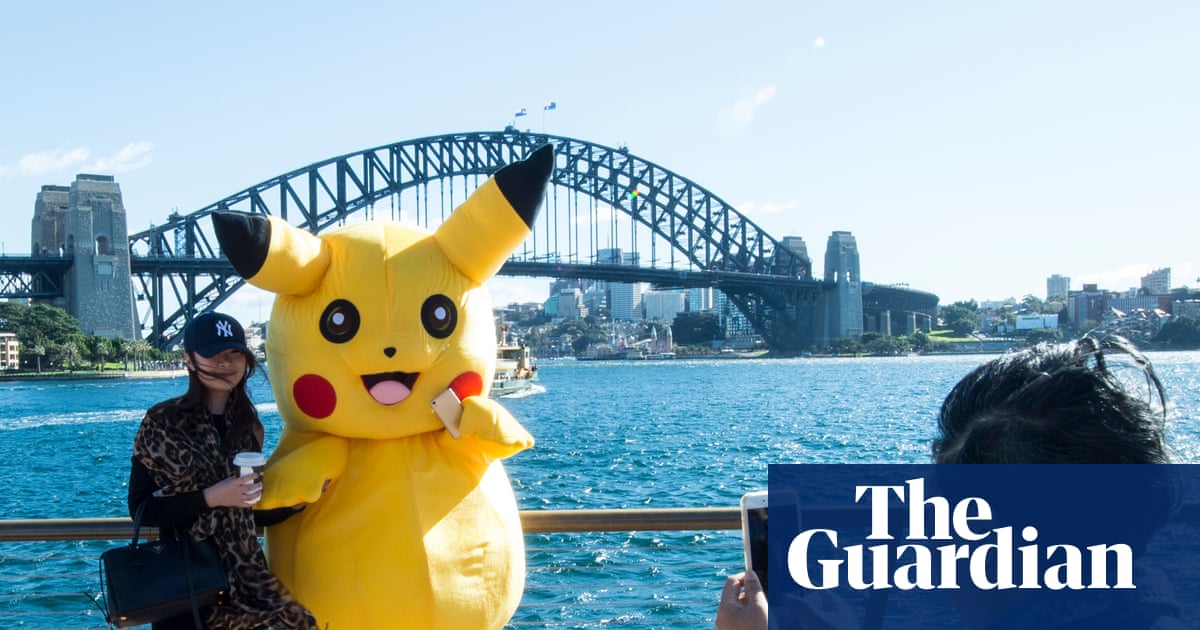
There’s a generation of Australians for whom Cheez TV was a religion. Every morning before school, I’d sit in my little white plastic chair about three feet from our big wooden television and watch 90 minutes of cartoons “curated” by the show’s teenage hosts, Jade and Ryan.
Premiering in 1995, Cheez TV dominated the children’s breakfast market by 1998, stealing the crown from Channel Seven’s bogan-muppet icon Agro. A daily dose of Cheez TV was such an important ritual to me that I remember feeling active resentment towards Princess Diana’s death because the news coverage bumped Earthworm Jim.
But in September of 1998 my world was rocked when Jade and Ryan introduced something unlike anything I had ever seen – a Japanese cartoon called Pokémon. I remember sitting there, tinned spaghetti-soaked toastie in hand, gripped by a feeling of meteoric magic and wonder as the opening bars of the theme song rolled over me: “I want to be the very best / like no one ever was.” Yes, I thought, yes! I want that more than anything!
But it wouldn’t be long before Pokémania became a moral panic in the Australian media – not so much a kids’ cartoon as a national security threat.
Celebrating its 30th anniversary this year, Pokémon was created by zinester turned game designer Satoshi Tajiri, developed by his company Game Freak and released in Japan by Nintendo as a sort of swan song for the ageing Game Boy. In Japan, it rapidly transformed from a schoolyard phenomenon to a national one, but it would take two years before it arrived in the west and became as omnipresent as Zubats in a dark cave.
It crash-landed in Australia via Cheez TV and, within a month of its debut, my life (and an entire generation of lives) revolved around the singular quest to “catch ’em all”.
When the Game Boy games hit Australian shelves, they were an instant sensation too, jointly selling more than 400m worldwide.
For the uninitiated, these games asked the player to explore a region called Kanto to collect, research and battle an enormous variety of creatures known as Pokémon.
I became so immersed in the world they presented – mythical animals and explorable forests and caves – that I felt my sense of what was possible, from my imagination to life itself, actively shift and expand. Pokémon was beautiful.
So of course, my school, the media and Australia at large responded to it like it was a plague devouring the hearts, souls and minds of the nation’s youth.
“The most popular toy this Christmas could be turning our children to witchcraft and violence,” began a Channel Seven news feature on Pokémon in 1999, citing the concerns of Sunshine Coast pastor Chas Gullo.
“It’s short for ‘Pocket Monster,’” opined another Seven news anchor, “and when you discover the cost, it’s not a bad description.”
On ABC radio, Mark Colvin warned: “The slogan is ‘gotta catch ’em all’, but many parents would be wondering whether that refers to the characters or the company’s aims for every primary school child in Australia”. He handed over to a reporter who called it “a worldwide craze over a collection of odd-looking creatures. One hundred and fifty-one, to be precise. With names like Pikachu, Meowth and Giber”.
(There is no Pokémon that goes by the name “Giber”.)
The release of the Pokémon Trading Card Game midway through 1999 turned recess and lunch into something resembling the two-up game from Wake in Fright. The trading card game was and is a beast unto itself – a loose adaptation of the video game’s mechanics that also revolves around battling, trading and collecting them all – and Australians spent $11m on the trading cards in the first two months of their release. They invited lunchbreak drama, which led to school-wide bans.
These bans were met at some schools with protests. At my own, we led a sit-in at the special school assembly to debate the matter, with appointed representatives tasked with explaining the concept of Gengar to our beleaguered principal.
In this early wave of media hysteria, which was not contained to Australia, Pokémon was seen as something between a vice, an addiction and, according to Peta, a past-time that could lead to animal abuse and dogfighting. There were reports of robberies, fraud and counterfeit, and old wives’ tales of kids jumping off buildings because they thought they’d evolved into Pidgeotto.
Undercutting a lot of these Australian news stories of a “dangerous craze”, however, was the footage that accompanied it: of children playing amicably in large groups, smiling at the camera and excitedly explaining to puzzled journos why Alakazam can easily defeat Machamp, despite the latter’s muscles.
Lost in the reactionary response was a misunderstanding of its genius: to catch ’em all, you had to interact, befriend and trust your fellow players. Pokémon not only encouraged community, it required it.
Pokémon was also my first taste of places and people beyond my own sphere. I remember one of my cousins coming back from Japan with a boxful of Japanese Pokémon cards; a Canadian exchange student swapping US-exclusive toys for rare Yowies; sharing the language of Pokémon with Sri Lankan kids, none of whom spoke English.
Young fans knew that Pokémania was not an affliction but a shared, communal experience that linked you to people all over the globe. Millions of kids around the world knew what a Cubone was and, for me, that made my life in Perth feel a little less isolated.
Today Pokémon remains bound up in the national zeitgeist while still attracting controversy: there’s currently a wave of hobby-shop burglaries around the country, sparked by the insane inflation of the value of Pokémon trading cards, which have almost become their own currency – the most valuable of these auction for $16.5m.
But despite the earnest wishes of my teachers, parents and the Australian media, Pokémon’s staying power has proved that the kids were right all along. It is now the single largest media franchise in the world, with countless games, media, toys, a new theme park and even crockery. Pokémon remains at the top of the food chain because of its emphasis on simple joys; it will always be a franchise that unites people because it continues to ask one simple question: do you want to have some fun?
Read the full story at The Guardian ↗
Pokémon outlived the moral panic of its early days in Australia and its staying power has proved that simple joy can cross borders. There’s a generation of Australians for whom…
This lens runs the verified story through Cinnamon's AI — wired in the next step.
There’s a generation of Australians for whom Cheez TV was a religion. Every morning before school, I’d sit in my little white plastic chair about three feet from our big wooden television and watch 90 minutes of cartoons “curated” by the show’s teenage hosts, Jade and Ryan.
Premiering in 1995, Cheez TV dominated the children’s breakfast market by 1998, stealing the crown from Channel Seven’s bogan-muppet icon Agro. A daily dose of Cheez TV was such an important ritual to me that I remember feeling active resentment towards Princess Diana’s death because the news coverage bumped Earthworm Jim.
But in September of 1998 my world was rocked when Jade and Ryan introduced something unlike anything I had ever seen – a Japanese cartoon called Pokémon. I remember sitting there, tinned spaghetti-soaked toastie in hand, gripped by a feeling of meteoric magic and wonder as the opening bars of the theme song rolled over me: “I want to be the very best / like no one ever was.” Yes, I thought, yes! I want that more than anything!
But it wouldn’t be long before Pokémania became a moral panic in the Australian media – not so much a kids’ cartoon as a national security threat.
Celebrating its 30th anniversary this year, Pokémon was created by zinester turned game designer Satoshi Tajiri, developed by his company Game Freak and released in Japan by Nintendo as a sort of swan song for the ageing Game Boy. In Japan, it rapidly transformed from a schoolyard phenomenon to a national one, but it would take two years before it arrived in the west and became as omnipresent as Zubats in a dark cave.
It crash-landed in Australia via Cheez TV and, within a month of its debut, my life (and an entire generation of lives) revolved around the singular quest to “catch ’em all”.
When the Game Boy games hit Australian shelves, they were an instant sensation too, jointly selling more than 400m worldwide.
For the uninitiated, these games asked the player to explore a region called Kanto to collect, research and battle an enormous variety of creatures known as Pokémon.
I became so immersed in the world they presented – mythical animals and explorable forests and caves – that I felt my sense of what was possible, from my imagination to life itself, actively shift and expand. Pokémon was beautiful.
So of course, my school, the media and Australia at large responded to it like it was a plague devouring the hearts, souls and minds of the nation’s youth.
“The most popular toy this Christmas could be turning our children to witchcraft and violence,” began a Channel Seven news feature on Pokémon in 1999, citing the concerns of Sunshine Coast pastor Chas Gullo.
“It’s short for ‘Pocket Monster,’” opined another Seven news anchor, “and when you discover the cost, it’s not a bad description.”
On ABC radio, Mark Colvin warned: “The slogan is ‘gotta catch ’em all’, but many parents would be wondering whether that refers to the characters or the company’s aims for every primary school child in Australia”. He handed over to a reporter who called it “a worldwide craze over a collection of odd-looking creatures. One hundred and fifty-one, to be precise. With names like Pikachu, Meowth and Giber”.
(There is no Pokémon that goes by the name “Giber”.)
The release of the Pokémon Trading Card Game midway through 1999 turned recess and lunch into something resembling the two-up game from Wake in Fright. The trading card game was and is a beast unto itself – a loose adaptation of the video game’s mechanics that also revolves around battling, trading and collecting them all – and Australians spent $11m on the trading cards in the first two months of their release. They invited lunchbreak drama, which led to school-wide bans.
These bans were met at some schools with protests. At my own, we led a sit-in at the special school assembly to debate the matter, with appointed representatives tasked with explaining the concept of Gengar to our beleaguered principal.
In this early wave of media hysteria, which was not contained to Australia, Pokémon was seen as something between a vice, an addiction and, according to Peta, a past-time that could lead to animal abuse and dogfighting. There were reports of robberies, fraud and counterfeit, and old wives’ tales of kids jumping off buildings because they thought they’d evolved into Pidgeotto.
Undercutting a lot of these Australian news stories of a “dangerous craze”, however, was the footage that accompanied it: of children playing amicably in large groups, smiling at the camera and excitedly explaining to puzzled journos why Alakazam can easily defeat Machamp, despite the latter’s muscles.
Lost in the reactionary response was a misunderstanding of its genius: to catch ’em all, you had to interact, befriend and trust your fellow players. Pokémon not only encouraged community, it required it.
Pokémon was also my first taste of places and people beyond my own sphere. I remember one of my cousins coming back from Japan with a boxful of Japanese Pokémon cards; a Canadian exchange student swapping US-exclusive toys for rare Yowies; sharing the language of Pokémon with Sri Lankan kids, none of whom spoke English.
Young fans knew that Pokémania was not an affliction but a shared, communal experience that linked you to people all over the globe. Millions of kids around the world knew what a Cubone was and, for me, that made my life in Perth feel a little less isolated.
Today Pokémon remains bound up in the national zeitgeist while still attracting controversy: there’s currently a wave of hobby-shop burglaries around the country, sparked by the insane inflation of the value of Pokémon trading cards, which have almost become their own currency – the most valuable of these auction for $16.5m.
But despite the earnest wishes of my teachers, parents and the Australian media, Pokémon’s staying power has proved that the kids were right all along. It is now the single largest media franchise in the world, with countless games, media, toys, a new theme park and even crockery. Pokémon remains at the top of the food chain because of its emphasis on simple joys; it will always be a franchise that unites people because it continues to ask one simple question: do you want to have some fun?
Read the full story at The Guardian ↗
There’s a generation of Australians for whom Cheez TV was a religion. Every morning before school, I’d sit in my little white plastic chair about three feet from our big wooden television and watch 90 minutes of cartoons “curated” by the show’s teenage hosts, Jade and Ryan.
Premiering in 1995, Cheez TV dominated the children’s breakfast market by 1998, stealing the crown from Channel Seven’s bogan-muppet icon Agro. A daily dose of Cheez TV was such an important ritual to me that I remember feeling active resentment towards Princess Diana’s death because the news coverage bumped Earthworm Jim.
But in September of 1998 my world was rocked when Jade and Ryan introduced something unlike anything I had ever seen – a Japanese cartoon called Pokémon. I remember sitting there, tinned spaghetti-soaked toastie in hand, gripped by a feeling of meteoric magic and wonder as the opening bars of the theme song rolled over me: “I want to be the very best / like no one ever was.” Yes, I thought, yes! I want that more than anything!
But it wouldn’t be long before Pokémania became a moral panic in the Australian media – not so much a kids’ cartoon as a national security threat.
Celebrating its 30th anniversary this year, Pokémon was created by zinester turned game designer Satoshi Tajiri, developed by his company Game Freak and released in Japan by Nintendo as a sort of swan song for the ageing Game Boy. In Japan, it rapidly transformed from a schoolyard phenomenon to a national one, but it would take two years before it arrived in the west and became as omnipresent as Zubats in a dark cave.
It crash-landed in Australia via Cheez TV and, within a month of its debut, my life (and an entire generation of lives) revolved around the singular quest to “catch ’em all”.
When the Game Boy games hit Australian shelves, they were an instant sensation too, jointly selling more than 400m worldwide.
For the uninitiated, these games asked the player to explore a region called Kanto to collect, research and battle an enormous variety of creatures known as Pokémon.
I became so immersed in the world they presented – mythical animals and explorable forests and caves – that I felt my sense of what was possible, from my imagination to life itself, actively shift and expand. Pokémon was beautiful.
So of course, my school, the media and Australia at large responded to it like it was a plague devouring the hearts, souls and minds of the nation’s youth.
“The most popular toy this Christmas could be turning our children to witchcraft and violence,” began a Channel Seven news feature on Pokémon in 1999, citing the concerns of Sunshine Coast pastor Chas Gullo.
“It’s short for ‘Pocket Monster,’” opined another Seven news anchor, “and when you discover the cost, it’s not a bad description.”
On ABC radio, Mark Colvin warned: “The slogan is ‘gotta catch ’em all’, but many parents would be wondering whether that refers to the characters or the company’s aims for every primary school child in Australia”. He handed over to a reporter who called it “a worldwide craze over a collection of odd-looking creatures. One hundred and fifty-one, to be precise. With names like Pikachu, Meowth and Giber”.
(There is no Pokémon that goes by the name “Giber”.)
The release of the Pokémon Trading Card Game midway through 1999 turned recess and lunch into something resembling the two-up game from Wake in Fright. The trading card game was and is a beast unto itself – a loose adaptation of the video game’s mechanics that also revolves around battling, trading and collecting them all – and Australians spent $11m on the trading cards in the first two months of their release. They invited lunchbreak drama, which led to school-wide bans.
These bans were met at some schools with protests. At my own, we led a sit-in at the special school assembly to debate the matter, with appointed representatives tasked with explaining the concept of Gengar to our beleaguered principal.
In this early wave of media hysteria, which was not contained to Australia, Pokémon was seen as something between a vice, an addiction and, according to Peta, a past-time that could lead to animal abuse and dogfighting. There were reports of robberies, fraud and counterfeit, and old wives’ tales of kids jumping off buildings because they thought they’d evolved into Pidgeotto.
Undercutting a lot of these Australian news stories of a “dangerous craze”, however, was the footage that accompanied it: of children playing amicably in large groups, smiling at the camera and excitedly explaining to puzzled journos why Alakazam can easily defeat Machamp, despite the latter’s muscles.
Lost in the reactionary response was a misunderstanding of its genius: to catch ’em all, you had to interact, befriend and trust your fellow players. Pokémon not only encouraged community, it required it.
Pokémon was also my first taste of places and people beyond my own sphere. I remember one of my cousins coming back from Japan with a boxful of Japanese Pokémon cards; a Canadian exchange student swapping US-exclusive toys for rare Yowies; sharing the language of Pokémon with Sri Lankan kids, none of whom spoke English.
Young fans knew that Pokémania was not an affliction but a shared, communal experience that linked you to people all over the globe. Millions of kids around the world knew what a Cubone was and, for me, that made my life in Perth feel a little less isolated.
Today Pokémon remains bound up in the national zeitgeist while still attracting controversy: there’s currently a wave of hobby-shop burglaries around the country, sparked by the insane inflation of the value of Pokémon trading cards, which have almost become their own currency – the most valuable of these auction for $16.5m.
But despite the earnest wishes of my teachers, parents and the Australian media, Pokémon’s staying power has proved that the kids were right all along. It is now the single largest media franchise in the world, with countless games, media, toys, a new theme park and even crockery. Pokémon remains at the top of the food chain because of its emphasis on simple joys; it will always be a franchise that unites people because it continues to ask one simple question: do you want to have some fun?
Read the full story at The Guardian ↗
This lens runs the verified story through Cinnamon's AI — wired in the next step.
- Pokémon outlived the moral panic of its early days in Australia and its staying power has proved that simple joy can cross borders.
- There’s a generation of Australians for whom…