‘The sea took everything away’: how Nigeria’s ‘Happy City’ is disappearing beneath the waves
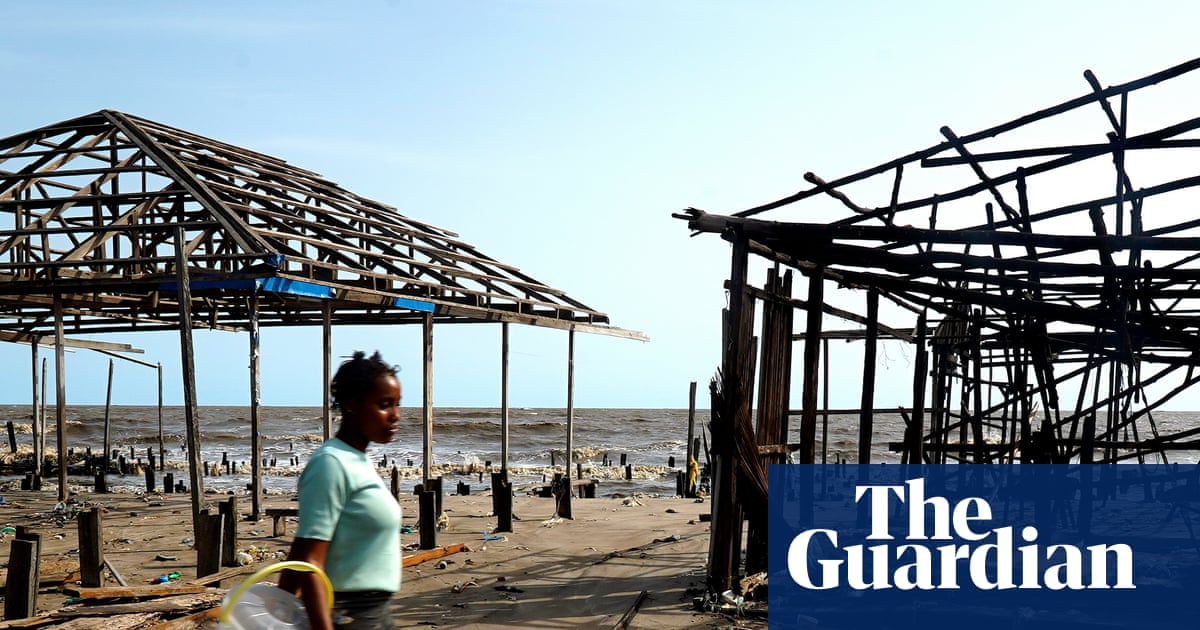
In the early hours of 15 February 2019, the Atlantic Ocean came for Arowo Victoria’s livelihood. The 60-year-old retired midwife was asleep when neighbours began banging on her door, shouting that the sea had started covering buildings along the nearby coastline.
By the time she got to her small shop, she discovered that the Atlantic had already swept it away, destroying the business she had built with borrowed money after retirement.
“There was nothing I could save,” she says, staring at the shoreline where her shop once stood. “The sea took everything away.”
After retiring from decades of helping women give birth, Victoria had taken out a loan to start a business that she had hoped would see her through retirement. Instead, the sea has left her with mounting debts and no business to help her repay it.
“I am paying for something that doesn’t exist any more,” she says. “They come to collect their money every month.”
Ayetoro was once known as Nigeria’s “Happy City” after it was founded by a Christian group in the 1940s who wanted it to operate on the basis of a communist-style society. Now, the historic coastal settlement, located in Nigeria’s south-western Ondo state, is gradually being eroded by tidal surges that people say have grown more severe over the past decade.
The Atlantic Ocean, according to people living there, has already swallowed more than half of the community, washing away hundreds of homes and other buildings, including schools and churches, over the past two decades.
While big cities such as Lagos are often in the headlines as some of the world’s most vulnerable coastal places, small settlements like Ayetoro are already vanishing. Those who live here can’t rely on money for infrastructure such as sea walls – they simply rebuild each time they are flooded.
“My uncle’s house is very close to the water now,” says 35-year-old Emmanuel Aralu. “Each time the sea rises, it gets closer. We already know it may not survive another big tide.”
As a child, Aralu remembers large stretches of empty land where children would play football. “All that space is gone now,” he says. “At times, it feels like the entire community is being erased.”
Across the town, Motunrayo Asakasiki, 28, still remembers the day her mother lost her grocery store to floods driven by the encroaching sea. “The water came very fast,” she says. “People were screaming and trying to save what they could, but some things had already been washed away.”
After the destruction, the family moved the business to Alaba Street, which they considered safer. However, even there, the sea has continued to advance. “The ocean is still threatening this new place,” she says. “My mother always wonders how many times she should start over.”
The destruction has hit home hard for 79-year-old Lawrence Lemanu, who lost his 10-room house to the sea in 2023 after working on it all his life.
“I raised my children there,” he says. “Everything I’ve laboured for was inside.” He describes watching helplessly as the waves ripped through the building. “You cannot fight the sea,” he says. “You just watch it take everything.”
Fishing, once the lifeblood of Ayetoro’s economy, has become more dangerous and unpredictable. As local fisher Egba Taiwo puts it, the water no longer behaves as it used to.
“Now the tides are very rough,” he says. “There are times you fear going out fishing because the sea has become so dangerous.” Even when fishers return safely, their hauls are smaller, he says.
The crisis is also threatening the buildings that house vital public institutions.
Hannah Olanrewaju, the officer in charge of the Ayetoro primary health centre (PHC), describes how dangerously close the sea has come to the facility.
“When you open the back door, you see the sea directly,” she says. “When I came here in 2016, it was never like this. Now we struggle to carry out immunisation and malaria tests because it is so difficult to walk on the community’s wooden bridges.”
Health workers fear continued erosion may soon cut off the community’s access to essential health services.
At Ayetoro College, school administrators say students and teachers work under the constant fear that the sea could one day submerge the entire building.
“It breaks my heart watching our young people trying to plan their future in a town that is steadily losing land to the sea,” says Ogungbure Isaac, principal of Happy City College. “The situation is taking a psychological toll, which is affecting the children’s academic performance due to the fear of the incursions.”
Environmental experts say Ayetoro represents one of Nigeria’s starkest examples of climate vulnerability. Dr Nnimmo Bassey of the Health of Mother Earth Foundation describes the situation as a “profound injustice”.
“When global discussions on climate change are held, and people talk about loss and damage, there are communities that are already almost totally lost and damaged,” he says. “The interests of communities like Ayetoro should be central to these discussions.”
Dr Joseph Onoja of the Nigeria Conservation Foundation says weak environmental protections have accelerated the destruction.
“What is happening in Ayetoro is a warning sign for many coastal communities across Nigeria,” he says. “Major [human] interventions have reshaped the behaviour of the Atlantic along the coast.”
He names the construction of the Commodore Channel, a 3km waterway built from the sea into Lagos’s major ports as an example of this. Human interference disrupts the natural eastward currents of the Atlantic, he says, intensifying wave action and increasing damage in unprotected communities such as Ayetoro.
Despite the threat of rising tides, for many people leaving Ayetoro is not a simple option.
“This is our home,” Aralu says. “Where do we go?”
Read the full story at The Guardian ↗
Ayetoro, a coastal settlement in Nigeria's Ondo state founded in the 1940s, has experienced significant coastal erosion over the past two decades. The Atlantic Ocean has eroded more than half the original community, destroying hundreds of homes and essential infrastructure including schools, health facilities, and churches. Multiple residents have lost businesses and property—a retired midwife lost her post-retirement shop in 2019, a 79-year-old lost his home in 2023, and fishing families have seen both declining catches and increased danger. A primary health centre and local college now sit dangerously close to the water's edge, threatening public health and education services. Fishing, historically the economic foundation, has become less predictable and more hazardous. Environmental experts point to both climate vulnerability and human infrastructure—specifically the Commodore Channel built into Lagos's ports—as factors that have disrupted Atlantic currents and intensified erosion in unprotected settlements. Most residents remain unable or unwilling to leave, citing lack of resources and deep community ties.
Read the full story at The Guardian ↗
In the early hours of 15 February 2019, the Atlantic Ocean came for Arowo Victoria’s livelihood. The 60-year-old retired midwife was asleep when neighbours began banging on her door, shouting that the sea had started covering buildings along the nearby coastline.
By the time she got to her small shop, she discovered that the Atlantic had already swept it away, destroying the business she had built with borrowed money after retirement.
“There was nothing I could save,” she says, staring at the shoreline where her shop once stood. “The sea took everything away.”
After retiring from decades of helping women give birth, Victoria had taken out a loan to start a business that she had hoped would see her through retirement. Instead, the sea has left her with mounting debts and no business to help her repay it.
“I am paying for something that doesn’t exist any more,” she says. “They come to collect their money every month.”
Ayetoro was once known as Nigeria’s “Happy City” after it was founded by a Christian group in the 1940s who wanted it to operate on the basis of a communist-style society. Now, the historic coastal settlement, located in Nigeria’s south-western Ondo state, is gradually being eroded by tidal surges that people say have grown more severe over the past decade.
The Atlantic Ocean, according to people living there, has already swallowed more than half of the community, washing away hundreds of homes and other buildings, including schools and churches, over the past two decades.
While big cities such as Lagos are often in the headlines as some of the world’s most vulnerable coastal places, small settlements like Ayetoro are already vanishing. Those who live here can’t rely on money for infrastructure such as sea walls – they simply rebuild each time they are flooded.
“My uncle’s house is very close to the water now,” says 35-year-old Emmanuel Aralu. “Each time the sea rises, it gets closer. We already know it may not survive another big tide.”
As a child, Aralu remembers large stretches of empty land where children would play football. “All that space is gone now,” he says. “At times, it feels like the entire community is being erased.”
Across the town, Motunrayo Asakasiki, 28, still remembers the day her mother lost her grocery store to floods driven by the encroaching sea. “The water came very fast,” she says. “People were screaming and trying to save what they could, but some things had already been washed away.”
After the destruction, the family moved the business to Alaba Street, which they considered safer. However, even there, the sea has continued to advance. “The ocean is still threatening this new place,” she says. “My mother always wonders how many times she should start over.”
The destruction has hit home hard for 79-year-old Lawrence Lemanu, who lost his 10-room house to the sea in 2023 after working on it all his life.
“I raised my children there,” he says. “Everything I’ve laboured for was inside.” He describes watching helplessly as the waves ripped through the building. “You cannot fight the sea,” he says. “You just watch it take everything.”
Fishing, once the lifeblood of Ayetoro’s economy, has become more dangerous and unpredictable. As local fisher Egba Taiwo puts it, the water no longer behaves as it used to.
“Now the tides are very rough,” he says. “There are times you fear going out fishing because the sea has become so dangerous.” Even when fishers return safely, their hauls are smaller, he says.
The crisis is also threatening the buildings that house vital public institutions.
Hannah Olanrewaju, the officer in charge of the Ayetoro primary health centre (PHC), describes how dangerously close the sea has come to the facility.
“When you open the back door, you see the sea directly,” she says. “When I came here in 2016, it was never like this. Now we struggle to carry out immunisation and malaria tests because it is so difficult to walk on the community’s wooden bridges.”
Health workers fear continued erosion may soon cut off the community’s access to essential health services.
At Ayetoro College, school administrators say students and teachers work under the constant fear that the sea could one day submerge the entire building.
“It breaks my heart watching our young people trying to plan their future in a town that is steadily losing land to the sea,” says Ogungbure Isaac, principal of Happy City College. “The situation is taking a psychological toll, which is affecting the children’s academic performance due to the fear of the incursions.”
Environmental experts say Ayetoro represents one of Nigeria’s starkest examples of climate vulnerability. Dr Nnimmo Bassey of the Health of Mother Earth Foundation describes the situation as a “profound injustice”.
“When global discussions on climate change are held, and people talk about loss and damage, there are communities that are already almost totally lost and damaged,” he says. “The interests of communities like Ayetoro should be central to these discussions.”
Dr Joseph Onoja of the Nigeria Conservation Foundation says weak environmental protections have accelerated the destruction.
“What is happening in Ayetoro is a warning sign for many coastal communities across Nigeria,” he says. “Major [human] interventions have reshaped the behaviour of the Atlantic along the coast.”
He names the construction of the Commodore Channel, a 3km waterway built from the sea into Lagos’s major ports as an example of this. Human interference disrupts the natural eastward currents of the Atlantic, he says, intensifying wave action and increasing damage in unprotected communities such as Ayetoro.
Despite the threat of rising tides, for many people leaving Ayetoro is not a simple option.
“This is our home,” Aralu says. “Where do we go?”
Read the full story at The Guardian ↗
In February 2019, Atlantic Ocean tidal surge destroyed buildings along Ayetoro's coastline, including a retired midwife's shop built with borrowed money. Ayetoro was founded by a Christian group in the 1940s intending to operate on communist principles and became known as Nigeria's 'Happy City.' Over the past two decades, the Atlantic has eroded more than half of Ayetoro, washing away hundreds of homes, schools, and churches. A 79-year-old resident lost a 10-room house to the sea in 2023 after a lifetime of work. Fishing hauls have become smaller and tidal conditions more dangerous than historically normal. A primary health centre's back door now opens directly onto the sea, making it difficult to deliver immunisations and malaria tests. The principal of Happy City College reports the psychological toll of coastal erosion is affecting students' academic performance. Environmental experts describe Ayetoro as one of Nigeria's starkest examples of climate vulnerability. The construction of the Commodore Channel in Lagos has reshaped Atlantic currents, intensifying wave action in unprotected communities like Ayetoro. The situation represents a 'profound injustice' in the context of global climate loss and damage discussions.
Read the full story at The Guardian ↗
- Ayetoro, a coastal settlement in Nigeria's Ondo state, has lost over half its community to Atlantic Ocean erosion over two decades, displacing hundreds and destroying homes, schools, and churches.
- Residents including a retired midwife, fishers, and business owners have lost livelihoods and property; essential services like primary healthcare and education are now threatened by advancing sea water.
- Environmental experts attribute the accelerated erosion partly to human infrastructure like the Commodore Channel in Lagos, which disrupts Atlantic currents and intensifies wave action in unprotected communities.
- Most residents lack resources to relocate and remain despite ongoing losses, as Ayetoro lacks government funding for protective infrastructure like sea walls.