The Trump administration is charging these Minneapolis protesters with conspiracy. Organizers won’t back down
Days after pleading not guilty to conspiracy charges, Emmett Doyle took the stage at a dive bar in Minneapolis, and performed an Irish protest ballad. “And you dare to call me a terrorist, while you look down your gun,” he sang during his set.
The tune has particular resonance now that Doyle, a musician and carpenter who the US government claims is an “antifa” domestic terrorist, awaits trial for protesting. “That song has been a source of inspiration for me, in finding courage to face this ordeal,” he said.
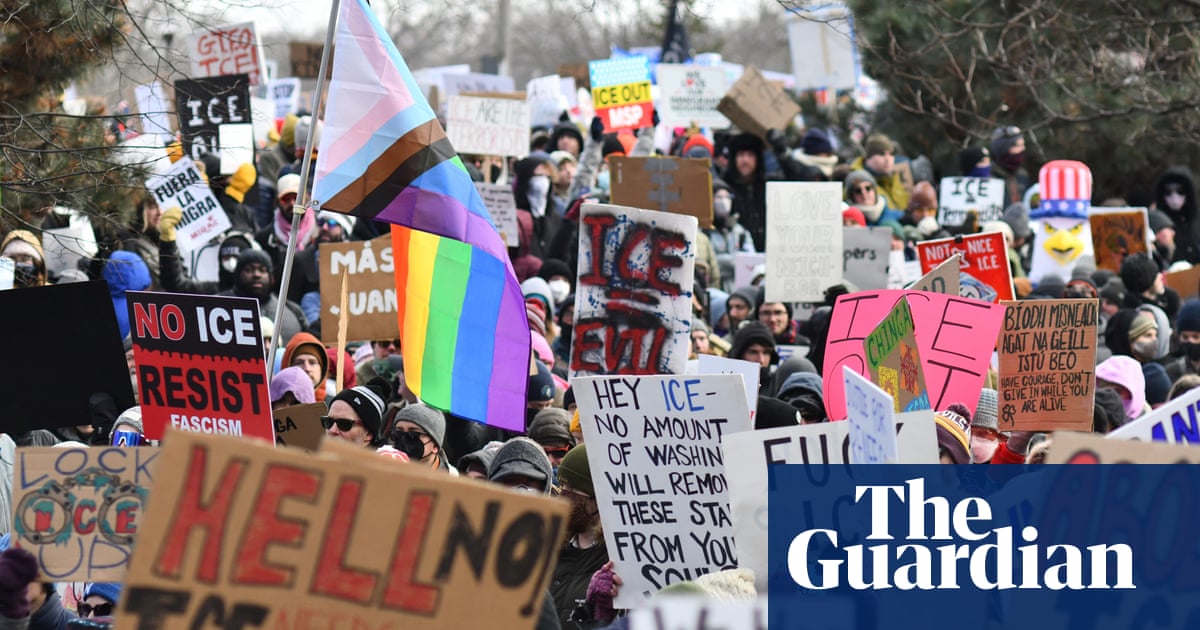
Doyle is one of 15 Minneapolis protesters the federal government recently charged with conspiracy for resisting Immigration and Customs Enforcement (ICE) operations earlier this year. The group known as the “Minnesota 15” is primarily linked through Direct Action MN, a loose group of Twin Cities residents that provided community defense during the ICE surge.
According to the 94-page indictment, the defendants’ charges stem not from one specific incident, but from coordinating with rapid response groups to alert people to ICE agents and organizing blockades at the city’s ICE headquarters. Prosecutors have characterized the group as affiliated with “antifa”, a decentralized group of people against fascism, which the Trump administration named a domestic terror organization last fall.
“These are teachers and nurses and electricians,” said Kelly Peterson, a Minneapolis organizer. “They just have to keep going to work, knowing that they did what 100,000 other people did, and that they got charged for it.”
The case is the latest attempt by Trump’s Department of Justice to criminalize resistance. Protesters in Chicago and Spokane, Washington, faced the same charges as the Minnesota 15, with mixed results; the Chicago case was tossed for prosecutorial misconduct, while the Spokane protesters, accused of forming a human wall to block an ICE bus, were convicted and face a maximum of six years in prison. Last month, protesters in Prairieland, Texas, dubbed part of a “north Texas antifa cell” by prosecutors, received sentences ranging from 30 to 100 years – one for simply moving a box of zines.
“This is naked political repression, part of a nationwide trend,” Isaac Sant, the lead defendant in the Minneapolis case, told the Guardian.
Legal experts say the Minneapolis case is akin to Prairieland in its use of conspiracy law to target so-called antifa and in turn chill the resistance. But the charges in question are far less severe.
Organizers in Minneapolis, meanwhile, have said they are not deterred.
“They’re trying to stop us and silence us and scare us,” Treasure Thoreson, one of the Minneapolis defendants, told the Guardian. “I’m not going to let them scare me.”
In January, nearly 4,000 immigration agents flooded the streets of the Twin Cities for Operation Metro Surge, the largest immigration operation in national history. Residents responded quickly, bringing food and essentials to people in hiding and forming neighborhood-level watch groups to track ICE vehicles and alert neighbors to their presence. ICE agents pulled people from cars, forcefully entered homes and repeatedly teargassed observers. Two residents who had been monitoring ICE activity, Renee Good and Alex Pretti, were shot and killed by federal agents. No one has been charged for their deaths.
Federal conspiracy charges were first brought against Minneapolis organizers in January during the height of Operation Metro Surge. Nine activists and journalists, including the former CNN anchor Don Lemon, were charged with conspiracy to impede religious freedom in connection with a protest at a church where a pastor is a field director for ICE.
Following the formal end of Operation Metro Surge, another 30 people were indicted for the same protest. Monique Cullars-Doty, one of the defendants, spoke at a rally for the Minnesota 15 last week: “While some of us might be a bit out of commission, it’s up to you to continue to stand up and hold the line in Minnesota for our immigrant neighbors, our union workers and in solidarity with all those who are oppressed.”
Legal experts and local organizers who spoke with the Guardian said the Minnesota 15 indictment was not a surprise. Three days after the Trump administration designated “antifa” a terrorist group in September, it released a memo directing the FBI’s joint terrorism taskforce to target “violent and terroristic activities under the umbrella of self-described ‘anti-fascism’”.
According to Rachel Cohen, a Chicago-based attorney, the administration is trying to “build this narrative … that there is some defined antifa group that exists in the United States, when there very much is not”.
One defendant in the Minneapolis case, Kyle Wagner, self-identifies as antifa. The prosecution appears to be using his association to apply the label to the entire group, Doyle said.
While the Minnesota 15 do not currently face terrorism charges, the indictment does call the group “antifa”, claiming the conspiracy was carried out using “force, intimidation, and threats” – language Khalid interprets as a signal that prosecutors will seek a terrorism enhancement, which would increase the sentencing guidelines. Currently, the principal conspiracy charge in the case carries a maximum of six years. Two defendants are also charged with destruction of government property, which carries a 10-year maximum.
In the Prairieland case, eight protesters were convicted of providing “material support to terrorists”; part of the federal government’s evidence of “conspiring” to support “terrorism” including owning a “printing press” and distributing political zines. The judges in the case gave the defendants the harshest possible sentences, including for other defendants who took non-cooperating plea deals.
“The same theory that they used to apply that enhancement in Prairieland, they could have used for all 1,500 of the January 6 protesters,” Sufia Khalid, a defense attorney on the case, said. “They did not.”
What set the Prairieland case apart from other protest cases, many legal experts say, was that a protester shot an officer during the Fourth of July noise demonstration. After setting off fireworks in solidarity with detainees in the Prairieland facility, some protesters broke off and vandalized employees’ cars and security equipment.
When a police officer arrived on the scene and drew his gun, an armed protester shot her rifle, hitting the officer in the shoulder. He survived. The protester was sentenced to 100 years. Others who left before the shooting were sentenced to 50 years.
“The allegations here are much lower level than the most serious allegations in Prairieland,” Jordan Kushner, a lawyer on the Minnesota 15 case, said. “There was no violence committed. No one was hurt.”
The Prairieland defendants were also tried in one of the country’s more conservative federal districts; the Minnesota 15 will face jurors from a far more liberal region – one shaped by the aftermath of George Floyd’s murder and years of sustained protest over state violence.
“It’ll be much tougher for Minnesota to get a jury that’s overwhelmingly receptive to what the government is doing,” Kushner said.
Another thing that could change the course of the case is if any defendants take plea bargains, Xavier de Janon, a Prairieland defense lawyer, said. In the Prairieland case, five of the 22 Prairieland defendants took plea deals. Cooperating defendants received lighter sentences than those who did not, ranging from 22 months all the way to nine years.
“The reason why the Prairieland prosecutions happened was because so many people talked to the government,” De Janon said. “If the government gets anyone to cooperate and talk [in Minneapolis], the government won.”
The common thread between the two cases, though, is conspiracy. “Conspiracy is usually called the prosecutor’s darling because it doesn’t take a lot of evidence to prove,” said De Janon. “The element of a conspiracy is that there was an agreement to commit a crime. And that’s it.”
Despite the charges, Minneapolis organizers are not backing down. “Any time that you’re involved in a really heightened moment of resistance to a regime like this, you know that there’s a possibility that infiltration is happening,” Doyle said. “You can’t be frozen by that fear.”
Increasingly, encrypted messaging apps such as Signal are appearing in protest prosecutions. In the Minnesota 15 case, the prosecution has 15 to 16 terabytes of Signal chats, which have not been made available to the defense. In the Prairieland case, the FBI made copies of messages that had appeared on a defendant’s lock screen even after the app was deleted. Apple has since patched that security bug.
Signal should be treated as if it is or could be public information, said organizers who spoke to the Guardian. “You have to assume that it is all being recorded and can all get read back to you in an indictment,” Jonathan, an organizer who asked his last name not be used.
The government maintains its investigative methods are lawful. Whether those powers have become too expansive, however, remains a point of contention. States, even blue ones, have “really sharpened surveillance” in recent years, De Janon said, including under the Biden administration. Tools such as geofencing (a digital boundary to identify who is in an area), social media monitoring, drones, facial recognition, and digital forensics form a broad web of surveillance.
“Tools were sharpened, and sharpened, and sharpened,” he said, “and now they’re in the hands of this federal government that isn’t afraid to use all of them.”
While some organizers the Guardian spoke with were anxious upon learning of the indictment, most are aware of the risks of protesting. “It was always something you could get killed doing,” Jonathan said, in reference to the deaths of Good and Pretti. “They shot someone, and then I still went and [protested].”
ICE agents remain in Minneapolis, organizers say, and as long as they do, people will be out protesting and protecting their neighbors.
“I don’t see our case as Trump’s revenge for the resistance during Metro Surge,” Doyle said. “I see it more as the government attempting to break the resistance so that they can come back and do another round of spectacular violence in our community and claim victory.”
“But the resistance here was leaderless,” he added. “It was mass resistance. My community’s not going to be intimidated.”
Read the full story at The Guardian ↗
‘Minnesota 15’ indicted after opposing ICE crackdown – just the latest attempt by Trump DoJ to criminalize resistance. Days after pleading not guilty to conspiracy charges, Emmett…
This lens runs the verified story through Cinnamon's AI — wired in the next step.
Days after pleading not guilty to conspiracy charges, Emmett Doyle took the stage at a dive bar in Minneapolis, and performed an Irish protest ballad. “And you dare to call me a terrorist, while you look down your gun,” he sang during his set.
The tune has particular resonance now that Doyle, a musician and carpenter who the US government claims is an “antifa” domestic terrorist, awaits trial for protesting. “That song has been a source of inspiration for me, in finding courage to face this ordeal,” he said.
Doyle is one of 15 Minneapolis protesters the federal government recently charged with conspiracy for resisting Immigration and Customs Enforcement (ICE) operations earlier this year. The group known as the “Minnesota 15” is primarily linked through Direct Action MN, a loose group of Twin Cities residents that provided community defense during the ICE surge.
According to the 94-page indictment, the defendants’ charges stem not from one specific incident, but from coordinating with rapid response groups to alert people to ICE agents and organizing blockades at the city’s ICE headquarters. Prosecutors have characterized the group as affiliated with “antifa”, a decentralized group of people against fascism, which the Trump administration named a domestic terror organization last fall.
“These are teachers and nurses and electricians,” said Kelly Peterson, a Minneapolis organizer. “They just have to keep going to work, knowing that they did what 100,000 other people did, and that they got charged for it.”
The case is the latest attempt by Trump’s Department of Justice to criminalize resistance. Protesters in Chicago and Spokane, Washington, faced the same charges as the Minnesota 15, with mixed results; the Chicago case was tossed for prosecutorial misconduct, while the Spokane protesters, accused of forming a human wall to block an ICE bus, were convicted and face a maximum of six years in prison. Last month, protesters in Prairieland, Texas, dubbed part of a “north Texas antifa cell” by prosecutors, received sentences ranging from 30 to 100 years – one for simply moving a box of zines.
“This is naked political repression, part of a nationwide trend,” Isaac Sant, the lead defendant in the Minneapolis case, told the Guardian.
Legal experts say the Minneapolis case is akin to Prairieland in its use of conspiracy law to target so-called antifa and in turn chill the resistance. But the charges in question are far less severe.
Organizers in Minneapolis, meanwhile, have said they are not deterred.
“They’re trying to stop us and silence us and scare us,” Treasure Thoreson, one of the Minneapolis defendants, told the Guardian. “I’m not going to let them scare me.”
In January, nearly 4,000 immigration agents flooded the streets of the Twin Cities for Operation Metro Surge, the largest immigration operation in national history. Residents responded quickly, bringing food and essentials to people in hiding and forming neighborhood-level watch groups to track ICE vehicles and alert neighbors to their presence. ICE agents pulled people from cars, forcefully entered homes and repeatedly teargassed observers. Two residents who had been monitoring ICE activity, Renee Good and Alex Pretti, were shot and killed by federal agents. No one has been charged for their deaths.
Federal conspiracy charges were first brought against Minneapolis organizers in January during the height of Operation Metro Surge. Nine activists and journalists, including the former CNN anchor Don Lemon, were charged with conspiracy to impede religious freedom in connection with a protest at a church where a pastor is a field director for ICE.
Following the formal end of Operation Metro Surge, another 30 people were indicted for the same protest. Monique Cullars-Doty, one of the defendants, spoke at a rally for the Minnesota 15 last week: “While some of us might be a bit out of commission, it’s up to you to continue to stand up and hold the line in Minnesota for our immigrant neighbors, our union workers and in solidarity with all those who are oppressed.”
Legal experts and local organizers who spoke with the Guardian said the Minnesota 15 indictment was not a surprise. Three days after the Trump administration designated “antifa” a terrorist group in September, it released a memo directing the FBI’s joint terrorism taskforce to target “violent and terroristic activities under the umbrella of self-described ‘anti-fascism’”.
According to Rachel Cohen, a Chicago-based attorney, the administration is trying to “build this narrative … that there is some defined antifa group that exists in the United States, when there very much is not”.
One defendant in the Minneapolis case, Kyle Wagner, self-identifies as antifa. The prosecution appears to be using his association to apply the label to the entire group, Doyle said.
While the Minnesota 15 do not currently face terrorism charges, the indictment does call the group “antifa”, claiming the conspiracy was carried out using “force, intimidation, and threats” – language Khalid interprets as a signal that prosecutors will seek a terrorism enhancement, which would increase the sentencing guidelines. Currently, the principal conspiracy charge in the case carries a maximum of six years. Two defendants are also charged with destruction of government property, which carries a 10-year maximum.
In the Prairieland case, eight protesters were convicted of providing “material support to terrorists”; part of the federal government’s evidence of “conspiring” to support “terrorism” including owning a “printing press” and distributing political zines. The judges in the case gave the defendants the harshest possible sentences, including for other defendants who took non-cooperating plea deals.
“The same theory that they used to apply that enhancement in Prairieland, they could have used for all 1,500 of the January 6 protesters,” Sufia Khalid, a defense attorney on the case, said. “They did not.”
What set the Prairieland case apart from other protest cases, many legal experts say, was that a protester shot an officer during the Fourth of July noise demonstration. After setting off fireworks in solidarity with detainees in the Prairieland facility, some protesters broke off and vandalized employees’ cars and security equipment.
When a police officer arrived on the scene and drew his gun, an armed protester shot her rifle, hitting the officer in the shoulder. He survived. The protester was sentenced to 100 years. Others who left before the shooting were sentenced to 50 years.
“The allegations here are much lower level than the most serious allegations in Prairieland,” Jordan Kushner, a lawyer on the Minnesota 15 case, said. “There was no violence committed. No one was hurt.”
The Prairieland defendants were also tried in one of the country’s more conservative federal districts; the Minnesota 15 will face jurors from a far more liberal region – one shaped by the aftermath of George Floyd’s murder and years of sustained protest over state violence.
“It’ll be much tougher for Minnesota to get a jury that’s overwhelmingly receptive to what the government is doing,” Kushner said.
Another thing that could change the course of the case is if any defendants take plea bargains, Xavier de Janon, a Prairieland defense lawyer, said. In the Prairieland case, five of the 22 Prairieland defendants took plea deals. Cooperating defendants received lighter sentences than those who did not, ranging from 22 months all the way to nine years.
“The reason why the Prairieland prosecutions happened was because so many people talked to the government,” De Janon said. “If the government gets anyone to cooperate and talk [in Minneapolis], the government won.”
The common thread between the two cases, though, is conspiracy. “Conspiracy is usually called the prosecutor’s darling because it doesn’t take a lot of evidence to prove,” said De Janon. “The element of a conspiracy is that there was an agreement to commit a crime. And that’s it.”
Despite the charges, Minneapolis organizers are not backing down. “Any time that you’re involved in a really heightened moment of resistance to a regime like this, you know that there’s a possibility that infiltration is happening,” Doyle said. “You can’t be frozen by that fear.”
Increasingly, encrypted messaging apps such as Signal are appearing in protest prosecutions. In the Minnesota 15 case, the prosecution has 15 to 16 terabytes of Signal chats, which have not been made available to the defense. In the Prairieland case, the FBI made copies of messages that had appeared on a defendant’s lock screen even after the app was deleted. Apple has since patched that security bug.
Signal should be treated as if it is or could be public information, said organizers who spoke to the Guardian. “You have to assume that it is all being recorded and can all get read back to you in an indictment,” Jonathan, an organizer who asked his last name not be used.
The government maintains its investigative methods are lawful. Whether those powers have become too expansive, however, remains a point of contention. States, even blue ones, have “really sharpened surveillance” in recent years, De Janon said, including under the Biden administration. Tools such as geofencing (a digital boundary to identify who is in an area), social media monitoring, drones, facial recognition, and digital forensics form a broad web of surveillance.
“Tools were sharpened, and sharpened, and sharpened,” he said, “and now they’re in the hands of this federal government that isn’t afraid to use all of them.”
While some organizers the Guardian spoke with were anxious upon learning of the indictment, most are aware of the risks of protesting. “It was always something you could get killed doing,” Jonathan said, in reference to the deaths of Good and Pretti. “They shot someone, and then I still went and [protested].”
ICE agents remain in Minneapolis, organizers say, and as long as they do, people will be out protesting and protecting their neighbors.
“I don’t see our case as Trump’s revenge for the resistance during Metro Surge,” Doyle said. “I see it more as the government attempting to break the resistance so that they can come back and do another round of spectacular violence in our community and claim victory.”
“But the resistance here was leaderless,” he added. “It was mass resistance. My community’s not going to be intimidated.”
Read the full story at The Guardian ↗
Days after pleading not guilty to conspiracy charges, Emmett Doyle took the stage at a dive bar in Minneapolis, and performed an Irish protest ballad. “And you dare to call me a terrorist, while you look down your gun,” he sang during his set.
The tune has particular resonance now that Doyle, a musician and carpenter who the US government claims is an “antifa” domestic terrorist, awaits trial for protesting. “That song has been a source of inspiration for me, in finding courage to face this ordeal,” he said.
Doyle is one of 15 Minneapolis protesters the federal government recently charged with conspiracy for resisting Immigration and Customs Enforcement (ICE) operations earlier this year. The group known as the “Minnesota 15” is primarily linked through Direct Action MN, a loose group of Twin Cities residents that provided community defense during the ICE surge.
According to the 94-page indictment, the defendants’ charges stem not from one specific incident, but from coordinating with rapid response groups to alert people to ICE agents and organizing blockades at the city’s ICE headquarters. Prosecutors have characterized the group as affiliated with “antifa”, a decentralized group of people against fascism, which the Trump administration named a domestic terror organization last fall.
“These are teachers and nurses and electricians,” said Kelly Peterson, a Minneapolis organizer. “They just have to keep going to work, knowing that they did what 100,000 other people did, and that they got charged for it.”
The case is the latest attempt by Trump’s Department of Justice to criminalize resistance. Protesters in Chicago and Spokane, Washington, faced the same charges as the Minnesota 15, with mixed results; the Chicago case was tossed for prosecutorial misconduct, while the Spokane protesters, accused of forming a human wall to block an ICE bus, were convicted and face a maximum of six years in prison. Last month, protesters in Prairieland, Texas, dubbed part of a “north Texas antifa cell” by prosecutors, received sentences ranging from 30 to 100 years – one for simply moving a box of zines.
“This is naked political repression, part of a nationwide trend,” Isaac Sant, the lead defendant in the Minneapolis case, told the Guardian.
Legal experts say the Minneapolis case is akin to Prairieland in its use of conspiracy law to target so-called antifa and in turn chill the resistance. But the charges in question are far less severe.
Organizers in Minneapolis, meanwhile, have said they are not deterred.
“They’re trying to stop us and silence us and scare us,” Treasure Thoreson, one of the Minneapolis defendants, told the Guardian. “I’m not going to let them scare me.”
In January, nearly 4,000 immigration agents flooded the streets of the Twin Cities for Operation Metro Surge, the largest immigration operation in national history. Residents responded quickly, bringing food and essentials to people in hiding and forming neighborhood-level watch groups to track ICE vehicles and alert neighbors to their presence. ICE agents pulled people from cars, forcefully entered homes and repeatedly teargassed observers. Two residents who had been monitoring ICE activity, Renee Good and Alex Pretti, were shot and killed by federal agents. No one has been charged for their deaths.
Federal conspiracy charges were first brought against Minneapolis organizers in January during the height of Operation Metro Surge. Nine activists and journalists, including the former CNN anchor Don Lemon, were charged with conspiracy to impede religious freedom in connection with a protest at a church where a pastor is a field director for ICE.
Following the formal end of Operation Metro Surge, another 30 people were indicted for the same protest. Monique Cullars-Doty, one of the defendants, spoke at a rally for the Minnesota 15 last week: “While some of us might be a bit out of commission, it’s up to you to continue to stand up and hold the line in Minnesota for our immigrant neighbors, our union workers and in solidarity with all those who are oppressed.”
Legal experts and local organizers who spoke with the Guardian said the Minnesota 15 indictment was not a surprise. Three days after the Trump administration designated “antifa” a terrorist group in September, it released a memo directing the FBI’s joint terrorism taskforce to target “violent and terroristic activities under the umbrella of self-described ‘anti-fascism’”.
According to Rachel Cohen, a Chicago-based attorney, the administration is trying to “build this narrative … that there is some defined antifa group that exists in the United States, when there very much is not”.
One defendant in the Minneapolis case, Kyle Wagner, self-identifies as antifa. The prosecution appears to be using his association to apply the label to the entire group, Doyle said.
While the Minnesota 15 do not currently face terrorism charges, the indictment does call the group “antifa”, claiming the conspiracy was carried out using “force, intimidation, and threats” – language Khalid interprets as a signal that prosecutors will seek a terrorism enhancement, which would increase the sentencing guidelines. Currently, the principal conspiracy charge in the case carries a maximum of six years. Two defendants are also charged with destruction of government property, which carries a 10-year maximum.
In the Prairieland case, eight protesters were convicted of providing “material support to terrorists”; part of the federal government’s evidence of “conspiring” to support “terrorism” including owning a “printing press” and distributing political zines. The judges in the case gave the defendants the harshest possible sentences, including for other defendants who took non-cooperating plea deals.
“The same theory that they used to apply that enhancement in Prairieland, they could have used for all 1,500 of the January 6 protesters,” Sufia Khalid, a defense attorney on the case, said. “They did not.”
What set the Prairieland case apart from other protest cases, many legal experts say, was that a protester shot an officer during the Fourth of July noise demonstration. After setting off fireworks in solidarity with detainees in the Prairieland facility, some protesters broke off and vandalized employees’ cars and security equipment.
When a police officer arrived on the scene and drew his gun, an armed protester shot her rifle, hitting the officer in the shoulder. He survived. The protester was sentenced to 100 years. Others who left before the shooting were sentenced to 50 years.
“The allegations here are much lower level than the most serious allegations in Prairieland,” Jordan Kushner, a lawyer on the Minnesota 15 case, said. “There was no violence committed. No one was hurt.”
The Prairieland defendants were also tried in one of the country’s more conservative federal districts; the Minnesota 15 will face jurors from a far more liberal region – one shaped by the aftermath of George Floyd’s murder and years of sustained protest over state violence.
“It’ll be much tougher for Minnesota to get a jury that’s overwhelmingly receptive to what the government is doing,” Kushner said.
Another thing that could change the course of the case is if any defendants take plea bargains, Xavier de Janon, a Prairieland defense lawyer, said. In the Prairieland case, five of the 22 Prairieland defendants took plea deals. Cooperating defendants received lighter sentences than those who did not, ranging from 22 months all the way to nine years.
“The reason why the Prairieland prosecutions happened was because so many people talked to the government,” De Janon said. “If the government gets anyone to cooperate and talk [in Minneapolis], the government won.”
The common thread between the two cases, though, is conspiracy. “Conspiracy is usually called the prosecutor’s darling because it doesn’t take a lot of evidence to prove,” said De Janon. “The element of a conspiracy is that there was an agreement to commit a crime. And that’s it.”
Despite the charges, Minneapolis organizers are not backing down. “Any time that you’re involved in a really heightened moment of resistance to a regime like this, you know that there’s a possibility that infiltration is happening,” Doyle said. “You can’t be frozen by that fear.”
Increasingly, encrypted messaging apps such as Signal are appearing in protest prosecutions. In the Minnesota 15 case, the prosecution has 15 to 16 terabytes of Signal chats, which have not been made available to the defense. In the Prairieland case, the FBI made copies of messages that had appeared on a defendant’s lock screen even after the app was deleted. Apple has since patched that security bug.
Signal should be treated as if it is or could be public information, said organizers who spoke to the Guardian. “You have to assume that it is all being recorded and can all get read back to you in an indictment,” Jonathan, an organizer who asked his last name not be used.
The government maintains its investigative methods are lawful. Whether those powers have become too expansive, however, remains a point of contention. States, even blue ones, have “really sharpened surveillance” in recent years, De Janon said, including under the Biden administration. Tools such as geofencing (a digital boundary to identify who is in an area), social media monitoring, drones, facial recognition, and digital forensics form a broad web of surveillance.
“Tools were sharpened, and sharpened, and sharpened,” he said, “and now they’re in the hands of this federal government that isn’t afraid to use all of them.”
While some organizers the Guardian spoke with were anxious upon learning of the indictment, most are aware of the risks of protesting. “It was always something you could get killed doing,” Jonathan said, in reference to the deaths of Good and Pretti. “They shot someone, and then I still went and [protested].”
ICE agents remain in Minneapolis, organizers say, and as long as they do, people will be out protesting and protecting their neighbors.
“I don’t see our case as Trump’s revenge for the resistance during Metro Surge,” Doyle said. “I see it more as the government attempting to break the resistance so that they can come back and do another round of spectacular violence in our community and claim victory.”
“But the resistance here was leaderless,” he added. “It was mass resistance. My community’s not going to be intimidated.”
Read the full story at The Guardian ↗
This lens runs the verified story through Cinnamon's AI — wired in the next step.
- ‘Minnesota 15’ indicted after opposing ICE crackdown – just the latest attempt by Trump DoJ to criminalize resistance.
- Days after pleading not guilty to conspiracy charges, Emmett…