U.S. and Iran each announce retaliatory strikes in Iran, Kuwait and Bahrain
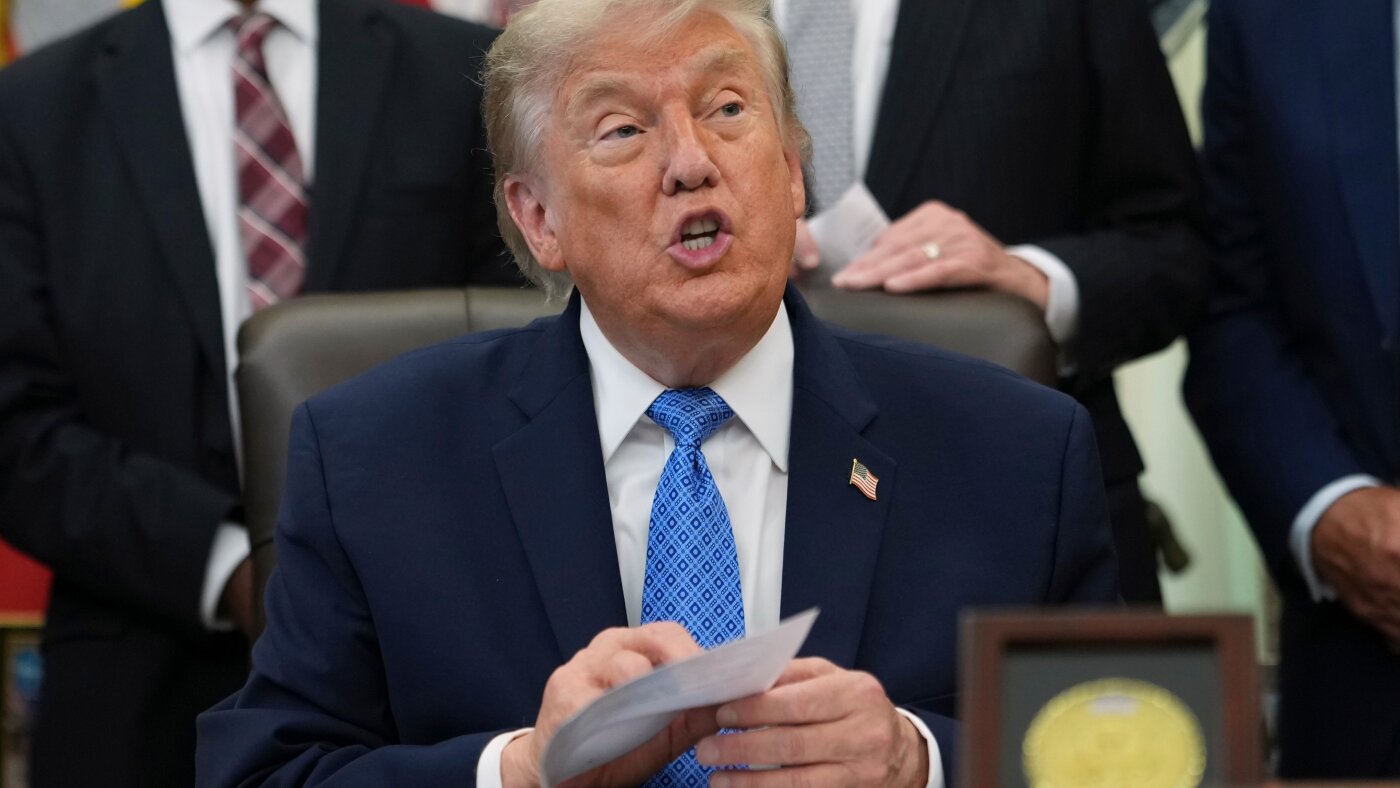 ✓
✓President Donald Trump speaks in the Oval Office of the White House, Friday, June 26, 2026, in Washington. Julia Demaree Nikhinson/AP hide caption
toggle caption
Julia Demaree Nikhinson/AP
The U.S. military said it struck multiple targets in Iran at the direction of President Trump on Saturday, in response to "continued Iranian aggression against commercial shipping." Early Sunday, Iran's Islamic Revolutionary Guard Corps said it struck U.S. military sites in Kuwait and Bahrain in response to the earlier strikes from the U.S., according to Iran's state news agency. It's the latest challenge to a fragile interim agreement Tehran and Washington reached earlier this month.
Amid a broader day of strikes and increasing tension across the region, U.S. Central Command said on social media that U.S. military aircraft targeted Iranian military "surveillance infrastructure, communication systems, air defense sites, drone storage facilities, and minelayer capabilities" in response to an attack on a Panama-flagged merchant vessel early Saturday morning.
"United States aircraft just struck Iranian missile and drone storage locations, and coastal radar sites, for violating the Cease Fire Agreement, AGAIN!" President Trump wrote on his Truth Social platform Saturday evening.
Trump's post ended with a vague threat against Iran:
"There may come a point when we are no longer able to be reasonable, and will be forced to militarily complete the job that we very successfully started. If that happens, the Islamic Republic of Iran will no longer exist!"
U.S. Central Command said Iranian forces hit the Kiku tanker with a one-way drone as it was traveling near the Strait of Hormuz with more than 2 million barrels of crude oil.
Earlier Saturday, Bahrain accused Iran of targeting it with drones.
The United Kingdom Maritime Trade Operations Centre, a British maritime security agency, also reported an attack on a commercial vessel Saturday, close to the coast of Oman.
There were no immediate reports of damage from the strikes. But Bahrain state media accused Iran of "exporting chaos and undermining regional stability." Egypt and Kuwait also swiftly condemned the attack.
Iran's paramilitary Revolutionary Guard issued a statement Saturday carried by the state-run IRNA news agency saying simply it had targeted several locations "of the U.S. terrorist army in the region."
The strikes came hours after American military forces targeted several Iranian military sites late Friday in response to an Iranian drone attack the previous day on a cargo ship navigating the Strait of Hormuz.
The Ever Lovely, a Singapore-flagged cargo ship, had been exiting the Strait close to the Omani coast, after U.S. forces had established and cleared Iranian mines from that particular route. Iran has insisted vessels should only use routes it has designated closer to its own coastline, and has repeatedly warned vessels against transiting that U.S.-supported corridor near Oman.
U.S. Central Command said Friday its warplanes hit missile and drone storage locations along Iran's coast, as well as coastal radar installations.
Following Saturday's attack on the Kiku oil tanker, Central Command said: "Iran was given a chance to honor the ceasefire agreement but elected not to when its forces launched a one-way attack drone that hit M/T Kiku this morning at 4:30 a.m. ET."
It was the third time in three weeks American warplanes had struck similar targets after Iranian drone attacks in the strait.
Map showing the approximate route of a new shipping lane by Oman. Will Jarrett/AP hide caption
toggle caption
Will Jarrett/AP
The strikes place the ceasefire under immediate strain. President Trump, speaking at the White House before the military action, said the drone attack on the Ever Lovely had violated the ceasefire. "I don't like the fact that they took a shot yesterday, actually four of them," he said from the Oval Office. Asked why the U.S. would strike back while insisting that talks with Tehran were progressing, Trump said of Iran: "They're a little bit different," before cutting off questions and having reporters removed from the room.
Vice President JD Vance, writing on social media Friday evening, said Iran should "pick up the phone" if it had objections to the terms of the ceasefire agreement, adding that "violence will be met with violence."
Iranian officials pushed back on the characterization that their actions constituted a ceasefire violation.
Ebrahim Azizi, who chairs Iran's parliamentary national security commission, wrote on social media: "the Strait of Hormuz is governed by Iran," and warned the Trump administration that it should "not mistake control for escalation." He said Thursday's attack amounted to "ceasefire management" rather than a breach.
The incidents threatened to slow what had been a cautious reopening of the waterway to commercial shipping.
A United Nations maritime agency had begun moving stranded vessels out of the Strait via the alternative Omani coastal route earlier this week, but halted those operations after Thursday's attack and said they would not resume without guarantees of safe passage.
The marine data firm Windward noted on social media that while the Strait remained operationally open, with dozens of vessels transiting after the incident, "the pace of normalization has slowed."
The U.S. and Iran are still working through the terms of a broader settlement under the 60-day window set by last week's memorandum of understanding, including the future of Iran's stockpile of highly enriched uranium.
The U.S. and Iran have exchanged military strikes following an Iranian drone attack on a commercial tanker near the Strait of Hormuz. The U.S. military targeted Iranian military infrastructure including surveillance, communications, and drone storage facilities. Iran responded with strikes on U.S. military sites in Kuwait and Bahrain. Both countries operate under a ceasefire agreement reached this month, but dispute whether recent actions constitute violations. Iran characterizes its response as 'ceasefire management' and asserts its authority over the Strait, while U.S. officials treat the actions as breach of agreement terms. Commercial shipping through the corridor has slowed, and broader negotiations on a settlement continue.
President Donald Trump speaks in the Oval Office of the White House, Friday, June 26, 2026, in Washington. Julia Demaree Nikhinson/AP hide caption
toggle caption
Julia Demaree Nikhinson/AP
The U.S. military said it struck multiple targets in Iran at the direction of President Trump on Saturday, in response to "continued Iranian aggression against commercial shipping." Early Sunday, Iran's Islamic Revolutionary Guard Corps said it struck U.S. military sites in Kuwait and Bahrain in response to the earlier strikes from the U.S., according to Iran's state news agency. It's the latest challenge to a fragile interim agreement Tehran and Washington reached earlier this month.
Amid a broader day of strikes and increasing tension across the region, U.S. Central Command said on social media that U.S. military aircraft targeted Iranian military "surveillance infrastructure, communication systems, air defense sites, drone storage facilities, and minelayer capabilities" in response to an attack on a Panama-flagged merchant vessel early Saturday morning.
"United States aircraft just struck Iranian missile and drone storage locations, and coastal radar sites, for violating the Cease Fire Agreement, AGAIN!" President Trump wrote on his Truth Social platform Saturday evening.
Trump's post ended with a vague threat against Iran:
"There may come a point when we are no longer able to be reasonable, and will be forced to militarily complete the job that we very successfully started. If that happens, the Islamic Republic of Iran will no longer exist!"
U.S. Central Command said Iranian forces hit the Kiku tanker with a one-way drone as it was traveling near the Strait of Hormuz with more than 2 million barrels of crude oil.
Earlier Saturday, Bahrain accused Iran of targeting it with drones.
The United Kingdom Maritime Trade Operations Centre, a British maritime security agency, also reported an attack on a commercial vessel Saturday, close to the coast of Oman.
There were no immediate reports of damage from the strikes. But Bahrain state media accused Iran of "exporting chaos and undermining regional stability." Egypt and Kuwait also swiftly condemned the attack.
Iran's paramilitary Revolutionary Guard issued a statement Saturday carried by the state-run IRNA news agency saying simply it had targeted several locations "of the U.S. terrorist army in the region."
The strikes came hours after American military forces targeted several Iranian military sites late Friday in response to an Iranian drone attack the previous day on a cargo ship navigating the Strait of Hormuz.
The Ever Lovely, a Singapore-flagged cargo ship, had been exiting the Strait close to the Omani coast, after U.S. forces had established and cleared Iranian mines from that particular route. Iran has insisted vessels should only use routes it has designated closer to its own coastline, and has repeatedly warned vessels against transiting that U.S.-supported corridor near Oman.
U.S. Central Command said Friday its warplanes hit missile and drone storage locations along Iran's coast, as well as coastal radar installations.
Following Saturday's attack on the Kiku oil tanker, Central Command said: "Iran was given a chance to honor the ceasefire agreement but elected not to when its forces launched a one-way attack drone that hit M/T Kiku this morning at 4:30 a.m. ET."
It was the third time in three weeks American warplanes had struck similar targets after Iranian drone attacks in the strait.
Map showing the approximate route of a new shipping lane by Oman. Will Jarrett/AP hide caption
toggle caption
Will Jarrett/AP
The strikes place the ceasefire under immediate strain. President Trump, speaking at the White House before the military action, said the drone attack on the Ever Lovely had violated the ceasefire. "I don't like the fact that they took a shot yesterday, actually four of them," he said from the Oval Office. Asked why the U.S. would strike back while insisting that talks with Tehran were progressing, Trump said of Iran: "They're a little bit different," before cutting off questions and having reporters removed from the room.
Vice President JD Vance, writing on social media Friday evening, said Iran should "pick up the phone" if it had objections to the terms of the ceasefire agreement, adding that "violence will be met with violence."
Iranian officials pushed back on the characterization that their actions constituted a ceasefire violation.
Ebrahim Azizi, who chairs Iran's parliamentary national security commission, wrote on social media: "the Strait of Hormuz is governed by Iran," and warned the Trump administration that it should "not mistake control for escalation." He said Thursday's attack amounted to "ceasefire management" rather than a breach.
The incidents threatened to slow what had been a cautious reopening of the waterway to commercial shipping.
A United Nations maritime agency had begun moving stranded vessels out of the Strait via the alternative Omani coastal route earlier this week, but halted those operations after Thursday's attack and said they would not resume without guarantees of safe passage.
The marine data firm Windward noted on social media that while the Strait remained operationally open, with dozens of vessels transiting after the incident, "the pace of normalization has slowed."
The U.S. and Iran are still working through the terms of a broader settlement under the 60-day window set by last week's memorandum of understanding, including the future of Iran's stockpile of highly enriched uranium.
The U.S. military struck Iranian military targets on Saturday at President Trump's direction in response to an Iranian drone attack on the Panama-flagged Kiku tanker early that morning Iran's Islamic Revolutionary Guard Corps struck U.S. military sites in Kuwait and Bahrain on Sunday in response Both actions occurred under a ceasefire agreement reached between Tehran and Washington earlier this month The attacks violated the ceasefire agreement Iran's actions constituted 'ceasefire management' rather than a breach U.S. Central Command stated Iranian forces hit the Kiku tanker with a one-way drone near the Strait of Hormuz This was the third time in three weeks American warplanes had struck similar Iranian targets after drone attacks in the strait President Trump stated there may come a point when the U.S. will 'complete the job' militarily and that 'the Islamic Republic of Iran will no longer exist' under such circumstances Iran disputes that vessels should only use the U.S.-supported corridor near Oman and has insisted on routes closer to its own coastline A UN maritime agency halted moving stranded vessels through the alternative route after Thursday's attack pending safety guarantees The U.S. and Iran are negotiating a broader settlement under a 60-day window, including terms for Iran's highly enriched uranium stockpile
- The U.S. struck Iranian military targets Saturday in response to an Iranian drone attack on a Panama-flagged tanker; Iran retaliated Sunday with strikes on U.S. sites in Kuwait and Bahrain
- Both sides accuse each other of violating a ceasefire agreement reached earlier this month
- The incidents involved commercial shipping in the Strait of Hormuz and surrounding waters; Iran disputes U.S. characterization of its actions as violations
- President Trump threatened military action to complete 'the job,' while Iran frames its actions as 'ceasefire management' rather than breach
- Negotiations on a broader settlement, including Iran's uranium stockpile, continue under a 60-day window