Venezuela quake death toll reaches 920 as interim president vows to save ‘as many as possible’
 ✓
✓Venezuela’s interim president, Delcy Rodríguez, has vowed to fight to save “as many people as possible” as the official death toll from the country’s worst earthquake in more than a century almost doubled, but frustration was growing at the perceived sluggishness of the government’s response.
Rodríguez’s brother, Jorge, who is the president of the national assembly, said on Friday that the official number of dead had risen to 920. Delcy Rodríguez had earlier said that almost 3,000 people were injured. Speaking during a tour of La Guaira, the most devastated region, she said foreign search and rescue groups were starting to arrive.
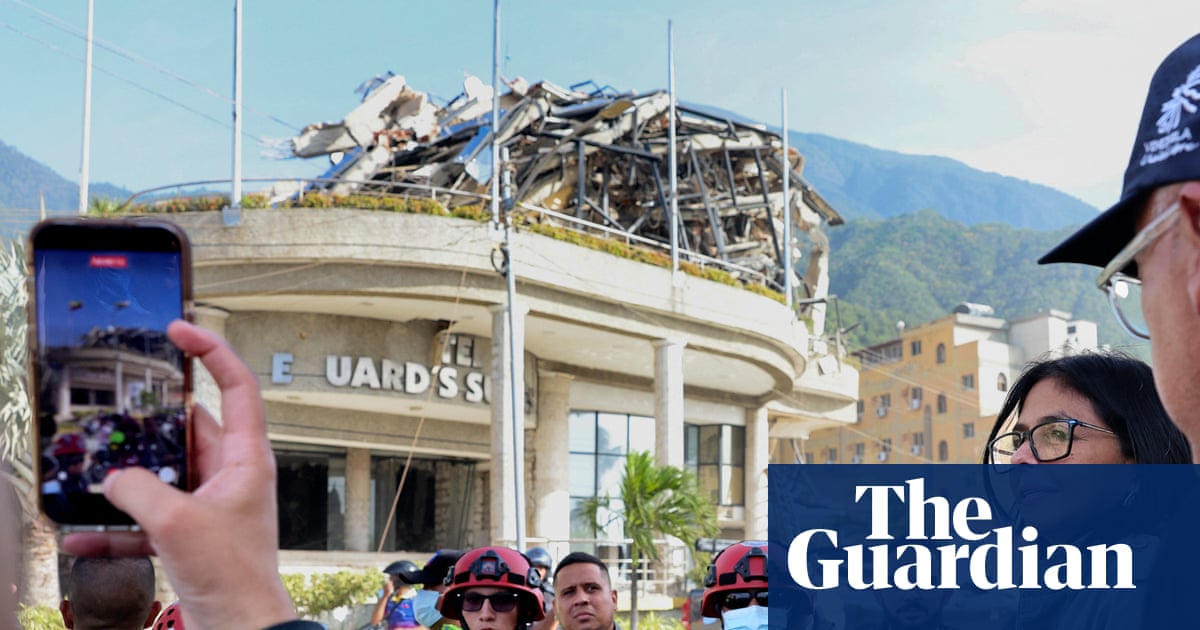
“We offer our solidarity [to families of victims],” Rodríguez said late on Thursday outside the ruins of an eight-floor seafront hotel that had been obliterated by twin 7.2- and 7.5-magnitude quakes.
Volunteer searchers and the relatives of the many missing voiced exasperation and anger at the lack of an official response as they waited for government teams.
Rotny Bombart, a 33-year-old paramedic, said he had spent five hours hunting for his mother, María Eugenia, in a collapsed tower block in La Guaira called OPP 33. “It has 15 floors. Or rather, it used to, because there’s nothing left of it now,” Bombart said after being treated at a public hospital in the capital, Caracas, for a gash to his right arm sustained during the search.
Bombart said that at first no government emergency workers had appeared at the scene. In their absence, desperate local people seized the initiative, picking their way through the rubble with bare hands and basic tools. “You’re prepared for emergencies, but not for this. Nothing prepares you for this,” he said, recalling seeing dismembered bodies, dead people and children in the wreckage.
Another searcher, Diego González, said he had spent hours digging his 34-year-old cousin, Helari Rodríguez, out of the debris of Residencias Belo Horizonte, an apartment building in the seaside town of Catia La Mar.
“It took us four hours to pull her out of the rubble with the help of some friends,” he said. “People are working with their bare hands. Tools are essential. But Catia La Mar is destroyed – very few buildings will have survived.”
On Thursday, the US defence secretary, Pete Hegseth, said that on Donald Trump’s orders he had mobilised troops to “support the Venezuelan people” in their hour of need. “Our mission is clear: save lives and rapidly deliver critical aid where it is most needed,” Hegseth tweeted.
US Southern Command said Marine Corps Maj Gen Kevin J Jarrard had landed in Caracas to oversee the use of “the US military’s unparalleled logistical and operational capabilities” to help with the search. Other countries, including Brazil, Colombia, El Salvador, Mexico, Spain, France, Turkey and Switzerland, have offered to send humanitarian aid and rescue teams.
Thirty-six hours after the back-to-back earthquakes devastated Venezuela’s northern coast, there was scant sign of government help reaching many areas, exposing how years of economic misrule and corruption have left authorities woefully unprepared for a disaster on this scale.
Chaotic footage from the José María Vargas hospital in La Guaira captured the extent to which Venezuela’s public health system had withered as Rodríguez’s predecessor, Nicolás Maduro, led the country into economic freefall. Patients could be seen lying on the floor as they waited for treatment in the facility’s car park.
Orlando Pérez, a Latin America expert at the University of North Texas at Dallas, said: “It seems they weren’t prepared at all. Natural disasters reveal the true capabilities of a government because you have to respond quickly, you have to respond efficiently, you have to do search and rescue, you have to provide services in situations where it’s difficult. And it seems that the government has been caught flat-footed completely.
“It’s incredible because this is a resource-rich country,” Pérez added. Venezuela boasts the world’s largest proven reserves of oil but under Maduro was plunged into one of the worst peacetime economic crises in modern history.
“Yet you have completely degraded health infrastructure, buildings that were not built to code that collapsed very easily,” Pérez said. “They have had the resources but they have squandered it. The health infrastructure in particular is very weak. Hospitals lack equipment, they lack medicine – and that is going to cost lives.”
An opposition activist, Jesús Armas, said successive Chavista administrations had failed to invest sufficiently in the emergency and healthcare services that would have enabled them to better cope with a disaster they should have anticipated, given Venezuela’s location along the boundary between the Caribbean and South American tectonic plates. “Every 50 or 70 years we have a [major] earthquake ... We should have been prepared,” he said.
“Yesterday we saw people working in these [destroyed] places – people from civil protection and the police and national guard – without gloves, without helmets and without any kind of tools ... So we need all the international support possible.”
Compounding the problem was Venezuela’s severe migration crisis, in which nearly 8 million citizens had fled abroad to escape economic crisis and political repression. “A lot of doctors, a lot of engineers that we need right now, a lot of experts in civil protection and rescue operations [have all left] ... This is a tragedy.”
Writing on X, Juan Pablo Guanipa, a prominent opposition politician, questioned why Venezuela’s armed forces were not doing more to help civilian victims. “So far we have not seen real mobilisation or action [from the military] in the face of this grave situation that we are facing. We have seen families, neighbours and rescue workers trying to save lives with their own hands,” Guanipa said. “Right now, all of us need to be involved, the armed forces included.”
Pérez said he was puzzled by reports that there had been little sign of action by Venezuela’s Bolivarian national armed forces (FANB).
He said: “What I am hearing from people is that they have not seen large contingencies of FANB personnel and equipment being mobilised … We know that the FANB’s capabilities had been degraded; that it was an armed force that was structured to prevent a coup. That it was top heavy with a lot of brass and not a lot of capability down in the middle and the bottom – and that it was involved in illicit activities.”
But even so, Pérez thought the “lack of coordinated response and presence seemingly of the FANB” was striking.
Read the full story at NPR ↗ · The Guardian ↗
Venezuela has experienced its worst earthquake in over a century, with two major quakes (7.2 and 7.5 magnitude) striking its northern coast. The official death toll stands at 920, with approximately 3,000 injured. Interim president Delcy Rodríguez stated the government would work to save as many people as possible, and international search and rescue teams have begun arriving. However, 36 hours after the earthquakes, many affected areas reported minimal visible government emergency response. Civilians and volunteers, working with limited tools and bare hands, conducted most early rescue operations. Venezuela's healthcare system, already degraded by years of economic mismanagement, showed strain with patients waiting on hospital floors. Experts attribute the slow response to decades of underinvestment in emergency and healthcare services, combined with the departure of skilled workers due to Venezuela's economic crisis. International assistance from the US, Brazil, Colombia, Spain, France, Turkey, Switzerland, Mexico, and El Salvador has been mobilized.
Read the full story at NPR ↗ · The Guardian ↗
Venezuela’s interim president, Delcy Rodríguez, has vowed to fight to save “as many people as possible” as the official death toll from the country’s worst earthquake in more than a century almost doubled, but frustration was growing at the perceived sluggishness of the government’s response.
Rodríguez’s brother, Jorge, who is the president of the national assembly, said on Friday that the official number of dead had risen to 920. Delcy Rodríguez had earlier said that almost 3,000 people were injured. Speaking during a tour of La Guaira, the most devastated region, she said foreign search and rescue groups were starting to arrive.
“We offer our solidarity [to families of victims],” Rodríguez said late on Thursday outside the ruins of an eight-floor seafront hotel that had been obliterated by twin 7.2- and 7.5-magnitude quakes.
Volunteer searchers and the relatives of the many missing voiced exasperation and anger at the lack of an official response as they waited for government teams.
Rotny Bombart, a 33-year-old paramedic, said he had spent five hours hunting for his mother, María Eugenia, in a collapsed tower block in La Guaira called OPP 33. “It has 15 floors. Or rather, it used to, because there’s nothing left of it now,” Bombart said after being treated at a public hospital in the capital, Caracas, for a gash to his right arm sustained during the search.
Bombart said that at first no government emergency workers had appeared at the scene. In their absence, desperate local people seized the initiative, picking their way through the rubble with bare hands and basic tools. “You’re prepared for emergencies, but not for this. Nothing prepares you for this,” he said, recalling seeing dismembered bodies, dead people and children in the wreckage.
Another searcher, Diego González, said he had spent hours digging his 34-year-old cousin, Helari Rodríguez, out of the debris of Residencias Belo Horizonte, an apartment building in the seaside town of Catia La Mar.
“It took us four hours to pull her out of the rubble with the help of some friends,” he said. “People are working with their bare hands. Tools are essential. But Catia La Mar is destroyed – very few buildings will have survived.”
On Thursday, the US defence secretary, Pete Hegseth, said that on Donald Trump’s orders he had mobilised troops to “support the Venezuelan people” in their hour of need. “Our mission is clear: save lives and rapidly deliver critical aid where it is most needed,” Hegseth tweeted.
US Southern Command said Marine Corps Maj Gen Kevin J Jarrard had landed in Caracas to oversee the use of “the US military’s unparalleled logistical and operational capabilities” to help with the search. Other countries, including Brazil, Colombia, El Salvador, Mexico, Spain, France, Turkey and Switzerland, have offered to send humanitarian aid and rescue teams.
Thirty-six hours after the back-to-back earthquakes devastated Venezuela’s northern coast, there was scant sign of government help reaching many areas, exposing how years of economic misrule and corruption have left authorities woefully unprepared for a disaster on this scale.
Chaotic footage from the José María Vargas hospital in La Guaira captured the extent to which Venezuela’s public health system had withered as Rodríguez’s predecessor, Nicolás Maduro, led the country into economic freefall. Patients could be seen lying on the floor as they waited for treatment in the facility’s car park.
Orlando Pérez, a Latin America expert at the University of North Texas at Dallas, said: “It seems they weren’t prepared at all. Natural disasters reveal the true capabilities of a government because you have to respond quickly, you have to respond efficiently, you have to do search and rescue, you have to provide services in situations where it’s difficult. And it seems that the government has been caught flat-footed completely.
“It’s incredible because this is a resource-rich country,” Pérez added. Venezuela boasts the world’s largest proven reserves of oil but under Maduro was plunged into one of the worst peacetime economic crises in modern history.
“Yet you have completely degraded health infrastructure, buildings that were not built to code that collapsed very easily,” Pérez said. “They have had the resources but they have squandered it. The health infrastructure in particular is very weak. Hospitals lack equipment, they lack medicine – and that is going to cost lives.”
An opposition activist, Jesús Armas, said successive Chavista administrations had failed to invest sufficiently in the emergency and healthcare services that would have enabled them to better cope with a disaster they should have anticipated, given Venezuela’s location along the boundary between the Caribbean and South American tectonic plates. “Every 50 or 70 years we have a [major] earthquake ... We should have been prepared,” he said.
“Yesterday we saw people working in these [destroyed] places – people from civil protection and the police and national guard – without gloves, without helmets and without any kind of tools ... So we need all the international support possible.”
Compounding the problem was Venezuela’s severe migration crisis, in which nearly 8 million citizens had fled abroad to escape economic crisis and political repression. “A lot of doctors, a lot of engineers that we need right now, a lot of experts in civil protection and rescue operations [have all left] ... This is a tragedy.”
Writing on X, Juan Pablo Guanipa, a prominent opposition politician, questioned why Venezuela’s armed forces were not doing more to help civilian victims. “So far we have not seen real mobilisation or action [from the military] in the face of this grave situation that we are facing. We have seen families, neighbours and rescue workers trying to save lives with their own hands,” Guanipa said. “Right now, all of us need to be involved, the armed forces included.”
Pérez said he was puzzled by reports that there had been little sign of action by Venezuela’s Bolivarian national armed forces (FANB).
He said: “What I am hearing from people is that they have not seen large contingencies of FANB personnel and equipment being mobilised … We know that the FANB’s capabilities had been degraded; that it was an armed force that was structured to prevent a coup. That it was top heavy with a lot of brass and not a lot of capability down in the middle and the bottom – and that it was involved in illicit activities.”
But even so, Pérez thought the “lack of coordinated response and presence seemingly of the FANB” was striking.
Read the full story at NPR ↗ · The Guardian ↗
Two earthquakes measuring 7.2 and 7.5 magnitude struck Venezuela's northern coast The official death toll from the earthquakes has reached 920 Nearly 3,000 people were injured in the earthquakes Interim president Delcy Rodríguez vowed to save 'as many people as possible' Foreign search and rescue groups began arriving at the affected areas 36 hours after the earthquakes, volunteer searchers and families reported a lack of official government response Rescue workers and volunteers used bare hands and basic tools to search for survivors The José María Vargas hospital in La Guaira had patients lying on the floor waiting for treatment Venezuela's economic crisis and migration have resulted in the departure of doctors, engineers, and emergency services experts It seems the government was completely unprepared for a disaster of this scale Venezuela should have been better prepared given earthquakes occur every 50 to 70 years in the region Years of Chavista administrations failed to invest sufficiently in emergency and healthcare services The lack of coordinated response and visible presence from Venezuela's armed forces is striking
Read the full story at NPR ↗ · The Guardian ↗
- Venezuela's death toll from back-to-back earthquakes (7.2 and 7.5 magnitude) has reached 920, with nearly 3,000 injured
- Interim president Delcy Rodríguez pledged rescue efforts as international aid arrived, but civilians reported minimal government response 36 hours after the quakes
- Volunteers and families conducted rescue operations with bare hands and basic tools while awaiting official emergency services
- Years of economic decline and migration have left Venezuela's health infrastructure, emergency services, and armed forces understaffed and under-equipped
- Multiple countries including the US, Brazil, Colombia, Spain, and others have offered humanitarian aid and rescue teams