What to know about nationwide protests in India over voter list changes
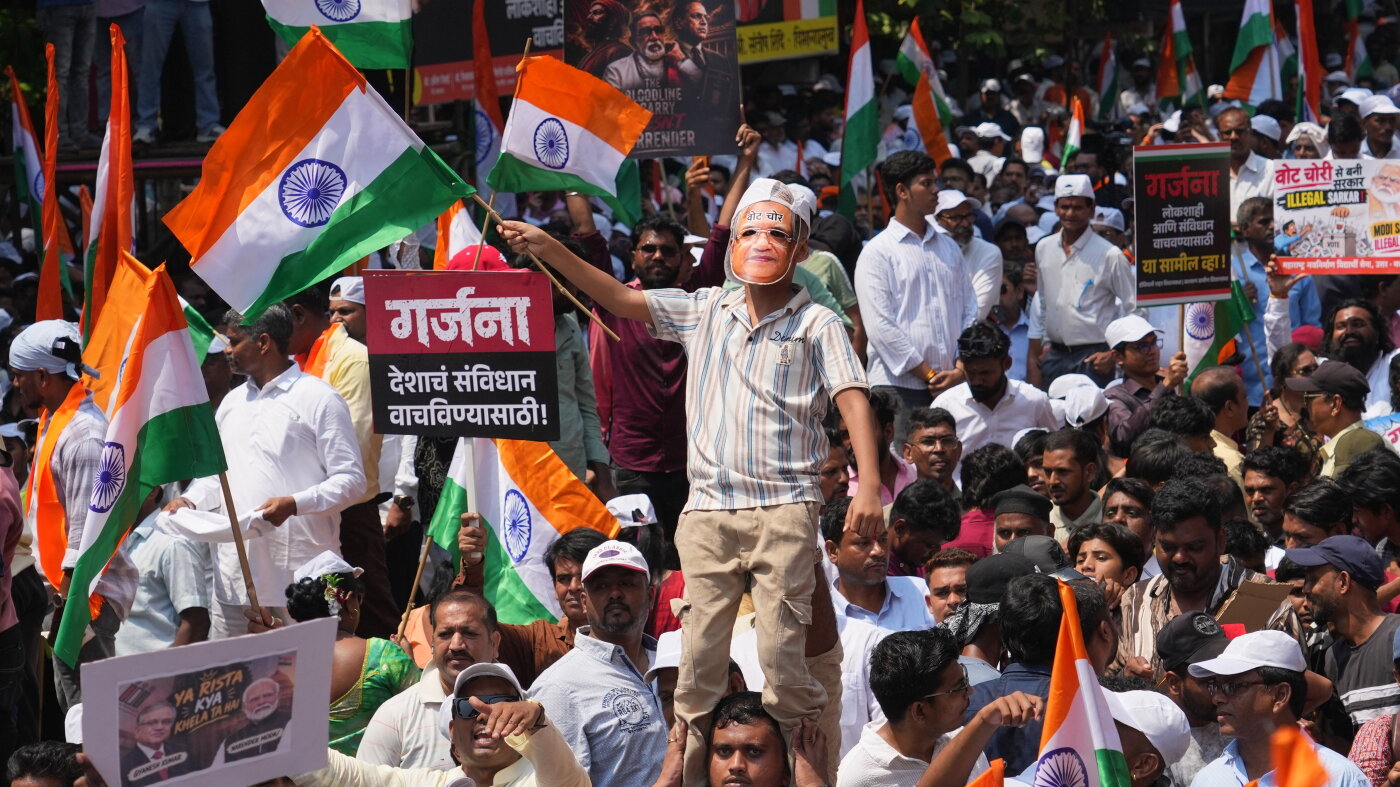 ✓
✓A protester wears a mask depicting Chief Election Commissioner Gyanesh Kumar with the words "vote theft" during a protest organized by Shiv Sena (UBT) and the Maharashtra Navnirman Sena , demanding his resignation and the suspension of the Special Intensive Revision (SIR) of electoral rolls, in Mumbai, India, Sunday, Oct. 4, 2026. Rafiq Maqbool/AP hide caption
Rafiq Maqbool/AP
NEW DELHI — Protests have spread across India in the past week as opposition parties and civil society groups demand the resignation of the country's election chief over alleged manipulation of voter lists.
The campaign has been led in part by India's "Cockroach" youth movement, which previously organized street protests that forced the education minister to resign in July.
Protesters demand the resignation of Chief Election Commissioner Gyanesh Kumar and an end to the poll body's ongoing revision of voter lists. They accuse the revision could disenfranchise millions of voters and benefit Prime Minister Narendra Modi's ruling Hindu nationalist Bharatiya Janata Party, or BJP. The commission and government deny any wrongdoing.
Here's what to know:
India is the world's largest democracy with hundreds of millions of people voting in national and state elections. The Election Commission plays a central role in determining voter eligibility and administering elections, making changes to electoral lists politically significant.
The dispute centers on a nationwide voter list revision known as the Special Intensive Revision, or SIR. It began last year in the eastern state of Bihar ahead of local elections and has since expanded to most of India's states and federally administered territories.
Under the process, voters are required to provide documents showing they are eligible to remain on the lists.
The Election Commission says the exercise is needed to remove duplicate and ineligible entries and ensure legitimate voters remain registered. Critics say it could instead exclude legitimate voters, particularly poorer and other vulnerable communities.
They also say the requirements are confusing and difficult for many people to provide, particularly those who lack older government records or other documents.
India's Election Commission is an independent constitutional body overseeing elections and maintaining voter lists, but opposition parties accuse the commission of favoring Modi's party. They allege the changes could remove people more likely to support opposition parties while preserving or adding voters who favor the BJP.
The BJP and the Election Commission reject the allegations and say the revision has no political motive. Modi's party says the list is being updated to weed out what they call "infiltrators."
The issue was prominent in West Bengal's crucial state elections earlier this year after a voter list revision removed about 9 million names, or roughly 12% of the electorate. The deletions left millions of eligible voters unable to cast ballots. Modi's party won the state for the first time.
Protesters hold placards during a protest organized by Shiv Sena (UBT) and the Maharashtra Navnirman Sena, demanding the resignation of Chief Election Commissioner Gyanesh Kumar and the suspension of the Special Intensive Revision (SIR) of electoral rolls, in Mumbai, India, Sunday, Oct. 4, 2026. Rafiq Maqbool/AP hide caption
Rafiq Maqbool/AP
Indian law requires a majority vote of commission members to enact changes making disagreements among its members potentially significant.
The Indian Express newspaper reported in September that two of the three election commissioners had formally objected to several decisions involving voter list revisions, registration procedures and the commission's digital systems.
The newspaper reported Kumar, the election chief, rejected those objections.
The Election Commission said the report reflected "differing views and deliberations" rather than formal written objections.
The "Cockroach" movement, opposition parties and civil society groups have called for Kumar to resign or be removed and for an inquiry into his conduct, including possible criminal proceedings. They want the current revision halted and the previous electoral lists used for future elections.
They also demand a more independent and transparent process for appointing election commissioners.
Election Commission data indicates voter lists in some regions could shrink by as much as 30%, fueling concerns among opposition parties and protest groups over potential exclusions.
The dispute is likely to intensify as the changes resulting from the revision expand throughout India, which is facing a series of state elections early next year.
Read the full story at Al Jazeera ↗ · Al Jazeera ↗ · NPR ↗
The campaign is led in part by India's "Cockroach" youth movement, which previously forced the education minister to resign
This lens runs the verified story through Cinnamon's AI — wired in the next step.
A protester wears a mask depicting Chief Election Commissioner Gyanesh Kumar with the words "vote theft" during a protest organized by Shiv Sena (UBT) and the Maharashtra Navnirman Sena , demanding his resignation and the suspension of the Special Intensive Revision (SIR) of electoral rolls, in Mumbai, India, Sunday, Oct. 4, 2026. Rafiq Maqbool/AP hide caption
Rafiq Maqbool/AP
NEW DELHI — Protests have spread across India in the past week as opposition parties and civil society groups demand the resignation of the country's election chief over alleged manipulation of voter lists.
The campaign has been led in part by India's "Cockroach" youth movement, which previously organized street protests that forced the education minister to resign in July.
Protesters demand the resignation of Chief Election Commissioner Gyanesh Kumar and an end to the poll body's ongoing revision of voter lists. They accuse the revision could disenfranchise millions of voters and benefit Prime Minister Narendra Modi's ruling Hindu nationalist Bharatiya Janata Party, or BJP. The commission and government deny any wrongdoing.
Here's what to know:
India is the world's largest democracy with hundreds of millions of people voting in national and state elections. The Election Commission plays a central role in determining voter eligibility and administering elections, making changes to electoral lists politically significant.
The dispute centers on a nationwide voter list revision known as the Special Intensive Revision, or SIR. It began last year in the eastern state of Bihar ahead of local elections and has since expanded to most of India's states and federally administered territories.
Under the process, voters are required to provide documents showing they are eligible to remain on the lists.
The Election Commission says the exercise is needed to remove duplicate and ineligible entries and ensure legitimate voters remain registered. Critics say it could instead exclude legitimate voters, particularly poorer and other vulnerable communities.
They also say the requirements are confusing and difficult for many people to provide, particularly those who lack older government records or other documents.
India's Election Commission is an independent constitutional body overseeing elections and maintaining voter lists, but opposition parties accuse the commission of favoring Modi's party. They allege the changes could remove people more likely to support opposition parties while preserving or adding voters who favor the BJP.
The BJP and the Election Commission reject the allegations and say the revision has no political motive. Modi's party says the list is being updated to weed out what they call "infiltrators."
The issue was prominent in West Bengal's crucial state elections earlier this year after a voter list revision removed about 9 million names, or roughly 12% of the electorate. The deletions left millions of eligible voters unable to cast ballots. Modi's party won the state for the first time.
Protesters hold placards during a protest organized by Shiv Sena (UBT) and the Maharashtra Navnirman Sena, demanding the resignation of Chief Election Commissioner Gyanesh Kumar and the suspension of the Special Intensive Revision (SIR) of electoral rolls, in Mumbai, India, Sunday, Oct. 4, 2026. Rafiq Maqbool/AP hide caption
Rafiq Maqbool/AP
Indian law requires a majority vote of commission members to enact changes making disagreements among its members potentially significant.
The Indian Express newspaper reported in September that two of the three election commissioners had formally objected to several decisions involving voter list revisions, registration procedures and the commission's digital systems.
The newspaper reported Kumar, the election chief, rejected those objections.
The Election Commission said the report reflected "differing views and deliberations" rather than formal written objections.
The "Cockroach" movement, opposition parties and civil society groups have called for Kumar to resign or be removed and for an inquiry into his conduct, including possible criminal proceedings. They want the current revision halted and the previous electoral lists used for future elections.
They also demand a more independent and transparent process for appointing election commissioners.
Election Commission data indicates voter lists in some regions could shrink by as much as 30%, fueling concerns among opposition parties and protest groups over potential exclusions.
The dispute is likely to intensify as the changes resulting from the revision expand throughout India, which is facing a series of state elections early next year.
Read the full story at Al Jazeera ↗ · Al Jazeera ↗ · NPR ↗
A protester wears a mask depicting Chief Election Commissioner Gyanesh Kumar with the words "vote theft" during a protest organized by Shiv Sena (UBT) and the Maharashtra Navnirman Sena , demanding his resignation and the suspension of the Special Intensive Revision (SIR) of electoral rolls, in Mumbai, India, Sunday, Oct. 4, 2026. Rafiq Maqbool/AP hide caption
Rafiq Maqbool/AP
NEW DELHI — Protests have spread across India in the past week as opposition parties and civil society groups demand the resignation of the country's election chief over alleged manipulation of voter lists.
The campaign has been led in part by India's "Cockroach" youth movement, which previously organized street protests that forced the education minister to resign in July.
Protesters demand the resignation of Chief Election Commissioner Gyanesh Kumar and an end to the poll body's ongoing revision of voter lists. They accuse the revision could disenfranchise millions of voters and benefit Prime Minister Narendra Modi's ruling Hindu nationalist Bharatiya Janata Party, or BJP. The commission and government deny any wrongdoing.
Here's what to know:
India is the world's largest democracy with hundreds of millions of people voting in national and state elections. The Election Commission plays a central role in determining voter eligibility and administering elections, making changes to electoral lists politically significant.
The dispute centers on a nationwide voter list revision known as the Special Intensive Revision, or SIR. It began last year in the eastern state of Bihar ahead of local elections and has since expanded to most of India's states and federally administered territories.
Under the process, voters are required to provide documents showing they are eligible to remain on the lists.
The Election Commission says the exercise is needed to remove duplicate and ineligible entries and ensure legitimate voters remain registered. Critics say it could instead exclude legitimate voters, particularly poorer and other vulnerable communities.
They also say the requirements are confusing and difficult for many people to provide, particularly those who lack older government records or other documents.
India's Election Commission is an independent constitutional body overseeing elections and maintaining voter lists, but opposition parties accuse the commission of favoring Modi's party. They allege the changes could remove people more likely to support opposition parties while preserving or adding voters who favor the BJP.
The BJP and the Election Commission reject the allegations and say the revision has no political motive. Modi's party says the list is being updated to weed out what they call "infiltrators."
The issue was prominent in West Bengal's crucial state elections earlier this year after a voter list revision removed about 9 million names, or roughly 12% of the electorate. The deletions left millions of eligible voters unable to cast ballots. Modi's party won the state for the first time.
Protesters hold placards during a protest organized by Shiv Sena (UBT) and the Maharashtra Navnirman Sena, demanding the resignation of Chief Election Commissioner Gyanesh Kumar and the suspension of the Special Intensive Revision (SIR) of electoral rolls, in Mumbai, India, Sunday, Oct. 4, 2026. Rafiq Maqbool/AP hide caption
Rafiq Maqbool/AP
Indian law requires a majority vote of commission members to enact changes making disagreements among its members potentially significant.
The Indian Express newspaper reported in September that two of the three election commissioners had formally objected to several decisions involving voter list revisions, registration procedures and the commission's digital systems.
The newspaper reported Kumar, the election chief, rejected those objections.
The Election Commission said the report reflected "differing views and deliberations" rather than formal written objections.
The "Cockroach" movement, opposition parties and civil society groups have called for Kumar to resign or be removed and for an inquiry into his conduct, including possible criminal proceedings. They want the current revision halted and the previous electoral lists used for future elections.
They also demand a more independent and transparent process for appointing election commissioners.
Election Commission data indicates voter lists in some regions could shrink by as much as 30%, fueling concerns among opposition parties and protest groups over potential exclusions.
The dispute is likely to intensify as the changes resulting from the revision expand throughout India, which is facing a series of state elections early next year.
Read the full story at Al Jazeera ↗ · Al Jazeera ↗ · NPR ↗
This lens runs the verified story through Cinnamon's AI — wired in the next step.
- The campaign is led in part by India's "Cockroach" youth movement, which previously forced the education minister to resign