When and where to see the solar eclipse in London
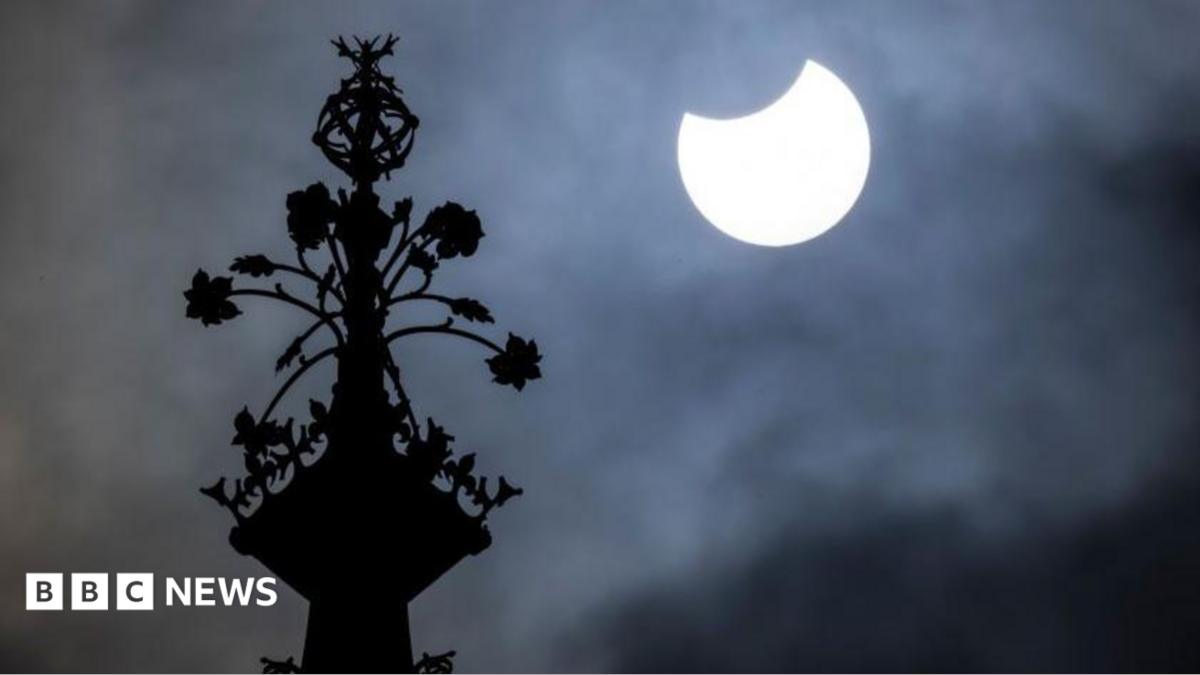
Image source, Getty Images
A partial solar eclipse over Big Ben in London on 10 June 2021
ByAmy Clarke
Reporting fromLondon
On Wednesday 12 August, Londoners will be able to see a rare partial solar eclipse.
A solar eclipse takes place when the Moon moves between the Sun and the Earth, blocking the Sun's light either partially or completely. This casts a small shadow on the Earth for a short period.
During this eclipse, around 90% of the Sun will be covered by the Moon for people viewing it from London. According to Royal Museums Greenwich, this is the greatest coverage visible from the UK since 1999.
Here's what you need to know about the solar eclipse, including the best places to watch it in the capital and how to do so safely.
The museums say there will be a noticeable difference in temperature and light levels. However, as it is not a total eclipse, the sky will not become completely dark.
After this week's event, the UK will not see another deep partial solar eclipse until 2050, while the next total solar eclipse visible from the UK is not due until 2090.
The "first contact" of the eclipse, when the Moon begins to cover the edge of the Sun, will take place at 18:17 BST in London, according to Skyscanner.
The eclipse will reach its maximum at around 19:12 BST before ending at about 20:06 BST.
Image source, Getty Images
People photograph a partial solar eclipse from Primrose Hill in London on 10 June 2021
Viewing a solar eclipse can potentially damage your eyes, so it is important to take precautions to watch it safely.
The UK Health Security Agency says the event can make the Sun appear dimmer than usual, making it easier to look at directly. Despite appearing less bright, this can still cause serious damage to the retina.
Royal Museums Greenwich recommends buying or borrowing a pair of ISO 12312-2 certified eclipse glasses.
It says ordinary sunglasses are not safe to use, as they do not provide enough protection against harmful solar radiation.
Royal Museums Greenwich also provides instructions on how to make a pinhole projector, which allows people to view the eclipse indirectly through a projection.
A colander can work in a similar way. By holding it up and looking at the shadow it casts, you can see multiple projected images of the eclipse.
If you are taking a picture of the event with your smart phone you should protect your camera with a solar filter or you can just put a pair of eclipse glasses over the lens.
Image source, Getty Images
A TV presenter wears eclipse glasses in Parliament Square, London, during the 2015 partial solar eclipse
As the eclipse is taking place late in the day, it is advisable to find a wide open space where your view will not be blocked by buildings.
Higher points across the capital that offer an uninterrupted view towards the west or west-north-west are likely to provide the best viewing conditions.
Open spaces in London that could make good viewing spots include:
Telegraph Hill, near Nunhead, Lewisham
Primrose Hill, north of Regent's Park
Parliament Hill in Hampstead Heath
Alexandra Palace, Haringey
Crystal Palace Park on the Norwood Ridge
Greenwich Park - Visitors can either buy a standard Royal Observatory admission ticket to join a public partial solar eclipse viewing session hosted by the Flamsteed Astronomy Society near the Dolphin Sundial from 16:00 to 20:00 or view the eclipse for free around the park.
Image source, Getty Images
A man calibrates his powered telescope for the start of the partial solar eclipse in Greenwich park on March 20, 2015
Other astronomical societies across London will also be watching the eclipse, with smaller public viewing events taking place in a number of locations.
The Croydon Astronomical Society will host free viewing sessions at Kenley Airfield, Warlingham and Addiscombe, while Loughton Astronomical Society members will gather at sites in Chingford and Theydon Bois.
The SW London Stargazers Meetup group is also planning an eclipse watch in Tooting Bec.
If you would prefer to stay at home you can also watch the Royal Observatory's live free stream of the eclipse from London.
Listen to the best of BBC Radio London on Sounds and follow BBC London on Facebook, external, X, external and Instagram, external. Send your story ideas to hello.bbclondon@bbc.co.uk, external
Read the full story at BBC ↗
What you need to know about the solar eclipse on 12 August and the best viewing spots in London
This lens runs the verified story through Cinnamon's AI — wired in the next step.
Image source, Getty Images
A partial solar eclipse over Big Ben in London on 10 June 2021
ByAmy Clarke
Reporting fromLondon
On Wednesday 12 August, Londoners will be able to see a rare partial solar eclipse.
A solar eclipse takes place when the Moon moves between the Sun and the Earth, blocking the Sun's light either partially or completely. This casts a small shadow on the Earth for a short period.
During this eclipse, around 90% of the Sun will be covered by the Moon for people viewing it from London. According to Royal Museums Greenwich, this is the greatest coverage visible from the UK since 1999.
Here's what you need to know about the solar eclipse, including the best places to watch it in the capital and how to do so safely.
The museums say there will be a noticeable difference in temperature and light levels. However, as it is not a total eclipse, the sky will not become completely dark.
After this week's event, the UK will not see another deep partial solar eclipse until 2050, while the next total solar eclipse visible from the UK is not due until 2090.
The "first contact" of the eclipse, when the Moon begins to cover the edge of the Sun, will take place at 18:17 BST in London, according to Skyscanner.
The eclipse will reach its maximum at around 19:12 BST before ending at about 20:06 BST.
Image source, Getty Images
People photograph a partial solar eclipse from Primrose Hill in London on 10 June 2021
Viewing a solar eclipse can potentially damage your eyes, so it is important to take precautions to watch it safely.
The UK Health Security Agency says the event can make the Sun appear dimmer than usual, making it easier to look at directly. Despite appearing less bright, this can still cause serious damage to the retina.
Royal Museums Greenwich recommends buying or borrowing a pair of ISO 12312-2 certified eclipse glasses.
It says ordinary sunglasses are not safe to use, as they do not provide enough protection against harmful solar radiation.
Royal Museums Greenwich also provides instructions on how to make a pinhole projector, which allows people to view the eclipse indirectly through a projection.
A colander can work in a similar way. By holding it up and looking at the shadow it casts, you can see multiple projected images of the eclipse.
If you are taking a picture of the event with your smart phone you should protect your camera with a solar filter or you can just put a pair of eclipse glasses over the lens.
Image source, Getty Images
A TV presenter wears eclipse glasses in Parliament Square, London, during the 2015 partial solar eclipse
As the eclipse is taking place late in the day, it is advisable to find a wide open space where your view will not be blocked by buildings.
Higher points across the capital that offer an uninterrupted view towards the west or west-north-west are likely to provide the best viewing conditions.
Open spaces in London that could make good viewing spots include:
Telegraph Hill, near Nunhead, Lewisham
Primrose Hill, north of Regent's Park
Parliament Hill in Hampstead Heath
Alexandra Palace, Haringey
Crystal Palace Park on the Norwood Ridge
Greenwich Park - Visitors can either buy a standard Royal Observatory admission ticket to join a public partial solar eclipse viewing session hosted by the Flamsteed Astronomy Society near the Dolphin Sundial from 16:00 to 20:00 or view the eclipse for free around the park.
Image source, Getty Images
A man calibrates his powered telescope for the start of the partial solar eclipse in Greenwich park on March 20, 2015
Other astronomical societies across London will also be watching the eclipse, with smaller public viewing events taking place in a number of locations.
The Croydon Astronomical Society will host free viewing sessions at Kenley Airfield, Warlingham and Addiscombe, while Loughton Astronomical Society members will gather at sites in Chingford and Theydon Bois.
The SW London Stargazers Meetup group is also planning an eclipse watch in Tooting Bec.
If you would prefer to stay at home you can also watch the Royal Observatory's live free stream of the eclipse from London.
Listen to the best of BBC Radio London on Sounds and follow BBC London on Facebook, external, X, external and Instagram, external. Send your story ideas to hello.bbclondon@bbc.co.uk, external
Read the full story at BBC ↗
Image source, Getty Images
A partial solar eclipse over Big Ben in London on 10 June 2021
ByAmy Clarke
Reporting fromLondon
On Wednesday 12 August, Londoners will be able to see a rare partial solar eclipse.
A solar eclipse takes place when the Moon moves between the Sun and the Earth, blocking the Sun's light either partially or completely. This casts a small shadow on the Earth for a short period.
During this eclipse, around 90% of the Sun will be covered by the Moon for people viewing it from London. According to Royal Museums Greenwich, this is the greatest coverage visible from the UK since 1999.
Here's what you need to know about the solar eclipse, including the best places to watch it in the capital and how to do so safely.
The museums say there will be a noticeable difference in temperature and light levels. However, as it is not a total eclipse, the sky will not become completely dark.
After this week's event, the UK will not see another deep partial solar eclipse until 2050, while the next total solar eclipse visible from the UK is not due until 2090.
The "first contact" of the eclipse, when the Moon begins to cover the edge of the Sun, will take place at 18:17 BST in London, according to Skyscanner.
The eclipse will reach its maximum at around 19:12 BST before ending at about 20:06 BST.
Image source, Getty Images
People photograph a partial solar eclipse from Primrose Hill in London on 10 June 2021
Viewing a solar eclipse can potentially damage your eyes, so it is important to take precautions to watch it safely.
The UK Health Security Agency says the event can make the Sun appear dimmer than usual, making it easier to look at directly. Despite appearing less bright, this can still cause serious damage to the retina.
Royal Museums Greenwich recommends buying or borrowing a pair of ISO 12312-2 certified eclipse glasses.
It says ordinary sunglasses are not safe to use, as they do not provide enough protection against harmful solar radiation.
Royal Museums Greenwich also provides instructions on how to make a pinhole projector, which allows people to view the eclipse indirectly through a projection.
A colander can work in a similar way. By holding it up and looking at the shadow it casts, you can see multiple projected images of the eclipse.
If you are taking a picture of the event with your smart phone you should protect your camera with a solar filter or you can just put a pair of eclipse glasses over the lens.
Image source, Getty Images
A TV presenter wears eclipse glasses in Parliament Square, London, during the 2015 partial solar eclipse
As the eclipse is taking place late in the day, it is advisable to find a wide open space where your view will not be blocked by buildings.
Higher points across the capital that offer an uninterrupted view towards the west or west-north-west are likely to provide the best viewing conditions.
Open spaces in London that could make good viewing spots include:
Telegraph Hill, near Nunhead, Lewisham
Primrose Hill, north of Regent's Park
Parliament Hill in Hampstead Heath
Alexandra Palace, Haringey
Crystal Palace Park on the Norwood Ridge
Greenwich Park - Visitors can either buy a standard Royal Observatory admission ticket to join a public partial solar eclipse viewing session hosted by the Flamsteed Astronomy Society near the Dolphin Sundial from 16:00 to 20:00 or view the eclipse for free around the park.
Image source, Getty Images
A man calibrates his powered telescope for the start of the partial solar eclipse in Greenwich park on March 20, 2015
Other astronomical societies across London will also be watching the eclipse, with smaller public viewing events taking place in a number of locations.
The Croydon Astronomical Society will host free viewing sessions at Kenley Airfield, Warlingham and Addiscombe, while Loughton Astronomical Society members will gather at sites in Chingford and Theydon Bois.
The SW London Stargazers Meetup group is also planning an eclipse watch in Tooting Bec.
If you would prefer to stay at home you can also watch the Royal Observatory's live free stream of the eclipse from London.
Listen to the best of BBC Radio London on Sounds and follow BBC London on Facebook, external, X, external and Instagram, external. Send your story ideas to hello.bbclondon@bbc.co.uk, external
Read the full story at BBC ↗
This lens runs the verified story through Cinnamon's AI — wired in the next step.
- What you need to know about the solar eclipse on 12 August and the best viewing spots in London