Whereabouts of nearly 300 people with Ebola unknown in DR Congo
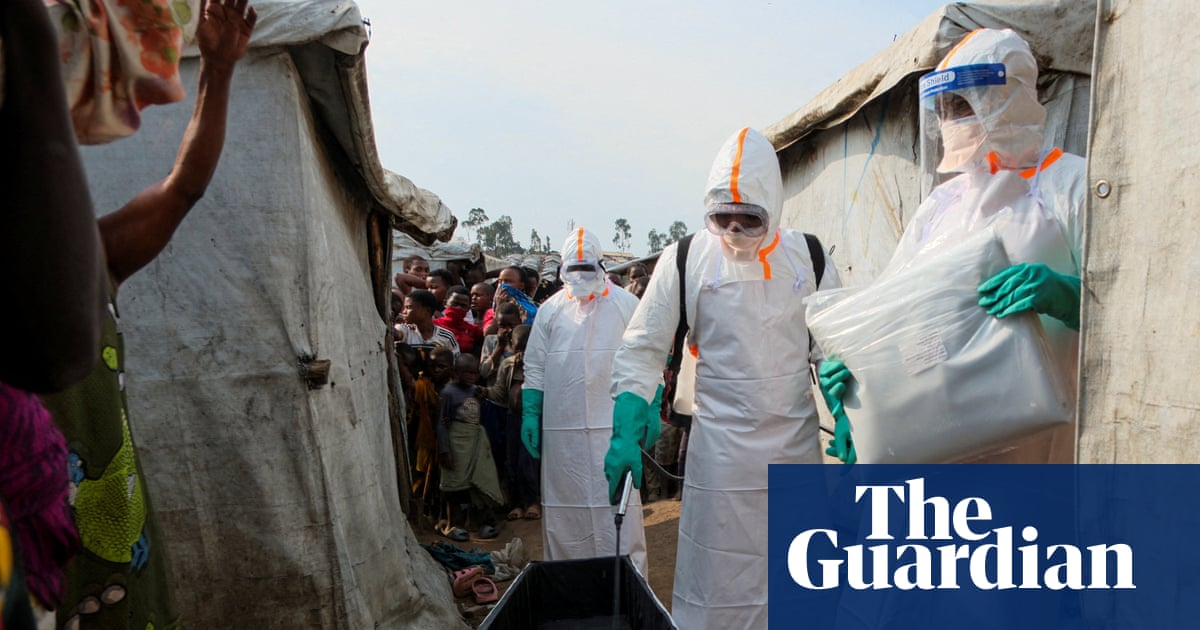
The whereabouts of almost 300 people who have tested positive for Ebola in the Democratic Republic of the Congo is unknown, according to Africa’s top public health official.
The humanitarian crisis amid the conflict in the affected areas means more than 1 million people are living in camps to which health workers have no access, Dr Jean Kaseya, director general of the Africa Centers for Disease Control and Prevention (CDC), said on Thursday.
His comments came as projections from the World Health Organization’s Africa regional office, published in the Lancet Infectious Diseases journal, predicted there will be about 8,210 cases and 1,420 deaths by mid-September.
The modelling suggested the outbreak had a 70% chance of spreading to neighbouring South Sudan in the coming weeks.
There have been 1,118 confirmed cases and 291 deaths to date in the DRC, as well as 20 cases and two deaths in neighbouring Uganda.
On Wednesday, France announced that a doctor who had been working in the DRC had tested positive on his return. His employer, medical NGO Alima, said they were “working to understand how the contamination may have occurred”.
Figures on the number of patients who have recovered and those being treated, as well as deaths, indicate 297 people who tested positive are unaccounted for.
“This is a concern that we have. Where are these people?” asked Kaseya.
DRC authorities said on Thursday that anyone who had been in affected provinces would need to wait 21 days before they could travel onwards.
The outbreak, caused by the Bundibugyo strain of the virus, is the largest on record for five weeks after declaration. At the same stage, the west Africa outbreak of 2014 to 2016, which infected more than 28,000 people and killed more than 11,000, had 239 cases and 160 deaths.
Computer models were used by the WHO to simulate three trajectories – low, central or high transmissibility.
There are signs that the DRC’s response is working to slow transmission, the authors said, and current figures are most in line with the central scenario, predicting between 6,636 and 10,287 cases by 16 September.
The worst-case scenario projects 66,000 confirmed cases by September.
Kaseya said 30% of new cases are among known contacts of confirmed cases, indicating “huge, huge community transmission”. Authorities intend to recruit 20,000 community health workers from the local area to boost contact tracing efforts, he said.
Bed occupancy in Ebola treatment centres is at 95% and “we didn’t reach the peak yet”, he added.
He said camps in which displaced people were living “have cases, and because we don’t have access to these camps, we cannot have the contact tracing. We cannot have a photo of what’s happening there. We cannot stop this outbreak, without resolving the humanitarian issue.”
Africa CDC and the WHO had earlier said $518m (£392m) of health spending would be needed to tackle the outbreak. When humanitarian needs are added, the total rises to $1.4bn, Kaseya said.
Only about 13% of $910m pledged to the response by international governments and organisations has so far been supplied, he said.
The first trial of drugs that may be able to treat the Bundibugyo virus is due to begin in the DRC next week, while a trial of an antiviral given to contacts to prevent them developing the disease will begin a week later.
Read the full story at The Guardian ↗
An Ebola outbreak in the Democratic Republic of the Congo has created a tracking and response challenge. Nearly 300 people who tested positive are unaccounted for, according to the Africa Centers for Disease Control director. The outbreak has produced 1,118 confirmed cases and 291 deaths in DRC, plus 20 cases and 2 deaths in Uganda. Displacement camps housing over 1 million people lack health worker access, preventing contact tracing. The Bundibugyo strain outbreak is the largest recorded at this five-week stage compared to the 2014–2016 West African outbreak. WHO modelling suggests 6,636–10,287 cases by mid-September under current transmission rates, with a 70% chance of spread to South Sudan. Treatment centre bed occupancy stands at 95%. Clinical trials for Bundibugyo treatments and preventive antivirals are beginning. Funding remains constrained: only 13% of $910 million pledged has arrived, while total needs including humanitarian response reach $1.4 billion.
Read the full story at The Guardian ↗
The whereabouts of almost 300 people who have tested positive for Ebola in the Democratic Republic of the Congo is unknown, according to Africa’s top public health official.
The humanitarian crisis amid the conflict in the affected areas means more than 1 million people are living in camps to which health workers have no access, Dr Jean Kaseya, director general of the Africa Centers for Disease Control and Prevention (CDC), said on Thursday.
His comments came as projections from the World Health Organization’s Africa regional office, published in the Lancet Infectious Diseases journal, predicted there will be about 8,210 cases and 1,420 deaths by mid-September.
The modelling suggested the outbreak had a 70% chance of spreading to neighbouring South Sudan in the coming weeks.
There have been 1,118 confirmed cases and 291 deaths to date in the DRC, as well as 20 cases and two deaths in neighbouring Uganda.
On Wednesday, France announced that a doctor who had been working in the DRC had tested positive on his return. His employer, medical NGO Alima, said they were “working to understand how the contamination may have occurred”.
Figures on the number of patients who have recovered and those being treated, as well as deaths, indicate 297 people who tested positive are unaccounted for.
“This is a concern that we have. Where are these people?” asked Kaseya.
DRC authorities said on Thursday that anyone who had been in affected provinces would need to wait 21 days before they could travel onwards.
The outbreak, caused by the Bundibugyo strain of the virus, is the largest on record for five weeks after declaration. At the same stage, the west Africa outbreak of 2014 to 2016, which infected more than 28,000 people and killed more than 11,000, had 239 cases and 160 deaths.
Computer models were used by the WHO to simulate three trajectories – low, central or high transmissibility.
There are signs that the DRC’s response is working to slow transmission, the authors said, and current figures are most in line with the central scenario, predicting between 6,636 and 10,287 cases by 16 September.
The worst-case scenario projects 66,000 confirmed cases by September.
Kaseya said 30% of new cases are among known contacts of confirmed cases, indicating “huge, huge community transmission”. Authorities intend to recruit 20,000 community health workers from the local area to boost contact tracing efforts, he said.
Bed occupancy in Ebola treatment centres is at 95% and “we didn’t reach the peak yet”, he added.
He said camps in which displaced people were living “have cases, and because we don’t have access to these camps, we cannot have the contact tracing. We cannot have a photo of what’s happening there. We cannot stop this outbreak, without resolving the humanitarian issue.”
Africa CDC and the WHO had earlier said $518m (£392m) of health spending would be needed to tackle the outbreak. When humanitarian needs are added, the total rises to $1.4bn, Kaseya said.
Only about 13% of $910m pledged to the response by international governments and organisations has so far been supplied, he said.
The first trial of drugs that may be able to treat the Bundibugyo virus is due to begin in the DRC next week, while a trial of an antiviral given to contacts to prevent them developing the disease will begin a week later.
Read the full story at The Guardian ↗
Nearly 300 people who tested positive for Ebola in DRC have unknown whereabouts There have been 1,118 confirmed cases and 291 deaths in DRC; 20 cases and 2 deaths in Uganda Over 1 million people live in displacement camps where health workers have no access WHO projections estimate 6,636–10,287 confirmed cases by 16 September under central transmissibility scenario The worst-case scenario projects 66,000 confirmed cases by September The outbreak has a 70% modelled chance of spreading to South Sudan 30% of new cases are among known contacts of confirmed cases Treatment centre bed occupancy is at 95% Only 13% of $910 million pledged internationally has been supplied; $1.4 billion total needed Lack of camp access prevents contact tracing and containment of the outbreak The humanitarian crisis is a barrier to stopping the outbreak
Read the full story at The Guardian ↗
- Nearly 300 people who tested positive for Ebola in DR Congo have unknown whereabouts, hampering response efforts
- As of reporting, 1,118 confirmed cases and 291 deaths recorded in DRC; 20 cases and 2 deaths in Uganda
- WHO projections estimate 6,636–10,287 cases by mid-September under central scenario; worst-case projects 66,000
- Humanitarian access to displacement camps is blocked, preventing contact tracing and outbreak containment
- Only 13% of pledged international funding ($910m) has been supplied; $1.4bn total needed including humanitarian response