Why does everything feel so joyless? Welcome to the age of decadence without pleasure | Michèle Mendelssohn and Charlie Tyson
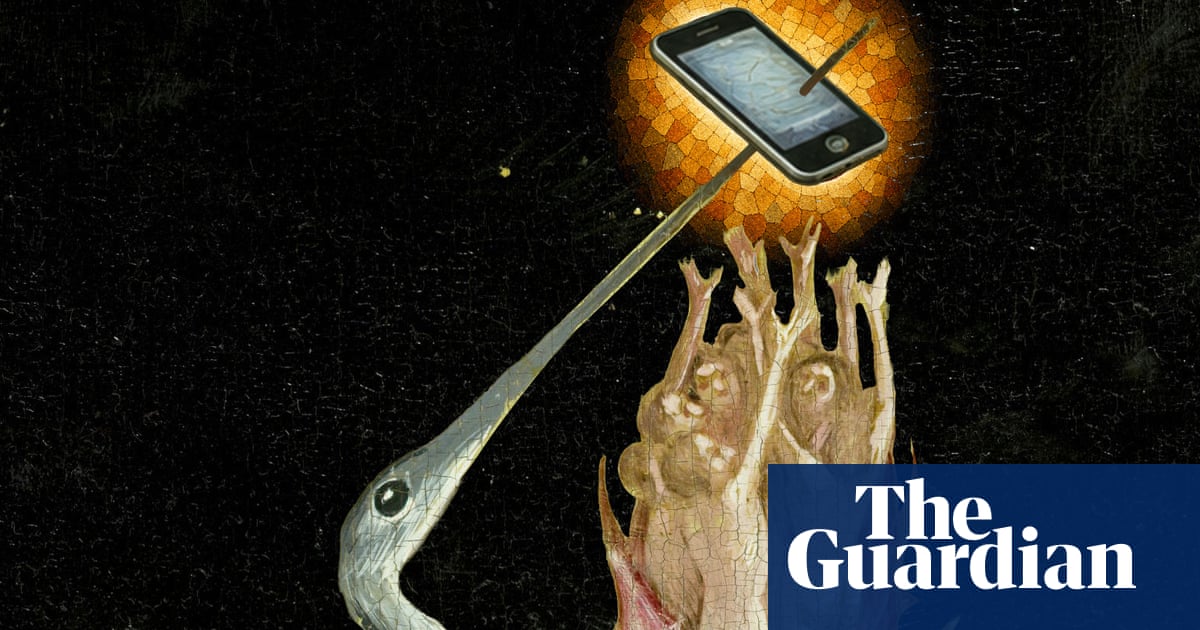
Do you want to have a good time? You know, really enjoy yourself? Click here, and tell us your desires. Maybe it’s a new outfit, or some exotic cuisine delivered anonymously and steaming hot to your door. Maybe it’s porn or gambling. Perhaps you prefer the infinite scroll, the endlessly unfurling ribbon of glossy images and videos starring people you’ll never meet doing things you’ll never do. Or maybe you favor talking to a chatbot who will assure you that you are the most special of all its users.
For anyone with an Internet connection and a little discretionary income, the contemporary moment offers a superabundance of seductive distractions. Why then the pervasive mood of emptiness? Why are so many at once overstimulated and bored?
Welcome to the era of decadence without pleasure.
The concept of decadence as a marker of cultural decline coinciding with a high level of wealth has been around since the twilight of the ancient Greeks and Romans. After the Roman emperor Elagabalus took the throne at 14, he served flamingo brains, seasoned his food with pearls, and, according to one account, smothered guests to death with an avalanche of rose petals. But his vices were outdone by Nero, who had his enemies sewn into wild animal skins and devoured by dogs in an elaborate garden spectacle.
So decadence has an inescapably pejorative ring, suggesting decay, excess and a falling away from norms and ideals. Critics of decadence have usually hailed from the political right, and the same is true today: consider conservative New York Times columnist Ross Douthat’s critique of cultural and economic stagnation in his 2020 book The Decadent Society, or billionaire investor Peter Thiel’s complaints about faltering innovation and the supposed decline of the west. JD Vance likes to invoke the fall of Rome, warning, in his 2026 memoir Communion, that the US is “a great civilization” tumbling into “disrepair”. But plenty of thinkers on the left also worry that modern wealthy societies have entered a period of paralysis, under the shadow of what the Italian theorist Franco “Bifo” Berardi calls “the slow cancellation of the future”.
That all sounds bad. Yet a passionate minority has sometimes found, in decadence, reasons for hope. Cultures later judged decadent produced extraordinary upwellings of art, like the flare of a dying star. Think of the undulating arabesques of Rococo painting before the French Revolution, or the lush shimmering silks of the late Ottomans, or the experimental cinema and nightlife of Weimar Berlin.
Nowhere was the cultural potential of decadence more visible than in the late-19th century. In France, Britain and (with less gusto) in the United States, artists such as Oscar Wilde, Aubrey Beardsley, Joris-Karl Huysmans and Rachilde developed new literary and visual styles championing extravagance, sensuousness and the superiority of artifice. It is to these avant-garde experiments that we owe green carnations (the fakest of flowers), frivolous dandies obsessed with perfumes, a bejeweled tortoise crushed to death by the weight of its splendor, and erotic nightmares including a woman with monstrous flowers growing between her thighs and a male anatomical model whose legs spread at the click of a spring so that he can be penetrated by his female lover. Such taboo-busting grotesquery protested against the inertia of modern civilization by applying moral and aesthetic shock treatment.
The decadents, however, were not just provocateurs. Their revolt against Victorian society’s deadening enslavement to usefulness, materialism and conventionality put forward a positive philosophy of life, a certain way of thinking about pleasure. Against their era’s obsession with use-value and profit, the decadents insisted that pleasure was, or ought to be, “useless”, enjoyed for its own sake in life’s passing moments. “Not the fruit of experience, but experience itself, is the end,” intoned the essayist Walter Pater, one of the guiding lights of English decadence, in his masterpiece The Renaissance. A reclusive Oxford don, Pater was said to have once stopped High Street traffic to stroke a cat. Why? For the sensation of fur beneath his fingers. The virtue of decadent pleasure is that it is useless, an end in itself.
The fixations of fin-de-siècle decadence that inspired Oscar Wilde and company are still with us, but in shrivelled, technologically mediated forms. GLP-1s turn the delights of eating into a problem to be managed. Anti-ageing remedies and “looksmaxxing” turn decadence’s preoccupation with self-styling into a (literally painful) form of self-optimisation. AI restages decadence’s love of artifice by outsourcing human thinking to a chatty, eager-to-please machine butler.
The problem with contemporary culture isn’t that we’re too decadent. We have inherited the surfaces of decadence – luxury, excess, artifice, bodily display – but have surrendered the fin de siècle’s commitment to pleasure. The result is a culture in which pleasure is subordinated to programs of optimisation and replaced at scale by numbing algorithmic stimulation and promises of instant gratification. Whether you’re after goods, food, art or ideas, you can get more, faster, now.
But quantity and speed can’t make up for the paradox at the heart of today’s decadence: the fact that it’s often “meh” and oddly joyless. It’s a sign of the times that this spring, Amazon’s Chinese rival launched in the UK and Europe under a name that promises to deliver emotional fulfilment: Joybuy.
Bryan Johnson, the frequently shirtless tech tycoon who has funnelled his fortune into what he calls the “Don’t Die” movement, has turned his quest for immortality into a prolonged exhibition of ascetic self-management. His lifestyle is harrowingly spartan: he doesn’t drink alcohol, avoids the sun, never goes out in the evening, and subsists primarily on lentils, boiled broccoli and macadamia nuts. Yet his regimen is, in its peculiar way, one of prurient excess. He swallows up to 111 pills a day, tracks his night-time erections, and once tapped his teenage son for blood plasma. His fight against death costs a reported $2m a year.
Johnson presents himself as a man of the future, but he has a 19th-century double. While pallid, faintly androgynous men with money and strange habits are not rare in decadent literature, the most famous is Duke Jean des Esseintes, the hero of Joris-Karl Huysmans’s 1884 novel Against the Grain, a work considered the Bible of decadence. The last scion of an aristocratic French family, des Esseintes creates for himself a cloistered world of voluptuous artifice: padded walls, rare books, exotic flowers, fragrant bonbons, subtle liqueurs, perfumes so sweet they verge on rancid.
Like Johnson, des Esseintes is medically fragile, obsessed with death, and preoccupied with the minutiae of his private sensations. Like Johnson, he sees his retreat from ordinary society into a tightly controlled artificial environment as an experiment that tests the limits of human possibility. But whereas des Esseintes’s withdrawal is an immersion into the subtleties of sensation, Johnson’s “Don’t Die” movement treats the delights of the senses as suspect, even fatal. Des Esseintes hosts a funeral banquet for his “dead virility” in a dining room draped in black, opening on to charcoaled gardens, with guests dining on black-bordered plates filled with black food (rye bread, caviar, black pudding, cuts of meat dripping with liquorice-coloured sauce). Johnson, by contrast, treats impotence as a technical problem, repeatedly shocking his penis to increase his erections.
Johnson’s programme is extreme, but he is not an anomaly. His lifestyle makes visible, in exaggerated form, new attitudes toward pleasure and embodiment being pushed by today’s tech billionaires. While some superwealthy people in or around Palo Alto are biohacking for longevity with the help of concierge medics, others are treating even sexual pleasure as a domain to be perfected through medical interventions. For example, at Dr Sally Greenwald’s exclusive OB-GYN practice, nicknamed the “Billionaire’s Vagina Club” – Greenwald describes her clientele as “the top 0.001%” – middle-aged women can improve their “sexspan” through bespoke advice, hormonal cocktails and tracking devices. “Sex equals sleep, stress reduction, cardiovascular engagement, relational fulfilment, and pelvic-floor health, and each of those equals health,” Greenwald says.
These attitudes reflect the fantasies of a narrow elite obsessed with human enhancement and – above all else – the prolongation of their own survival. The class politics of pleasureless decadence can be roughly summarized as: biohacking and quantified asceticism for the rich, algorithmic stimulation for the rest.
In contexts of extreme inequality, rich people tend to set the terms by which pleasure is understood and experienced. The very fact of inequality injures pleasure, because in a stratified society, food, art, travel and other delights can devolve into occasions to demonstrate rank or taste. Our present social order, however, is not just radically unequal; it’s dominated by a ruling class that distrusts pleasure and sensation. What passes for “fun” among today’s top 0.001% amounts to anything but: think of the 80-hour workweeks championed by tech titans like Elon Musk, or Equinox gym’s “Optimize” longevity membership costing $40,000 a year, or courtside seats at Knicks games inside the miniature surveillance state that is Madison Square Garden. And because of their outsized political and cultural influence, their sway over public and private investment, and their habit of not paying their share of tax, the pleasurelessness of the ultra-monied classes trickles down to the rest of us.
“I think trying to optimise things … is actually the divine spark within us,” recently professed the German biotech billionaire Christian Angermayer, a champion of “humanmaxxing”, the use of drugs and supplements to enhance the body. Divinity aside, it seems pertinent to mention that the person content with every day sensations makes for a poor consumer. But get people outside the plutocratic class to reconceive their minds and bodies as sites of perpetual self-improvement, and you have, in Angermayer’s words, “a total addressable market of ideally 100%”.
The most culturally revealing such market is for GLP-1s such as Ozempic, Wegovy and Mounjaro. One in eight American adults report taking GLP-1 injectables for weight loss, according to a 2025 Gallup poll, and far more express interest in taking them. The global market for this class of drugs is expected to reach $190bn by 2035. For many, these medications confer real benefits. Yet it seems fair to ask: what does the widespread embrace of appetite-governing pharmaceuticals suggest about our culture’s handling of pleasure and desire?
GLP-1s reshape the felt relation between desire and satisfaction, as research has already begun to show. While more studies are needed, some users report a diminution of pleasure across several areas of their lives: they complain of lethargy, decreased libido, emotional flatness and a weakened connection to the social dimensions of eating.
The decadence of the fin de siècle celebrated cornucopian abundance. Take for example Aubrey Beardsley’s 1896 drawing The Fruit Bearers, depicting two figures bearing colossal bowls of fruit, lush grapes overhanging, a peacock in the background observing the opulent procession. In contrast, today’s anhedonic decadence celebrates the inhibition, even the transcendence, of appetite. While in haute cuisine the trappings of indulgence are preserved – some upmarket eateries now offer “small appetite” menus featuring caviar and foie gras – the tendency is toward delicate minimalism. Because eating is a quintessentially communal activity, an intervention in how people eat is also an intervention in how we socialize.
It seems reasonable to expect, meanwhile, that the widespread uptake of such drugs may contribute to a tightening not just of belts but of beauty norms. Looksmaxxing, an online subculture aimed primarily at young men, presents a darker strain of physical perfectionism, treating the body as a site of correction. Of course, women have long been ground down by painful and impossible beauty standards. What’s striking about looksmaxxing is the migration of this kind of disciplinary logic into a male subculture that speaks of beauty in terms of brutal domination: anyone can be “mogged” (outshone by a more handsome man), and one of the purposes of maxxing is to increase one’s “sexual market value”. Key to this subculture is the rejection of subjective taste in favor of mathematical norms (looksmaxxers prize certain ratios of facial proportion, measuring, for instance, the height of the forehead or the distance between the pupils).
“[T]o make oneself beautiful is a universal instinct,” a young Max Beerbohm wrote in his 1894 essay A Defence of Cosmetics, a send-up of decadence’s cult of artifice. Whereas the fin-de-siècle decadents with their love of makeup treated the face as a mask to play with or an enigma to contemplate, looksmaxxers recast the face as a set of homogenizing metrics requiring arduous correction. “The men are weeping in the gym,” writes Andrew McMillan in his prescient 2015 poem about punitive male beauty standards:
they have got too close to the glass
and now they are laying
in the broken pools of their own faces.
The fin de siècle had its own cult of masculine self-display in the form of the dandy, with his carefully tailored coat, polished shoes and pigskin gloves. The dandy’s concern for appearance was just part of the era’s wide-ranging love of stylization. “The first duty in life is to be as artificial as possible,” Oscar Wilde proclaimed. “What the second duty is no one has yet discovered.” Wilde and other decadents prized the made over the natural. Artifice was a way of intensifying the given world, overlaying the hard facts of life with a glittering sheen or a more pleasant smell. After all, what is the dandy’s perfume but a victory for pleasure over necessity?
AI marks a triumph of artifice more sweeping than the old decadents could have imagined. Yet far from bolstering our capacity for perceptual intensity, AI presents new threats to both. Its productions – LinkedIn posts about the virtues of entrepreneurship, cartoon soap operas about the infidelities of anthropomorphized fruits – are eerily hollow, with no felt experience, embodiment or sensation behind them. AI is the pleasureless decadence machine.
Already our algorithmically driven culture is saturated with a deluge of slop that promises numbing, empty stimulation. The old decadents were fascinated by the prospect of mental oblivion, the loss of self-control in the face of overwhelming beauty. Today, AI researchers warn of “human enfeeblement” as tech companies seek to draw users into relations of dependency and infantilization, with machines to do their “thinking” for them.
While the fin-de-siècle left imprints on visual art, fashion, music and other art forms, it was primarily as a literary movement that its decadence made cultural interventions. Crucial to decadent writing was a taste for language – lilting rhythms, overheated exclamations – that would affect the reader viscerally, leaving her trembling, her moral assumptions upended. In contrast, LLMs leach language of pleasure by blandifying it: the algorithm steers language away from the idiosyncratic and toward the predictable.
Pleasure isn’t just about hedonism or indulgence in “useless” objects. It is one of the principal ways we, as embodied beings, perceive value. Pain teaches us not to touch the hot stove twice; pleasure guides us toward the sweetness of clean water and fresh air. Pleasure is not infallible: some things that feel good are cruel, addictive, or destructive. But the embodied experience of pleasure is crucial to how we learn and how we make judgments about what is good, beautiful and worth pursuing. These are not judgments we can wisely cede to disembodied machines.
“There is no pleasure or pain for an AI, no skin in the game,” the philosopher Carissa Véliz writes in her recent book Prophecy. As a result, an AI “cannot care, and therefore cannot value”. Without some felt relation to pleasure and pain, judgments of value and taste become abstract and bloodless.
Because of its commitment to embodied pleasure, fin-de-siècle decadence offers powerful lessons for the increasingly disembodied, tech-optimised world championed by elites. This is not to suggest, however, that the old decadents were living uncomplicated lives of satisfaction and joy. WB Yeats called the poets of 1890s London “the tragic generation”. The decadents could be moody and morbid, susceptible to ennui, spleen and other Baudelairean ailments. In other words, they were all too human. Some died young, succumbing to alcoholism or tuberculosis; others abandoned the religion of art to join the Catholic church. Fin-de-siècle decadence had, moreover, an aristocratic and misogynistic bent. Many of its most influential English champions were highly educated men who regarded ordinary life with aloofness, even contempt.
From the start, however, decadence was both an elite and a minoritarian movement, spearheaded largely by men (and some women) of privilege – but responsible for injecting a new awareness of queerness into public consciousness.
Oscar Wilde’s 1890 novel The Picture of Dorian Gray is a story of a thrill-seeker’s descent into decadent squalor – hedonism, moral bankruptcy, irresponsible self-indulgence and the exploitation of others – in the name of never ageing. But when Victorian society raged at Dorian’s monstrosity, Wilde countered that “vice and virtue are to the artist materials for an art” that can reveal humanity to itself. Sure, Dorian was a perverted Peter Pan, a bad boy who didn’t want to grow up and face consequences. But his scandalous romp reflected society’s concealed desires back to itself.
In fin-de-siècle decadence, we can also see a growing appreciation of female desire. The 1892 poetry collection Sight and Song by Michael Field – the pen name of two lesbian lovers who wrote as one – turns an explicitly female gaze on the art-historical canon. A poem in response to Leonardo da Vinci’s drawing of Leda, the princess seduced by Zeus in the form of a swan, grants Leda all the power: “She draws the fondled creature to her will.” Their Saint Sebastian is, by contrast, a passive icon of masculine beauty, “with body fresh for use, for pleasure fit, / With its energies and needs together knit”.
So too have Black and postcolonial artists drawn from late-19th-century decadence in asserting their own claims to pleasure. Bruce Nugent’s homoerotic story Smoke, Lilies and Jade (1926), one of the more audacious works of the Harlem Renaissance, opens with the Black hero, Alex, lying on his bed, exhaling blue smoke from a cigarette. Alex idly ponders Wilde’s remark that “a cigarette is the most perfect pleasure because it leaves one unsatisfied” before passing into the streets in search of more gratifying pleasures. He meets a white man he calls Beauty, and the two embrace: Alex “could feel Beauty’s body … close against his … hot … tense … white … and soft”. That sentence’s panting prose gives away the game – Alex knows that enjoying the pleasure forbidden to him is the ultimate decadent act.
And now? A renewed, democratic decadence could stage a revolt against optimisation, encouraging ordinary people to brace themselves against the siren simulations of the digital world. Because contemporary culture looks decadent but feels punishing and devoid of meaning, a New Decadence could respond powerfully to this essential contradiction. Every day acts of aesthetic perception – such as Walter Pater stopping traffic to stroke a cat – matter. But if a New Decadence is to emerge, we need artists to invent it and individuals to pause and appreciate its disruptive energies.
So far, neodecadent energies in art have been submerged in satirical entertainments about rich people behaving badly – films like Saltburn or TV shows like The White Lotus that reproduce the structure of pleasureless decadence by equating pleasure with status, power and consumption.
There are signs, however, of something more original and less reactive emerging, an art that foregrounds the senses for an era that distrusts the body. The sensuous cinema of Peter Strickland; the frightening but gorgeous blood-coloured sculptures of Anish Kapoor; the reinvigoration of Black decadence in Shola von Reinhold’s novel Lote; the Dionysian reimagining of the fin de siècle in John Corigliano’s opera The Lord of Cries – none of this amounts to a coherent movement. Yet all these works offer, to their respective artforms, materials from which a New Decadence could arise – a movement that could give pleasure back to people, make the social body’s pulses race again, and force fresh blood through today’s complacent, anemic culture.
Walter Pater prefaced his study of the Renaissance with a sort of epicurean pleasure script, a series of diagnostic questions you can ask yourself to get a better handle on what you experience:
What is this song or picture, this engaging personality presented in life or in a book, to me? What effect does it really produce on me? Does it give me pleasure? and if so, what sort or degree of pleasure? How is my nature modified by its presence, and under its influence?
Your answers to these questions, he argues, have the virtue of satisfying your soul. Giving your attention to what you are feeling, analyzing your impressions, being moved and attentive to life’s everyday experiences – this is where real pleasure lies, so long as your pleasure harms no one else’s.
Why strive for pleasure? Why long for it? Because – contra the Bryan Johnsons of the world – we will die. “A counted number of pulses only,” Pater writes, “is given to us of a variegated, dramatic life.” Like Johnson, like the humanmaxxers, Pater counts his pulses. “Our one chance lies,” he writes, “in expanding that interval, in getting as many pulsations as possible into the given time.”
How different Pater’s pulse-counting is from that of the biometric ascetics. Against the pressure to optimise life, decadence issues a different command: feel it.
.
Read the full story at The Guardian ↗
Decadence in our era comes in technologically mediated forms, emptied of desire and obsessed with self-optimisation. Do you want to have a good time? You know, really enjoy…
This lens runs the verified story through Cinnamon's AI — wired in the next step.
Do you want to have a good time? You know, really enjoy yourself? Click here, and tell us your desires. Maybe it’s a new outfit, or some exotic cuisine delivered anonymously and steaming hot to your door. Maybe it’s porn or gambling. Perhaps you prefer the infinite scroll, the endlessly unfurling ribbon of glossy images and videos starring people you’ll never meet doing things you’ll never do. Or maybe you favor talking to a chatbot who will assure you that you are the most special of all its users.
For anyone with an Internet connection and a little discretionary income, the contemporary moment offers a superabundance of seductive distractions. Why then the pervasive mood of emptiness? Why are so many at once overstimulated and bored?
Welcome to the era of decadence without pleasure.
The concept of decadence as a marker of cultural decline coinciding with a high level of wealth has been around since the twilight of the ancient Greeks and Romans. After the Roman emperor Elagabalus took the throne at 14, he served flamingo brains, seasoned his food with pearls, and, according to one account, smothered guests to death with an avalanche of rose petals. But his vices were outdone by Nero, who had his enemies sewn into wild animal skins and devoured by dogs in an elaborate garden spectacle.
So decadence has an inescapably pejorative ring, suggesting decay, excess and a falling away from norms and ideals. Critics of decadence have usually hailed from the political right, and the same is true today: consider conservative New York Times columnist Ross Douthat’s critique of cultural and economic stagnation in his 2020 book The Decadent Society, or billionaire investor Peter Thiel’s complaints about faltering innovation and the supposed decline of the west. JD Vance likes to invoke the fall of Rome, warning, in his 2026 memoir Communion, that the US is “a great civilization” tumbling into “disrepair”. But plenty of thinkers on the left also worry that modern wealthy societies have entered a period of paralysis, under the shadow of what the Italian theorist Franco “Bifo” Berardi calls “the slow cancellation of the future”.
That all sounds bad. Yet a passionate minority has sometimes found, in decadence, reasons for hope. Cultures later judged decadent produced extraordinary upwellings of art, like the flare of a dying star. Think of the undulating arabesques of Rococo painting before the French Revolution, or the lush shimmering silks of the late Ottomans, or the experimental cinema and nightlife of Weimar Berlin.
Nowhere was the cultural potential of decadence more visible than in the late-19th century. In France, Britain and (with less gusto) in the United States, artists such as Oscar Wilde, Aubrey Beardsley, Joris-Karl Huysmans and Rachilde developed new literary and visual styles championing extravagance, sensuousness and the superiority of artifice. It is to these avant-garde experiments that we owe green carnations (the fakest of flowers), frivolous dandies obsessed with perfumes, a bejeweled tortoise crushed to death by the weight of its splendor, and erotic nightmares including a woman with monstrous flowers growing between her thighs and a male anatomical model whose legs spread at the click of a spring so that he can be penetrated by his female lover. Such taboo-busting grotesquery protested against the inertia of modern civilization by applying moral and aesthetic shock treatment.
The decadents, however, were not just provocateurs. Their revolt against Victorian society’s deadening enslavement to usefulness, materialism and conventionality put forward a positive philosophy of life, a certain way of thinking about pleasure. Against their era’s obsession with use-value and profit, the decadents insisted that pleasure was, or ought to be, “useless”, enjoyed for its own sake in life’s passing moments. “Not the fruit of experience, but experience itself, is the end,” intoned the essayist Walter Pater, one of the guiding lights of English decadence, in his masterpiece The Renaissance. A reclusive Oxford don, Pater was said to have once stopped High Street traffic to stroke a cat. Why? For the sensation of fur beneath his fingers. The virtue of decadent pleasure is that it is useless, an end in itself.
The fixations of fin-de-siècle decadence that inspired Oscar Wilde and company are still with us, but in shrivelled, technologically mediated forms. GLP-1s turn the delights of eating into a problem to be managed. Anti-ageing remedies and “looksmaxxing” turn decadence’s preoccupation with self-styling into a (literally painful) form of self-optimisation. AI restages decadence’s love of artifice by outsourcing human thinking to a chatty, eager-to-please machine butler.
The problem with contemporary culture isn’t that we’re too decadent. We have inherited the surfaces of decadence – luxury, excess, artifice, bodily display – but have surrendered the fin de siècle’s commitment to pleasure. The result is a culture in which pleasure is subordinated to programs of optimisation and replaced at scale by numbing algorithmic stimulation and promises of instant gratification. Whether you’re after goods, food, art or ideas, you can get more, faster, now.
But quantity and speed can’t make up for the paradox at the heart of today’s decadence: the fact that it’s often “meh” and oddly joyless. It’s a sign of the times that this spring, Amazon’s Chinese rival launched in the UK and Europe under a name that promises to deliver emotional fulfilment: Joybuy.
Bryan Johnson, the frequently shirtless tech tycoon who has funnelled his fortune into what he calls the “Don’t Die” movement, has turned his quest for immortality into a prolonged exhibition of ascetic self-management. His lifestyle is harrowingly spartan: he doesn’t drink alcohol, avoids the sun, never goes out in the evening, and subsists primarily on lentils, boiled broccoli and macadamia nuts. Yet his regimen is, in its peculiar way, one of prurient excess. He swallows up to 111 pills a day, tracks his night-time erections, and once tapped his teenage son for blood plasma. His fight against death costs a reported $2m a year.
Johnson presents himself as a man of the future, but he has a 19th-century double. While pallid, faintly androgynous men with money and strange habits are not rare in decadent literature, the most famous is Duke Jean des Esseintes, the hero of Joris-Karl Huysmans’s 1884 novel Against the Grain, a work considered the Bible of decadence. The last scion of an aristocratic French family, des Esseintes creates for himself a cloistered world of voluptuous artifice: padded walls, rare books, exotic flowers, fragrant bonbons, subtle liqueurs, perfumes so sweet they verge on rancid.
Like Johnson, des Esseintes is medically fragile, obsessed with death, and preoccupied with the minutiae of his private sensations. Like Johnson, he sees his retreat from ordinary society into a tightly controlled artificial environment as an experiment that tests the limits of human possibility. But whereas des Esseintes’s withdrawal is an immersion into the subtleties of sensation, Johnson’s “Don’t Die” movement treats the delights of the senses as suspect, even fatal. Des Esseintes hosts a funeral banquet for his “dead virility” in a dining room draped in black, opening on to charcoaled gardens, with guests dining on black-bordered plates filled with black food (rye bread, caviar, black pudding, cuts of meat dripping with liquorice-coloured sauce). Johnson, by contrast, treats impotence as a technical problem, repeatedly shocking his penis to increase his erections.
Johnson’s programme is extreme, but he is not an anomaly. His lifestyle makes visible, in exaggerated form, new attitudes toward pleasure and embodiment being pushed by today’s tech billionaires. While some superwealthy people in or around Palo Alto are biohacking for longevity with the help of concierge medics, others are treating even sexual pleasure as a domain to be perfected through medical interventions. For example, at Dr Sally Greenwald’s exclusive OB-GYN practice, nicknamed the “Billionaire’s Vagina Club” – Greenwald describes her clientele as “the top 0.001%” – middle-aged women can improve their “sexspan” through bespoke advice, hormonal cocktails and tracking devices. “Sex equals sleep, stress reduction, cardiovascular engagement, relational fulfilment, and pelvic-floor health, and each of those equals health,” Greenwald says.
These attitudes reflect the fantasies of a narrow elite obsessed with human enhancement and – above all else – the prolongation of their own survival. The class politics of pleasureless decadence can be roughly summarized as: biohacking and quantified asceticism for the rich, algorithmic stimulation for the rest.
In contexts of extreme inequality, rich people tend to set the terms by which pleasure is understood and experienced. The very fact of inequality injures pleasure, because in a stratified society, food, art, travel and other delights can devolve into occasions to demonstrate rank or taste. Our present social order, however, is not just radically unequal; it’s dominated by a ruling class that distrusts pleasure and sensation. What passes for “fun” among today’s top 0.001% amounts to anything but: think of the 80-hour workweeks championed by tech titans like Elon Musk, or Equinox gym’s “Optimize” longevity membership costing $40,000 a year, or courtside seats at Knicks games inside the miniature surveillance state that is Madison Square Garden. And because of their outsized political and cultural influence, their sway over public and private investment, and their habit of not paying their share of tax, the pleasurelessness of the ultra-monied classes trickles down to the rest of us.
“I think trying to optimise things … is actually the divine spark within us,” recently professed the German biotech billionaire Christian Angermayer, a champion of “humanmaxxing”, the use of drugs and supplements to enhance the body. Divinity aside, it seems pertinent to mention that the person content with every day sensations makes for a poor consumer. But get people outside the plutocratic class to reconceive their minds and bodies as sites of perpetual self-improvement, and you have, in Angermayer’s words, “a total addressable market of ideally 100%”.
The most culturally revealing such market is for GLP-1s such as Ozempic, Wegovy and Mounjaro. One in eight American adults report taking GLP-1 injectables for weight loss, according to a 2025 Gallup poll, and far more express interest in taking them. The global market for this class of drugs is expected to reach $190bn by 2035. For many, these medications confer real benefits. Yet it seems fair to ask: what does the widespread embrace of appetite-governing pharmaceuticals suggest about our culture’s handling of pleasure and desire?
GLP-1s reshape the felt relation between desire and satisfaction, as research has already begun to show. While more studies are needed, some users report a diminution of pleasure across several areas of their lives: they complain of lethargy, decreased libido, emotional flatness and a weakened connection to the social dimensions of eating.
The decadence of the fin de siècle celebrated cornucopian abundance. Take for example Aubrey Beardsley’s 1896 drawing The Fruit Bearers, depicting two figures bearing colossal bowls of fruit, lush grapes overhanging, a peacock in the background observing the opulent procession. In contrast, today’s anhedonic decadence celebrates the inhibition, even the transcendence, of appetite. While in haute cuisine the trappings of indulgence are preserved – some upmarket eateries now offer “small appetite” menus featuring caviar and foie gras – the tendency is toward delicate minimalism. Because eating is a quintessentially communal activity, an intervention in how people eat is also an intervention in how we socialize.
It seems reasonable to expect, meanwhile, that the widespread uptake of such drugs may contribute to a tightening not just of belts but of beauty norms. Looksmaxxing, an online subculture aimed primarily at young men, presents a darker strain of physical perfectionism, treating the body as a site of correction. Of course, women have long been ground down by painful and impossible beauty standards. What’s striking about looksmaxxing is the migration of this kind of disciplinary logic into a male subculture that speaks of beauty in terms of brutal domination: anyone can be “mogged” (outshone by a more handsome man), and one of the purposes of maxxing is to increase one’s “sexual market value”. Key to this subculture is the rejection of subjective taste in favor of mathematical norms (looksmaxxers prize certain ratios of facial proportion, measuring, for instance, the height of the forehead or the distance between the pupils).
“[T]o make oneself beautiful is a universal instinct,” a young Max Beerbohm wrote in his 1894 essay A Defence of Cosmetics, a send-up of decadence’s cult of artifice. Whereas the fin-de-siècle decadents with their love of makeup treated the face as a mask to play with or an enigma to contemplate, looksmaxxers recast the face as a set of homogenizing metrics requiring arduous correction. “The men are weeping in the gym,” writes Andrew McMillan in his prescient 2015 poem about punitive male beauty standards:
they have got too close to the glass
and now they are laying
in the broken pools of their own faces.
The fin de siècle had its own cult of masculine self-display in the form of the dandy, with his carefully tailored coat, polished shoes and pigskin gloves. The dandy’s concern for appearance was just part of the era’s wide-ranging love of stylization. “The first duty in life is to be as artificial as possible,” Oscar Wilde proclaimed. “What the second duty is no one has yet discovered.” Wilde and other decadents prized the made over the natural. Artifice was a way of intensifying the given world, overlaying the hard facts of life with a glittering sheen or a more pleasant smell. After all, what is the dandy’s perfume but a victory for pleasure over necessity?
AI marks a triumph of artifice more sweeping than the old decadents could have imagined. Yet far from bolstering our capacity for perceptual intensity, AI presents new threats to both. Its productions – LinkedIn posts about the virtues of entrepreneurship, cartoon soap operas about the infidelities of anthropomorphized fruits – are eerily hollow, with no felt experience, embodiment or sensation behind them. AI is the pleasureless decadence machine.
Already our algorithmically driven culture is saturated with a deluge of slop that promises numbing, empty stimulation. The old decadents were fascinated by the prospect of mental oblivion, the loss of self-control in the face of overwhelming beauty. Today, AI researchers warn of “human enfeeblement” as tech companies seek to draw users into relations of dependency and infantilization, with machines to do their “thinking” for them.
While the fin-de-siècle left imprints on visual art, fashion, music and other art forms, it was primarily as a literary movement that its decadence made cultural interventions. Crucial to decadent writing was a taste for language – lilting rhythms, overheated exclamations – that would affect the reader viscerally, leaving her trembling, her moral assumptions upended. In contrast, LLMs leach language of pleasure by blandifying it: the algorithm steers language away from the idiosyncratic and toward the predictable.
Pleasure isn’t just about hedonism or indulgence in “useless” objects. It is one of the principal ways we, as embodied beings, perceive value. Pain teaches us not to touch the hot stove twice; pleasure guides us toward the sweetness of clean water and fresh air. Pleasure is not infallible: some things that feel good are cruel, addictive, or destructive. But the embodied experience of pleasure is crucial to how we learn and how we make judgments about what is good, beautiful and worth pursuing. These are not judgments we can wisely cede to disembodied machines.
“There is no pleasure or pain for an AI, no skin in the game,” the philosopher Carissa Véliz writes in her recent book Prophecy. As a result, an AI “cannot care, and therefore cannot value”. Without some felt relation to pleasure and pain, judgments of value and taste become abstract and bloodless.
Because of its commitment to embodied pleasure, fin-de-siècle decadence offers powerful lessons for the increasingly disembodied, tech-optimised world championed by elites. This is not to suggest, however, that the old decadents were living uncomplicated lives of satisfaction and joy. WB Yeats called the poets of 1890s London “the tragic generation”. The decadents could be moody and morbid, susceptible to ennui, spleen and other Baudelairean ailments. In other words, they were all too human. Some died young, succumbing to alcoholism or tuberculosis; others abandoned the religion of art to join the Catholic church. Fin-de-siècle decadence had, moreover, an aristocratic and misogynistic bent. Many of its most influential English champions were highly educated men who regarded ordinary life with aloofness, even contempt.
From the start, however, decadence was both an elite and a minoritarian movement, spearheaded largely by men (and some women) of privilege – but responsible for injecting a new awareness of queerness into public consciousness.
Oscar Wilde’s 1890 novel The Picture of Dorian Gray is a story of a thrill-seeker’s descent into decadent squalor – hedonism, moral bankruptcy, irresponsible self-indulgence and the exploitation of others – in the name of never ageing. But when Victorian society raged at Dorian’s monstrosity, Wilde countered that “vice and virtue are to the artist materials for an art” that can reveal humanity to itself. Sure, Dorian was a perverted Peter Pan, a bad boy who didn’t want to grow up and face consequences. But his scandalous romp reflected society’s concealed desires back to itself.
In fin-de-siècle decadence, we can also see a growing appreciation of female desire. The 1892 poetry collection Sight and Song by Michael Field – the pen name of two lesbian lovers who wrote as one – turns an explicitly female gaze on the art-historical canon. A poem in response to Leonardo da Vinci’s drawing of Leda, the princess seduced by Zeus in the form of a swan, grants Leda all the power: “She draws the fondled creature to her will.” Their Saint Sebastian is, by contrast, a passive icon of masculine beauty, “with body fresh for use, for pleasure fit, / With its energies and needs together knit”.
So too have Black and postcolonial artists drawn from late-19th-century decadence in asserting their own claims to pleasure. Bruce Nugent’s homoerotic story Smoke, Lilies and Jade (1926), one of the more audacious works of the Harlem Renaissance, opens with the Black hero, Alex, lying on his bed, exhaling blue smoke from a cigarette. Alex idly ponders Wilde’s remark that “a cigarette is the most perfect pleasure because it leaves one unsatisfied” before passing into the streets in search of more gratifying pleasures. He meets a white man he calls Beauty, and the two embrace: Alex “could feel Beauty’s body … close against his … hot … tense … white … and soft”. That sentence’s panting prose gives away the game – Alex knows that enjoying the pleasure forbidden to him is the ultimate decadent act.
And now? A renewed, democratic decadence could stage a revolt against optimisation, encouraging ordinary people to brace themselves against the siren simulations of the digital world. Because contemporary culture looks decadent but feels punishing and devoid of meaning, a New Decadence could respond powerfully to this essential contradiction. Every day acts of aesthetic perception – such as Walter Pater stopping traffic to stroke a cat – matter. But if a New Decadence is to emerge, we need artists to invent it and individuals to pause and appreciate its disruptive energies.
So far, neodecadent energies in art have been submerged in satirical entertainments about rich people behaving badly – films like Saltburn or TV shows like The White Lotus that reproduce the structure of pleasureless decadence by equating pleasure with status, power and consumption.
There are signs, however, of something more original and less reactive emerging, an art that foregrounds the senses for an era that distrusts the body. The sensuous cinema of Peter Strickland; the frightening but gorgeous blood-coloured sculptures of Anish Kapoor; the reinvigoration of Black decadence in Shola von Reinhold’s novel Lote; the Dionysian reimagining of the fin de siècle in John Corigliano’s opera The Lord of Cries – none of this amounts to a coherent movement. Yet all these works offer, to their respective artforms, materials from which a New Decadence could arise – a movement that could give pleasure back to people, make the social body’s pulses race again, and force fresh blood through today’s complacent, anemic culture.
Walter Pater prefaced his study of the Renaissance with a sort of epicurean pleasure script, a series of diagnostic questions you can ask yourself to get a better handle on what you experience:
What is this song or picture, this engaging personality presented in life or in a book, to me? What effect does it really produce on me? Does it give me pleasure? and if so, what sort or degree of pleasure? How is my nature modified by its presence, and under its influence?
Your answers to these questions, he argues, have the virtue of satisfying your soul. Giving your attention to what you are feeling, analyzing your impressions, being moved and attentive to life’s everyday experiences – this is where real pleasure lies, so long as your pleasure harms no one else’s.
Why strive for pleasure? Why long for it? Because – contra the Bryan Johnsons of the world – we will die. “A counted number of pulses only,” Pater writes, “is given to us of a variegated, dramatic life.” Like Johnson, like the humanmaxxers, Pater counts his pulses. “Our one chance lies,” he writes, “in expanding that interval, in getting as many pulsations as possible into the given time.”
How different Pater’s pulse-counting is from that of the biometric ascetics. Against the pressure to optimise life, decadence issues a different command: feel it.
.
Read the full story at The Guardian ↗
Do you want to have a good time? You know, really enjoy yourself? Click here, and tell us your desires. Maybe it’s a new outfit, or some exotic cuisine delivered anonymously and steaming hot to your door. Maybe it’s porn or gambling. Perhaps you prefer the infinite scroll, the endlessly unfurling ribbon of glossy images and videos starring people you’ll never meet doing things you’ll never do. Or maybe you favor talking to a chatbot who will assure you that you are the most special of all its users.
For anyone with an Internet connection and a little discretionary income, the contemporary moment offers a superabundance of seductive distractions. Why then the pervasive mood of emptiness? Why are so many at once overstimulated and bored?
Welcome to the era of decadence without pleasure.
The concept of decadence as a marker of cultural decline coinciding with a high level of wealth has been around since the twilight of the ancient Greeks and Romans. After the Roman emperor Elagabalus took the throne at 14, he served flamingo brains, seasoned his food with pearls, and, according to one account, smothered guests to death with an avalanche of rose petals. But his vices were outdone by Nero, who had his enemies sewn into wild animal skins and devoured by dogs in an elaborate garden spectacle.
So decadence has an inescapably pejorative ring, suggesting decay, excess and a falling away from norms and ideals. Critics of decadence have usually hailed from the political right, and the same is true today: consider conservative New York Times columnist Ross Douthat’s critique of cultural and economic stagnation in his 2020 book The Decadent Society, or billionaire investor Peter Thiel’s complaints about faltering innovation and the supposed decline of the west. JD Vance likes to invoke the fall of Rome, warning, in his 2026 memoir Communion, that the US is “a great civilization” tumbling into “disrepair”. But plenty of thinkers on the left also worry that modern wealthy societies have entered a period of paralysis, under the shadow of what the Italian theorist Franco “Bifo” Berardi calls “the slow cancellation of the future”.
That all sounds bad. Yet a passionate minority has sometimes found, in decadence, reasons for hope. Cultures later judged decadent produced extraordinary upwellings of art, like the flare of a dying star. Think of the undulating arabesques of Rococo painting before the French Revolution, or the lush shimmering silks of the late Ottomans, or the experimental cinema and nightlife of Weimar Berlin.
Nowhere was the cultural potential of decadence more visible than in the late-19th century. In France, Britain and (with less gusto) in the United States, artists such as Oscar Wilde, Aubrey Beardsley, Joris-Karl Huysmans and Rachilde developed new literary and visual styles championing extravagance, sensuousness and the superiority of artifice. It is to these avant-garde experiments that we owe green carnations (the fakest of flowers), frivolous dandies obsessed with perfumes, a bejeweled tortoise crushed to death by the weight of its splendor, and erotic nightmares including a woman with monstrous flowers growing between her thighs and a male anatomical model whose legs spread at the click of a spring so that he can be penetrated by his female lover. Such taboo-busting grotesquery protested against the inertia of modern civilization by applying moral and aesthetic shock treatment.
The decadents, however, were not just provocateurs. Their revolt against Victorian society’s deadening enslavement to usefulness, materialism and conventionality put forward a positive philosophy of life, a certain way of thinking about pleasure. Against their era’s obsession with use-value and profit, the decadents insisted that pleasure was, or ought to be, “useless”, enjoyed for its own sake in life’s passing moments. “Not the fruit of experience, but experience itself, is the end,” intoned the essayist Walter Pater, one of the guiding lights of English decadence, in his masterpiece The Renaissance. A reclusive Oxford don, Pater was said to have once stopped High Street traffic to stroke a cat. Why? For the sensation of fur beneath his fingers. The virtue of decadent pleasure is that it is useless, an end in itself.
The fixations of fin-de-siècle decadence that inspired Oscar Wilde and company are still with us, but in shrivelled, technologically mediated forms. GLP-1s turn the delights of eating into a problem to be managed. Anti-ageing remedies and “looksmaxxing” turn decadence’s preoccupation with self-styling into a (literally painful) form of self-optimisation. AI restages decadence’s love of artifice by outsourcing human thinking to a chatty, eager-to-please machine butler.
The problem with contemporary culture isn’t that we’re too decadent. We have inherited the surfaces of decadence – luxury, excess, artifice, bodily display – but have surrendered the fin de siècle’s commitment to pleasure. The result is a culture in which pleasure is subordinated to programs of optimisation and replaced at scale by numbing algorithmic stimulation and promises of instant gratification. Whether you’re after goods, food, art or ideas, you can get more, faster, now.
But quantity and speed can’t make up for the paradox at the heart of today’s decadence: the fact that it’s often “meh” and oddly joyless. It’s a sign of the times that this spring, Amazon’s Chinese rival launched in the UK and Europe under a name that promises to deliver emotional fulfilment: Joybuy.
Bryan Johnson, the frequently shirtless tech tycoon who has funnelled his fortune into what he calls the “Don’t Die” movement, has turned his quest for immortality into a prolonged exhibition of ascetic self-management. His lifestyle is harrowingly spartan: he doesn’t drink alcohol, avoids the sun, never goes out in the evening, and subsists primarily on lentils, boiled broccoli and macadamia nuts. Yet his regimen is, in its peculiar way, one of prurient excess. He swallows up to 111 pills a day, tracks his night-time erections, and once tapped his teenage son for blood plasma. His fight against death costs a reported $2m a year.
Johnson presents himself as a man of the future, but he has a 19th-century double. While pallid, faintly androgynous men with money and strange habits are not rare in decadent literature, the most famous is Duke Jean des Esseintes, the hero of Joris-Karl Huysmans’s 1884 novel Against the Grain, a work considered the Bible of decadence. The last scion of an aristocratic French family, des Esseintes creates for himself a cloistered world of voluptuous artifice: padded walls, rare books, exotic flowers, fragrant bonbons, subtle liqueurs, perfumes so sweet they verge on rancid.
Like Johnson, des Esseintes is medically fragile, obsessed with death, and preoccupied with the minutiae of his private sensations. Like Johnson, he sees his retreat from ordinary society into a tightly controlled artificial environment as an experiment that tests the limits of human possibility. But whereas des Esseintes’s withdrawal is an immersion into the subtleties of sensation, Johnson’s “Don’t Die” movement treats the delights of the senses as suspect, even fatal. Des Esseintes hosts a funeral banquet for his “dead virility” in a dining room draped in black, opening on to charcoaled gardens, with guests dining on black-bordered plates filled with black food (rye bread, caviar, black pudding, cuts of meat dripping with liquorice-coloured sauce). Johnson, by contrast, treats impotence as a technical problem, repeatedly shocking his penis to increase his erections.
Johnson’s programme is extreme, but he is not an anomaly. His lifestyle makes visible, in exaggerated form, new attitudes toward pleasure and embodiment being pushed by today’s tech billionaires. While some superwealthy people in or around Palo Alto are biohacking for longevity with the help of concierge medics, others are treating even sexual pleasure as a domain to be perfected through medical interventions. For example, at Dr Sally Greenwald’s exclusive OB-GYN practice, nicknamed the “Billionaire’s Vagina Club” – Greenwald describes her clientele as “the top 0.001%” – middle-aged women can improve their “sexspan” through bespoke advice, hormonal cocktails and tracking devices. “Sex equals sleep, stress reduction, cardiovascular engagement, relational fulfilment, and pelvic-floor health, and each of those equals health,” Greenwald says.
These attitudes reflect the fantasies of a narrow elite obsessed with human enhancement and – above all else – the prolongation of their own survival. The class politics of pleasureless decadence can be roughly summarized as: biohacking and quantified asceticism for the rich, algorithmic stimulation for the rest.
In contexts of extreme inequality, rich people tend to set the terms by which pleasure is understood and experienced. The very fact of inequality injures pleasure, because in a stratified society, food, art, travel and other delights can devolve into occasions to demonstrate rank or taste. Our present social order, however, is not just radically unequal; it’s dominated by a ruling class that distrusts pleasure and sensation. What passes for “fun” among today’s top 0.001% amounts to anything but: think of the 80-hour workweeks championed by tech titans like Elon Musk, or Equinox gym’s “Optimize” longevity membership costing $40,000 a year, or courtside seats at Knicks games inside the miniature surveillance state that is Madison Square Garden. And because of their outsized political and cultural influence, their sway over public and private investment, and their habit of not paying their share of tax, the pleasurelessness of the ultra-monied classes trickles down to the rest of us.
“I think trying to optimise things … is actually the divine spark within us,” recently professed the German biotech billionaire Christian Angermayer, a champion of “humanmaxxing”, the use of drugs and supplements to enhance the body. Divinity aside, it seems pertinent to mention that the person content with every day sensations makes for a poor consumer. But get people outside the plutocratic class to reconceive their minds and bodies as sites of perpetual self-improvement, and you have, in Angermayer’s words, “a total addressable market of ideally 100%”.
The most culturally revealing such market is for GLP-1s such as Ozempic, Wegovy and Mounjaro. One in eight American adults report taking GLP-1 injectables for weight loss, according to a 2025 Gallup poll, and far more express interest in taking them. The global market for this class of drugs is expected to reach $190bn by 2035. For many, these medications confer real benefits. Yet it seems fair to ask: what does the widespread embrace of appetite-governing pharmaceuticals suggest about our culture’s handling of pleasure and desire?
GLP-1s reshape the felt relation between desire and satisfaction, as research has already begun to show. While more studies are needed, some users report a diminution of pleasure across several areas of their lives: they complain of lethargy, decreased libido, emotional flatness and a weakened connection to the social dimensions of eating.
The decadence of the fin de siècle celebrated cornucopian abundance. Take for example Aubrey Beardsley’s 1896 drawing The Fruit Bearers, depicting two figures bearing colossal bowls of fruit, lush grapes overhanging, a peacock in the background observing the opulent procession. In contrast, today’s anhedonic decadence celebrates the inhibition, even the transcendence, of appetite. While in haute cuisine the trappings of indulgence are preserved – some upmarket eateries now offer “small appetite” menus featuring caviar and foie gras – the tendency is toward delicate minimalism. Because eating is a quintessentially communal activity, an intervention in how people eat is also an intervention in how we socialize.
It seems reasonable to expect, meanwhile, that the widespread uptake of such drugs may contribute to a tightening not just of belts but of beauty norms. Looksmaxxing, an online subculture aimed primarily at young men, presents a darker strain of physical perfectionism, treating the body as a site of correction. Of course, women have long been ground down by painful and impossible beauty standards. What’s striking about looksmaxxing is the migration of this kind of disciplinary logic into a male subculture that speaks of beauty in terms of brutal domination: anyone can be “mogged” (outshone by a more handsome man), and one of the purposes of maxxing is to increase one’s “sexual market value”. Key to this subculture is the rejection of subjective taste in favor of mathematical norms (looksmaxxers prize certain ratios of facial proportion, measuring, for instance, the height of the forehead or the distance between the pupils).
“[T]o make oneself beautiful is a universal instinct,” a young Max Beerbohm wrote in his 1894 essay A Defence of Cosmetics, a send-up of decadence’s cult of artifice. Whereas the fin-de-siècle decadents with their love of makeup treated the face as a mask to play with or an enigma to contemplate, looksmaxxers recast the face as a set of homogenizing metrics requiring arduous correction. “The men are weeping in the gym,” writes Andrew McMillan in his prescient 2015 poem about punitive male beauty standards:
they have got too close to the glass
and now they are laying
in the broken pools of their own faces.
The fin de siècle had its own cult of masculine self-display in the form of the dandy, with his carefully tailored coat, polished shoes and pigskin gloves. The dandy’s concern for appearance was just part of the era’s wide-ranging love of stylization. “The first duty in life is to be as artificial as possible,” Oscar Wilde proclaimed. “What the second duty is no one has yet discovered.” Wilde and other decadents prized the made over the natural. Artifice was a way of intensifying the given world, overlaying the hard facts of life with a glittering sheen or a more pleasant smell. After all, what is the dandy’s perfume but a victory for pleasure over necessity?
AI marks a triumph of artifice more sweeping than the old decadents could have imagined. Yet far from bolstering our capacity for perceptual intensity, AI presents new threats to both. Its productions – LinkedIn posts about the virtues of entrepreneurship, cartoon soap operas about the infidelities of anthropomorphized fruits – are eerily hollow, with no felt experience, embodiment or sensation behind them. AI is the pleasureless decadence machine.
Already our algorithmically driven culture is saturated with a deluge of slop that promises numbing, empty stimulation. The old decadents were fascinated by the prospect of mental oblivion, the loss of self-control in the face of overwhelming beauty. Today, AI researchers warn of “human enfeeblement” as tech companies seek to draw users into relations of dependency and infantilization, with machines to do their “thinking” for them.
While the fin-de-siècle left imprints on visual art, fashion, music and other art forms, it was primarily as a literary movement that its decadence made cultural interventions. Crucial to decadent writing was a taste for language – lilting rhythms, overheated exclamations – that would affect the reader viscerally, leaving her trembling, her moral assumptions upended. In contrast, LLMs leach language of pleasure by blandifying it: the algorithm steers language away from the idiosyncratic and toward the predictable.
Pleasure isn’t just about hedonism or indulgence in “useless” objects. It is one of the principal ways we, as embodied beings, perceive value. Pain teaches us not to touch the hot stove twice; pleasure guides us toward the sweetness of clean water and fresh air. Pleasure is not infallible: some things that feel good are cruel, addictive, or destructive. But the embodied experience of pleasure is crucial to how we learn and how we make judgments about what is good, beautiful and worth pursuing. These are not judgments we can wisely cede to disembodied machines.
“There is no pleasure or pain for an AI, no skin in the game,” the philosopher Carissa Véliz writes in her recent book Prophecy. As a result, an AI “cannot care, and therefore cannot value”. Without some felt relation to pleasure and pain, judgments of value and taste become abstract and bloodless.
Because of its commitment to embodied pleasure, fin-de-siècle decadence offers powerful lessons for the increasingly disembodied, tech-optimised world championed by elites. This is not to suggest, however, that the old decadents were living uncomplicated lives of satisfaction and joy. WB Yeats called the poets of 1890s London “the tragic generation”. The decadents could be moody and morbid, susceptible to ennui, spleen and other Baudelairean ailments. In other words, they were all too human. Some died young, succumbing to alcoholism or tuberculosis; others abandoned the religion of art to join the Catholic church. Fin-de-siècle decadence had, moreover, an aristocratic and misogynistic bent. Many of its most influential English champions were highly educated men who regarded ordinary life with aloofness, even contempt.
From the start, however, decadence was both an elite and a minoritarian movement, spearheaded largely by men (and some women) of privilege – but responsible for injecting a new awareness of queerness into public consciousness.
Oscar Wilde’s 1890 novel The Picture of Dorian Gray is a story of a thrill-seeker’s descent into decadent squalor – hedonism, moral bankruptcy, irresponsible self-indulgence and the exploitation of others – in the name of never ageing. But when Victorian society raged at Dorian’s monstrosity, Wilde countered that “vice and virtue are to the artist materials for an art” that can reveal humanity to itself. Sure, Dorian was a perverted Peter Pan, a bad boy who didn’t want to grow up and face consequences. But his scandalous romp reflected society’s concealed desires back to itself.
In fin-de-siècle decadence, we can also see a growing appreciation of female desire. The 1892 poetry collection Sight and Song by Michael Field – the pen name of two lesbian lovers who wrote as one – turns an explicitly female gaze on the art-historical canon. A poem in response to Leonardo da Vinci’s drawing of Leda, the princess seduced by Zeus in the form of a swan, grants Leda all the power: “She draws the fondled creature to her will.” Their Saint Sebastian is, by contrast, a passive icon of masculine beauty, “with body fresh for use, for pleasure fit, / With its energies and needs together knit”.
So too have Black and postcolonial artists drawn from late-19th-century decadence in asserting their own claims to pleasure. Bruce Nugent’s homoerotic story Smoke, Lilies and Jade (1926), one of the more audacious works of the Harlem Renaissance, opens with the Black hero, Alex, lying on his bed, exhaling blue smoke from a cigarette. Alex idly ponders Wilde’s remark that “a cigarette is the most perfect pleasure because it leaves one unsatisfied” before passing into the streets in search of more gratifying pleasures. He meets a white man he calls Beauty, and the two embrace: Alex “could feel Beauty’s body … close against his … hot … tense … white … and soft”. That sentence’s panting prose gives away the game – Alex knows that enjoying the pleasure forbidden to him is the ultimate decadent act.
And now? A renewed, democratic decadence could stage a revolt against optimisation, encouraging ordinary people to brace themselves against the siren simulations of the digital world. Because contemporary culture looks decadent but feels punishing and devoid of meaning, a New Decadence could respond powerfully to this essential contradiction. Every day acts of aesthetic perception – such as Walter Pater stopping traffic to stroke a cat – matter. But if a New Decadence is to emerge, we need artists to invent it and individuals to pause and appreciate its disruptive energies.
So far, neodecadent energies in art have been submerged in satirical entertainments about rich people behaving badly – films like Saltburn or TV shows like The White Lotus that reproduce the structure of pleasureless decadence by equating pleasure with status, power and consumption.
There are signs, however, of something more original and less reactive emerging, an art that foregrounds the senses for an era that distrusts the body. The sensuous cinema of Peter Strickland; the frightening but gorgeous blood-coloured sculptures of Anish Kapoor; the reinvigoration of Black decadence in Shola von Reinhold’s novel Lote; the Dionysian reimagining of the fin de siècle in John Corigliano’s opera The Lord of Cries – none of this amounts to a coherent movement. Yet all these works offer, to their respective artforms, materials from which a New Decadence could arise – a movement that could give pleasure back to people, make the social body’s pulses race again, and force fresh blood through today’s complacent, anemic culture.
Walter Pater prefaced his study of the Renaissance with a sort of epicurean pleasure script, a series of diagnostic questions you can ask yourself to get a better handle on what you experience:
What is this song or picture, this engaging personality presented in life or in a book, to me? What effect does it really produce on me? Does it give me pleasure? and if so, what sort or degree of pleasure? How is my nature modified by its presence, and under its influence?
Your answers to these questions, he argues, have the virtue of satisfying your soul. Giving your attention to what you are feeling, analyzing your impressions, being moved and attentive to life’s everyday experiences – this is where real pleasure lies, so long as your pleasure harms no one else’s.
Why strive for pleasure? Why long for it? Because – contra the Bryan Johnsons of the world – we will die. “A counted number of pulses only,” Pater writes, “is given to us of a variegated, dramatic life.” Like Johnson, like the humanmaxxers, Pater counts his pulses. “Our one chance lies,” he writes, “in expanding that interval, in getting as many pulsations as possible into the given time.”
How different Pater’s pulse-counting is from that of the biometric ascetics. Against the pressure to optimise life, decadence issues a different command: feel it.
.
Read the full story at The Guardian ↗
This lens runs the verified story through Cinnamon's AI — wired in the next step.
- Decadence in our era comes in technologically mediated forms, emptied of desire and obsessed with self-optimisation.
- Do you want to have a good time?
- You know, really enjoy…