How England's class divide shaped Andy Burnham, the U.K.'s likely next prime minister
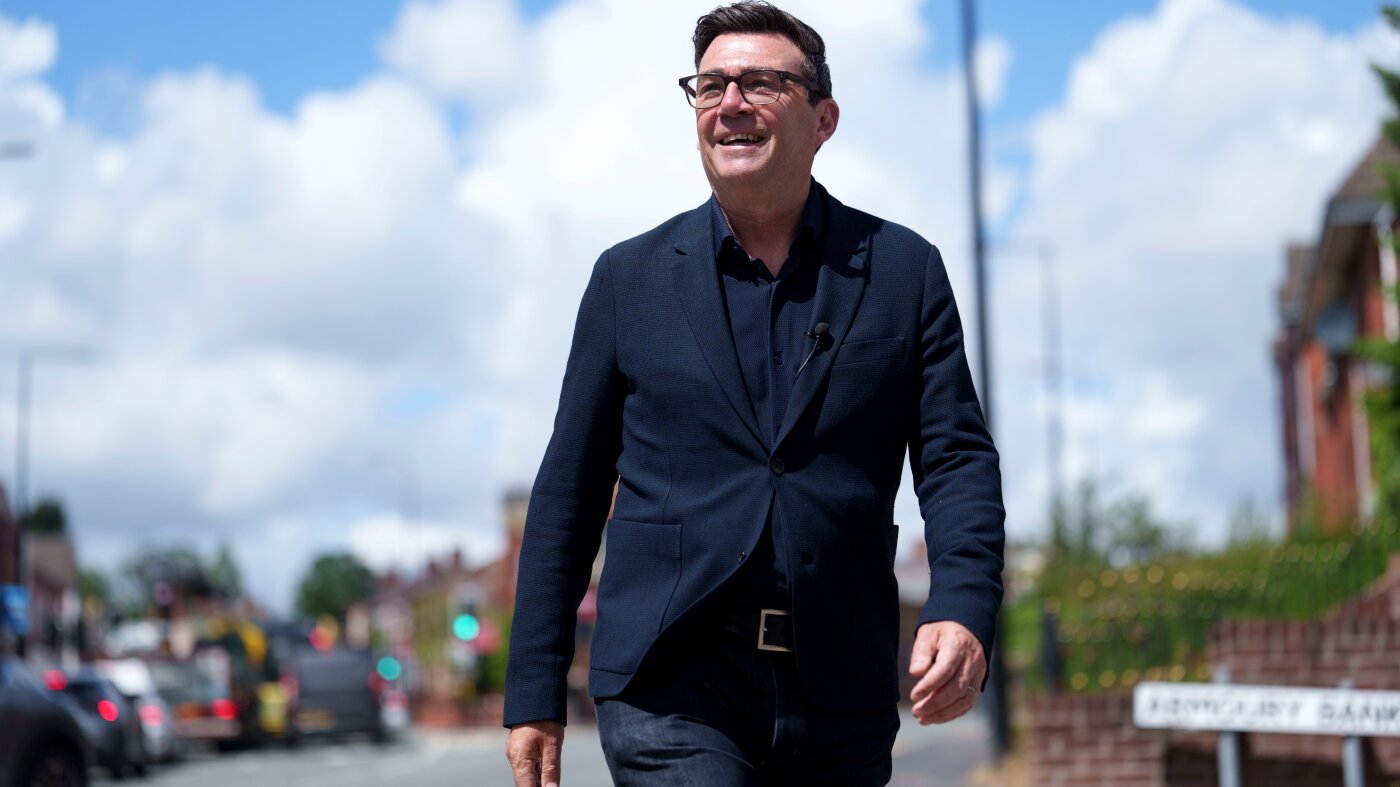
Andy Burnham smiles during a campaign visit to Ashton-in-Makerfield before a by-election, in Manchester, England, on June 9. Burnham is expected to succeed Keir Starmer as the U.K.'s Labour Party leader and prime minister. Jon Super/AP hide caption
toggle caption
Jon Super/AP
MANCHESTER, England — Born and raised in northern England, Andy Burnham moved to the generally more posh south to study English literature at the University of Cambridge, where one professor recalls him wearing a soccer jersey to class.
"I think that might be quite common on the streets of northwest England, but it's not necessarily a common thing in a Cambridge college," professor John Mullan told the Times of London. He recalled the young Burnham as a soccer-obsessed lad who recited Shakespeare and dated "the coolest girl in the college." She is Dutch-born Marie-France van Heel, and the couple are now married.
The soccer jersey was an early example of the working-class identity that would later define Burnham in politics.
Now widely expected to succeed Keir Starmer as prime minister this month, Burnham, 56, often highlights his northern, blue-collar roots. Analysts say his upbringing and his time as mayor of Greater Manchester — which prides itself as the world's birthplace of the working class, during the Industrial Revolution — have shaped his national policies. That background could also help his center-left Labour Party win back working-class voters, some of whom have shifted to voting for right-wing parties in recent years.
"I want to do whatever I can to make Labour a party that [people] can believe in again, a party that's solidly on the side of working-class people," Burnham told the U.K.'s Channel 4 News in May.
Then-Culture, Media and Sport Secretary Andy Burnham speaks at an official memorial event at Liverpool's Anfield Stadium to mark the 20th anniversary of the Hillsborough disaster in which 96 football fans died. Peter Byrne/PA Images via Getty Images hide caption
toggle caption
Peter Byrne/PA Images via Getty Images
Born in a suburb of Liverpool to parents who worked as a telephone engineer and a receptionist, Burnham was raised in a village about halfway between there and Manchester. After graduating from Cambridge, he and van Heel stayed south, moving to London. Burnham was first elected to Parliament at age 31, with Labour, representing a northern district.
He served as secretary of state for culture, media and sports under Prime Minister Gordon Brown, and in 2009, was sent to Liverpool to give a speech on the anniversary of the 1989 Hillsborough disaster, when nearly 100 soccer fans were crushed to death in an overcrowded stadium in northern England. It was the deadliest sports accident in British history. But the victims were stereotyped as hooligans, and many survivors and victims' families felt the government had not done enough to investigate. Initially, the crowd heckled Burnham. Fighting back tears, he abandoned his prepared remarks, nodding his head as the crowd chanted for justice.
"They were treated so badly, and [Burnham] was one of the first politicians to really listen," says Charlotte Wildman, a University of Manchester historian who studies the working class.
Burnham launched a government inquiry that found police failures, not the victims themselves, were responsible for the disaster. That helped change a national stereotype, Wildman says.
"Particularly northern, working-class men were demonized. They were accused of being violent, aggressive, criminal, and that was a very entrenched stereotype," she says.
It's a demographic in which some feel left behind by globalization, ignored by politicians in the more affluent south, where London is — and which Burnham won over early, with his Hillsborough advocacy.
A view of the skyline behind Deansgate station in Manchester, on June 22. James Speakman/PA Images via Getty Images hide caption
toggle caption
James Speakman/PA Images via Getty Images
As a member of Parliament, Burnham ran twice for the Labour leadership. In 2015, he was nominated by his fellow lawmaker and friend, Keir Starmer. But he lost both times and ultimately quit Parliament after 16 years, to return north. In 2017, he was elected mayor of Greater Manchester — where, in local politics, he built a national reputation.
In the 1980s and '90s, Manchester was known for two things: post-industrial blight, and a vibrant indie music scene (with bands like The Smiths, New Order, The Stone Roses and Oasis). Burnham set out to fix the former, and immerse himself in the latter.
Redevelopment was already underway in Manchester when Burnham took office, and he doubled those efforts, seeking to change the stereotype of his city, in the same way he'd done for soccer fans. He took control of city buses, and convinced the central government to devolve more powers over education and housing to cities like his.
"Regeneration, it was almost like marketing and branding!" Wildman notes. "Manchester used to have such a negative image. It was so associated with urban decay."
Today, Manchester's skyline is lined with construction cranes. An area of canals and former industrial warehouses hosts an arts center. There are glass skyscrapers that look more like Dubai than England. And Manchester now has one of the fastest-growing municipal economies in the United Kingdom.
Burnham is pitching what he calls "Manchesterism" as a model for economic growth nationwide. He says he'll shift power away from the central government in London, toward cities and regions — and open a branch of Downing Street in the north.
"Imagine good growth in every postcode and hope in every heart. Imagine no more, let's make it happen," Burnham said in a June 29 policy speech.
He also promises to cut tax rates for retail businesses, build the most public housing since World War II, and cut welfare spending in a way that's "fair and lasting."
"'Manchesterism' for us is people coming together to effect change, doing things for themselves, and having a real can-do attitude," says Rose Marley, CEO of Co-operatives UK, a Manchester-based federation of cooperative businesses. "From an economic viewpoint, Andy would call it an end to neoliberalism."
Marley worked as an adviser to Burnham when he was mayor. But she met him earlier, on the city's indie music scene — where Burnham moonlights as a DJ. She recalls how, when he first arrived from London, he was "suited and booted" and acted like a lawmaker straight from Parliament at Westminster.
"But on the very first day he arrived, the tie was loosened, and the idea of this Westminster MP went out the very quickly!" Marley recalls. "The Mancunian way is trainers and T-shirts! That's when he started DJing." (Mancunian is what people from Manchester are called.)
People wear protective suits as they walk along Market Street in the near-deserted city center in Manchester, England, on April 15, 2020, during the nationwide lockdown to combat the coronavirus pandemic. Anthony Devlin/AFP via Getty Images hide caption
toggle caption
Anthony Devlin/AFP via Getty Images
When the pandemic hit, the U.K.'s central government tailored lockdowns to local infection numbers, and Manchester was subject to tighter restrictions than many other cities. But the rules were often confusing.
In October 2020, Burnham happened to be holding a news conference on live TV, when an aide passed him a phone with news of another lockdown — and the mayor reacted angrily, lashing out at the central government.
"This is no way to run the country in a national crisis. It isn't. This is not right," Burnham said, predicting the restrictions would disproportionately hurt lower-paid blue-collar workers. "People too often forgotten by those in power!"
Burnham's outburst went viral, and he became a national hero during those dark, uncertain days of the pandemic, says Joshi Herrmann, founder of The Mill, a local Manchester news site.
"He expressed helplessness, a feeling that perhaps the government didn't really understand what it's like to be in a place like Manchester. He really identified himself as a different type of politician in this country," Herrmann recalls. "And I think without that moment, he wouldn't be going into Downing Street in the next few weeks."
Andy Burnham is sworn-in as a member of Parliament in the House of Commons in London, on June 22. House of Commons via AP hide caption
toggle caption
House of Commons via AP
Since then, Burnham has remained one of Britain's most popular politicians.
But he's likely to face many of the same challenges that hurt Starmer: low national growth, high energy prices, pressure to ramp up defense spending, amid Russia's ongoing war in Ukraine — and a certain volatile ally across the Atlantic.
Herrmann says he's not sure how Burnham will weather those.
"Andy Burnham is someone who really likes to have affirmation. I don't know what lengths he'll go to to make sure Donald Trump isn't truth socialing about him in [the] middle of the night, because he won't like that," Herrmann says. "He will be more hurt by that, I think, than someone like Keir Starmer."
Governing a country rather than a city, he says, is something Britain's next prime minister will quickly have to get used to.
Read the full story at NPR ↗
Andy Burnham, born near Liverpool to working-class parents, studied at Cambridge before entering Parliament at 31. He served as secretary of state for culture, media and sports, and notably responded to grievances over the 1989 Hillsborough stadium disaster by launching a government inquiry that shifted blame from victims to police failures. After two unsuccessful bids for Labour leadership, he left Parliament to become mayor of Greater Manchester in 2017. There he oversaw urban regeneration that transformed the city's economy and image. During the 2020 pandemic, Burnham publicly criticized central government's lockdown policies in a televised moment that gained widespread attention. He is now expected to become prime minister. His stated agenda centers on devolving power from London to regional cities, increasing public housing, and cutting retail business taxes. He faces inherited challenges including low growth, energy costs, defense spending pressures related to Ukraine, and international relations complexities.
Read the full story at NPR ↗
Andy Burnham smiles during a campaign visit to Ashton-in-Makerfield before a by-election, in Manchester, England, on June 9. Burnham is expected to succeed Keir Starmer as the U.K.'s Labour Party leader and prime minister. Jon Super/AP hide caption
toggle caption
Jon Super/AP
MANCHESTER, England — Born and raised in northern England, Andy Burnham moved to the generally more posh south to study English literature at the University of Cambridge, where one professor recalls him wearing a soccer jersey to class.
"I think that might be quite common on the streets of northwest England, but it's not necessarily a common thing in a Cambridge college," professor John Mullan told the Times of London. He recalled the young Burnham as a soccer-obsessed lad who recited Shakespeare and dated "the coolest girl in the college." She is Dutch-born Marie-France van Heel, and the couple are now married.
The soccer jersey was an early example of the working-class identity that would later define Burnham in politics.
Now widely expected to succeed Keir Starmer as prime minister this month, Burnham, 56, often highlights his northern, blue-collar roots. Analysts say his upbringing and his time as mayor of Greater Manchester — which prides itself as the world's birthplace of the working class, during the Industrial Revolution — have shaped his national policies. That background could also help his center-left Labour Party win back working-class voters, some of whom have shifted to voting for right-wing parties in recent years.
"I want to do whatever I can to make Labour a party that [people] can believe in again, a party that's solidly on the side of working-class people," Burnham told the U.K.'s Channel 4 News in May.
Then-Culture, Media and Sport Secretary Andy Burnham speaks at an official memorial event at Liverpool's Anfield Stadium to mark the 20th anniversary of the Hillsborough disaster in which 96 football fans died. Peter Byrne/PA Images via Getty Images hide caption
toggle caption
Peter Byrne/PA Images via Getty Images
Born in a suburb of Liverpool to parents who worked as a telephone engineer and a receptionist, Burnham was raised in a village about halfway between there and Manchester. After graduating from Cambridge, he and van Heel stayed south, moving to London. Burnham was first elected to Parliament at age 31, with Labour, representing a northern district.
He served as secretary of state for culture, media and sports under Prime Minister Gordon Brown, and in 2009, was sent to Liverpool to give a speech on the anniversary of the 1989 Hillsborough disaster, when nearly 100 soccer fans were crushed to death in an overcrowded stadium in northern England. It was the deadliest sports accident in British history. But the victims were stereotyped as hooligans, and many survivors and victims' families felt the government had not done enough to investigate. Initially, the crowd heckled Burnham. Fighting back tears, he abandoned his prepared remarks, nodding his head as the crowd chanted for justice.
"They were treated so badly, and [Burnham] was one of the first politicians to really listen," says Charlotte Wildman, a University of Manchester historian who studies the working class.
Burnham launched a government inquiry that found police failures, not the victims themselves, were responsible for the disaster. That helped change a national stereotype, Wildman says.
"Particularly northern, working-class men were demonized. They were accused of being violent, aggressive, criminal, and that was a very entrenched stereotype," she says.
It's a demographic in which some feel left behind by globalization, ignored by politicians in the more affluent south, where London is — and which Burnham won over early, with his Hillsborough advocacy.
A view of the skyline behind Deansgate station in Manchester, on June 22. James Speakman/PA Images via Getty Images hide caption
toggle caption
James Speakman/PA Images via Getty Images
As a member of Parliament, Burnham ran twice for the Labour leadership. In 2015, he was nominated by his fellow lawmaker and friend, Keir Starmer. But he lost both times and ultimately quit Parliament after 16 years, to return north. In 2017, he was elected mayor of Greater Manchester — where, in local politics, he built a national reputation.
In the 1980s and '90s, Manchester was known for two things: post-industrial blight, and a vibrant indie music scene (with bands like The Smiths, New Order, The Stone Roses and Oasis). Burnham set out to fix the former, and immerse himself in the latter.
Redevelopment was already underway in Manchester when Burnham took office, and he doubled those efforts, seeking to change the stereotype of his city, in the same way he'd done for soccer fans. He took control of city buses, and convinced the central government to devolve more powers over education and housing to cities like his.
"Regeneration, it was almost like marketing and branding!" Wildman notes. "Manchester used to have such a negative image. It was so associated with urban decay."
Today, Manchester's skyline is lined with construction cranes. An area of canals and former industrial warehouses hosts an arts center. There are glass skyscrapers that look more like Dubai than England. And Manchester now has one of the fastest-growing municipal economies in the United Kingdom.
Burnham is pitching what he calls "Manchesterism" as a model for economic growth nationwide. He says he'll shift power away from the central government in London, toward cities and regions — and open a branch of Downing Street in the north.
"Imagine good growth in every postcode and hope in every heart. Imagine no more, let's make it happen," Burnham said in a June 29 policy speech.
He also promises to cut tax rates for retail businesses, build the most public housing since World War II, and cut welfare spending in a way that's "fair and lasting."
"'Manchesterism' for us is people coming together to effect change, doing things for themselves, and having a real can-do attitude," says Rose Marley, CEO of Co-operatives UK, a Manchester-based federation of cooperative businesses. "From an economic viewpoint, Andy would call it an end to neoliberalism."
Marley worked as an adviser to Burnham when he was mayor. But she met him earlier, on the city's indie music scene — where Burnham moonlights as a DJ. She recalls how, when he first arrived from London, he was "suited and booted" and acted like a lawmaker straight from Parliament at Westminster.
"But on the very first day he arrived, the tie was loosened, and the idea of this Westminster MP went out the very quickly!" Marley recalls. "The Mancunian way is trainers and T-shirts! That's when he started DJing." (Mancunian is what people from Manchester are called.)
People wear protective suits as they walk along Market Street in the near-deserted city center in Manchester, England, on April 15, 2020, during the nationwide lockdown to combat the coronavirus pandemic. Anthony Devlin/AFP via Getty Images hide caption
toggle caption
Anthony Devlin/AFP via Getty Images
When the pandemic hit, the U.K.'s central government tailored lockdowns to local infection numbers, and Manchester was subject to tighter restrictions than many other cities. But the rules were often confusing.
In October 2020, Burnham happened to be holding a news conference on live TV, when an aide passed him a phone with news of another lockdown — and the mayor reacted angrily, lashing out at the central government.
"This is no way to run the country in a national crisis. It isn't. This is not right," Burnham said, predicting the restrictions would disproportionately hurt lower-paid blue-collar workers. "People too often forgotten by those in power!"
Burnham's outburst went viral, and he became a national hero during those dark, uncertain days of the pandemic, says Joshi Herrmann, founder of The Mill, a local Manchester news site.
"He expressed helplessness, a feeling that perhaps the government didn't really understand what it's like to be in a place like Manchester. He really identified himself as a different type of politician in this country," Herrmann recalls. "And I think without that moment, he wouldn't be going into Downing Street in the next few weeks."
Andy Burnham is sworn-in as a member of Parliament in the House of Commons in London, on June 22. House of Commons via AP hide caption
toggle caption
House of Commons via AP
Since then, Burnham has remained one of Britain's most popular politicians.
But he's likely to face many of the same challenges that hurt Starmer: low national growth, high energy prices, pressure to ramp up defense spending, amid Russia's ongoing war in Ukraine — and a certain volatile ally across the Atlantic.
Herrmann says he's not sure how Burnham will weather those.
"Andy Burnham is someone who really likes to have affirmation. I don't know what lengths he'll go to to make sure Donald Trump isn't truth socialing about him in [the] middle of the night, because he won't like that," Herrmann says. "He will be more hurt by that, I think, than someone like Keir Starmer."
Governing a country rather than a city, he says, is something Britain's next prime minister will quickly have to get used to.
Read the full story at NPR ↗
Andy Burnham was born in a suburb of Liverpool to parents who worked as a telephone engineer and a receptionist. He studied English literature at Cambridge University and later married Dutch-born Marie-France van Heel. As Culture Secretary under Gordon Brown, Burnham was sent to Liverpool in 2009 for a speech on the 20th anniversary of the Hillsborough disaster. He abandoned his prepared remarks and a government inquiry he launched found police failures, not the victims, were responsible for the disaster. Burnham is expected to succeed Keir Starmer as UK prime minister this month. His upbringing and time as mayor of Greater Manchester have shaped his national policies and could help Labour win back working-class voters. In October 2020, during a televised news conference, Burnham angrily criticized central government lockdown decisions and predicted they would disproportionately hurt lower-paid blue-collar workers. His outburst went viral and he became a national hero during the pandemic. He proposes 'Manchesterism' as a model for nationwide economic growth, involving devolution of power from London to cities and regions. As mayor, he doubled redevelopment efforts and convinced central government to devolve more powers over education and housing. He promises to cut tax rates for retail businesses, build the most public housing since World War II, and cut welfare spending. Burnham may be more sensitive to criticism from international figures than his predecessor, which could affect his governing style.
Read the full story at NPR ↗
- Andy Burnham, 56, a Labour politician from northern England, is expected to succeed Keir Starmer as UK prime minister
- His working-class background and tenure as mayor of Greater Manchester have shaped his focus on regional devolution and economic growth outside London
- Burnham gained national prominence during the pandemic for publicly criticizing central government lockdown decisions affecting Manchester
- He proposes 'Manchesterism'—a policy model emphasizing local power, public housing, and retail tax cuts as an alternative to centralized governance