Trump looms large as Nato grapples with challenge of rearming Europe
Black-clad Turkish police on street corners, giant blue banners proclaiming "The Key to Peace" and a ceremonial welcome for Donald Trump.
This may be a Nato summit but it's the US president who's had the metaphorical red carpet laid out for him.
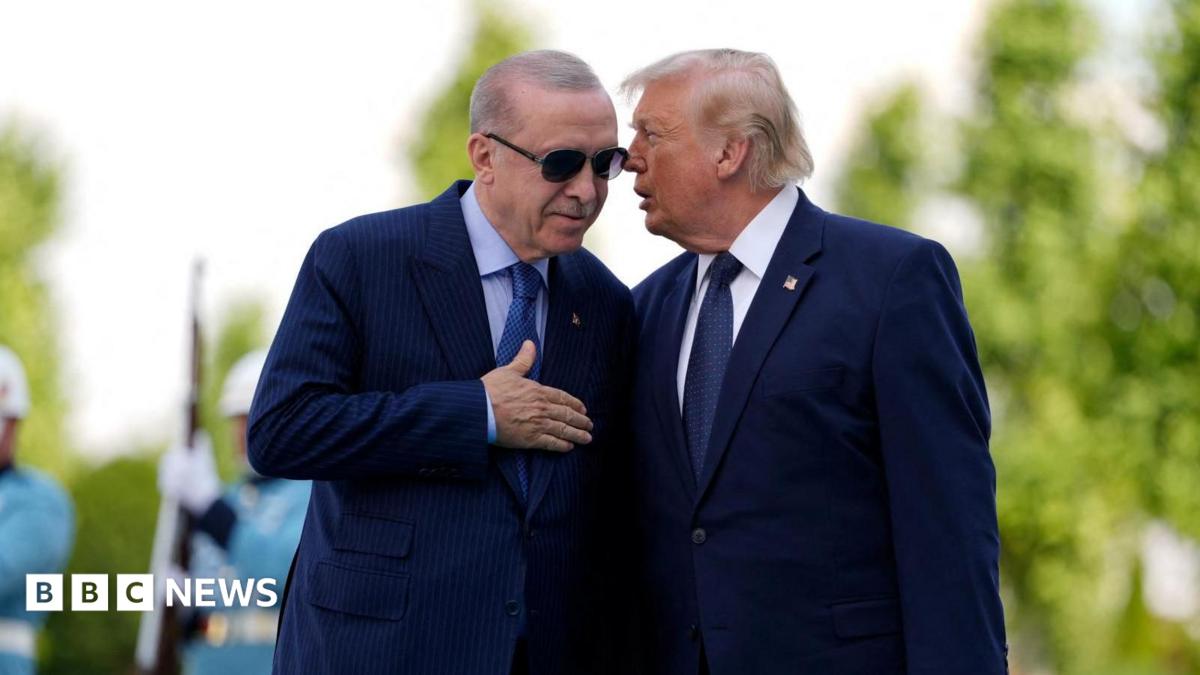
Trump has made no secret of his disdain for Nato. He says he has only come to Ankara this year because the summit is being hosted by his friend, the Turkish President Recep Tayyip Erdogan, who made a point of going to the airport to welcome Trump in person.
Then the two men walked arm-in-arm while a band played the Stars and Stripes, and Turkish air force jets performed a flypast overhead, trailing red, white and blue smoke.
There was always the risk that Trump would be something of a disruptor at this summit. And sure enough, his inflammatory words have punctuated the carefully crafted image of unity at this crucial gathering.
Soon after landing, he delivered a throwaway line repeating that the US should really take over Greenland, an island that is part of the Kingdom of Denmark, a fellow Nato member.
He did acknowledge, though, that his earlier thoughts on this subject had upset his relations with Nato. They certainly did.
Denmark's prime minister has said if the US were ever to take Greenland by force it would spell the end for the alliance.
Then there is Iran. Trump is clearly still bitter that his Nato allies did not join in his war of choice earlier this year, a conflict launched without consulting allies that played havoc with the global economy.
He even singled out the UK for criticism despite Sir Keir Starmer allowing him to launch airstrikes on Iranian missile sites from British airbases.
Referring to the UK prime minister, Trump said: "He said no we'll help after the war is over. I said I don't want that kind of help. We didn't need any help at all. In a way I was testing people, I was testing to see whether or not they'd be there because I've long said that we help them but I'm not sure that they'd be there for us."
The British delegation here has been keen to promote its defence collaboration with European partners.
But Sir Keir has come to Ankara, his final Nato summit, with a Defence Investment Plan derided for being billions of pounds short of the requirements set out in last year's much-praised Strategic Defence Review.
But beyond the optics and the speeches, Nato delegates have been getting down to the serious business of rearming Europe and seeing how their defence industries can best co-operate.
Large contracts have been announced for a new fleet of transport aircraft to be built by Airbus. Nato's ageing fleet of AWACS (Airborne Warning and Control System) early warning aircraft are to be replaced by Sweden's GlobeEye planes.
And there is much talk of joint projects on missiles. President Volodymyr Zelensky of Ukraine is here. He knows all too well what can happen to a country that lacks sufficient air defence.
In recent days Russia's ballistic missiles have been smashing into residential buildings in Kyiv, killing dozens of civilians, with the air defence teams complaining of a desperate shortage of interceptors.
"Europe needs its own effective anti-ballistic system and missiles" said President Zelensky.
"And this work is already under way and I urge you and all of our partners to give it the attention it deserves. And this cannot wait until 2030 or beyond, Europe needs affordable mass-produced anti-ballistic systems as soon as possible."
He's right. As the US steadily reduces its defence commitments to Europe, the race is on to build up credible air defences against Russia's growing arsenal of powerful missiles and drones.
Everyone here says they want the war in Ukraine to stop. But there is also a fear that once that happens, Russia will embark on a rapid rearmament programme and be in a position to threaten Nato territory within four years.
Read the full story at BBC ↗
At NATO's summit in Ankara, member states are advancing major defence procurement and cooperation projects. Contracts for new transport aircraft and early warning systems have been announced, alongside discussions of joint missile development. Ukraine's President Zelensky addressed the summit, emphasizing the urgency of developing European air defence systems capable of countering Russian ballistic missiles and drones. Alliance members are discussing how to strengthen European defence capabilities as US military commitments to the region adjust. Trump attended the summit and made several contentious remarks, including restating interest in Greenland and expressing criticism of allied responses to recent military actions. NATO officials are proceeding with substantive defence planning while managing diplomatic tensions.
Read the full story at BBC ↗
Black-clad Turkish police on street corners, giant blue banners proclaiming "The Key to Peace" and a ceremonial welcome for Donald Trump.
This may be a Nato summit but it's the US president who's had the metaphorical red carpet laid out for him.
Trump has made no secret of his disdain for Nato. He says he has only come to Ankara this year because the summit is being hosted by his friend, the Turkish President Recep Tayyip Erdogan, who made a point of going to the airport to welcome Trump in person.
Then the two men walked arm-in-arm while a band played the Stars and Stripes, and Turkish air force jets performed a flypast overhead, trailing red, white and blue smoke.
There was always the risk that Trump would be something of a disruptor at this summit. And sure enough, his inflammatory words have punctuated the carefully crafted image of unity at this crucial gathering.
Soon after landing, he delivered a throwaway line repeating that the US should really take over Greenland, an island that is part of the Kingdom of Denmark, a fellow Nato member.
He did acknowledge, though, that his earlier thoughts on this subject had upset his relations with Nato. They certainly did.
Denmark's prime minister has said if the US were ever to take Greenland by force it would spell the end for the alliance.
Then there is Iran. Trump is clearly still bitter that his Nato allies did not join in his war of choice earlier this year, a conflict launched without consulting allies that played havoc with the global economy.
He even singled out the UK for criticism despite Sir Keir Starmer allowing him to launch airstrikes on Iranian missile sites from British airbases.
Referring to the UK prime minister, Trump said: "He said no we'll help after the war is over. I said I don't want that kind of help. We didn't need any help at all. In a way I was testing people, I was testing to see whether or not they'd be there because I've long said that we help them but I'm not sure that they'd be there for us."
The British delegation here has been keen to promote its defence collaboration with European partners.
But Sir Keir has come to Ankara, his final Nato summit, with a Defence Investment Plan derided for being billions of pounds short of the requirements set out in last year's much-praised Strategic Defence Review.
But beyond the optics and the speeches, Nato delegates have been getting down to the serious business of rearming Europe and seeing how their defence industries can best co-operate.
Large contracts have been announced for a new fleet of transport aircraft to be built by Airbus. Nato's ageing fleet of AWACS (Airborne Warning and Control System) early warning aircraft are to be replaced by Sweden's GlobeEye planes.
And there is much talk of joint projects on missiles. President Volodymyr Zelensky of Ukraine is here. He knows all too well what can happen to a country that lacks sufficient air defence.
In recent days Russia's ballistic missiles have been smashing into residential buildings in Kyiv, killing dozens of civilians, with the air defence teams complaining of a desperate shortage of interceptors.
"Europe needs its own effective anti-ballistic system and missiles" said President Zelensky.
"And this work is already under way and I urge you and all of our partners to give it the attention it deserves. And this cannot wait until 2030 or beyond, Europe needs affordable mass-produced anti-ballistic systems as soon as possible."
He's right. As the US steadily reduces its defence commitments to Europe, the race is on to build up credible air defences against Russia's growing arsenal of powerful missiles and drones.
Everyone here says they want the war in Ukraine to stop. But there is also a fear that once that happens, Russia will embark on a rapid rearmament programme and be in a position to threaten Nato territory within four years.
Read the full story at BBC ↗
The NATO summit is being held in Ankara and hosted by Turkish President Recep Tayyip Erdogan Trump said the US should take over Greenland, an island that is part of the Kingdom of Denmark Denmark's prime minister said if the US took Greenland by force it would end the alliance Trump criticized UK allies for not joining military action against Iran earlier in the year Airbus has announced a contract for a new fleet of transport aircraft for NATO Sweden's GlobeEye planes will replace NATO's ageing AWACS early warning aircraft Russian ballistic missiles have recently struck residential buildings in Kyiv, killing dozens of civilians Ukraine's air defence teams report a desperate shortage of interceptors President Zelensky called for urgent European anti-ballistic systems that cannot wait until 2030 Trump came to the summit only because Erdogan is his friend and hosted it Trump had the metaphorical red carpet laid out for him at a NATO summit Trump is something of a disruptor at this summit As the US reduces its defence commitments to Europe, Europe faces a race to build credible air defences NATO members fear Russia will embark on rapid rearmament and threaten NATO territory within four years if the Ukraine war ends
Read the full story at BBC ↗
- NATO is rearming Europe with major defence contracts including Airbus transport aircraft and Swedish GlobeEye early warning planes to counter Russian threats
- Trump has made inflammatory statements at the Ankara NATO summit including repeating claims about acquiring Greenland and criticizing allies' support in the Iran conflict
- Ukraine's President Zelensky is calling for urgent development of European air defence systems against Russian ballistic missiles, citing civilian casualties in Kyiv
- NATO members are concerned Russia could threaten allied territory within four years if Ukraine war ends without adequate European defence capabilities built
- US defence commitments to Europe are reducing, accelerating allied focus on independent military cooperation and capability-building