Trump renews call for US to take over Greenland as he arrives for Nato summit
 ✓
✓Donald Trump has revived his bid for the US to acquire Greenland, threatening to pull all American armed forces out of Europe after the continent repeatedly pushed back.
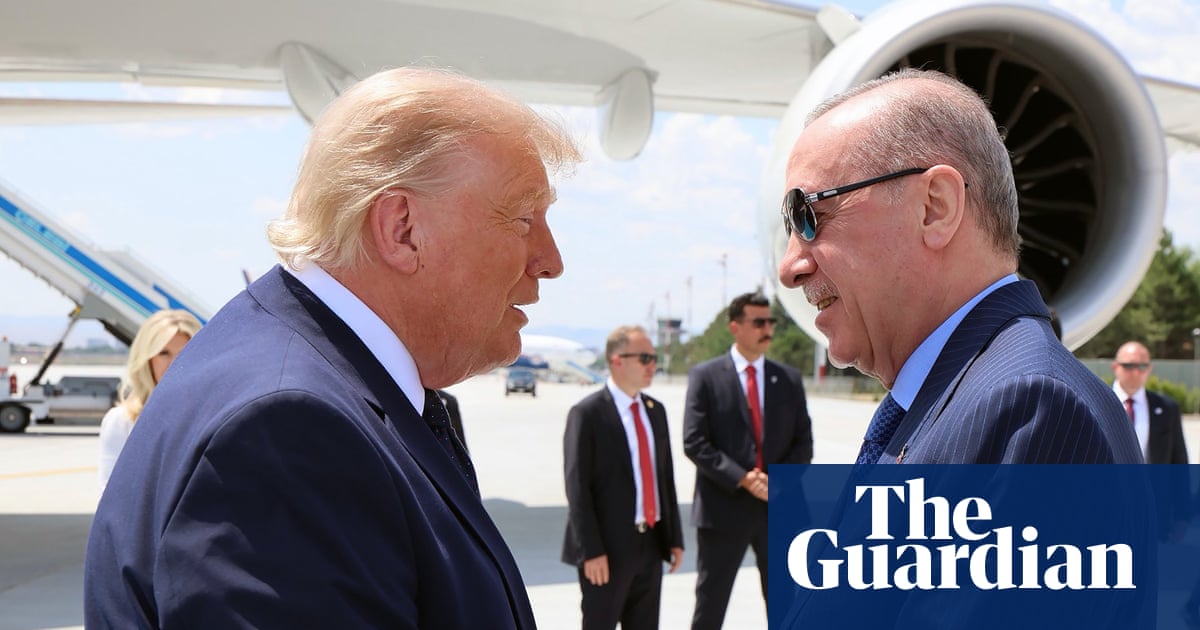
Arriving at the Nato summit in Ankara on Tuesday, the US president also suggested his commitment to defending Europe had been tempered by political decisions by leaders on immigration and energy.
Keir Starmer and European allies have been determined to avoid another public bust-up with Trump over defence spending after a bruising year for Nato, in which the Iran war once again exposed cracks in the alliance.
The UK has already pushed back on criticism from the US that some allies are “lagging behind” on funding, with Trump expected to rebuke countries, including the UK, for not making enough progress on hitting the target of spending 3.5% of GDP by 2035.
As Trump arrived in Turkey, he suggested that Starmer’s decision to keep out of the war against Iran had contributed to his downfall, whereas the prime minister’s stance had in fact been popular with the British public.
“I was very disappointed with Nato. We weren’t treated well because we did something in Iran. We don’t need anybody’s help, but before I asked they said they wouldn’t be there,” the US president told reporters.
“In the case of the United Kingdom, the prime minister, I guess he’s no longer there, maybe because of this, it was a very unpopular thing he did. He said: ‘No, we’ll help after the war is over.’ I said: ‘We don’t need that kind of help.’”
Reviving an earlier row, Trump also suggested that the disagreement about the ownership of Greenland – which is part of Denmark, a fellow Nato member – had “hurt” his relationship with the military alliance.
“Denmark doesn’t spend money to really help Greenland, but it’s an important part for the US, and it’s surrounded by China ships and Russian ships … [It] should be controlled by the US, not by Denmark. And when they wouldn’t go along with it, and with all the money we spend to help them with Russia,” he said.
“We don’t have to spend any money; we could remove all of our soldiers out of Europe because, as you probably noticed, Europe’s a very different place than it was 20 years ago … they better be careful with immigration and energy. If they’re not careful with those two things, you’re not going to have a Europe any more.”
In response, Rachel Reeves, the UK chancellor, told reporters: “The future of Greenland is up to the people of Greenland and of Denmark, and not up to the US president. I’ve been very clear about that ever since it was first suggested.”
Trump also renewed his criticism that Nato allies do not spend enough on defence and are too reliant on the US – an argument European members are attempting to meet head-on by announcing multi-billion-pound defence collaborations.
“Why are we spending hundreds of billions of dollars and they’re not there for us? We’ve always been there for them,” he said, although Nato’s mutual defence clause has only ever been triggered after the September 11 attacks on New York, where allies joined US troops in Afghanistan.
The UK will lead a £37bn European project to develop a long-range missile that could strike thousands of milies behind Russia’s frontline with Ukraine as part of efforts to end Nato’s reliance on the US.
Amid ongoing uncertainty over Trump’s commitment to the alliance, the UK will work with countries including France, Germany and the Baltic states to produce its own deep-precision strike capability.
The new weapon, which would be the most advanced Nato has at its disposal, could strike targets between 200 miles and 1,200 miles away with pinpoint accuracy, meaning from Ukraine it could hit military targets well behind Russian lines, and could even reach Moscow.
As Labour struggles to fund a steep increase in defence spending to meet Nato targets, Reeves suggested for the first time that the “multilateral defence mechanism” of off-balance sheet financing could be merged with Canada’s Defence, Security and Resilience Bank initiative.
Supporters argue the Canadian-led scheme, which was supported by John Healey when he was defence secretary but opposed by the Treasury, would give the UK access to a bank with £86bn of lending capability for defence projects, for a UK subscription of £900m.
Read the full story at Al Jazeera ↗ · NPR ↗ · Axios ↗ · Axios ↗ · The Guardian ↗
At the NATO summit in Ankara, Trump revived his proposal for US control of Greenland, stating it should not remain under Denmark given its strategic importance near Chinese and Russian vessels. He also suggested potential withdrawal of US military presence from Europe, citing concerns about allied immigration and energy policies. Trump repeated criticism that NATO members under-fund defence while relying on US support. In response, UK Chancellor Rachel Reeves affirmed that Greenland's future rests with Greenland and Denmark. European allies, including the UK, are advancing independent defence initiatives—notably a £37bn collaborative missile programme spanning France, Germany, and Baltic states—to reduce NATO dependence on US capabilities. The UK is also exploring off-balance sheet defence financing mechanisms.
Read the full story at Al Jazeera ↗ · NPR ↗ · Axios ↗ · Axios ↗ · The Guardian ↗
Donald Trump has revived his bid for the US to acquire Greenland, threatening to pull all American armed forces out of Europe after the continent repeatedly pushed back.
Arriving at the Nato summit in Ankara on Tuesday, the US president also suggested his commitment to defending Europe had been tempered by political decisions by leaders on immigration and energy.
Keir Starmer and European allies have been determined to avoid another public bust-up with Trump over defence spending after a bruising year for Nato, in which the Iran war once again exposed cracks in the alliance.
The UK has already pushed back on criticism from the US that some allies are “lagging behind” on funding, with Trump expected to rebuke countries, including the UK, for not making enough progress on hitting the target of spending 3.5% of GDP by 2035.
As Trump arrived in Turkey, he suggested that Starmer’s decision to keep out of the war against Iran had contributed to his downfall, whereas the prime minister’s stance had in fact been popular with the British public.
“I was very disappointed with Nato. We weren’t treated well because we did something in Iran. We don’t need anybody’s help, but before I asked they said they wouldn’t be there,” the US president told reporters.
“In the case of the United Kingdom, the prime minister, I guess he’s no longer there, maybe because of this, it was a very unpopular thing he did. He said: ‘No, we’ll help after the war is over.’ I said: ‘We don’t need that kind of help.’”
Reviving an earlier row, Trump also suggested that the disagreement about the ownership of Greenland – which is part of Denmark, a fellow Nato member – had “hurt” his relationship with the military alliance.
“Denmark doesn’t spend money to really help Greenland, but it’s an important part for the US, and it’s surrounded by China ships and Russian ships … [It] should be controlled by the US, not by Denmark. And when they wouldn’t go along with it, and with all the money we spend to help them with Russia,” he said.
“We don’t have to spend any money; we could remove all of our soldiers out of Europe because, as you probably noticed, Europe’s a very different place than it was 20 years ago … they better be careful with immigration and energy. If they’re not careful with those two things, you’re not going to have a Europe any more.”
In response, Rachel Reeves, the UK chancellor, told reporters: “The future of Greenland is up to the people of Greenland and of Denmark, and not up to the US president. I’ve been very clear about that ever since it was first suggested.”
Trump also renewed his criticism that Nato allies do not spend enough on defence and are too reliant on the US – an argument European members are attempting to meet head-on by announcing multi-billion-pound defence collaborations.
“Why are we spending hundreds of billions of dollars and they’re not there for us? We’ve always been there for them,” he said, although Nato’s mutual defence clause has only ever been triggered after the September 11 attacks on New York, where allies joined US troops in Afghanistan.
The UK will lead a £37bn European project to develop a long-range missile that could strike thousands of milies behind Russia’s frontline with Ukraine as part of efforts to end Nato’s reliance on the US.
Amid ongoing uncertainty over Trump’s commitment to the alliance, the UK will work with countries including France, Germany and the Baltic states to produce its own deep-precision strike capability.
The new weapon, which would be the most advanced Nato has at its disposal, could strike targets between 200 miles and 1,200 miles away with pinpoint accuracy, meaning from Ukraine it could hit military targets well behind Russian lines, and could even reach Moscow.
As Labour struggles to fund a steep increase in defence spending to meet Nato targets, Reeves suggested for the first time that the “multilateral defence mechanism” of off-balance sheet financing could be merged with Canada’s Defence, Security and Resilience Bank initiative.
Supporters argue the Canadian-led scheme, which was supported by John Healey when he was defence secretary but opposed by the Treasury, would give the UK access to a bank with £86bn of lending capability for defence projects, for a UK subscription of £900m.
Read the full story at Al Jazeera ↗ · NPR ↗ · Axios ↗ · Axios ↗ · The Guardian ↗
Trump renewed his call for US acquisition of Greenland at the NATO summit in Ankara Trump stated Greenland is strategically important and surrounded by Chinese and Russian ships Trump suggested withdrawing US military forces from Europe if allies do not improve immigration and energy policies UK Chancellor Rachel Reeves stated that Greenland's future should be determined by the people of Greenland and Denmark, not the US president Trump criticized NATO allies for not spending enough on defence relative to US expenditure The UK is leading a £37bn European defence project to develop a long-range missile with 200–1,200 mile range capability NATO's Article 5 mutual defence clause has only been invoked once, after the September 11 attacks, when allies joined US operations in Afghanistan Trump framed the disagreement over Greenland as having 'hurt' his relationship with NATO Trump suggested UK Prime Minister Keir Starmer's decision to withhold support in Iran operations contributed to his political downfall
Read the full story at Al Jazeera ↗ · NPR ↗ · Axios ↗ · Axios ↗ · The Guardian ↗
- Trump renewed his call for US acquisition of Greenland at the NATO summit in Ankara, citing geopolitical and energy concerns
- Trump suggested withdrawing US military support from Europe unless allies improve immigration and energy policies and increase defence spending
- UK and European allies are developing independent defence capabilities, including a £37bn long-range missile project, amid uncertainty over US commitment to NATO
How we verified this · 85% agreement
The thread
- Former U.S. ambassador on Turkey hosting the NATO summit
- ‘Why take those jobs away?’: the unionized workers decrying Trump’s war on wind
- Trump criticises NATO allies over Iran conflict support
- Woman accuses Graham Platner of sexual assault. And, NATO summit begins
- COP30: Trump and many leaders are skipping it, so does the summit still have a point?
- Trump looms large as Nato grapples with challenge of rearming Europe