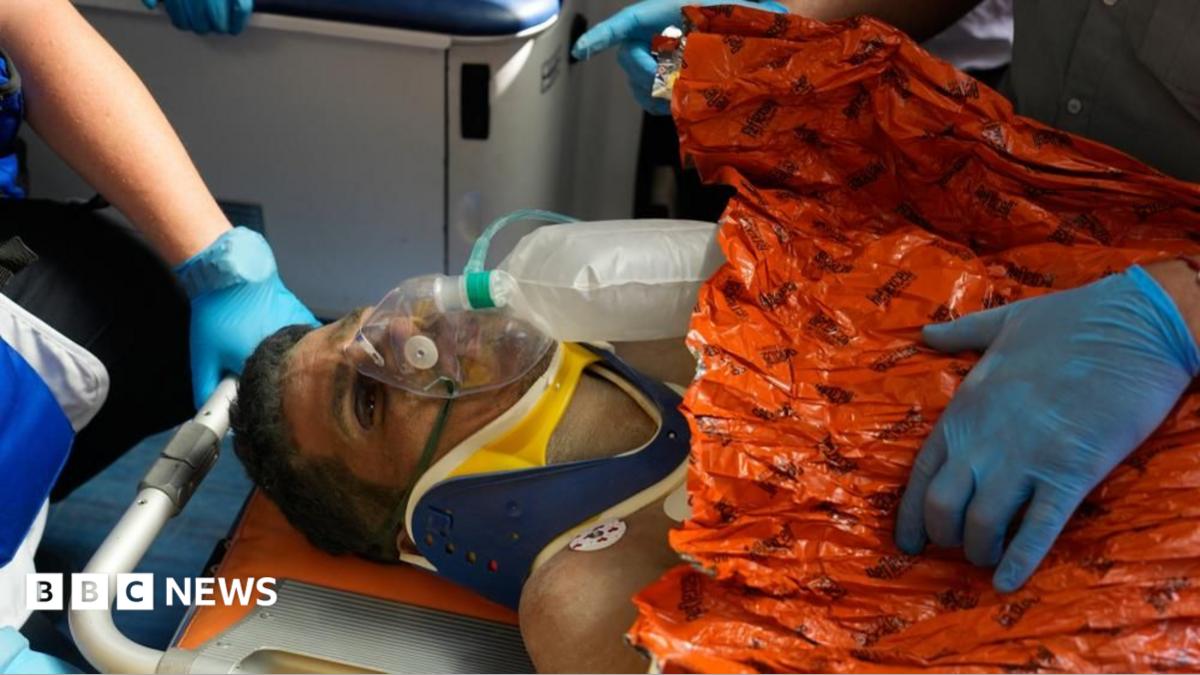
Venezuela quake survivor pulled out alive after eight days
Speaking at a press conference on Thursday, Rodríguez called the earthquakes "a natural tragedy on a scale we never imagined".
She rejected criticism that her government had reacted too slowly, saying that thousands of officials had been deployed after the quakes.
"We've done everything in our power, and we'll continue to do everything in our power and more," Rodríguez told journalists.
A Chilean firefighter had earlier described the operation to rescue Gil as "without doubt the most complex and technically difficult which I've had to tackle".
Allan Madrigal, a paramedic with the Costa Rican Red Cross, told journalists at the site that Gil had "emerged just perfect" from the ordeal.
Madrigal is the rescuer who heard Gil's faint cries for help emerging from the rubble on Sunday.
"It was an emotional moment," he recalled, explaining that at first he had not trusted his own ears and asked a colleague to confirm that he "wasn't just imagining it".
From that moment on, rescuers raced to try and dig the security guard out.
Gil had been on duty in a small concrete booth in the basement of the parking lot adjacent to the Galerias Playa Grande mall in Catia La Mar when the twin quakes struck.
It appears that the booth created a shell around him, protecting him from the 140 tonnes of rubble which collapsed around and on top of him.
"He has told us that he does not even have a crushed nail," another Costa Rican Red Cross worker said shortly before Gil was pulled from the rubble.
Gil had been given water and medics had attached him to an intravenous drip while teams from Venezuela, Chile, Costa Rica, El Salvador, Mexico, Portugal and the United States worked to free him.
Parts of the access ducts rescuers built to reach him collapsed several times, highlighting the dangers the work posed to the rescuers as well as Gil.
Overnight, the search teams were finally able to establish visual contact with the survivor.
In footage recorded by a small camera inserted into the rubble where Gil was trapped, a Chilean firefighter could be heard asking him to turn his head towards the camera.
One of his eyes was bloodshot and he was wearing a face mask, which rescuers had earlier passed to him through a small hole to protect him from the dust and debris created by their efforts to free him.
The firefighter also asked him to don goggles to protect his eyes as rescuers continued to carefully dig away at the rubble surrounding him.
Marco Antonio Franco from the Mexican Red Cross described Gil as "a cheerful man".
He told Mexican news site Milenio, external that the survivor "even asked for hydration drinks of specific flavours he likes", adding that "of course we indulged him".
"He himself drives us on, telling us to carry on. He recognises our team members, saying 'how nice that you came back and that you're with me again'."
According to Franco, the rescuers and Gil kept up a steady chatter about his family and about the challenging rescue.
Madrigal, the paramedic who located Gil, was on his first international rescue mission and said the work he had carried out in Venezuela had changed him.
"The lad who came here a week ago is not the same one that will return to Costa Rica, believe me," he told reporters.
Read the full story at BBC ↗
Twin earthquakes struck Venezuela, causing significant destruction. A security guard working in a basement booth at a parking structure near a shopping mall in Catia La Mar became trapped under approximately 140 tonnes of collapsed debris. A paramedic from Costa Rica heard faint cries from the rubble on Sunday and initiated a rescue operation. International teams from Venezuela, Chile, Costa Rica, El Salvador, Mexico, Portugal, and the United States coordinated extraction efforts over eight days. The concrete booth where the guard had been stationed appears to have provided protective shielding. Rescuers established visual contact overnight using a small camera and provided water, medical support, and protective equipment through small openings. The rescue required careful excavation as access tunnels repeatedly collapsed. The guard was successfully extracted and emerged in good health with no serious injuries. Venezuelan officials stated the government deployed thousands of officials in response to the earthquakes.
Read the full story at BBC ↗
Speaking at a press conference on Thursday, Rodríguez called the earthquakes "a natural tragedy on a scale we never imagined".
She rejected criticism that her government had reacted too slowly, saying that thousands of officials had been deployed after the quakes.
"We've done everything in our power, and we'll continue to do everything in our power and more," Rodríguez told journalists.
A Chilean firefighter had earlier described the operation to rescue Gil as "without doubt the most complex and technically difficult which I've had to tackle".
Allan Madrigal, a paramedic with the Costa Rican Red Cross, told journalists at the site that Gil had "emerged just perfect" from the ordeal.
Madrigal is the rescuer who heard Gil's faint cries for help emerging from the rubble on Sunday.
"It was an emotional moment," he recalled, explaining that at first he had not trusted his own ears and asked a colleague to confirm that he "wasn't just imagining it".
From that moment on, rescuers raced to try and dig the security guard out.
Gil had been on duty in a small concrete booth in the basement of the parking lot adjacent to the Galerias Playa Grande mall in Catia La Mar when the twin quakes struck.
It appears that the booth created a shell around him, protecting him from the 140 tonnes of rubble which collapsed around and on top of him.
"He has told us that he does not even have a crushed nail," another Costa Rican Red Cross worker said shortly before Gil was pulled from the rubble.
Gil had been given water and medics had attached him to an intravenous drip while teams from Venezuela, Chile, Costa Rica, El Salvador, Mexico, Portugal and the United States worked to free him.
Parts of the access ducts rescuers built to reach him collapsed several times, highlighting the dangers the work posed to the rescuers as well as Gil.
Overnight, the search teams were finally able to establish visual contact with the survivor.
In footage recorded by a small camera inserted into the rubble where Gil was trapped, a Chilean firefighter could be heard asking him to turn his head towards the camera.
One of his eyes was bloodshot and he was wearing a face mask, which rescuers had earlier passed to him through a small hole to protect him from the dust and debris created by their efforts to free him.
The firefighter also asked him to don goggles to protect his eyes as rescuers continued to carefully dig away at the rubble surrounding him.
Marco Antonio Franco from the Mexican Red Cross described Gil as "a cheerful man".
He told Mexican news site Milenio, external that the survivor "even asked for hydration drinks of specific flavours he likes", adding that "of course we indulged him".
"He himself drives us on, telling us to carry on. He recognises our team members, saying 'how nice that you came back and that you're with me again'."
According to Franco, the rescuers and Gil kept up a steady chatter about his family and about the challenging rescue.
Madrigal, the paramedic who located Gil, was on his first international rescue mission and said the work he had carried out in Venezuela had changed him.
"The lad who came here a week ago is not the same one that will return to Costa Rica, believe me," he told reporters.
Read the full story at BBC ↗
Twin earthquakes struck Venezuela A security guard was trapped under approximately 140 tonnes of rubble The guard was discovered after eight days when a Costa Rican paramedic heard faint cries Rescue teams from Venezuela, Chile, Costa Rica, El Salvador, Mexico, Portugal, and the United States participated in the extraction The concrete booth provided protective shielding around the survivor The rescue was described as the most complex and technically difficult operation by a Chilean firefighter Access tunnels collapsed multiple times during the rescue The survivor emerged without serious injuries including no crushed nails Venezuelan officials rejected criticism of slow government response and stated thousands of officials were deployed The rescue changed one paramedic's perspective on his work
Read the full story at BBC ↗
- A security guard was rescued alive after eight days trapped under rubble from twin earthquakes in Venezuela
- International rescue teams from seven countries worked for days to extract him from a collapsed parking structure
- The survivor emerged in remarkably good physical condition despite being buried under approximately 140 tonnes of debris
- Rescue operations were technically complex and dangerous, with access tunnels collapsing multiple times during extraction
- Venezuelan officials defended their government's response, stating thousands of officials were deployed after the quakes